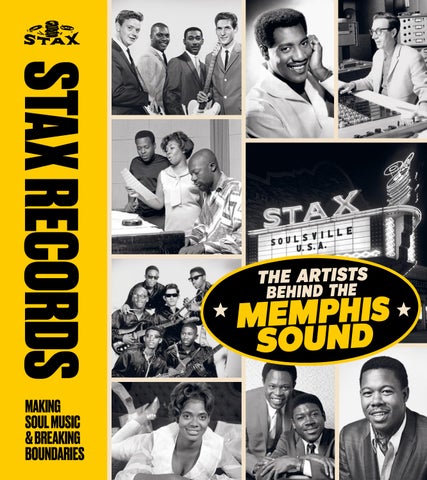
STAX RECORDS MAKING SOUL MUSIC & BREAKING BOUNDARIES
CONTENTS Foreword by Deanie Parker 12 Intro 1 6 The People of Stax Al Bell 40 Albert King 44 The Astors 50 Bar-Kays 5 4 Bill Carrier Jr. 62 Booker T. & The M.G.’s 66 Carla Thomas 74 David Porter 84 Deanie Parker 90 Eddie Floyd 94 Estelle Axton 102 The Goodees 108 Isaac Hayes 1 1 2 Jeanne and the Darlings 120 Jim Stewart 124 Johnnie Taylor 130 Judy Clay 140 Mable John 144 The Mad Lads 150 The Mar-Keys 156 The Memphis Horns 160 Otis Redding 164 The Packers 172 Ruby Johnson 176 Rufus Thomas 182 Sam & Dave 186 Shirley Walton 196 Stax/Volt Revue 204 Steve Cropper 212 Wendy Rene 216 William Bell 220
David Porter (left), during a recording session with Sam Moore (middle) and Dave Prater (right), aka Sam & Dave.
The Legacy 228 Soulsville Foundation 238 Acknowledgments/Image Credits 239
t ‘Duck’ Dunn deep in soulful concentration. Following pages: Mable John strikes a series of poses during a publicity shoot. Pages 38–39: Another of Bill Carrier Jr.ʼs fantastic shots of a Stax studio session, with Wayne Jackson in the foreground, joined by (left to right) Isaac Hayes, David Porter, Sam Moore, ʻDuckʼ Dunn, Dave Prater, Steve Cropper, and Booker T. Jones.
t ‘Duck’ Dunn deep in soulful concentration. Following pages: Mable John strikes a series of poses during a publicity shoot. Pages 38–39: Another of Bill Carrier Jr.ʼs fantastic shots of a Stax studio session, with Wayne Jackson in the foreground, joined by (left to right) Isaac Hayes, David Porter, Sam Moore, ʻDuckʼ Dunn, Dave Prater, Steve Cropper, and Booker T. Jones.
ALBERT KING
When Albert King walked through the doors of Stax Records in the mid 1960s, he brought with him a thunderous guitar style and a commanding stage presence that would forever alter the label’s musical landscape. King not only solidified his own reputation as a modern Blues giant but also expanded Stax’s creative horizons by fusing the label’s southern Soul with electrifying urban Blues… and thus opened the door to a new adventure in cross-genre innovation.
As left-hand guitars weren’t widely available, Albert King, like many left handers at the time, played a right-hand guitar upside down.
44 |
King’s arrival signaled a turning point, both for his career and the label itself. Prior to signing with Stax, he’d released a handful of singles on smaller labels. But it was at Stax that King found the perfect creative partnership. In 1966, he released his first Stax single, “Laundromat Blues,” an immediate classic that pushed his deeply expressive voice and stinging, economical guitar licks front and center. The song climbed the R&B charts and established King as a force to be reckoned with in the Blues world—as well as a fresh new voice in the Stax galaxy. The following year, King recorded “Born Under a Bad Sign,” the title track of what would become his landmark 1967 album. Written by Booker T. Jones and William Bell, “Born Under a Bad Sign” boasted a groove-heavy Stax rhythm section, sharp horn arrangements, and King’s one-of-one guitar work: direct, soulful, and utterly unmistakable. The album also featured staples like “Crosscut Saw” and “The Hunter,” further blurring the boundaries between Blues and Soul in a way that would influence a generation of guitarists from Eric Clapton to Stevie Ray Vaughan.
| 45
CARLA THOMAS
When talking about the architects who blueprinted the Memphis sound, Carla Thomas is always front and center— a regal presence whose voice and artistry helped define an era and propel Stax Records onto the national stage. Dubbed the ‘Queen of Memphis Soul,’ Thomas’s reign during the mid 1960s was marked by a string of hits, an unmistakable style, and a cultural resonance that still shimmers across decades.
Carla Thomas, Stax’s first female star, shows off her glamorous side in these publicity stills.
74 |
Music was Thomas’s birthright. The daughter of Rufus Thomas, another Stax legend, she recorded her first song—the 1960 regional hit “’Cause I Love You”—as a duet with her father at 17 years old. Gifted with a voice that was both sweet and strong, vulnerable yet commanding, Thomas soon established her solo standing with “Gee Whiz (Look at His Eyes).” Originally released by Satellite in 1960, the song was later licensed to Atlantic in 1961. The top-five R&B hit, which Thomas penned at 16, also showcased her songwriting talent. But it was between 1965 and 1967 that Thomas truly came into her own as Stax’s first female star. During this golden period, her artistry blossomed. Her 1966 album Carla showcased her versatility, moving effortlessly from dreamy ballads to up-tempo R&B. Featured track “B-A-B-Y,” penned by Isaac Hayes and David Porter, became an instant classic. It was an R&B and Pop crossover hit (No. 3 and No. 14 respectively) and a declaration that Stax could produce Pop-leaning Soul without sacrificing authenticity. The song’s insistent groove, paired with Thomas’s playful yet assertive vocals, captured the spirit of Memphis and the aspirations of a new generation of Soul fans.
| 75
Thomas relaxing poolside during another classic Bill Carrier Jr. photoshoot.
| 83
Thomas relaxing poolside during another classic Bill Carrier Jr. photoshoot.
| 83
“He was one of the most brilliant minds that ever wrote a song.” —David Porter (audible blog, 2026)
Hayes jams in the studio with (from left) Wayne Jackson, Andrew Love, Joe Arnold, and Porter.
| 119
“He was one of the most brilliant minds that ever wrote a song.” —David Porter (audible blog, 2026)
Hayes jams in the studio with (from left) Wayne Jackson, Andrew Love, Joe Arnold, and Porter.
| 119
Johnson’s series of single releases included the No. 31 R&B hit “I’ll Run Your Hurt Away.”
Johnson’s series of single releases included the No. 31 R&B hit “I’ll Run Your Hurt Away.”
“I was influenced by Stax Records before I could play any instrument.” —Raphael Saadiq “Stax Records was truly a godsend and a trendsetter.” —William Bell “Stax was a huge part of my life and my education.” —Questlove Stax Records: Making Soul Music and Breaking Boundaries tells the story of the origins and early years of Stax Records. Founded as a country music label in a Black neighborhood of segregated Memphis, Stax would become a beacon for the unifying force of music, transcending racial divides. With a rotating cast of house bands and musicians, as well as headliners like Otis Redding, Carla Thomas, Isaac Hayes, Sam & Dave, Booker T. & The M.G.’s, and many more, the label produced a string of anthems that soundtracked the era of civil rights and social revolution and changed American music forever.
ISBN: 978-1-78884-394-2
9 781788 843942 www.accartbooks.com
55000 £40.00/$50.00