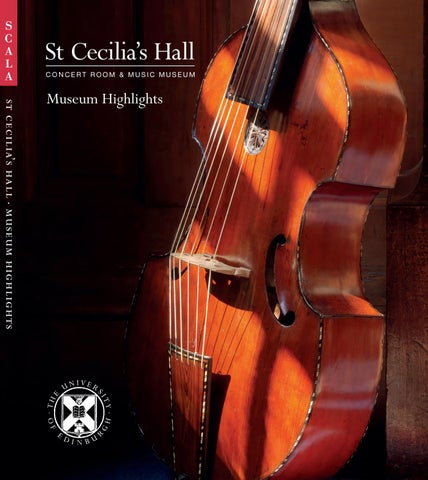
St Cecilia’s Hall · Museum Highlights
ISBN ISBN ISBN978-1-78551-228-5 978-1-78551-228-5 978-1-78551-228-5
Museum Museum Highlights Highlights
St St StCeCIlIa’S CeCIlIa’S CeCIlIa’SHall Hall HallIS IS ISSCotlaNd’S SCotlaNd’S SCotlaNd’S oldest oldest oldestpurpose-built purpose-built purpose-builtconcert concert concerthall hall halland and andhome home home to to tothe the theUniversity University Universityof of ofEdinburgh’s Edinburgh’s Edinburgh’sworldworldworldfamous famous famousmusical musical musicalinstrument instrument instrumentcollection. collection. collection. Comprising Comprising Comprisingover over over500 500 500instruments instruments instruments from from fromacross across acrossthe the theglobe, globe, globe,the the thecollection collection collectionisisis housed housed housedin in inthe the thenewly newly newlyrefurbished refurbished refurbishedMusic Music Music Museum. Museum. Museum.On On Ondisplay display displayare are arerare rare rareand and andbeautiful beautiful beautiful instruments instruments instrumentsthat that thatspan span spanfive five fivecenturies centuries centuriesof of of musical musical musicalheritage heritage heritageand and andhistory. history. history.Many Many Manyof of ofthe the the instruments instruments instrumentsare are arestill still stillplayable playable playableand and andused used usedin in in aaalively lively livelyprogramme programme programmeof of ofconcerts concerts concertsand and andevents events events in in inthe the theelegant elegant eleganteighteenth-century eighteenth-century eighteenth-centuryconcert concert concert hall. hall. hall.This This Thisbook book bookshowcases showcases showcasesthe the thecollection’s collection’s collection’s highlights, highlights, highlights,bringing bringing bringingthese these thesefascinating fascinating fascinating instruments instruments instrumentsto to toaaawider wider wideraudience audience audiencethan than thanever. ever. ever. dr dr drSaraH SaraH SaraHdeterS deterS deterSisisisthe the theLearning Learning Learningand and and Engagement Engagement EngagementCurator Curator Curatorat at atSt St StCecilia’s Cecilia’s Cecilia’sHall. Hall. Hall.
Introduction
St Cecilia’s Hall is the oldest purpose-built concert hall in Scotland and home to the University of Edinburgh’s collection of musical instruments, including its world-famous harpsichord collection. Named for the patron saint of music, St Cecilia’s Hall has a long and important history. It was designed by Robert Mylne (1733–1811) for the Edinburgh Musical Society and opened in 1763. During its heyday, the Concert Room was the venue for some of the best performances in Scotland. This Georgian treasure is a testament to the Scottish Enlightenment and is located just off the Royal Mile in the heart of Edinburgh’s Old Town, a UNESCO World Heritage Site. After closing as a music venue in 1798, St Cecilia’s Hall was used for a variety of purposes. Over the years it became a Baptist chapel, Masonic Lodge, school, furniture warehouse, dance hall and even a bar. In 1959 the University of Edinburgh purchased the building to house the Raymond Russell Collection of Early Keyboard Instruments, which were given with the intention of making them available for academic use and public concerts. The building reopened in 1968 as a concert hall and historic keyboard museum. The Raymond Russell Collection complemented the University of Edinburgh’s existing collection of wind, string and percussion instruments, which were on display at the Reid Concert Hall. The Collection’s origins can be traced back to John Donaldson (d.1865), Reid Professor of Music, who began collecting instruments for use in teaching in the 1850s.
Thanks to generous gifts from numerous donors, the Collection has grown significantly over the years and now numbers over 5,500 musical instruments. It ranks among the world’s most important collections of musical heritage and is a Recognised Collection of National Significance to Scotland. St Cecilia’s Hall reopened in 2017 after undergoing a £6.5 million redevelopment supported by the Heritage Lottery Fund. The new St Cecilia’s Hall brings the Collection under one roof, allowing visitors to truly engage with the objects and their stories. The elegant oval Concert Room remains at the heart of the Georgian building and is now complemented by four galleries that display over 500 musical instruments dating from the sixteenth century to today. Many of the instruments in the Collection are still playable and are featured in a dynamic concert programme. The building is open to the public and is a centre for the study, display and enjoyment of musical instruments.
OPPOSITE The oval Concert Room provides excellent acoustics for musical performances. On display in the space is MIMEd 4328, a chamber organ made c. 1775 and attributed to James Jones, London.
3
St Cecilia's Hall for production LF_OP.indd 3
30/05/19 13:40
Virginal Stephen Keene ¡ London, England, 1668 Raymond Russell Collection ¡ MIMEd 4308
This beautifully decorated instrument is the largest and probably the best known of the surviving English virginals. A type of harpsichord, the virginal was a domestic instrument used for practicing and music making within the home. They were often played by women and the name virginal probably comes from this association. Looking at the sumptuous details of this fine example one can imagine the interior of the seventeenth-century home in which it once sat. The instrument is made of fumed oak with handforged iron hinges. The lid is painted with scenes of courting couples promenading in a park (complete with an essential high-class accessory – a poodle); gilt embossed papers decorate much of the instrument; painted birds and flowers grace the soundboard; and snakewood, gold and ivory are used on the keys. This particular instrument sits on a tall stand, which served a practical purpose: it allowed women wearing cumbersome dresses to play the instrument standing up. The instrument was made by Stephen Keene, a noted English harpsichord, virginal and spinet maker. He was born around 1640, probably in Sydenham in Oxfordshire, and at the age of sixteen was apprenticed to the noted English virginal maker Gabriel Townsend in London. Keene is believed to have died in 1719 and during his long life he taught numerous apprentices, several of whom later became noted English keyboard instrument makers. 4
St Cecilia's Hall for production LF_OP.indd 4
30/05/19 13:40
Double-manual harpsichord Ioannes Ruckers · Antwerp, Belgium, 1638 Raymond Russell Collection · MIMEd 4306
Just as violinists value Stradivarius instruments above all others, there is one family whose harpsichords are the most sought after – the Ruckers family. Established by Hans Ruckers in Antwerp in the 1570s, this dynasty of harpsichord makers included his sons Ioannes and Andreas, and his grandsons Andreas II and Ioannes Couchet. The Ruckers family pioneered many technical developments in harpsichord design including introducing a second keyboard (called a manual) and strengthening the instrument’s body to create a louder, deeper sound. Ruckers harpsichords were so prized that owners extended the instruments’ lives by altering them rather than replacing them with newly made instruments. This is one of the most important instruments on display at St Cecilia’s Hall as it is the only known example of a seventeenth-century double-manual
harpsichord that has survived with its original, unaligned keyboards. When the instrument was made, the two sets of keys were never expected to be played together as their main purpose was for transposition. As fashion and music tastes changed owners upgraded their instruments so that they could play two keyboards at the same time, and all but this instrument were altered to have matching, aligned keyboards.
12
St Cecilia's Hall for production LF_OP.indd 12
30/05/19 13:41
St Cecilia's Hall for production LF_OP.indd 13
30/05/19 13:41
Double-manual harpsichord Jacob Kirkman, also known as Kirckman · London, England, 1755 Raymond Russell Collection · MIMEd 4330
Jacob Kirkman was one of the most in-demand harpsichord makers of eighteenth-century London and he spared no expense on this instrument. With elaborate decoration that may be admired from all angles, it made an impressive centrepiece for a grand room. In addition to the beautifully veneered outer case, the instrument has intricate marquetry on the interior complete with floral designs, the maker’s monogram and fierce eagles. The carved stand with claw and ball feet is also an unusual luxury on a harpsichord of the period. This instrument demonstrates how harpsichord makers were highly skilled craftsmen who combined expert woodworking and metalworking. Many also
ran their own businesses in cities that were full of competing workshops. The most successful, like Jacob Kirkman, used innovative design, clientfriendly finishes and clever marketing to seek out customers, build their reputation and boost the value of their instruments. Kirkman, born in 1710 in the Alsatian town of Bischweiler in modern-day Germany, came to England in the early 1730s. Initially he worked for the Flemish harpsichord maker Hermann Tabel, and when Tabel died Kirkman married his widow and took over the workshop. Kirkman was extremely successful and included kings, queens and other nobility among his customers. He died in 1792.
36
St Cecilia's Hall for production LF_OP.indd 36
30/05/19 13:41
St Cecilia's Hall for production LF_OP.indd 37
30/05/19 13:41
Clavichord Johann Adolph Hass · Hamburg, Germany, 1763 Raymond Russell Collection · MIMEd 4322
This instrument is a fine example of a large German clavichord. It was made by Johann Adolph Hass (d.1776), who, like his father Hieronymus, was known for his richly decorated instruments. This clavichord is sumptuous in its detail, made from the finest materials imported from all over the world. The ivory-fronted keys are covered with tortoiseshell and mother-of-pearl and the interior of the instrument’s case is lined with exotic wood veneers. Three different styles are used in the decoration: flowers are painted on the soundboard; a pastoral scene adorns the inside of the lid; and the exterior is covered in ornate Chinese motifs known as chinoiserie painted in silver and gold on a vermilion red background. Today these different styles might seem to clash, but the decoration was at the height of fashion in eighteenth-century Europe. Clavichords are intimate instruments. Their soft, delicate sound made them ideal for accompanying singing or as a solo instrument, but this gentle sound also limited their performance to the parlour rather than the concert stage. The playing technique of the clavichord is nuanced as it is incredibly responsive to the player’s touch, and many musicians, especially organists, had clavichords in their homes as practice instruments. This lavishly decorated clavichord would have been a beautiful domestic instrument for its wealthy owner.
48
St Cecilia's Hall for production LF_OP.indd 48
30/05/19 13:42
St Cecilia's Hall for production LF_OP.indd 49
30/05/19 13:42
Romantic guitars
The six-string guitar first appeared towards the end of the eighteenth century, probably in the Italian city of Naples. In addition to a new arrangement of strings, many of these instruments had larger bodies than earlier guitars and mechanical tuners, which helped hold the strings taut. These modifications not only made the guitar louder, but also increased its appeal with amateur musicians. By 1820 this style of guitar had become hugely popular across Europe, with virtuoso guitar players such as Fernando Sor touring the continent. The music played on these instruments was from the Romantic era (c.1780–1910), giving the guitars their name. The five guitars pictured were made by some of the most well-known makers of the period, each of whom left their own innovative mark on the development of the guitar. These makers worked with leading composers and performers, such as Niccolò Paganini and Mauro Giuliani, and their designs shaped the acoustic guitar we know today.
Left to right:
Guitar, 6 strings · Rene Lacote · Paris, France, c.1830 Gift of Wilfrid Appleby · MIMEd 2521
Guitar, 6 strings · Louis Panormo · London, England, c.1845 Gift of Wilfrid Appleby · MIMEd 2522
Guitar, 6 courses · Josef Pages · Cadiz, Spain, 1813 Anne Macaulay Collection · MIMEd 0282
Guitar, 6 strings · Gennaro Fabricatore · Naples, Italy, 1822 Anne Macaulay Collection · MIMEd 0770
Guitar, 6 strings, ‘Legnani’ model · Johan Georg Staufer · Vienna, Austria, 1829 MIMEd 3838
62
St Cecilia's Hall for production LF_OP.indd 62
30/05/19 13:42
St Cecilia's Hall for production LF_OP.indd 63
30/05/19 13:42
Chinese instruments collected by John Donaldson
The University of Edinburgh began collecting musical instruments in the mid-nineteenth century when John Donaldson became the Reid Professor of Music. Donaldson used musical instruments as teaching tools in his classroom and he collected over 100 musical instruments over 20 years. Those instruments formed the foundations of the collection on display at St Cecilia’s Hall today. The musical instruments Donaldson collected span a variety of periods and regions and he seemed particularly interested in the instruments of China. These five examples are beautifully crafted string instruments. They would have featured in a variety of musical ensembles and their use dates back to antiquity.
Yuequin · Maker unknown · China, before 1855 Donaldson Collection · MIMEd 443 illustrated above left
Guzheng · Maker unknown · South China, 19th century Donaldson Collection · MIMEd 447 illustrated above centre
Pipa · Maker unknown · China, 19th century Donaldson Collection · MIMEd 442 illustrated above right
Sanxian · Maker unknown · China, before 1888 Donaldson Collection · MIMEd 437 illustrated opposite, left
Sihu · Maker unknown · China, before 1888 Donaldson Collection · MIMEd 438 illustrated opposite, right
74
St Cecilia's Hall for production LF_OP.indd 74
30/05/19 13:42
5
8
St Cecilia's Hall for production LF_OP.indd 75
30/05/19 13:42
St Cecilia’s Hall · Museum Highlights
ISBN ISBN ISBN978-1-78551-228-5 978-1-78551-228-5 978-1-78551-228-5
Museum Museum Highlights Highlights
St St StCeCIlIa’S CeCIlIa’S CeCIlIa’SHall Hall HallIS IS ISSCotlaNd’S SCotlaNd’S SCotlaNd’S oldest oldest oldestpurpose-built purpose-built purpose-builtconcert concert concerthall hall halland and andhome home home to to tothe the theUniversity University Universityof of ofEdinburgh’s Edinburgh’s Edinburgh’sworldworldworldfamous famous famousmusical musical musicalinstrument instrument instrumentcollection. collection. collection. Comprising Comprising Comprisingover over over500 500 500instruments instruments instruments from from fromacross across acrossthe the theglobe, globe, globe,the the thecollection collection collectionisisis housed housed housedin in inthe the thenewly newly newlyrefurbished refurbished refurbishedMusic Music Music Museum. Museum. Museum.On On Ondisplay display displayare are arerare rare rareand and andbeautiful beautiful beautiful instruments instruments instrumentsthat that thatspan span spanfive five fivecenturies centuries centuriesof of of musical musical musicalheritage heritage heritageand and andhistory. history. history.Many Many Manyof of ofthe the the instruments instruments instrumentsare are arestill still stillplayable playable playableand and andused used usedin in in aaalively lively livelyprogramme programme programmeof of ofconcerts concerts concertsand and andevents events events in in inthe the theelegant elegant eleganteighteenth-century eighteenth-century eighteenth-centuryconcert concert concert hall. hall. hall.This This Thisbook book bookshowcases showcases showcasesthe the thecollection’s collection’s collection’s highlights, highlights, highlights,bringing bringing bringingthese these thesefascinating fascinating fascinating instruments instruments instrumentsto to toaaawider wider wideraudience audience audiencethan than thanever. ever. ever. dr dr drSaraH SaraH SaraHdeterS deterS deterSisisisthe the theLearning Learning Learningand and and Engagement Engagement EngagementCurator Curator Curatorat at atSt St StCecilia’s Cecilia’s Cecilia’sHall. Hall. Hall.