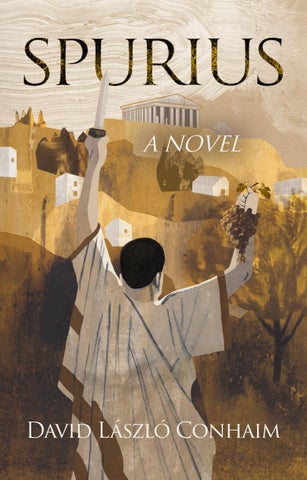
A NOVEL
David László Conhaim
Contents
Illustrations / VIII Foreword David László Conhaim / XI Map: The Mediterranean in the Age of Spurius / XIV
Prologue
IV
097 Bacchic cult crushed in Latium and Rome; events in Ostia
V
001 Embassy to Ephesus: Spurius and P. Scipio Africanus encounter Hannibal, 193 BC
133 Affairs in Rome, 146 BC; celebrations in Rome, 186 BC; war with Gauls; intervention in Bithynia
I
Epilogue
011 Affairs in Rome, 146 BC; Bacchic disturbances, 186 BC; consul’s inquiry begins
155 Northeast to Nicomedia: Spurius demands surrender of Hannibal, 185 BC
II
033 Bacchanalians’ murderous response; cult exposed
III
059 Rome terrorized; consul addresses Senate, Assembly; proscription of Bacchanalians
Beyond Spurius / 168 Author’s Note / 170 Remembering Gore Vidal / 172 Acknowledgments / 177 Chronological Summary / 180 Senatus Consultum de Bacchanalibus / 182 Select Bibliography / 184 About the Author / 186
Foreword
FOREWORD David László Conhaim
U
ntil today most experts in Roman history would have shrugged if challenged to identify the statesman who crushed the cult of Bacchus in 186 BC. Yet Spurius Postumius Albinus was a principal figure in one of the most unusual stories to come down to us from the classical world. While occupying Rome’s highest office—the consulship—Spurius made an alarming discovery: the priests devoted to this god of wine and ecstatic transformation had turned their state-sanctioned religion into a secret society whose coercive recruiting methods, acquisition of property, and rape and murder of initiates threatened “the very heart of the state.” Or so Spurius believed and reported to the Senate in his plea for emergency powers. In the resultant special inquiry, his government rounded up some seven thousand suspects. Half were condemned. Our sources for the “Bacchic Conspiracy” are few. Livy, drawing from works by previous Roman annalists, now lost,1 and two centuries removed from events, produced the only detailed written account available to us until just two years ago, when excavators uncovered an estate on the bay of Naples once bequeathed by Spurius to the legendary Gracchus family. The ruins held two remarkable discoveries.
1 The histories of Gaius Acilius, Valerius Antias, and Claudius Quadrigarius; only fragments remain. Passages herein attributed to Acilius are taken from Penguin Classics’ Rome and the Mediterranean.
XI
SP URIUS: A NOVEL
While I fretted over how they would receive my admission of ignorance, I sensed a presence behind me. Here was Simonides, lighting a lamp on the terrace table where we often played dice games. The glow elongated and further ennobled his features. “What do you make of it, master?” he asked. “Nothing for now, Simonides. Perhaps it’s just a private party.” “But the chanting, sir …” I nodded. “Disconcerting, isn’t it … a religious ceremony, perhaps. Have you ever heard such a commotion—at night?” “We both have, master—last month, while we were packing up the dice late one evening. Don’t you remember? It was much softer then, as if the gods themselves were whispering us to sleep.” On second thought, I did recollect the previous occurrence, among other episodes. With irritation, I responded, “But now they’re keeping us awake … Where do you suppose it’s coming from?” Simonides peered over the ledge into the night. “Just as in April, sir, it seems to be coming from the grove of Stimula, or thereabouts.” “I can’t discern what tongue they’re chanting in …” Simonides leaned still farther over the parapet. “It sounds remarkably similar to the song of a Greek chorus. We’d have to get closer to the source to make out the verse.” If only Rome had street lamps, like some cities of the East, I thought. “Well, make a note of today’s date. And write invitations to dinner on Mercury’s Day for the pontifex maximus, the urban praetor, and the aedile in charge of that district. Perhaps the high pontiff can explain it. If not, the other two will investigate.” “And take it out of your hands? I hardly think so, master. We do owe them invitations, though. They’ve all had you to dine since your election.” “That they have. Remember the high pontiff’s stuffed quail? I brought one home for you wrapped in a serviette—delicious in that aged fish sauce.” “A delight, sir.” “We must put our heads together with Hamno and come up with a menu both memorable and—” 14
I
“The Triumph will come too,” I replied determinedly. But due to the Bacchanalia it would not. A Roman general cannot “triumph” over fellow Romans. At the outset of this affair, I could not have guessed that I would never draw lots with my consular colleague Quintus Marcius Philippus for the command of an army. Thanks to Publius Aebutius, my consulship would be spent restoring order to Rome. “There are fresh disturbances in Gaul and Spain that require an able commander’s attention,” I continued hopefully, “while in the East, Hannibal remains a gathering threat.” Hispala drank from her cup, then said, “Your colleague Marcius is also an able soldier—quite impetuous in bed, I might add …” I wasn’t rattled by her tease. “He’s impetuous on the field as well. We shall learn very soon how he performs in the supreme command against a strong adversary.” She reached backward and stroked my thigh. “Marcius does have a lot of energy. And endurance.” I stopped her hand. “He will need it.” With a coy grin, Hispala again regarded me over her shoulder. In the brilliant light from the windows overlooking the Tiber, I noticed the faintest of lines fanning out from the corner of her eye. “If you are wondering why I’m not wearing that rare Syrian perfume you gave me,” she said, “it’s because your intention today is hardly to experience the pleasures of my charms.” “No? And how could you have deduced that, given our sumptuous surroundings?” “Perhaps by the way my whole house shuddered from Valerius’ foreboding knocks?” A tight smile raised her rouged cheek. “So, what is this all about, Spurius?” “Perhaps you’ll tell me,” I whispered in her ear. Then I cruelly delivered the blow: “Beginning with what you know about the Bacchic cult.” Her cheek rose higher as she winced. The muscles of her back hardened against my chest. She tore herself away from me, sat up rigidly, and buried her face in her hands. 27
II
time the very size of the city concealed its popularity. Lepidus’ late predecessor, we learned, had originally allowed the mysteries to be performed twice a year, in daylight, and confined them to a secluded patch where the Campus Martius borders the Tiber. Scores of distinguished matrons had officiated in rotation. At the end of each ceremony they would return to their normal lives just as women have done for centuries after observing the equally secretive rites of the Good Goddess. Several years later, however, the Bacchanalia’s liturgy was altered abruptly by the new prelate, Paculla Annia, whose Greek origins will be dealt with later in this narrative. She started by inducting her twin sons, Minius and Herrenius, as the first male Bacchanalians. Contrary to the Greek tradition, the inclusion of men in the Bacchanalia constituted a shrewd missionary plan, for the cult became immensely popular overnight. Without approval from the College of Priests she also increased the number of initiation days to two in every month. Then, as if demand for membership had exceeded her means to provide it, she set down that the mysteries would no longer accept initiates over the age of twenty. Finally, in defiance of the high pontiff’s mandate, she ordered nocturnal performances of the rites. When Lepidus assumed office and heard of Annia’s worrisome alterations, he immediately summoned the self-styled priestess before him. Dutifully presenting herself at the State House on the appointed morning, she argued that the cult’s immense popularity derived mainly from its uplifting character, her contention being that, in the wake of the Hannibalic War, in which a quarter of a million Romans perished, we desired more opportunities for public thanksgiving. According to her, public appeal for membership had become so great that it was now impossible to satisfy demand without increasing the number of initiation days. Even so, an age limit was imposed on would-be initiates to lessen the burden on the priests. Finding her explanation reasonable thus far, Lepidus asked Annia why she had disobeyed his predecessor’s stipulation that she restrict the mysteries to daytime. 43
SP URIUS: A NOVEL
in front and Sextus bringing up the rear, we descended at a precarious grade for a harrowing interval, minding each step and wincing in the smoke from Valerius’ flaxen torch. At last we hit level ground and one by one filed into a chamber echoing with our footfalls. Each man came to an abrupt halt when he laid eyes on what had become of Longinus’ unfortunate unit. Given the ingloriousness of that subterranean coffin, its confined area, and the suddenness of the attack, Longinus’ men had been unable to close ranks. Now their corpses littered the cave floor in heaps and parts, saturated by a dark red film that glistened in the torchlight. Judging by the overturned or broken ampullae scattered around their bodies, after murdering and disarming Longinus and his team, their assailants had drenched them all with wine. I heard Sextus’ voice echo as if from a distance. But he was only a few feet away, holding his torch by a stony recess in the wall of the grotto. “As you suspected, sir …” he said. “With libations, this god celebrates any disgrace committed in his name …” Exposed by the dancing torchlight was a towering effigy garlanded by last year’s grapevines and offering in its blackened hands a corroded wine cup and pitcher. Disfigured by verdigris, its lips held the sinister smile of Bacchus. Valerius drew my attention to the most hideous discovery of all—the body of Longinus. It had been stripped bare from the waist down and set on its knees. What appeared to be a papyrus roll protruded from its rectum. Valerius resignedly passed his torch to Simonides. Then he grasped the exposed handle of the rod with his right hand and held the leaf in place with his left thumb and forefinger. Next, with a boot planted on the buttocks of the corpse, he extracted the shaft in a grisly effort. Grimacing from the stench, he held the oozing object at arm’s length as the leaf unrolled before us. Through a film of blood we made out the following message: Spurius is lost, his mother dead. Desist, or Rome will be lost, her consul dead.
78
SP URIUS: A NOVEL
IV
A charge predictably leveled at me by my critics was that our prosecution of the Bacchanalians had made a bad situation worse. By this they meant that many self-professed victims were really using the Bacchic disorder to repossess property that they had fairly forfeited or sold; still others were after the properties of those who’d fled, or of the accused who, should they be convicted, would lose their holdings at public auction. All this was painstaking to sort out. We arduously endeavored to distinguish the fallacious claims from ones corroborated by reliable witnesses. With some seven thousand Romans now facing either prosecution or punishment the courts were hard-pressed to distinguish truth from lies. We were by no means able to stop every Bacchanalian at the city boundary. Provincial authorities apprehended hundreds who slipped past us. Those of the accused who disappeared without a trace were prosecuted in absentia and their property confiscated. Meanwhile, letters from Romans alerting provincial friends and family of the Senate’s edicts spread the panic all across Italy before copies of the Senatus Consultum de Bacchanalibus could be posted in their marketplaces. On the subject of letters, after we began the hunt for cultists I received no additional written threats. The enemies of the state were on the run. Despite this obvious fact, not since Hannibal had encamped at our gates had Romans considered the possibility of their imminent destruction. Anyone who remembers my consulship recalls what it was like to fear the outbreak of fire or to wonder if his next sip of water from the aqueducts might be contaminated by putrefying animal carcasses. These were serious dangers because such acts against the population at large could be perpetrated by anyone with the intent to commit them. Never before did Romans have such fears. Never again, I say, can we rest easy at night—despite our accomplishments back then. In addition to the fire brigades and watches created throughout the city, street patrols were charged with preventing the looting of abandoned houses and shops. Special units searched the homes of the accused, of those who confessed, and of some who— 98
99
SP URIUS: A NOVEL
“He could have fallen to the floor by his own power to enable his attacker to set upon him in the manner we witnessed. Consider for a moment that the assailant’s weapon was not a knife, or a sword, but something improvised.” Another tactful pause from my secretary allowed me to arrive at the conclusion myself: “He died willingly.” This fact was later affirmed by his wife Imilce. She also identified his murderer and explained the significance of the spilled wine cup. When the king’s troops surrounded his castle and blocked all means of escape, Hannibal knew his end was near. Since Prusias would surely demand his suicide, Hannibal preferred dictating this order himself and summoned his lifelong physician, a noted Phoenician apothecary, who infused a wine vessel with a gentle poison. When our column was sighted approaching from the east, and its glinting standards were identified as Roman, he ordered a cup brought to his receiving room. Meantime, he retired to an antechamber to beg the gods to punish King Prusias for his treachery and to one day restore Carthage to its previous glory. But history has proven that the gods had utterly abandoned Hannibal and his nation. When he finally emerged from the shrine to mount his throne, his wife and core retainers gathered round to beg him to surrender. Perhaps, they submitted, the Romans would let him live in relative dignity as a hostage, like Croesus of Lydia at the Persian court. No longer a fugitive, he could help his nation as an ambassador of peace. Rooted in one soil at last, they pleaded, he might write his memoirs. But Hannibal rewarded their cowardly pleas with a contemptuous scowl. Then he resolutely drained his cup. As he was wiping his lips with the sleeve of his tunic, one of his retinue suddenly broke into the room to report that fleeing servants had opened the gates to the enemy. Conscious that the poison was slow-acting and aware that if captured he could be forced to empty his stomach, Hannibal dashed the cup against the floor and, without expressing so much as a word of parting affection, ordered everyone out. Only his lieutenant Aristo lingered purposefully at his side. 164
SP URIUS: A NOVEL
Re m e m be r in g Go r e V idal
Remembering Gore Vidal History is initially served, not discovered. Spurius is dedicated to my parents, Wallys and Roger Conhaim, who turned me on to their literary hero Gore Vidal in the late 1980s. Vidal’s elegant and convincing novels animating American history enthralled me through the cycle’s penultimate installment (Hollywood, 1990). Like all of his devoted readers, I’ve received a vast education from his novels, his famously witty essays (collected in United States, 1993), and his enthralling autobiography (Palimpsest, 1995). In Prague in 1995, Jason Russell, a 1980s college buddy and now my host in the Czech Republic, fatefully lent me Vidal’s novel of ancient Rome and the East, Julian (1964). Through it, I rediscovered a world I’d neglected since our Greek and Roman studies at USC. Julian tells the story of the “apostate” Roman emperor who, after his late uncle Constantine found Jesus, attempted to thwart the spread of Christianity by reintroducing the “true” Hellenic gods. This brilliant and highly entertaining novel—perhaps the most sophisticated of its genre—is comprised of three first-person narratives, including margin notes on Julian’s recovered memoir by the philosopher Priscus, and reactions to Priscus’ observations made by the rhetorician Libanius, both former confidents of the then deceased Julian. But back to Prague for a bit. That year, Jason and I cofounded The Prague Revue, an English-language paperback journal of international literature, together with restaurateur and author Max Munson and his poet-business partners Todd Morimoto and Will Pritts. Starting with Issue 2, I gave Vidal a complimentary subscription and slipped a personal letter into each mailing to his home in Ravello, Italy. I received no acknowledgment for a couple of years. Then, in 1997, while at dinner with friends, Jason handed me a blue onionskin envelope with my name scratched on
it. The reverse side read La Rondinaia—or “Swallow’s Nest”—the name of Vidal’s estate on the Amalfi Coast. I raised my eyes in astonishment to the others. “This letter is from Gore Vidal …” I heard myself say, a moment that Jason remembered recently as “pure joy.” After casually removing the envelope from my trembling grasp, Jason unsealed the letter, and read it aloud.
172
173
Gore Vidal, Prague, April 2001. Courtesy Prague Writers’ Festival
SP URIUS: A NOVEL
About the Author David László Conhaim is passionate about discovering stories and people somehow lost to history—and to inspire or renew public interest in them. His socially conscious, exhaustively researched novels in recent years have focused on the multiracial struggle for the American West, emphasizing issues of family, identity, and belonging. Conhaim’s Paul Robeson-inspired Western All Man’s Land (Broken Arrow Press, 2019) was selected Finalist Best Novel in the Western Writers of America Spur Awards and won “Maverick” in the Will Rogers Medallion Awards. His 2021 novel The Unredeemed—a sequel to 2017’s Comanche Captive— was a Best Novel winner in the Will Rogers Medallion Awards and a Best Novel finalist in the Western Fictioneers’ Peacemaker Awards. Back in 1995, Conhaim co-founded The Prague Revue, the longest-running literary journal to serve the community of international writers in Prague. For The Prague Revue, he wrote a fictional remembrance of Miguel de Unamuno, which Gore Vidal “read with delight,” republishing it in the 2024 All Man’s Land expanded second edition as “Don Miguel—The Wise.” Conhaim was born in Minneapolis, Minnesota in 1968.
186