CONTENTS
008 014
018
032 038 062 072 080 088
FOREWORD ACKOWLEDGMENTS
CHAPTER 1 INTRODUCTION From Luxury to Contemporary Fashion Design Jie SUN
FUTURE & INSPIRATION
Design, Art, Craftsmanship, Material and Culture Introduction Elizabeth FISCHER
Jewellery and Fashion: Their Intrinsic Bond through Art, Design and Savoir-faire Donatella ZAPPIERI
From Architecture to Fashion…. : Design Is All about Ideas Guillermo GARCIA-BADELL, Mercedes RODRIGUEZ
The Enduring Links between Jewellery and Fashion: From Craft to Design Elizabeth FISCHER
In Terrā Mediā: The Hybrid Territory of Les Métissages Nichka MAROBIN
Fashion Artifact, and Design as a Social Facilitator Naomi FILMER
CONTENTS
CHAPTER 2
CONTENTS
106
128 136 152 166 190 196 214 224
238
Can Professional Jewellery Designers Using Consensual Assessment Technique (CAT) Achieve an Appropriate Level of Inter-rated Agreement When Judging a Specific Jewellery Design Creativity Task? Mala SIAMPTANI
Sustainability through Materials: An Approach by SILENT GOODS Volker KOCH
Contemporary Jewellery Design in South Korea: Historical Development and Current Status Yong-il JEON
Beyond Art through the Concept of Jewellery: Contemporary Jewellery in Japan, Its History, and Possibilities Akio SEKI
Eelko MOORER
Accessories and Construction of Identities in Fashion: The Case of 19th-Century France Emilie HAMMEN
Belaboring Dress: Literature of Wear and Tear Paula RABINOWITZ
Accessories: Their Ontological Function as Superfluous/ Essential items of Clothing—with Some Instances of their Literary and Filmic Meanings Cristina GIORCELLI
The Body Common Christine LÜDEKE
CHAPTER 3
BELONGING & INTERDISCIPLINARY Sustainability and New Technology Introduction Jie SUN
CONTENTS
Critical Approaches to Footwear Design Practice
CONTENTS
242 254 262 274
286 288 314
326 330
Lessons We Should Learn Elizabeth SHAW
Could Innovations Such as Augmented Reality, the Internet of Things, and Artificial Intelligence Render the Fashion Industry More Sustainable? Katharina SAND
Where Fashion, Jewellery and Technology Meet
Maarten VERSTEEG, Elise van den HOVEN, Caroline HUMMELS
Post Digital Jewellery: The Future Scenarios of Contemporary Jewellery Design Chiara SCARPITTI
CHAPTER 4 Introduction Jie SUN
Research Methods and Strategies of Contemporary Design Curation: Take the TRIPLE PARADE Biennale for Contemporary Jewellery as an Example Jie SUN
Fashion and Museography: The Space as an Ally Héctor NAVARRO
CHAPTER 5 CONCLUSION
The Future Is Now and the Making of Things Elizabeth FISCHER
ABOUT THE EDITORS
CONTENTS
DIALOGUE & COMMUNICATION Curation
FOREWORD Contemporary fashion and jewellery is a market based on positive feedback loops in which, pieces are built, and, like other academic and professional disciplines, receive criticism and feedback; it is an evoloving field constantly adapting to changing discussion and challenges. It can even be spectacular, radical, and conceptual, provoking the imagination and perspectives on design, art, and innovation. Jewellery is also very personal; it is a medium through which one can tell their story, evoke memories, and reflect personality and character—it is a statement. The development of fashion and jewellery research continues to evolve as avant-garde design on the periphery of the field is accepted, studied, and developed further before becoming an accepted part of the field. Jewellery, and the design of these artifacts and fashion, has become a remarkable growth industry. Most academics and practical research on the subject focuses on the fields of fashion and dress (Evans, 2003; Kawamura, 2011, 2018; Johnson, 2003; Breward, 1998, 2015, 2016), textile technology and crafts (Fletcher, 2014; Sikarskie, 2020), textile pattern design (Emery, 2014), clothing and material culture (Miller, 2005), fashion and culture (Kaiser, 2013; Baudel, 2004; Laver, 2020), fashion history and theory (Taylor, 2004, 2013; Riello, 2010; Granata, 2012; Fukai, 2015; Burns, 2019), market economics (Entwistle, 2009; Griffith, 2000; Flynn, 2009; Burns et al., 2016 ), sociology (Tseelon, 1995; Fliigel, 2004; Paoletti, 2015), and aesthetics (Gaimster, 2011), museums (Anderson, 2013; Melchior, 2014; Petrov, 2019)—skewing heavily toward
008
textiles and clothing. However, fashion—as an interdisciplinary pursuit—involves many aspects, not just clothing and textiles. Fashion research based on clothing and textiles often shies away from jewellery and related items. Relatively independent from mainstream “fashion,” jewellery
This book has come about after two years of development following the First WoSoF World Symposium for Fashion,
FOREWORD
009
has its own history and development. The research on jewellery that proliferats usually focus on human history and archaeology (Chadour-Sampson, 2019; Awais-Dean, 2018; Scarisbrick, 2019), traditional crafts and techniques (Revere, 2018), gem stones and materials (Pointon, 2010), brand (Müller, 2015), contemporary art jewellery (Strauss, 2007; Skinner, 2013; Deckers et al., 2017), fashion and jewellery histories (Cera, 2019; Papi, 2016), and the modern and contemporary jewellery (Besten, 2011). Other fashion accessories such as footwear and bags (Høy, 2019; Steele, 2017; Pasols, 2012), human history (Wilcox, 2012), technology and crafts (Goonetilleke, 2017; Volken, 2019), and clothing accessories (Mauriès, 2017) mostly focus on luxury brands. The design of jewellery, watches, footwear, and bags is different from the design methods and processes of textiles—including a different frame of mind and sociological reasoning. Overall, there is a lack of discussion and research of the value and roles of jewellery and related objects in fashion and design. Research is critical in the current social culture, economy, and with material science and technological changes, and must go beyond industrial product design (Koskinen, 2011), architecture and environment (Colletti, 2017; Schaik, 2017), experiential design (Austin, 2020), fashion design, sustainable design (Stubbins, 2010), and research methodology (Plattner, 2017).
Jewellery, Accessories in Shanghai at the end of 2018 and the research and discussions had with scholars invited to Tongji University for the development of this book. There remains an academic divide between fashion and the role and value of jewellery design, and related accessories, when discussing contemporary fashion design theories and methods, making
FOREWORD
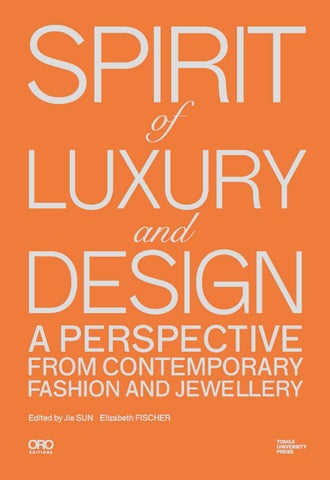
this forum necessary to further the field and support crossdisiplinary learning. The First WoSoF World Symposium for Fashion, Jewellery, and Accessories is part of the WoSoF World Fashion, Jewellery, and Accessories Innovation Design Project, which aslo includes the WoSoF Exhibition for Fashion, Jewellery, and Accessories and the publication of Spirit of Luxury and Design: A Perspective from Contemporary Fashion and Jewellery (this book).The whole WoSoF global fashion and jewellery innovation project has been successful thanks to the sponsorship of School of Design and Innovation at Tongji University, co-organized with Genève School of Art and Design, Switzerland, the Universidad Politecnica in Madrid, Spain, and the Institut Français de la Mode Paris, France. WoSoF Exhibition for Fashion, Jewellery, and Accessories was held at the Tianjin Academy of Fine Arts’ museum with roughly 60 pieces of work exhibited. Professor Elizabeth Fischer (Switzerland, Genève School of Art Design), Professor Guillermo García-Badell (Spain, the Universidad Politecnica in Madrid), and I jointly selected 30 cutting-edge designers from China, Switzerland, and Spain. These designers’ works mainly focus on jewellery, bags, glasses, and shoes, which showcase the emerging design practices in the field as relates to materials, new technology, innovative craftsmanship, and design methods. On the third day, after the grand opening of the exhibition in Tianjin, the First WoSoF World Symposium for Fashion, Jewellery, and Accessories kicked off in Shanghai, where 17 speakers from
010
nine countries—including China, the United Kingdom, the United States, France, Switzerland, the Netherlands, German, Australia and Italy gathered. The exhibition and symposium addressed centered on the question: “How does jewellery and related fashion items (shoes, hats, bags, glasses, watches, etc.) represent fashion design and contemporary culture?” Discussions addressed three topics: art, design, material, and culture; sustainability and new technology; curation and management.
Jie SUN National Distinguished Expert, Professor at Tongji University, Shanghai, China
FOREWORD
011
This book consists of five chapters organized according to these topical groups. The first chapter discusses the role of contemporary design in the development of fashion luxury goods. In Chapter Two, “Future & Inspiration,” 14 articles address fashion and jewellery as they relate to art, design, materials, and culture. In Chapter Three, “Belonging & Interdisciplinary,” four articles continue the discussion of jewellery as it relates to sustainable development and new technologies on the development of jewellery design. Chapter Four focuses on the curation of exhibitions. And Chapter Five, “The Future is Now,” draws a conclusion to the book and the WoSoF World Fashion, Jewellery, and Accessories Innovation Design Project. My hope is that this book can encourage readers from different backgrounds to re-examine jewellery and related fashion items as a distinct field of fashion and design and leads to new innovation within the industry.
Introduction Elizabeth FISCHER Professor, Dean of Fashion and Jewellery Design, HEAD—Genève School of Art and Design, HES-SO Geneva, Switzerland
The essays in this chapter show how design in fashion and jewellery has opened new avenues, both in their respective fields but also through what could be called cross-pollination, with various types of interactions between the two domains. A telling example is given by Donatella Zappieri (jewellery business and creative consultant), who explains how Italian jewellery has come to play a defining role in trends and fashion since the 1980s. Guillermo Garcia-Badell (director of the fashion studies CHAPTER 2
program at the Universidad Politecnica in Madrid) teaches students that design, in whatever field, is a holistic discipline, transcending boundaries and involving a mix of approaches, from the technical to the technological, from craft-based to concept-driven, combining both scientific and humanistic knowledge. Independent curator Nichka Marobin’s compelling visual narrative on the affinities between objects of art, fashion, and jewellery offers a vivid testimony to the vitality that comes out of interconnecting disciplines. Naomi Filmer (designer and senior lecturer in the MA Fashion Artefact at London College of Fashion), supports students in pushing the boundaries of design and fashion to explore more deeply and dynamically the body as the site and means for confronting ideas of wearing and adorning, in an industry where art, craft, design, and performance overlap with each other. Questioning the designer’s practice provides means to assess creative methods (Mala Simptani, visiting lecturer at London College of Fashion) to address pressing issues in sustainability (Volker Koch, director of product at Silent Goods) or to re-contextualize strong craft and design traditions in relation to new techniques and technologies (Yong-il Jeon, professor at Kookmin University in South Korea; Akio Sake, chief curator, Tokyo Metropolitan Teien Art Museum).
032
In this framework, identity and the body remain the core focus of fashion and jewellery. As indicated by Naomi Filmer, “accessories have evolved beyond adornment, and become key to expressing ways of thinking for design and living.” The essay by Eelko Moorer (designer and head of the MA program in footwear at London College of Fashion) is a case in point, showing how the practice of footwear design can become a tool for critical thinking in design. The way fashion and accessories situate the body and the individual in society are evoked in history by Emily Hammen (lecturer at Institut Français de la Mode Paris), Paula Rabinowitz (emerita professor at University of Minnesota), and Cristina Giorcelli (professor, University of Rome III). These three essays show the power of fashion and accessories in daily life through their symbolic meanings in literature, film, and other iconography. Finally, Christine Lüdeke (designer, professor at Pforzheim University) explains “how the making and wearing of jewellery, accessories, and fashion provide amplifications of the body and of the self—whether physical or immaterial: the body provides the context, the body is the context.” As the body is central to jewellery and fashion, the context, we need to know what body we are referring to today. Before coming to this point, I will provide a brief overview of the historic relationships between fashion and jewellery in relation to the body, as primary objects of material culture and of our symbolic system. “Diamonds are forever” and “Fashion is fickle,” if we are to believe those two sayings, which refer to the realm of luxury, jewellery, and fashion, stand worlds apart. Mainstream jewellery and fashion, however, share a lot in common as products that human beings use on a daily basis. Clothing, accessories, and jewellery are situated on the human body and in direct contact with it. Furthermore, all of them provide some functional or communicative extension to the body. In this way, they constitute our contemporary daily equipment (Farren and Hutchinson, 2004), the things we cannot live without to be able to function in society. These intensely personal items act as a primary means to express at once individual and social identity and to perform our daily tasks.
Introduction
033