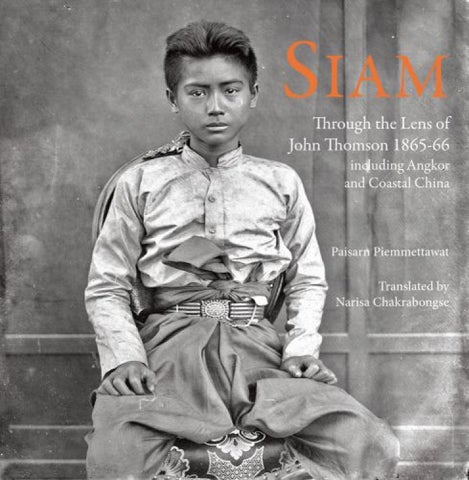
Contents This book accompanying the exhibition of historic photographs entitled Siam through the Lens of John Thomson including Cambodia and Coastal China is published to celebrate the 5th cycle of HRH Princess Maha Chakri Sirindhorn, as well the 150th anniversary of John Thomson’s visit to Siam.
Foreword
7
Introductory essays Photography in Siam – The Crucial Years (1861-66) Joachim K. Bautze
11
The Reign of King Mongkut (R. 1851-1868) Maj. Gen. M. R. Supbhawat Kasemsri and Rachanee Supvichit
25
John Thomson’s photographs of Thailand in the Wellcome Library William Schupbach
31
Photographs in the Exhibition
First edition published in 2015 by River Books Press Ltd., 396 Maharaj Road, Tatien, Bangkok 10200 Thailand T: (66 2) 622-1900, 224-6686 F: (66 2) 225-3861 E: order@riverbooksbk.com www.riverbooksbk.com
Copyright collective work © River Books 2015 Copyright John Thomson photographs © Wellcome Library, London except where indicated otherwise Reprinted January 2018 All rights reserved. No part of this publication may be reproduced, stored in a retrieval system, or transmitted, in any form, or by any means electronic, chemical, mechanical, photocopying, recording or otherwise, without the prior permission of the publisher.
Editor and translator: Narisa Chakrabongse Curators: Betty Yao MBE, Narisa Chakrabongse and Paisarn Piemmettawat Design River Books Press ISBN 978 616 7339 51 1
Printed in Thailand by Sirivatana Interprint Co.,Ltd
Portraits: Royalty and Commoners H.M. King Mongkut, King Rama IV (R. 1851-1863) H.M. King Mongkut, King Rama IV (R. 1851-1868) H.M. King Mongkut, King Rama IV (R. 1851-1868) Portrait of a princess Prime Minister in 1865, the Kralahom, Bangkok Wife of the Prime Minister Mom Rachothai (M. R. Kratai Issarangkul) Prince Mahamala The Crown Prince of Siam, 1865 The Crown Prince and two of his brothers in the Grand Palace Prince Chulalongkorn, two of his brothers and attendants Young boy Oarsman Ceremonies Presenting Lenten Robes, Friday 13th, October 1865 Offering lunch to Buddhist Monks Monk holding a fan Monks and their assistants Tonsurate ceremony of Crown Prince Chulalongkorn, first day Second Day of the Tonsurate ceremony, 5th January Mount Krailas ceremony, 3rd day, 6th January Funeral Meru for King Pinklao, the Second King (1808-1865) Funeral Meru for King Pinklao, (second view) Khon and Lakhon troupe Two Siamese dancers The King’s white elephant Royal barge procession for the Kathin ceremony
39 40 43 44 47 48 51 52 55 56 59 60 61
64 67 68 69 71 72 75 76 79 80 83 84 86
Views of Bangkok & Beyond Verandah outside the Chapel of the Emerald Buddha 91 Young Siamese man with a Samurai sword 92 Monk and young prince outside the Chapel of the Emerald Buddha 93 Sutthai Sawan Throne Hall 94 The main vihara of Wat Kalayanamitr 97 Three-photograph panorama of the Chao Phraya River 98 and Rattanakosin island, from the prang of Wat Arun Looking north over Thonburi from Wat Arun Rachaworaram 106 The Golden Mount 108 The Elephant Corral, Ayutthaya 111 Wat Chumphon Nikayaram, Bang Pa-In district, Ayutthaya 113 Wat Sena Sanaram, Ayutthaya 114 Phra Chom Klao Bridge, Phetchaburi 117 Cambodia Elephants outside Angkor Wat Angkor Wat Devata/Apsaras, Angkor Wat The face towers of the Bayon Face-Tower, Bayon War Elephant, Terrace of the Elephants, Angkor Thom
121 122 125 127 128 129
Coastal China Ruilin, Governor of Guangdong and Guangxi Buddhist Priests at Yongquan Monastery, Fujian A Cantonese Beauty, Guangzhou, Guangdong 1869-71 A Boatwoman, Guangzhou, Guangdong 1869-70 An old Cantonese Woman, Guangzhou, Guangdong 1868-70 A Cantonese Schoolboy, Guangzhou, Guangdong 1869-70 A Chinese girl, Guangdong 1869-70 Jinshan Temple, River Min, Fuzhou, Fujian 1870-7 A Bamboo Grove on the Bank of North River, Guangdong 1870 Pedder Street, Hong Kong 1869-71 Praya or Des Voeux Road, Central, Hong Kong 1869-71
134 135 136 137 138 139 139 140 141 142 143
Addendum Further Reading Acknowledgements
146 147
HRH Princess Maha Chakri Sirindhorn's visit to The Wellcome Institute
Foreword In January 2015 Betty Yao and I were privileged to have an opportunity to present John Thomson’s magnificent photographs to the Thai public and international visitors at the National Gallery in Bangkok in an exhibition opened by HRH Princess Maha Chakri Sirindhorn.
1 Her Royal Highness Princess Maha Chakri Sirindhorn studying the original glass negatives and prints of Siam by John Thomson, at the Wellcome Library with (left to right), the late Dr Henry Ginsburg (curator of Thai and Cambodian Collections at The British Library), Dr Nigel Allan (Curator of Oriental Collections at the Wellcome Library), and William Schupbach (Curator of Iconographic Collections at the Wellcome Library).
2 Her Royal Highness Princess Maha Chakri Sirindhorn with, on the left, the late Dr Henry Ginsburg and on the right, Dr Nigel Allan.
Since John Thomson was in Bangkok 150 years ago, this was the first time that his Siamese photographs had ever been shown together. It was also the first time that every detail captured by the delicate glass negatives were clear for all to see. Over 20,000 people visited the exhibition in a venue that was particularly appropriate, being just across Sanam Luang from the Grand Palace where Thomson had the great honour of being asked to photograph His Majesty King Mongkut and the then Crown Prince, HRH Prince Chulalongkorn, later King Rama V. Nevertheless, many people outside Bangkok were unable to visit the exhibition and as a result it was decided that the exhibition should travel to the Chiang Mai City Arts and Cultural Centre in December 2015. During his visit to Siam in 1864-65, the Scotsman also photographed Wat Pho, the Chao Phraya River, captured in magnificent panoramas taken from the upper level of Wat Arun, as well as to the north, the ancient capital of Ayutthaya and to the south, Petchaburi. In addition, His Majesty graciously allowed John Thomson to observe and record important royal ceremonies such as the presentation of Lenten Robes, the tonsurate of HRH Prince Chulalongkorn and the funeral Meru of the Second King, King Pinklao. Furthermore, King Mongkut also gave a letter of introduction for Thomson’s visit to Cambodia, where not only did he become the first photographer to capture the glories of Angkor Wat, but also photographed King Norodom. Included in the show are photographs of coastal China to reflect the importance of Chinese immigration to Siam.
3 Her Royal Highness Princess Maha Chakri Sirindhorn studying the catalogue of the John Thomson photographs.
On 10th December 1998 the Wellcome Trust was honoured with a visit by Her Royal Highness Princess Maha Chakri Sirindhorn to the Wellcome Building in London. Her Royal Highness was greeted by the Director of the Wellcome Trust and then visited the Wellcome Library. There she examined with great interest Thai astrological manuscripts in samut format, written on palm leaves, and the original glass negatives of Thailand by 6
4 Her Royal Highness Princess Maha Chakri Sirindhorn taking part in one of the scientific activities at the Wellcome Centre for Medical Science.
John Thomson from 1865. Over lunch she discussed with Dr David Gordon (Director of Special Initiatives, Wellcome Trust) the scientific work funded by the Wellcome Trust at the Wellcome Trust-Mahidol University-Oxford Tropical Medicine Research Programme, which was established in 1979 by scientists from Mahidol University in Bangkok. The morning concluded with a visit to the educational exhibition of the Wellcome Centre for Medical Science.
The exhibition and this book have been five years in preparation – ever since Betty Yao asked me to help with the international publication of her catalogue entitled China – Through the Lens of John Thomson. In 2010 she invited me to visit the Wellcome Library with her and look at their collection of Thai material. Learning that HRH Princess Maha Chakri Sirindhorn had earlier viewed the photographs, I became determined to try and organise a show in Bangkok. It was particularly fortunate that the exhibition could form part of the celebrations for her Fifth Cycle birthday. Obviously these exhibitions would not be possible without the generous support of the Wellcome Library, Singha Corporation Co., Ltd. and Ministry of Culture. We hope that the photographs will amaze and inspire all who see them.
M.R. Narisa Chakrabongse 7
Photography in Siam – The Crucial Years (1861-66)
Joachim K. Bautze
There are several ‘Firsts’ associated with John Thomson’s stay in Siam in 1865. At the time Angkor was part of Siam and Thomson was the first to photograph the ruins. Before that he had also recorded monuments in and around the capital Bangkok. When these were published as wood engravings in The Illustrated London News, these were the first accurate depictions of the capital of present-day Thailand to be seen by the English-speaking world. In addition, one of his sensitive images of King Mongkut was even reproduced on the front page of an illustrated French newspaper1 (figure 1), an almost unimaginable compliment to Thomson considering the political tensions that existed between France and the United Kingdom regarding the possible colonisation of “the land of the white elephant” – as the country used to be called in a number of publications. Finally, due to the proverbial generosity and benevolence of King Mongkut, Thomson was given the opportunity to take pictures of royal ceremonies, something which no other Western visitor had been able to photograph before. All these firsts are especially surprising, given that, in fact, Thomson was by no means the first Western photographer at the Siamese court. Several others had preceded him, notably from France and from Germany. Strangely, however, these men seem to have been unaware of each other’s visits during the photographically significant year of 1861. Perhaps the story is more complex than we are usually led to believe. The picture is made even more confusing by the trade in negatives amongst these photographers at a time when international photographic copyright did not exist. This then, is how it all started.
F. Nadar On February 7th, 1861, a Siamese embassy, consisting in all of 28 persons among which were three ambassadors, left Bangkok to travel to France, where they were received by Napoléon III (r. 1852-70) on June 27th at the palace of Fontainebleau. The embassy returned to Bangkok on December 10th 1861.2 There had been earlier Siamese embassies to Europe, but none attracted as much attention as this one. The French press reported on its progress at regular intervals, often accompanied by wood engravings showing members of the mission. Even the German press reported on it with an illustration of the royal reception.3 In Paris, the famous photographer Nadar (GaspardFélix Tournachon, 1820-1910) was their official photographer: “Nadar photographed them [i.e. members of the Siamese embassy] frontally, in profile, in groups or individually...”4 His photographs were to spark worldwide interest in the Siamese visitors. During the reception at Fontainebleau, great attention was paid to “Foskaï” aka Pho Chai, Rajikosa Thipusi or pho Xai, the son of the second Siamese ambassador Chao Mun Waiworanat, Phra Navaï aka Worn Bunnag.5 The boy was even introduced to the only son of Napoléon III, the Prince Impérial, Napoléon Eugène Louis Jean Joseph Bonaparte (1856-1879), an event which the
2. Nadar: Pho Chai, son of the second Siamese ambassador, Paris, 1861. © P&G collection, KarlsruheBerlin.
1
2 3
1. (Opposite) Front page from L'Univers Illustré, Paris, 8 September 1866.
4
5
3. Ch. Yriarte: Abbé Larnaudie, Pho Chai, Napoléon III, his son and the Empress. Engraving from Le Monde lllustré, 6 July 1861, front page.
10
6
L'Univers Illustré. 9e Année, No. 170. Samedi 8 Septembre 1866, front page and text p. 571. This constitutes probably the earliest published photograph by J. Thomson in France, not mentioned in Ovenden 1997, p. 205. For details see Baffie 1999 and Le Bas 1999. „Die siamesische Gesandtschaft in Paris.“ Illustrirte Zeitung, XXXVII Band, No. 942, Leipzig, 20. Juli 1861, p. 41 (illustration) and p. 42 (text). Yriarte 1861, p. 646, 2nd column: „Nadar les a photographiés de face, de profil, par groupe ou seuls...“ For details about his career see Baffie 1999, p.115. Présentation à S.A. le prince impérial du jeune Foskaï, fils du second ambassadeur de Siam. (D'après un croquis de M. Ch. Yriarte). Le Monde Illustré. Journal hebdomadaire. Tome IX, 5me Année. No. 224, 6 Juillet 1861, p. 417.
11
4. Nadar: Pho Chai, son of the second Siamese ambassador, distributed by J. Delton, Paris. © P&G collection, Karlsruhe-Berlin.
83, Avenue de l'Impératrice 83.” Jean-Louis Delton (1807-91) was a photographer, known for photographing his aristocratic customers on horseback. He might have acquired Nadar’s negative after the Siamese ambassadors had left.
F. Jagor
Abbé Larnaudie
6 „Présentation à S.A. le prince impérial du jeune Foskaï, fils du second ambassadeur de Siam. (D'après un croquis de M. Ch. Yriarte). Le Monde Illustré. Journal hebdomadaire. Tome IX, 5me Année. No 224, 6 Juillet 1861, p. 417. 7 As reported by the secretary of the royal embassy of the Siamese king, Mounn-na-raPakdee: „...son fils Proxaï a reçu des lèvres de l'auguste souveraine un baiser qui a retenti dans nos cœurs.“ Le Monde Illustré. Journal Hebdomadaire. Tome IX, 5me Année. No 224, 6 Juillet 1861, p. 422. 8 „Demain, je vais au Palais pour tirer le portrait du Roi et de la Reine en cinq à six éditions, il veut les envoyer à la Reine d'Angleterre, à l'Empereur des Français, aux États-Unis etc. Il a envoyé une barque tout exprès pour me prendre à Yuthia.“ Baffie 1999, p. 98. These photographs are mainly daguerreotypes but see Salmon 2011, p. 85. 9 Beauvoir 1870, p. 285. 10 Le Monde Illustré. Journal hebdomadaire. Tome IX, 5e Année. No 224, 6 Juillet 1861, p. 417. For his portrait by Nadar see Siripant 2012, p. 5, top left. 11 Wolkenhauer 1903. 12 Jagor 1866, p. 3. 13 Jagor notes about this photo-session: „Die kleinen Prinzessinnen von Siam wurden, bevor sie sich von mir photographiren liessen, mit Turmerik eingerieben, das ebenso wie der Reispuder der Pariserinnen den Teint verschönert und die Haut erfrischt (The little Siamese princesses, before they allowed me to photograph them, were rubbed with turmeric which, like the ricepowder of the Parisian, beautifies the complexion and refreshes the skin).“ Jagor 1866, p. 31. 14 „Femme du Kalahome, Ministre principal du roi de Siam entourée de ses esclaves portant l'éventail.“
12
writer and draughtsman Charles Yriarte (1832-1898) sketched for the Paris weekly, Le Monde Illustré, (figure 3).6 During the introduction, the Prince Impérial seems to have given a kiss to “Foskaï”7 of whom an individual portrait by the artist Jean-Léon Gérôme (1824-1904), dated 1861, exists. Nadar's picture of “Foskaï” is signed with an “N.” and is surrounded by a red rule, (figure 2). The back of this photographic carte-de-visite gives the name of the photographer and his address: “Nadar / 6, Avenue de la Faisanderie / à côté de la station du Chemin de fer de l'Avenue de l'Impératrice.” Another carte-de-visite shows a print obtained from exactly the same negative, although it lacks Nadar’s “N.”, (figure 4). The back of this carte-de-visite has a hand-written caption: “son of the second Siamese ambassador, who came to France in 1861 (fils du second Ambassadeur des Siam, venus en France 1861).” The printed name and address of the photographic studio is given as “Photographie Hippique / J. Delton et Cie /
During the ambassadorial visit, photographs of Siamese people were apparently so much in demand that another well-known and established French photographic studio, that of “Mayer & Pierson / Photographes de S.M. L'Empereur / Boulevart des Capucines, 3 / Paris” according to the imprint on the back of figure 5, was marketing a portrait of a Siamese lady. The imprint below this carte-de-visite photograph states: “photographed by Mayer & Pierson” (Mayer & Pierson Phot.) and: “guaranteed taken from life (garanti d'après nature)”. Léopold Ernest Mayer (1817-1865), Louis Frédéric Mayer (1822-1913) and Pierre Pierson (18221913) founded the photographic studio of Mayer & Pierson in 1855. However, among the members of the embassy there were no women. Luckily, a contemporary inscription added by hand supplies the answer to this apparent conundrum: “Wife of the third Siamese ambassador, in Paris in 1861. After a daguerreotype by the priest la Renaudie, missionary and translator (L'Epouse du 3e Ambassadeur de Siam à Paris 1861. D'après un Daguerréotype de l'Abbé la Renaudie, Missionaire et Interprète).” Shortly after his ordination in 1844, Jean Baptiste François Louis Larnaudie (1819-99) travelled to Siam, where he arrived in 1845. He is known to have photographed King Mongkut and his queen “for the queen of England and the emperor of France” in 1856, (figure 6).8 One traveller who actually met Abbé Larnaudie in Bangkok remarked: “Curious experiences have not been wanting in his life of voluntary exile. To begin with, he was the first to take photographs in the town, and you can fancy what a magical effect he produced.”9 A portrait of Larnaudie was reproduced together with that of the young Pho Chai as well as the prince imperial.10
6. Abbé Larnaudie: Daguerreotype of King Mongkut, about 1856. Royal Collection Trust/© Her Majesty Queen Elizabeth II 2014.
7. F. Jagor: King Mongkut, Queen Debsirindra and nine children, 1861. Stereoscopic card. Public domain.
Problems of attribution of early photographs abound in our story with one of the victims being another early Western photographer in Siam – the explorer Andreas Fedor Jagor (1816-1900) from Berlin, Prussia. Fedor Jagor was “one of the first travellers to employ photography on a daily basis.”11 Jagor left Hamburg in June 1857 and reached Singapore 105 days later.12 Four years thereafter, in 1861, he returned to Germany. By 1863, a set of about 130 stereographs by Jagor was published with captions in French. The general title of the set was “Voyage de M[onsieur] Iagor / Dans l’archipel indien et dans le royaume de Siam (Voyage of Mr. Jagor in the Indian archipelago and in the kingdom of Siam).” Apparently, no complete set has survived intact. The majority of the views, at least 74, relate to Siam. The subjects include people, scenes and buildings in Bangkok as well as “Xieng Maï” (Chiang Mai, Chiang Mai province). No. 88, figure 7, to give an example, illustrates “Le Roi de Siam (the king of Siam), ses enfants (his children, of which altogether nine are present in the photograph) et la Reine (and Queen Debsirindra, 1834-1861, second consort of King Mongkut and mother of King Chulalongkorn).”13 No. 92 introduces the “wife of the Prime Minister”14, who was to be photographed about five years later by Thomson.
5. Abbé Larnaudie: Wife of the third Siamese ambassador, about 1860, distributed by Mayer & Pierson, Paris. © P&G collection, KarlsruheBerlin.
13
H.M. King Mongkut, King Rama IV (r. 1851-1868) Signed “J. Thomson Photo” on the tablecloth
This impressive photograph of the King looking imposing and serious was subsequently exhibited at the Exposition Universelle in Paris in 1867. He is wearing his coronation apparel, with a woven gold gown and silk baggy trousers, known as jonggraben. On his head is the Maha Kathin Crown dating back almost 100 years to the reign of King Rama I. In his left hand he holds a walking stick. On his feet are curved gold and enamel slippers. He is seated on the Kong throne, which is carved with garudas holding nagas (visible on the left hand side of the throne, mythical beasts frequently seen together as they were regarded as mortal enemies destined to fight each other through the ages). On the right-hand table are various items of ceremonial regalia. A gold and enamel betel nut set within a pedestal tray has two containers, one for cut betel and one for the nuts, a holder for the betel leaves, a box for cardamom, as well as boxes for cut tobacco. There is also a gold water pot within a pedestal tray. In the very front is a small spittoon.
38
The left-hand table has a gold pedestal tray with two boxes while another pedestal tray holds a water ewer. In front is a large gold open-mouthed spittoon. An interesting feature to note about the pedestal trays in this photograph is that each one is wrapped around with a brocade cloth. This was so that the servants carrying the golden trays would not touch objects, which were considered too sacred for ordinary mortals. William Schupbach has noted that Thomson did not always sign his glass negatives. The fact that he did so on his royal subjects shows how important they were to him and how greatly he valued his opportunity of photographing the King. In this particular case, the signature confirms it was taken by Thomson and not by Francis Chit as has sometimes been claimed by various scholars. Two cloths hang behind the King, creating the impression of an interior shot, although in fact all the photographs were taken in the courtyard of the Aphinao Niwet Throne Hall within the Grand Palace.
39
Presenting Lenten Robes, Friday 13th, October 1865 This photograph shows King Rama IV arriving at Wat Phra Chetuphon (The Temple of the Reclining Buddha, Wat Pho) to present Lenten robes after a land procession from the Grand Palace. The King is in full traditional Thai regalia. He wears the Maha Kathin Crown, a gold embroidered gown and is seated on the Phuttan Kanjanasinghad throne, which was carried on two poles in the manner of a palanquin. Two war scythes used in battle on elephant back are affixed to either side of the throne, as well as a special spittoon. In addition, the king holds the Sword of Victory in his left hand. An attendant holds a parasol over his head and another, out of focus, is waiting inside for when he descends at the white platform with columns and walks to the temple. The attendants kneeling on the ground and wearing headdresses with finials hold gold and silver conical offerings, which are blurred and almost invisible as they were moving on the end of long sticks.
The entrance porch on the eastern side is topped with a roof in the style of a crown, covered in multi-coloured porcelain flowers. It dates from the Fourth Reign. Behind the wall inside the compound, the first gable porch is the eastern vihara, while behind is the chapel where the robe ceremony would take place. When the procession arrived at the eastern entrance to the temple, the King commanded it to wait so that Thomson could take his photograph. A few among the many attendants can be seen turning round to stare at the camera. During the rainy season (July to September) monks are confined to the temple to avoid accidentally stepping on small insects during their daily alms round. At the end of this period, new robes are presented. The practice dates back to the time of the Buddha when the Sangha in each temple would meet to decide which monk needed new robes and these would be donated by lay people to the community as a whole without specifying a particular monk. Kathin Luang refers to the robes donated by the King himself or senior members of the royal family and bought using their personal wealth, not state funds. Over time the ceremony of donation developed into a grand affair involving a procession on land and on water. Thomson, who had just arrived in the Siamese capital a few weeks earlier, was fortunate to be able to capture both ceremonies.
Engraving after John Thomson’s photograph. It was published in various French newspapers.
64
65
Verandah outside the Chapel of the Emerald Buddha
Nineteenth-century marble sculptures representing Winter (below) and Spring (below right) by a French artist, now in the Phra Narai National Museum, Lopburi.
90
The chapel housing the Emerald Buddha was built in the First Reign (1782-1810) and is a masterpiece of Siamese architecture and design. There are three entrances on this north wall of which the central doorway is reserved for the King and the royal family. The exterior wall is covered with low relief stucco in a design of phum khao bin which is gilded and inlaid with glass mosaic.The sidewalls of the deep porch have gilded Chinese-style guardians standing on lions. The door panels inlaid with mother of pearl created by craftsman from the First Reign portray mythological beasts from the Himavamsa forest. Chinese porcelain with a design of flowers and birds has been used for the risers on the steps, while granite stools were imported as ballast in junks during the Third Reign when maritime trade with China was at its height. The two marble sculptures in European style are now in the Lopburi National Museum. The dress and hairstyles of the ordinary people portrayed reflect the fashions of the time. Thomson took another view of the verandah (not exhibited) which is shown below.
91
The Middle Buddha Monthien Chapel
Bhanumas Chamroon Throne Hall
Reclining Buddha Chapel
Royal Shrine
The Ubosot of the Emerald Buddha Temple
The Southern Buddha Monthien Chapel The Southern ChineseTwin Pavillion
Chakrapat Phiman Throne Hall
Buddha Rattana Sathan Royal Chapel
Rear Throne Hall 2 of the 8 Prangs Top of Svasti Sobha Gate City Wall Rows of Inner Court residences
Bhupha Suthat Fort
Bhuwadol Thatsanai Clock Tower
Prapas Pipitthapant Royal Collection
Borom Phiman Bed Chamber
Phisal Sima Fort
The Former Ubosot
Chedi dedicated to King Rama IV under construction
Ananta SamakomThrone Hall
Nongkran Samosorn Throne Hall
Summit of Prasat Phra Thep Bidorn under construction
Chedi dedicated to King Rama II
Mandapa
Chedi dedicated to King Rama I
Chedi dedicated to King Rama III
Ubosot of Wat Rajapradit
Foreign Affairs Office and Justice Court
Ubosot of Wat Pho
Chandratip Opas Hall Anongka Raksha Gate
Royal Firewood The Western Store Vihara
Sutthai SawanThrone Hall Nokyung City Gate
Royal Theatre
City Pillar Shrine Royal Guest Houses
Maha Yaksha Fort
The Golden Mount under contruction
Chapel of Wat Suthat Ubosot of Wat Suthat
Elephants outside Angkor Wat On 27th January 1866, inspired by Henry Mouhot, Thomson set off for Cambodia in order to photograph the temple of Angkor Wat. Armed with a letter from King Mongkut as a passport, Thomson took a long boat from Bangkok together with Mr H. G. Kennedy from the British consulate, eight Thai rowers, and four assistants (a Malay called Mohammed Ali, a Thai called Kut, and two Chinese). On 31st January they had reached Prachinburi by river, and in the absence of the expected elephants, made the overland trip on pony to the Tonlé Sap Lake. A hired boat took them across the lake, and it seems to have been only then that the elephants arrived through the good offices of the governor of the province of Siem Reap and took them to the city. Thomson had never before had a close encounter with an elephant. Being greatly impressed by them, he took the opportunity to take this photograph, probably in early February 1866, and to write a full description: “Batabong and Siamrap are two provinces which were wrested by the Siamese from the Cambodians eighty-seven years ago. Ali returned in the afternoon, bringing a favourable account of his reception. The Governor had indeed done us the honour to despatch two elephants for our own riding, and five buffalo wagons for our baggage. The elephant howdahs were dome-shaped, of a kind used only by persons of a superior rank. My friend [Mr Kennedy] had had experience of elephant travelling in Korat, but the sensation was new to me. The colossal, soft-eyed brute, was requested, in Siamese, to give me a lift. Whereupon he bent his huge right fore-leg, and then looked me over slowly from head to foot, before venturing to hoist me on his back. I placed one foot firmly on his knee, and he then gently raised me until I could reach his neck, keeping me steady with his trunk until I had fairly scrambled into the howdah. This business finished, he then marches with a steady step onwards to his destination, knowing, apparently, all about the country. On he 120
goes through pools and marshes, but keeping an eye the while on the spreading branches of the trees above; for somehow, with a marvellous exactness, he knows the howdah's height, and if a branch would barely clear it, he halts, raises his trunk, and wrenches it off before he ventures to proceed." Thomson stayed in Cambodia for three months before returning to Bangkok again on 17th April 1866 together with over 40 glass negatives. As well as his visit to Angkor, where he stayed two weeks,Thomson photographed King Norodom (see below). The king had been crowned in Bangkok in 1860 and it was not until 1867, that the French protectorate over Cambodia requested by King Norodom in 1863 was enforced. However, it was only recognised by Siam when the province of Battambang was seceded to them and the French accepted their control of Angkor. The provinces of Siem Reap and Battambang were returned to Cambodia in 1907.
Below left: A map of Siam showing the border before losing part of Cambodia to the French in 1867. Below: King Norodom of Cambodia in full dress naval uniform wearing medals created by Thai craftsmen (Photograph: John Thomson, not exhibited).
121
John Thomson in China After his exciting travels in the Far East and having met the Kings of both Siam and Cambodia, Thomson decided to return to England and publish his photographs. In this he was fortunate to become the first photographer of Angkor to appear in print. He was elected a fellow of various learned societies, gave lectures and published his first book, The Antiquities of Cambodia, in early 1867. However, the lure of the east was compelling and by 1867 he was back, first to Singapore, then for three months in Saigon and then to China, finally settling in Hong Kong in 1868. Thomson set up his photographic studio at Queens Road and quickly made a name for himself. From Hong Kong he made short trips to southern China and photographed areas in Guangdong province. By 1870 Thomson had enough savings to fund a major expedition to other parts of China. He sold his studio and set off towards the end of 1870. His route took him from Guangzhou, to Macau and up to Xiamen. In Fuzhou he photographed tea plantations and took some stunning images of the River Min. In 1871 after a brief sojourn back in Hong Kong, Thomson set off for northern China via Shanghai, Nanjing, Tianjin and arrived in the capital Beijing. Many of Thomson’s signature works were made in Beijing including the portrait of Prince Gong and the Manchu bride. His diverse portfolio of photographs from street scenes and small traders to the Great Wall and Summer Palace are valuable documents of nineteenth-century China. In 1872 Thomson left China never to return.
Chinese Immigration to Thailand The history of Chinese immigration to Thailand dates back to at least the thirteenth century. The earlier immigrants were mainly traders from coastal provinces of Fujian and Guangdong. In the nineteenth century during the late Qing dynasty, corruption, high taxes alongside the vagaries of drought, flood and famine drove massive migration. Large numbers of men left their coastal villages to find work in Thailand, sending money home to support their extended families. These men settled and married Thai women. It was not until the twentieth century that Chinese women began to emigrate to Thailand. Chinese immigrants predominately settled in Bangkok. The first generations did back-breaking work such as pulling rickshaws, but frugality and self-sacrifice meant subsequent generations were able to start small businesses and some became successful entrepreneurs. Chinese families believed strongly in education and from the mid-twentieth century many also entered into the professions. Today, Sino-Thai families are among the wealthiest in the kingdom.
Map of John Thomson’s Journeys to the Far East 1862-1872 132
133