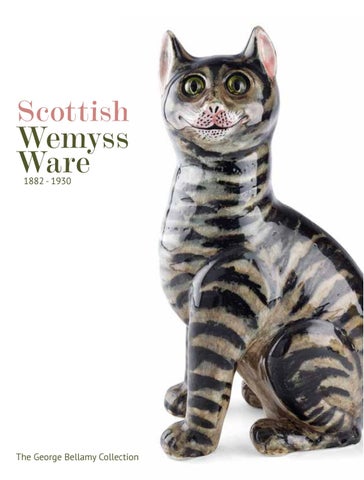
Scottish
Wemyss Ware 1882 - 1930
The George Bellamy Collection
The George Bellamy Collection
Scottish Wemyss Ware Contents
For the purposes of this book I have decided to divide the collection by subject matter, simply as a way of demonstrating the amazing range of patterns, shapes and designs available for this type of pottery. The vast majority of Wemyss Ware is marked in some way, either by an impressed stamp or a painted mark, usually “Wemyss”. Where neither of these is evident, there is often the reassurance of the printed retailer’s mark of Thomas Goode & Co. of Mayfair in London, where much of the Wemyss Ware range was sold. Where possible, I have indicated the artist responsible for the decoration, either identified on stylistic grounds or by the handwriting on the marks painted on the base of their pieces. I have also included the painted marks next to the text in each case. One soon becomes familiar with the handwriting of each decorator and it then becomes easier to spot their work stylistically, which I have always thought brings another dimension to the act of collecting Wemyss Ware.
7 Foreword – John Mackie 8 The World of Wemyss in Fife – Carol McNeill 18 A Lifetime’s Collection – George Bellamy 30 Animal Collection 42 Modelled Animal Collection 56 Bird Collection 80 Earlshall Collection 84 Fruit & Berry Collection 116 Garden Flower Collection 166 Cabbage Rose Collection 174 Insect Collection 184 Miscellaneous Collection 188 Wildflower Collection 218 Markings 220 The Decorators & Their Marks 223 Acknowledgements
A note on the makers and their marks can be found on pages 220-221. All measurements are approximate and the names of the flowers are drawn from my memory. George Bellamy
The George Bellamy Collection The World of Wemyss in Fife
13
I was amused too at the life-like pigs I saw, both finished and in the process of being turned out in the mould; I was told that all the great ladies of the countryside have them for placing in halls or conservatories. “Several are hand painted in two colours, the patterns being copies from old ware from Wemyss Castle. “A few of the vases for flowers are embellished with local views by the firm’s own artist. The new ware is likely to be as great a favourite as the black hand-painted enamelled ware for which the Messrs Heron are so famous.” So Robert Heron, a cosmopolitan man whose imaginative boundaries stretched far beyond his native Fife, travelled to the continent to find the artists who he hoped could deliver the designs of his dreams. It is thought that while he was on one of his many trips to Europe in the 1880s, Heron met several pottery decorators and persuaded them to come back to Fife to work. Most only stayed for a short time before returning home, but two men – Anton Weber and Karel Nekola – stayed to use their considerable artistic skills in the pottery. Weber stayed for a few years until he left in 1884, after being best man at Nekola’s wedding. Karel Nekola himself remained, marrying Isabella, who was cook-housekeeper to Robert Heron, and settling down in Kirkcaldy to raise their family of six children. It is no exaggeration to say that the iconic Wemyss Ware decorations, which are so keenly collected today, are mainly due to Nekola’s talents and vision. Several other involved artists were also highly skilled, including James Sharp, David Grinton, John Brown (who later worked at Methven’s Pottery in the Links area of Kirkcaldy), Christina McKinnon and her brother Hugh, James Adamson, and Karel’s son Joseph. The last major
decorator to come to Heron’s after Nekola’s death was Edwin Sandland, who had trained as a potter on his father’s farm and also studied at the art college in Stoke on Trent. There were also other decorators whose names are not recorded. Some of the experimental and very early Wemyss Ware pieces were painted with red rims and borders, but this was later changed to the more universally-recognised green. The beauty and originality of Wemyss Ware drew many prestigious visitors, including foreign royalty, possibly because of the connection with Wemyss Castle. Specially decorated pieces were ordered for aristocratic families, such as the loving cup made for the marriage of Lady Victoria and the Hon. Michael Wemyss, and a comb tray with a coronet for Violet, Countess of Rosslyn, at nearby Dysart House. Again, an 1896 article from the Fife Free Press, a contemporary local paper, gives a fascinating eye-witness insight into the range of ware that was being made at that time. “I journeyed to this pottery to have a look at its more famous productions, the Wemyss Ware which is well known to lovers of art and which is such an attractive feature at many bazaars nowadays,” wrote a journalist with the pen-name of Marguerite. “It would not be possible to catalogue all the novelties I saw here, but I may mention what struck me as outstanding. One was the lovely apple-green glaze which decorated various articles such as teapots and loving cups; the fruit designs on these I thought exceedingly good too, the glowing apples and cherries especially so. It was some articles of this kind,
20
The George Bellamy Collection A Lifetime’s Collection
Wemyss Ware was not easy to find when I first started collecting it. Gone are the days when choice pieces, unrecognised, could be found for a song in junk shops and flea markets.
“Plichta, London, England.” These pieces were made for Jan Plichta, an important customer for the Bovey pottery. His name appears on many items of Bovey pottery, both in the upmarket Wemyss range and items from its cheaper end. Joseph worked at the Bovey pottery from 1930 until his death in 1952. It can be interesting trying to identify the different decorators by the way “Wemyss” is painted on their pieces. Karel Nekola, James Sharp, Edwin Sandland and Joseph Nekola are the easiest to identify, but there were many other pieces marked by decorators whose identity still remains a mystery. I soon found out that Wemyss Ware was not so easy to find. I searched antique shops and fairs with little success, as I lived in Cheshire, and most Wemyss Ware was sold in the East of Scotland at auctions and some specialist antique shops. Another good area was London, as the main agent for Wemyss Ware in the south of England was Thomas Goode & Co.; the pieces sold by them bear the company’s oval stamp in red, black or blue. Portobello Road was another happy hunting ground for some people. Many a rare find has come from there – a set of rare Gordon plates featuring birds of prey is just one example. Victoria de Rin’s shop in Royal Hospital Road, Chelsea is another treasure trove. Unfortunately, I never got to see her exhibition at Sotheby’s as I was working seven days a week in the family bakery business, but sometime later I did make visits to Victoria de Rin’s shop, which always had many pieces of Wemyss Ware to covet. I would try and buy as many pieces as I could afford on these rare trips – perhaps three or four pieces once or twice a year.
Above The first published book on Wemyss Ware, written by Peter Davis and Robert Rankine and presented by Victoria de Rin and David Macmillan. Right George at home in the garden.
The George Bellamy Collection Modelled Animal Collection
Marmalade Cat 25
Tabby Cat 26
Height: 34cm
Height: 34cm
Impressed maker’s mark WEMYSS WARE/ R.H.&S., printed Thomas Goode & Co. retailer’s mark.
Impressed maker’s mark WEMYSS, printed Thomas Goode & Co. retailer’s mark.
25
26
26 A very alert cat amongst the catmint at home!
44
58
The George Bellamy Collection Bird Collection
Large Japan Vase 37
Large Grosvenor Vase 38
Small Grosvenor Vase 39
Height: 33cm
Height: 21cm
Height: 14cm
Painted with sand martins, dragonflies and mosquitos. Painted and impressed maker’s mark WEMYSS.
Painted with a turkey stag and hen. Impressed maker’s mark WEMYSS WARE/ R.H.&S., printed Thomas Goode & Co. retailer’s mark.
59
The George Bellamy Collection Bird Collection
Painted with a turkey hen. Impressed maker’s mark WEMYSS WARE/ R.H.&S., printed Thomas Goode & Co. retailer’s mark.
38
39
37
38 Reverse View
74
The George Bellamy Collection Bird Collection
Medium Basket 68
Tile 69
Tile 70
Length: 30cm
Height: 15cm Length: 15cm
Height: 15cm Length: 15cm
Painted with a frieze of geese. Impressed mark WEMYSS WARE/ R.H.&S., printed Thomas Goode & Co. retailer’s mark.
Painted with geese on a Minton’s blank. Moulded Minton’s mark, printed Thomas Goode & Co. retailer’s mark.
75
The George Bellamy Collection Bird Collection
Painted with a black hen and chicks on a Minton’s blank. Moulded Minton’s mark, printed Thomas Goode & Co. retailer’s mark.
Provenance: Collection of Hugh Hutchison.
69
68
70
Medium Tyg 81 Painted with mistletoe and holly. Impressed maker’s mark WEMYSS WARE/ R.H.&S., printed Thomas Goode & Co. retailer’s mark.
The George Bellamy Collection Fruit & Berry Collection
Height: 19.5cm Note: Holly is extremely rare; I have only seen three or four pieces that feature it, and this is the only one I have seen that also depicts mistletoe.
Fruit & Berry Collection
The abundance of fruits that grow in the fertile lands of Fife have found their way onto the myriad shapes produced by the Fife Pottery. Preserve jars were especially favoured, which is hardly a surprise, as the nearby Dundee was a centre of jam-making. The sweet tooth of the local inhabitants was likely an additional factor!
81
85
180
The George Bellamy Collection Insect Collection
Comb Tray 261
Large Mug 262
Painted by James Sharp with dragonflies. Painted and impressed maker’s mark WEMYSS.
Painted by Edwin Sandland with dragonflies. Painted maker’s mark WEMYSS. Height: 14cm
Length: 26cm
Stuart Flower Pot 263
Painted by Edwin Sandland with dragonflies. Painted and impressed maker’s marks WEMYSS.
181
The George Bellamy Collection Insect Collection
Height: 17cm
Note: Though not especially rare, dragonflies are a very popular design with collectors.
262
261
263
ISBN: 978-1-78884-017-0
ËxHSLHSIy840170zv&:%:&:+:+
£30.00/$45.00
www.accartbooks.com