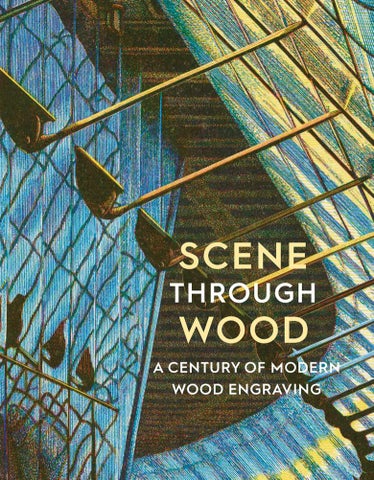
Foreword The technique of wood engraving is often said to have been invented by the Newcastle naturalist, Thomas Bewick. His associate, Charles Thompson, is widely credited with introducing the technique to France, where British engravers enjoyed extraordinary success with illustrated books and newspapers. The majority of wood engravings produced in the nineteenth century were reproductive, and it was not until the 1890s, with the rise of the private press in England and the influence of Auguste Lepère in France, that more artistic concerns were addressed. Just as Britain’s Society of Painter-Etchers, founded in 1880, was preceded by the Société des aquafortistes in Paris in 1863, so the Society of Wood Engravers (SWE) was anticipated by attempts by Lepère in 1912–13 to establish the Société des graveurs sur bois originale. These foundered on the eve of the First World War, and both the English and French societies were established in 1920. The French society lasted less than a decade, whereas the SWE is very happily celebrating its centenary in 2020 with this magnificent exhibition. The Ashmolean Museum houses one of the most extensive collections of wood engravings in the world, and it is therefore highly appropriate that this exhibition should begin its tour here. The collection effectively began with the gift in 1964, by Arthur Mitchell, of over 3,000 prints, including a large group of wood engravings. During the 1980s and 1990s, it expanded remarkably through the energies of a long-standing volunteer, Anne Stevens, under the guidance of Ian Lowe. The acquisition of large groups of prints, often as gifts from the artists, resulted in a succession of monographic exhibitions on some of the most important wood engravers. They included John Farleigh (1986), John Buckland Wright (1990), Clare Leighton (1992), Monica Poole (1993) and Anne Desmet (1998). A key point in this period of expansion was the acquisition of a comprehensive body of work by Gertrude Hermes and Blair Hughes-Stanton in 1995 from the artists’ family, which resulted in a memorable exhibition organised by Katharine Eustace. More recently, the Ashmolean has formed a close partnership with the SWE, and has been keeping the collection up to date by acquiring work by members, both at the Society’s annual exhibition and privately. It is thanks to the generosity of our benefactors that this exhibition has largely been formed from our own resources. Its curator, Anne Desmet, is only the third wood engraver to have been elected a Royal Academician; her predecessors were Gertrude Hermes and Charles Tunnicliffe. She has close links with the Ashmolean and with Oxford, having studied at the Ruskin School of Drawing and Fine Art as an undergraduate at Worcester College, which recently elected her to an honorary fellowship. Anne has worked tirelessly on this project, bringing a particular sensitivity to the selection as one of the most distinguished and imaginative of wood engravers. The exhibition and catalogue resoundingly demonstrate that the art of wood engraving and the Society of Wood Engravers have a distinguished past and a promising future. COLIN HARRISON Senior Curator of European Art, Ashmolean Museum
Opposite: detail of cat.196
7
Acknowledgements I am most grateful to Xa Sturgis for appointing me to curate Scene through Wood at the Ashmolean. Particular thanks go to Katherine Wodehouse for her tireless assistance in all aspects of the curatorial process, to Colin Harrison for his expertise and support, to Declan McCarthy for facilitating this book and to Stephen Hebron for designing it so beautifully. Thanks also go to Aisha Burtenshaw, Benjamin Heller, Katie Irwin, Byung Kim, Hannah Manson, Dr Caroline Palmer and Agnes Valencak at the Museum for their parts in preparing the exhibition. Thanks also go to the Society of Wood Engravers. It is the centenary of its founding that Scene through Wood celebrates. I am especially grateful to Peter Lawrence for being a behind the scenes rock and to Simon Brett for his insightful essay. I am also most grateful to the Rawlinson Fund (administered by the SWE) and anonymous donors who have kindly sponsored this exhibition. Huge thanks are due to Nigel Hamway for sponsoring this project, over many years, through buying fine wood engravings for the Ashmolean’s collection. Heartfelt thanks also go to Roy and Jane Darke, Jutta Manser, Terry Robertson, Joanna Selborne and Stuart Southall for generously sponsoring this book. Acknowledgements are gratefully given to all artists and artists’ estates for permission to reproduce copyright images. My thanks go to Grigory Babich, Peter Bosteels, Neil Bousfield, Chris Daunt, Andrew Davidson, Harry Dickinson, Julian Francis, David Gentleman, Jonathan Gibbs, Nigel Hamway, Nicolas McDowall, Hilary Paynter, Professor Roger Penrose, Stuart Southall, Brian Webb, Roy Willingham and Chris Wormell for loaning works from their private collections. Every effort has been made to contact all copyright holders but if, despite best efforts, anyone has been omitted, please contact the Ashmolean so that this can be rectified for any future editions. Additional thanks go to Tom Willingham for photographing various private loans featured on these pages. I would also like to acknowledge Professor Timothy Wilson, former Keeper of Western Art at the Ashmolean, who in 1990 began buying my engravings for the Museum. This began a relationship between the Ashmolean and myself which has been a constant source of inspiration to me. As a tirelessly committed volunteer for nearly two decades, Anne Stevens MBE (1928–2012) also facilitated the Ashmolean’s significant expansion of its wood engraving holdings, while Sheila Hönigsberg (1925–2015), after working in the Ashmolean Library for nearly 40 years, edited the SWE’s publication, Multiples, for 16 years. Timothy (and his predecessor, Ian Lowe), Anne and Sheila, along with the indefatigable Society of Wood Engravers of course, have all provided invaluable service keeping wood engravings in the public eye over many decades. Finally, to my husband, Roy Willingham, and my children Tom and Marion: thank you for your patience and support over all the months it has taken to create this book. ANNE DESMET RA Artist and Curator
Opposite: detail of cat.164
9
Setting the Scene: British Wood Engraving in History SIMON BRETT
To begin at the beginning, wood engraving is the only art form widely considered to have been invented in England. Its invention is generally attributed to Thomas Bewick (1753–1828) who worked in relative isolation in Northumberland. The greater part of this exhibition consists of fine art wood-engraved prints, an art form that simply did not exist before the twentieth century. If we include book illustration, however, wood engraving has a long history. No account of British art in the twentieth century should ignore it, although none ever knows quite how to place it. A half-hidden but persistent tradition, reflective of the times but relatively impervious to fashion, wood engraving has created its own devoted public and its own dedicated literature. It is a medium that will not go away. The streak of Neo-Romanticism which flows through wood engraving is also ‘very English’, entwining it most closely, or contrasting it most tellingly, with the wider history of art. What French or German artist would see the landscape as ‘little nooks and dells of Paradise’, as Samuel Palmer did? These are the ‘scenes through the wood’ unique to an English, Shakespearean sensibility. Yet its modernist credentials in 1920, at the founding of the Society of Wood Engravers, were impeccable. Wood engraving gave us modernism, seen through wood, with a look all of its own, unattainable in any other medium.
hisToRicAl conTexT
Opposite: detail of cat.75
For many years, engravers in wood or metal were not regarded as artists. The Royal Academy of Arts was founded in 1768 to raise the status of British artists by a system of teaching and the exhibition of contemporary works. At its best, it included whatever artists came up with. However, the Royal Society of Painters in Water Colours (RWS) and the Royal Society of Painter-Etchers and Engravers (RE) were formed, respectively, in 1804 and 1880 – in protest at the Academy’s failure to represent watercolour painters adequately and its refusal to admit printmakers. The Academy had a point, however. For 200 years printmaking had been used almost exclusively for reproducing paintings or drawings by other artists, not for making original works by the engravers themselves. Wood engraving monopolised commercial image-making in the nineteenth century. The question as to whether engravers were true artists or not was, at that time, a real one. Rembrandt, Dürer or Goya assuredly had been; so were Piranesi and Tiepolo – and Bewick and Callot, both of whom were specialist engravers. Yet it took nineteenth- and early twentieth-century revivals of interest in printmaking for these masters’ prints to be revalued. You could buy Rembrandts with pocket money even in the early twentieth century. The foundation of the Society of Wood Engravers in 1920 was similarly a breakaway, this time from the RE (a bastion of etchers), in order to promote wood engraving as a medium for modern artists. It was revived in 1984 explicitly to champion wood engraving as an undeniable part of the contemporary scene: 11
Richard Wagener (1944–) Wagener grew up in southern California, where he spent time with his grandfather in the desert and the Sierra. An after-school job selling newspapers at Disney Studios introduced him to illustrators and animators. He studied biological sciences at the University of San Diego and painting at the Art Center College of Design, Los Angeles, then took up engraving in 1980. He is a SWE member and has works in Columbia; Harvard; Stanford; the University
The Sierra Nevada Suite, 2013 Book of 31 engravings by Richard Wagener, The Book Club of California, 2013. Wood engravings (boxwood) on Zerkall 7624 off-white paper; page size: 32 × 19 cm, 76 pages. From the collection of Nigel Hamway. Photographs by Tom Willingham. © Richard Wagener
138
of California, Berkeley; and New York Public Library collections. Wagener has engraved for editions of Peter Koch, Berkeley, and for the Book Club of California. In 2006 he created his own imprint, Mixolydian Editions, and collaborated with Nawakum Press, Santa Rosa, on two books – one of which won the 2016 Carl Hertzog Award for Excellence in Book Design. Wagener also won the Oscar Lewis Award for book arts. He lives in northern California.
Path to The Summit from The Sierra Nevada Suite, 2013 Wood engraving (boxwood) on Zerkall 7624 off-white paper, 16 × 8 cm
139
Sierra Granite from The Sierra Nevada Suite, 2013 Wood engraving (boxwood) on Zerkall 7624 off-white paper, 13 × 9 cm
153
Sarah van Niekerk (1934–2018) Sarah van Niekerk taught wood engraving at West Dean College for many years, showing regularly in the RA Summer Exhibition. ‘I love the sparkle of black on white, and inventing the endless variety of textures that make up the colour and tone in wood engraving. Gertrude Hermes made it … totally understandable,’ she has observed.61 In 1988 she and her family moved from Oxfordshire to the banks of the River Severn, Gloucestershire. Former student Harry Brockway remembered her as ‘a great
stylist, using the full range of possibilities within her prints from bold areas of black and white, long sinuous … lines and delicate stippled tones, all underpinned with fine drawing … one of the most distinctive and influential engravers of her generation’. 62 61 Sarah van Niekerk, exhibition catalogue for Here and Now: the 75th Anniversary Exhibition of the SWE. Ashmolean Museum, Oxford, 1995, p.44. 62 Harry Brockway, Multiples, no.39, August 2018, p.4.
140
The Severn in Winter, 1997 Wood engraving on white paper, 11.4 × 11.4 cm. WA2016.86.187. Bequeathed by Sheila Hönigsberg, 2016. © Estate of Sarah van Niekerk
154
John Northcote Nash (1893–1977) Younger brother of painter-engraver Paul Nash, John was born in London. Encouraged by Paul to take up painting, they exhibited together at Dorien Leigh Gallery, Kensington (1913). Following Paul’s disillusionment with London’s Slade School, he insisted that John should not undertake formal art training. John was a founder of the London Group (1914) and showed in the first Camden Town Group exhibition (1915). He enlisted in the Artists’ Rifles (1916) and was commissioned as Official War Artist
(1918). A founder SWE member, 1921 saw Nash’s first solo show at London’s Goupil Gallery and a move to Meadle, near Princes Risborough. He taught at Oxford’s Ruskin School of Art (1924–9) and the RCA (1934–40). Briefly Official War Artist to the Admiralty (1940), he transferred to the Royal Marines, serving at Rosyth where his friend Eric Ravilious visited him. An English landscape painterprintmaker, Nash was also a fine botanical draughtsman.
142
Trees, 1919 Wood engraving on white paper, 6.7 × 8.8 cm. WA2010.49.6. Presented by Anne Stevens, 2010. © The John Nash Estate / Bridgeman Images
143
White Leaf Cross, 1919 Wood engraving on white paper, 7.5 × 6.9 cm. WA2010.49.10. Presented by Anne Stevens, 2010. © The John Nash Estate / Bridgeman Images
156
Robert John Gibbings (1889–1958) Born in Cork, Ireland, Gibbings studied at London’s Slade School of Fine Art (1912), then joined Noel Rooke’s wood engraving classes at Central School of Arts and Crafts. He produced his first white-line engravings (1913), enlisted with the Royal Munster Fusiliers (1914) and served at Gallipoli. Invalided out of the Army with a serious neck wound (1918), he became a freelance engraver. A founder of the SWE, Gibbings owned and ran Golden Cockerel Press in Berkshire (1924–33), commissioning
many engravers. His visit to Tahiti (1929) inspired many subsequent engravings. Clare Leighton praised the tonal complexity of one of Gibbings’palm tree engravings, noting ‘His simple masses of black and white have extra solidity … by the cross-hatching work with the graver which merges the black into the white with a grey’. 65 65 Clare Leighton, Wood-Engraving and Woodcuts, ‘How to do it’ series, no.2. 1932, p.70.
144
The Atoll, 1933 Wood engraving on off-white paper, 16.9 × 17.1 cm. WA1954.157.61. Presented by Thomas Balston, 1954. © Estate of Robert Gibbings
157
Joan Hassall (1906–88) In a highly successful career, Hassall was one of the first three women to be elected as members of the Art Workers’ Guild (1964). She became the first female Master of the Guild in 1972, and was awarded the bronze medal for engraving at the 1973 Paris salon. Hassall illustrated numerous books from 1936–64, including titles for Heinemann, Harrap, Jonathan Cape, the Folio Society,
Faber and Oxford University Press. She greatly admired Bewick’s engravings and emulated his work, sharing the prevailing philosophy of light being the most important character in a picture. Hassall also studied the work of nineteenth-century engravers. This gave her cutting a somewhat archaic character, but made for very successful illustrations.
146
The Old Tree, 1950 Wood engraving on white paper, 14.6 × 9.5 cm. WA1964.75.1081. Presented by Arthur Mitchell, 1964. © Estate of Joan Hassall
159