List of Contents
Preface
Dr Alexander Sturgis Acknowledgements
Susan Walker Introduction
Susan Walker
Part 1 The formation of the Wilshere Collection Chapter 1
The collector and his collection Susan Walker Chapter 2
The sources of Charles Wilshere’s collection Susan Walker/David Rini
Part 2 The Wilshere Collection in context Chapter 3
Honouring the dead in late antique Rome Susan Walker Chapter 4
Craft in context: the materials of the Wilshere Collection Susan Walker Chapter 5
Picturing prayers: the iconography of the Wilshere gold-glasses Sean V. Leatherbury
Catalogue Susan Walker with contributions by Sean Leatherbury and David Rini Gold-glass Group 1: decoloured with antimony only Group 2: decoloured with manganese only Group 3: clear glass decoloured with antimony and manganese Group 4: clear inner layer decoloured with antimony and manganese; coloured outer layer Sarcophagi and cinerary urn Funerary Inscriptions Jewish and Christian Inscriptions from Rome Christian inscriptions from Cumae and Aeclanum Pagan inscription from Sicily Inscription of unknown provenance Christian votive relief and silver spoon
Appendices Concordance of the Wilshere Collection
Susan Walker Transcriptions of Wilshere’s inventory of objects loaned to the Leeds Exhibition, 1868 and the Declaration of Trust in favour of Pusey House, 1895
Susan Walker Analysis of gold-glass from the Ashmolean Museum
Andrew Shortland, Kelly Domoney and Julian Henderson Sr-Nd isotopic characterisation of a Roman gold glass sample (Ashmolean Museum, entry AN2007.26)
Patrick Degryse & Annelore Blomme Stable isotope analysis of marble inscriptions from the Wilshere Collection, Ashmolean Museum
Peter Ditchfield Report on the ancient mortar on inscriptions from the Wilshere Collection, Ashmolean Museum Graham Morgan Abbreviations Bibliography Sources of Illustrations
List of Contents
Preface
Dr Alexander Sturgis Acknowledgements
Susan Walker Introduction
Susan Walker
Part 1 The formation of the Wilshere Collection Chapter 1
The collector and his collection Susan Walker Chapter 2
The sources of Charles Wilshere’s collection Susan Walker/David Rini
Part 2 The Wilshere Collection in context Chapter 3
Honouring the dead in late antique Rome Susan Walker Chapter 4
Craft in context: the materials of the Wilshere Collection Susan Walker Chapter 5
Picturing prayers: the iconography of the Wilshere gold-glasses Sean V. Leatherbury
Catalogue Susan Walker with contributions by Sean Leatherbury and David Rini Gold-glass Group 1: decoloured with antimony only Group 2: decoloured with manganese only Group 3: clear glass decoloured with antimony and manganese Group 4: clear inner layer decoloured with antimony and manganese; coloured outer layer Sarcophagi and cinerary urn Funerary Inscriptions Jewish and Christian Inscriptions from Rome Christian inscriptions from Cumae and Aeclanum Pagan inscription from Sicily Inscription of unknown provenance Christian votive relief and silver spoon
Appendices Concordance of the Wilshere Collection
Susan Walker Transcriptions of Wilshere’s inventory of objects loaned to the Leeds Exhibition, 1868 and the Declaration of Trust in favour of Pusey House, 1895
Susan Walker Analysis of gold-glass from the Ashmolean Museum
Andrew Shortland, Kelly Domoney and Julian Henderson Sr-Nd isotopic characterisation of a Roman gold glass sample (Ashmolean Museum, entry AN2007.26)
Patrick Degryse & Annelore Blomme Stable isotope analysis of marble inscriptions from the Wilshere Collection, Ashmolean Museum
Peter Ditchfield Report on the ancient mortar on inscriptions from the Wilshere Collection, Ashmolean Museum Graham Morgan Abbreviations Bibliography Sources of Illustrations
Chapter 1
The Collector and his Collection
Charles Willes Wilshere, a Hertfordshire gentleman
The Wilshere Collection of late Roman gold-glass, sarcophagi and inscriptions was formed by a landowner from Welwyn, Hertfordshire. Born a Georgian at Hitchin, Hertfordshire on 20 February 1814, Charles Willes Wilshere died an Edwardian at Welwyn on 29 September 1906, having shown, according to one local obituarist, ‘wonderful vitality, being confined to his bed for only three weeks’.1 An informal photograph taken in the late 1890s (Fig.1.1.1) shows a robust and apparently contented elderly man with patriarchal beard, standing in the splendid gardens of the family estate at The Frythe, Welwyn. As a second son, Charles Wilshere did not expect to inherit The Frythe. He was well-educated: a degree from Trinity College, Cambridge was followed by legal training at Lincoln’s Inn, London. He was cosmopolitan, marrying in Munich and travelling frequently in France, Germany and Italy. The family estate at Welwyn came to him on the unexpected death in Paris on 10 November 1868 of his unmarried elder brother William. For ten years, from 1837–47, William Wilshere had served as Whig M.P. for Great Yarmouth on the Norfolk coast; he was later appointed Deputy Lieutenant and, in 1858, High Sheriff of Hertfordshire.2 The considerable extra burden of local management and public roles, including service as Justice of the Peace and Deputy Lieutenant of Hertfordshire, was assumed by Charles Wilshere with great energy and sense of purpose. Yet it hardly inhibited his activities as a traveller, a collector of antiquities and a fervent supporter of the Anglo-Catholic Oxford Movement. The robust judgement of his obituarist was entirely typical of Charles Wilshere’s long and extremely active life.
18
Saints and Salvation
Part 1 ◆ The Formation of the Wilshere Collection
Fig.1.1.1 Photograph of Charles Wilshere in
the garden of The Frythe, 1899. After Gordon Longmead, 2006
The Wilshere Collection
19
Chapter 1
The Collector and his Collection
Charles Willes Wilshere, a Hertfordshire gentleman
The Wilshere Collection of late Roman gold-glass, sarcophagi and inscriptions was formed by a landowner from Welwyn, Hertfordshire. Born a Georgian at Hitchin, Hertfordshire on 20 February 1814, Charles Willes Wilshere died an Edwardian at Welwyn on 29 September 1906, having shown, according to one local obituarist, ‘wonderful vitality, being confined to his bed for only three weeks’.1 An informal photograph taken in the late 1890s (Fig.1.1.1) shows a robust and apparently contented elderly man with patriarchal beard, standing in the splendid gardens of the family estate at The Frythe, Welwyn. As a second son, Charles Wilshere did not expect to inherit The Frythe. He was well-educated: a degree from Trinity College, Cambridge was followed by legal training at Lincoln’s Inn, London. He was cosmopolitan, marrying in Munich and travelling frequently in France, Germany and Italy. The family estate at Welwyn came to him on the unexpected death in Paris on 10 November 1868 of his unmarried elder brother William. For ten years, from 1837–47, William Wilshere had served as Whig M.P. for Great Yarmouth on the Norfolk coast; he was later appointed Deputy Lieutenant and, in 1858, High Sheriff of Hertfordshire.2 The considerable extra burden of local management and public roles, including service as Justice of the Peace and Deputy Lieutenant of Hertfordshire, was assumed by Charles Wilshere with great energy and sense of purpose. Yet it hardly inhibited his activities as a traveller, a collector of antiquities and a fervent supporter of the Anglo-Catholic Oxford Movement. The robust judgement of his obituarist was entirely typical of Charles Wilshere’s long and extremely active life.
18
Saints and Salvation
Part 1 ◆ The Formation of the Wilshere Collection
Fig.1.1.1 Photograph of Charles Wilshere in
the garden of The Frythe, 1899. After Gordon Longmead, 2006
The Wilshere Collection
19
damage to the drawings, is dated 8 February 1872. One can only imagine Garrucci’s reaction to its somewhat insouciant tone, though Wilshere clearly hoped to placate him with an offer of giving him the full price agreed and partly paid in advance. …Mi spiace di dirla che i disegni sono un poco guasti: in modo che se vuol ritenergli, la pregherò di ritinere anche la moneta che già tiene sul conto; questo in ogni caso. Ella deciderà dunque se preferisce aver i disegni tali quali; o la rimanente del prezzo combinato. Il guasto proviene da due cose: principalmente dal fregamento (non so se questa sia la parola) soferto nel viaggio: taluni fogli della carta di China vitrapasti non erano morbidi assai, ed hanno ammaccato il lapis (spero che me capirà). Secondo: nel museo hanno scritti al’angolo di ciascuno, in richiastro, la papira dell’Arringhi dove si trova gli originali disegni. Ora mi scriva risposto. Ella in ogni caso non ritornerà i denari gia pagati: preferisce di aver i disegni, o i bilanci? Pregho una risposta al più presto, e resto suo servo ed amico devot.mo [devot(issi)mo] C. W. Wilshere (I’m sorry to tell you that the drawings are a little spoiled: in the event that you want to keep them, I pray you to keep also the money that you already hold on account: this in any case. You will then decide if you prefer to have the drawings however they are; or the remaining amount of the full price. The damage comes from two things: principally from rubbing (I don’t know if this is the word) suffered in transit: some glazed sheets of China paper were not damp enough, and have smudged the pencil (I hope that you will understand me). Second: in the museum they wrote on the corner of each one, as a reference, the manuscript of Arringhi, where one finds the original drawings. Now you’ll write me a reply. In any case you will not return the money already paid: do you prefer to have the drawings, or the balances? I beg you to send a response as soon as possible, and remain your servant and devoted friend C. W. Wilshere)55
Wilshere and the Roman art market Buying and selling antiquities in Rome in the 1860s
It is possible that Wilshere began to collect antiquities in Italy as a younger man, but no record survives earlier than his acquisition of the gold-glass from the Museo Recupero and other Roman sources. This purchase, from the Roman antiquarian Tommaso Capobianchi, whose shop was located at Via del Babuino 152 A and B (Fig.1.1.11), took place in 1864–5. Today the Via del Babuino retains hints of its nineteenth-century role in the art and antiquities trade in the re-creation of the
30
Saints and Salvation
Part 1 ◆ The Formation of the Wilshere Collection
sculptors’ workshop of Luigi Canova and the Tadolini family; however , no.152, like so many of its neighbours, is at the time of writing an up-market clothes shop. The archive of letters sent to Garrucci shows that the Capobianchi family were themselves frequent travellers, operating in London and Paris, and sometimes moving too quickly for the collectors’ convenience.56 Their shop was so well known to English visitors to Rome that Tommaso Capobianchi earned a personal citation in John Murray’s guide to the city.57 An evocative picture of collecting in Rome in the 1860s is offered by the Polish collector Count Michel Tyskiewicz:
Fig.1.1.11 Map of Rome engraved in 1857 by
Achille Pariboni. The approximate position of Tommaso Capobianchi’s shop is marked with an arrow. British School at Rome Archive 609.2.85.4.
The Rome of that day [1865] was indeed a Paradise for lovers and buyers of antiquities. Under Pius IX there still hung about the Eternal City an atmosphere that was almost patriarchal, or even provincial. In many respects you might fancy yourself back in the eighteenth century…The calm that reigned there, the liberty enjoyed by all who did not meddle with politics, the kind and cordial reception given to strangers by cardinals, nobles and people alike, the quiet and simple life led by everyone, the numberless interests of the place, and its artistic and scientific surroundings – these and other reasons attracted a vast influx of rich foreigners, savants, nobles and sovereigns, who
Chapter 1 ◆ The Collector and his Collection
The Wilshere Collection
31
damage to the drawings, is dated 8 February 1872. One can only imagine Garrucci’s reaction to its somewhat insouciant tone, though Wilshere clearly hoped to placate him with an offer of giving him the full price agreed and partly paid in advance. …Mi spiace di dirla che i disegni sono un poco guasti: in modo che se vuol ritenergli, la pregherò di ritinere anche la moneta che già tiene sul conto; questo in ogni caso. Ella deciderà dunque se preferisce aver i disegni tali quali; o la rimanente del prezzo combinato. Il guasto proviene da due cose: principalmente dal fregamento (non so se questa sia la parola) soferto nel viaggio: taluni fogli della carta di China vitrapasti non erano morbidi assai, ed hanno ammaccato il lapis (spero che me capirà). Secondo: nel museo hanno scritti al’angolo di ciascuno, in richiastro, la papira dell’Arringhi dove si trova gli originali disegni. Ora mi scriva risposto. Ella in ogni caso non ritornerà i denari gia pagati: preferisce di aver i disegni, o i bilanci? Pregho una risposta al più presto, e resto suo servo ed amico devot.mo [devot(issi)mo] C. W. Wilshere (I’m sorry to tell you that the drawings are a little spoiled: in the event that you want to keep them, I pray you to keep also the money that you already hold on account: this in any case. You will then decide if you prefer to have the drawings however they are; or the remaining amount of the full price. The damage comes from two things: principally from rubbing (I don’t know if this is the word) suffered in transit: some glazed sheets of China paper were not damp enough, and have smudged the pencil (I hope that you will understand me). Second: in the museum they wrote on the corner of each one, as a reference, the manuscript of Arringhi, where one finds the original drawings. Now you’ll write me a reply. In any case you will not return the money already paid: do you prefer to have the drawings, or the balances? I beg you to send a response as soon as possible, and remain your servant and devoted friend C. W. Wilshere)55
Wilshere and the Roman art market Buying and selling antiquities in Rome in the 1860s
It is possible that Wilshere began to collect antiquities in Italy as a younger man, but no record survives earlier than his acquisition of the gold-glass from the Museo Recupero and other Roman sources. This purchase, from the Roman antiquarian Tommaso Capobianchi, whose shop was located at Via del Babuino 152 A and B (Fig.1.1.11), took place in 1864–5. Today the Via del Babuino retains hints of its nineteenth-century role in the art and antiquities trade in the re-creation of the
30
Saints and Salvation
Part 1 ◆ The Formation of the Wilshere Collection
sculptors’ workshop of Luigi Canova and the Tadolini family; however , no.152, like so many of its neighbours, is at the time of writing an up-market clothes shop. The archive of letters sent to Garrucci shows that the Capobianchi family were themselves frequent travellers, operating in London and Paris, and sometimes moving too quickly for the collectors’ convenience.56 Their shop was so well known to English visitors to Rome that Tommaso Capobianchi earned a personal citation in John Murray’s guide to the city.57 An evocative picture of collecting in Rome in the 1860s is offered by the Polish collector Count Michel Tyskiewicz:
Fig.1.1.11 Map of Rome engraved in 1857 by
Achille Pariboni. The approximate position of Tommaso Capobianchi’s shop is marked with an arrow. British School at Rome Archive 609.2.85.4.
The Rome of that day [1865] was indeed a Paradise for lovers and buyers of antiquities. Under Pius IX there still hung about the Eternal City an atmosphere that was almost patriarchal, or even provincial. In many respects you might fancy yourself back in the eighteenth century…The calm that reigned there, the liberty enjoyed by all who did not meddle with politics, the kind and cordial reception given to strangers by cardinals, nobles and people alike, the quiet and simple life led by everyone, the numberless interests of the place, and its artistic and scientific surroundings – these and other reasons attracted a vast influx of rich foreigners, savants, nobles and sovereigns, who
Chapter 1 ◆ The Collector and his Collection
The Wilshere Collection
31
monetary value (Fig.1.1.13).68 It may be surmised (no letter from him survives) that Garrucci had made Wilshere too low an offer for the collection. This letter, written on 16 March 1869 in English (Wilshere reserved his native language for significant communications where he was anxious to avoid misunderstandings arising from his own grammatical errors in Italian or French), contains an important statement of Wilshere’s principles: Dear Father Garrucci, In answer to your kind letter I have to reply that I value my Christian glass so highly that it is likely to remain in my possession a very long while. Being unique in some of its specimens, and being also the only collection in private hands, and there being positively no specimens of value at all approaching mine in any national collections out of Italy except at the British Museum, where, as you know, there is nothing nearly so fine; I feel sure that as Christian antiquities (thanks to yourself and to Cav[aliere]. de Rossi and one or two other writers) are daily more appreciated, I shall some time or other, be able to make my own terms with the French, Prussian or Russian government, if not with our own. I do not refuse to sell to private individuals, and indeed should not regard the quarter from which an offer came, so much as the amount. I may say that the managers of the Leeds exhibition, to whom I lent my glass last year, gave me a guarantee in writing of £1200 in case of loss or destruction; and that in reply to an enquiry five weeks ago on behalf of the South Kensington Museum, I stated that fact, and added that I would not part with it to the director for that sum…. Believe me to remain, dear Father Garrucci, with the greatest esteem and respect, Yours C. W. Wilshere
The surviving correspondence, notably to de Rossi, with whom Wilshere corresponded for nearly 30 years, provides confirmation of Wilshere’s long-lasting relationships with his Italian academic and papal contacts. That with Garrucci may have been broken by the careless handling of the drawings of the catacombs (see above, p.00), but in 11 extant letters, written from 1868 to 1872, we see Wilshere going to extraordinary lengths to broker sales of objects to London museums on Garrucci’s behalf.69 In the 1890s Wilshere was awarded a medal by Pope Leo XIII ‘for his generosity in giving the top of a triumphal arch which he had rescued from some mason’s yard and a piece of ancient Christian glass, both now in the Vatican’.70 The ‘top of the triumphal arch’ surely refers to an inscription from the city of Aeclanum – namely the significant republican text CIL IX 1140, recording the building of the walls of the city. This monumental text had been the subject of fruitless negotiations by Wilshere, undertaken in the early 1870s in hope of an exchange of the monumental text for early Christian objects of equal value. The deal was to have been negotiated with Giuseppe Fiorelli, the distinguished director of the Archaeological Museum of Naples; there followed equally wearisome negotiations in the 1890s with de Rossi’s colleague at the Vatican, Commendatore C. R. Visconti. Eventually Wilshere gave the inscription to de Rossi in thanks for the latter’s apparent recovery from a stroke, but the actual transaction must have happened after de Rossi’s death later in 1894.71 The other returned object mentioned in the citation was the gold-glass representing the martyr Genesius with Saint Luke (Fig.1.1.14), published by Garrucci
34
Saints and Salvation
Part 1 ◆ The Formation of the Wilshere Collection
Chapter 1 ◆ The Collector and his Collection
Fig. 1.1.13 Part of Wilshere’s letter to Garrucci of 16 March 1869, explaining the value of his glass collection. Biblioteca San Luigi, Posilippo, Letters to R. Garrucci, R 14/1869. by courtesy of the Pontificia Facoltà Teologica dell’Italia Meridonale Sezione San Luigi – Biblioteca
The Wilshere Collection
35
monetary value (Fig.1.1.13).68 It may be surmised (no letter from him survives) that Garrucci had made Wilshere too low an offer for the collection. This letter, written on 16 March 1869 in English (Wilshere reserved his native language for significant communications where he was anxious to avoid misunderstandings arising from his own grammatical errors in Italian or French), contains an important statement of Wilshere’s principles: Dear Father Garrucci, In answer to your kind letter I have to reply that I value my Christian glass so highly that it is likely to remain in my possession a very long while. Being unique in some of its specimens, and being also the only collection in private hands, and there being positively no specimens of value at all approaching mine in any national collections out of Italy except at the British Museum, where, as you know, there is nothing nearly so fine; I feel sure that as Christian antiquities (thanks to yourself and to Cav[aliere]. de Rossi and one or two other writers) are daily more appreciated, I shall some time or other, be able to make my own terms with the French, Prussian or Russian government, if not with our own. I do not refuse to sell to private individuals, and indeed should not regard the quarter from which an offer came, so much as the amount. I may say that the managers of the Leeds exhibition, to whom I lent my glass last year, gave me a guarantee in writing of £1200 in case of loss or destruction; and that in reply to an enquiry five weeks ago on behalf of the South Kensington Museum, I stated that fact, and added that I would not part with it to the director for that sum…. Believe me to remain, dear Father Garrucci, with the greatest esteem and respect, Yours C. W. Wilshere
The surviving correspondence, notably to de Rossi, with whom Wilshere corresponded for nearly 30 years, provides confirmation of Wilshere’s long-lasting relationships with his Italian academic and papal contacts. That with Garrucci may have been broken by the careless handling of the drawings of the catacombs (see above, p.00), but in 11 extant letters, written from 1868 to 1872, we see Wilshere going to extraordinary lengths to broker sales of objects to London museums on Garrucci’s behalf.69 In the 1890s Wilshere was awarded a medal by Pope Leo XIII ‘for his generosity in giving the top of a triumphal arch which he had rescued from some mason’s yard and a piece of ancient Christian glass, both now in the Vatican’.70 The ‘top of the triumphal arch’ surely refers to an inscription from the city of Aeclanum – namely the significant republican text CIL IX 1140, recording the building of the walls of the city. This monumental text had been the subject of fruitless negotiations by Wilshere, undertaken in the early 1870s in hope of an exchange of the monumental text for early Christian objects of equal value. The deal was to have been negotiated with Giuseppe Fiorelli, the distinguished director of the Archaeological Museum of Naples; there followed equally wearisome negotiations in the 1890s with de Rossi’s colleague at the Vatican, Commendatore C. R. Visconti. Eventually Wilshere gave the inscription to de Rossi in thanks for the latter’s apparent recovery from a stroke, but the actual transaction must have happened after de Rossi’s death later in 1894.71 The other returned object mentioned in the citation was the gold-glass representing the martyr Genesius with Saint Luke (Fig.1.1.14), published by Garrucci
34
Saints and Salvation
Part 1 ◆ The Formation of the Wilshere Collection
Chapter 1 ◆ The Collector and his Collection
Fig. 1.1.13 Part of Wilshere’s letter to Garrucci of 16 March 1869, explaining the value of his glass collection. Biblioteca San Luigi, Posilippo, Letters to R. Garrucci, R 14/1869. by courtesy of the Pontificia Facoltà Teologica dell’Italia Meridonale Sezione San Luigi – Biblioteca
The Wilshere Collection
35
Chapter 2
The sources of Charles Wilshere’s collection
In this chapter the focus on Wilshere’s collecting activities, introduced in the first chapter, is broadened to consider the economic and social circumstances of the collectors whose antiquities he acquired. The earliest surviving records of Wilshere’s most significant gold-glasses are reviewed by David Rini in a section that includes a brief review of the history of recording texts. The sources of gold-glass vessels and a silver spoon in the Wilshere Collection
Both de Rossi, in his plea for funds of 1869, and Tyskiewicz, in his memoirs written 25 years later, mention the acquisition of an historic collection of ancient goldglass by Wilshere’s principal suppliers, the Roman dealers Tommaso and Vincenzo Capobianchi (Fig.1.2.1). The sale to Vincenzo Capobianchi occurred in 1862 in Catania, Sicily, where the gold-glass had formed part of a much larger collection of the Recupero family, the history of which can be traced back to the era of the European Enlightenment.1 In broad terms, the history of the Museo Recupero is matched by many other Italian private collections. The objects were acquired in the eighteenth century by an individual collector, in this case Baron Alessandro Recupero of Alminusa, also known as Alessio Motta (1745–1803; see further below, p.00). Recupero, like many of his peers, had international contacts, and combined a passionate personal commitment to his subject with a broad, increasingly didactic, intellectual outlook.2 For his immediate heirs, the collection became a focus of wider interest, both for visitors to the family home and for specialist scholars compiling corpora. However, for the subsequent generation, there was a loss of focus and memory, combined with increasing socio-economic difficulty during the convulsions of the final period of
48
Saints and Salvation
Part 1 ◆ The Formation of the Wilshere Collection
Chapter 2 ◆ The sources of Charles Wilshere’s collection
Fig.1.2.1. Gold-glass sold to Wilshere from the Museo Recupero, Catania
The Wilshere Collection
49
Chapter 2
The sources of Charles Wilshere’s collection
In this chapter the focus on Wilshere’s collecting activities, introduced in the first chapter, is broadened to consider the economic and social circumstances of the collectors whose antiquities he acquired. The earliest surviving records of Wilshere’s most significant gold-glasses are reviewed by David Rini in a section that includes a brief review of the history of recording texts. The sources of gold-glass vessels and a silver spoon in the Wilshere Collection
Both de Rossi, in his plea for funds of 1869, and Tyskiewicz, in his memoirs written 25 years later, mention the acquisition of an historic collection of ancient goldglass by Wilshere’s principal suppliers, the Roman dealers Tommaso and Vincenzo Capobianchi (Fig.1.2.1). The sale to Vincenzo Capobianchi occurred in 1862 in Catania, Sicily, where the gold-glass had formed part of a much larger collection of the Recupero family, the history of which can be traced back to the era of the European Enlightenment.1 In broad terms, the history of the Museo Recupero is matched by many other Italian private collections. The objects were acquired in the eighteenth century by an individual collector, in this case Baron Alessandro Recupero of Alminusa, also known as Alessio Motta (1745–1803; see further below, p.00). Recupero, like many of his peers, had international contacts, and combined a passionate personal commitment to his subject with a broad, increasingly didactic, intellectual outlook.2 For his immediate heirs, the collection became a focus of wider interest, both for visitors to the family home and for specialist scholars compiling corpora. However, for the subsequent generation, there was a loss of focus and memory, combined with increasing socio-economic difficulty during the convulsions of the final period of
48
Saints and Salvation
Part 1 ◆ The Formation of the Wilshere Collection
Chapter 2 ◆ The sources of Charles Wilshere’s collection
Fig.1.2.1. Gold-glass sold to Wilshere from the Museo Recupero, Catania
The Wilshere Collection
49
The Wilshere Collection in Context
70
Saints and Salvation
Part 2 ◆ The Wilshere Collection in Context
Chapter 3 ◆ Honouring the dead in late antique Rome
The Wilshere Collection
71
The Wilshere Collection in Context
70
Saints and Salvation
Part 2 ◆ The Wilshere Collection in Context
Chapter 3 ◆ Honouring the dead in late antique Rome
The Wilshere Collection
71
Chapter 4
Craft in context: the materials of the Wilshere Collection
What can be learned from the materials of the Wilshere Collection? In this chapter recent experimental work on making gold-glass, undertaken for the study of the British Museum collection (Howells 2015), is summarised; some key points are illustrated by individual gold-glasses in the Wilshere Collection. The results of XRF and other chemical analysis of the gold-glass in the Wilshere Collection (Appendices 4–5), set alongside similar research undertaken for the British Museum’s collection, help us to understand the complex manufacturing processes of the craft of making gold-glass and to develop a sequence of dates for late antique production. The use of gold-glass in the course of the fourth century ad is reviewed to explain that new social needs required new products, which led to changes in quality. Marble sarcophagi, like gold-glass, had a similar two-stage production process. The practice of recycling materials is considered across the range of media in the collection: gold-glass, sarcophagi and inscriptions.
Gold-glass Late antique gold-glass is not esteemed by modern historians of Roman art and society for its quality: it is, in the eyes of many scholars, nothing more than a clever craft (see Chapter 3, p.00). Nonetheless, the process of making gold-glass belies its apparent lack of aesthetic value. Crafting gold-glass required technical facility if not, in most cases, great artistry. Making gold-glass
In a recent experiment to recapture the craft of making sandwich gold-glass, in which the gold leaf design is attached to a glass base and protected by a covering layer of clear glass, the late Daniel Howells combined the advice of modern British glassmakers Mark Taylor and David Hill, experts in experimental glass archaeology, with
90
Saints and Salvation
Part 2 ◆ The Wilshere Collection in Context
Chapter 4 ◆ Craft in context: the materials of the Wilshere Collection
The Wilshere Collection
91
Chapter 4
Craft in context: the materials of the Wilshere Collection
What can be learned from the materials of the Wilshere Collection? In this chapter recent experimental work on making gold-glass, undertaken for the study of the British Museum collection (Howells 2015), is summarised; some key points are illustrated by individual gold-glasses in the Wilshere Collection. The results of XRF and other chemical analysis of the gold-glass in the Wilshere Collection (Appendices 4–5), set alongside similar research undertaken for the British Museum’s collection, help us to understand the complex manufacturing processes of the craft of making gold-glass and to develop a sequence of dates for late antique production. The use of gold-glass in the course of the fourth century ad is reviewed to explain that new social needs required new products, which led to changes in quality. Marble sarcophagi, like gold-glass, had a similar two-stage production process. The practice of recycling materials is considered across the range of media in the collection: gold-glass, sarcophagi and inscriptions.
Gold-glass Late antique gold-glass is not esteemed by modern historians of Roman art and society for its quality: it is, in the eyes of many scholars, nothing more than a clever craft (see Chapter 3, p.00). Nonetheless, the process of making gold-glass belies its apparent lack of aesthetic value. Crafting gold-glass required technical facility if not, in most cases, great artistry. Making gold-glass
In a recent experiment to recapture the craft of making sandwich gold-glass, in which the gold leaf design is attached to a glass base and protected by a covering layer of clear glass, the late Daniel Howells combined the advice of modern British glassmakers Mark Taylor and David Hill, experts in experimental glass archaeology, with
90
Saints and Salvation
Part 2 ◆ The Wilshere Collection in Context
Chapter 4 ◆ Craft in context: the materials of the Wilshere Collection
The Wilshere Collection
91
Fig.2.4.1 The base of the oval, gold-glass dish
(cat.3). At upper left may be seen the simply bent foot-ring below the layer of gold leaf, which is marked with an arrow. Drawing by Yvonne Beadnell
information from a tenth-century treatise by the Italian monk Eraclius.1 Howells described how the base and foot-ring are formed by inflating transparent glass on a blowpipe, leaving a parison (constriction) between the pipe and the glass bubble.2 The parison is then reheated to make the glass pliable, so the bubble of glass beyond it can be flattened and its sides made cylindrical against a flat, hand-held, metal or wooden surface. The parison is then cut from the blowpipe and slowly cooled. The flattened base may then be separated from it, with the base-pad’s cylindrical walls forming a simple, downturned foot. According to Eraclius, the circular sheet of gold leaf was attached to the base with gum. In modern practice any water-soluble glue that evaporates in intense heat may be used. When dry, with the gold leaf adhering securely to the upper surface of the base, text and image may be cut: a Roman stylus would have sufficed. The letters of the text were mostly set within parallel guidelines; indeed the sometimes extravagant serifs may be seen as the remnants of such lines, whose position could also be marked with dots of gold leaf (Fig.2.4.2). Such guide marks are to be distinguished from those marking the start and end of words and phrases; the latter are usually aligned with the centre of the adjacent letter (Fig.2.3.10). Over-painted enamelled decoration was sometimes added to the finished image, as in the green emerald settings of the jewels separating the saints in cat.11 (Fig.2.4.2). Excess gold leaf, once scraped off the base, could be collected for recycling. Howells noted that the process of removing excess gold leaf was often done sloppily in antiquity, and details of image and text were sometimes accidentally removed or retained. In cat.11, for example, the proper left foot of St Peter appears joined with, and indistinguishable from, the proper right foot of the adjacent saint (Fig.2.4.2).
The decorated base may then be slowly reheated to a maximum temperature of 550° C. (Higher temperatures risk distortion of the foot-ring.) The reheated base is removed from the oven by pushing it on to a wooden paddle with a stick: slippage results in scoring the gilding, an error sometimes evident in ancient goldglass (Fig.2.4.3).3 The gilded base is then placed into an oven-like box on the floor, thereby retaining its heat. The glass-maker stands over the box to inflate a new parison of glass at a similar temperature to the disc below, fusing the gold leaf between the two glass elements. The fused vessel is removed from the blowpipe and slowly cooled overnight. Once cooled, the excess upper portion of the parison (known as the moil) may be removed and recycled. This leaves a vessel in the shape of an open, shallow bowl, the rim of which could be smoothed with stones. Howells notes the difficulty of applying handles to vessels formed in this way, which raises a question about the accuracy of Boldetti’s well-known drawing of a gold-glass vessel prised from the plaster wall of a loculus in the catacombs.4 The survival of multi-layered vessel bases such as AN2007.6 suggests that the glass-maker was not always content with the shape of the finished vessel, in which case he simply blew a better shaped parison over the top of the discarded one. This results in an additional layer of glass covering the gold leaf.
Fig.2.4.3 Cracked nimbus to the right of the head of Christ on the fragment of gold-glass cat.8; this and the scored line above are the result of slippage in removal of the glass from the oven.
Fig.2.4.4 Drawing of cat.13 by Yvonne
Beadnell. The arrow shows that the gold leaf was applied to the base layer, while the presence of two layers above suggests that the glass-maker was dissatisfied with his first attempt to blow the covering vessel wall, which has cracked through the base layer at the left, and simply blew another one over it.
Fig.2.4.2 Detail of cat.11, showing a dot and a triangle of gold leaf beside the letter ‘P’, used to mark the start of this section of text. The horizontally extended serifs retain the position of the guide lines.
92
Saints and Salvation
Part 2 ◆ The Wilshere Collection in Context
Chapter 4 ◆ Craft in context: the materials of the Wilshere Collection
The Wilshere Collection
93
Fig.2.4.1 The base of the oval, gold-glass dish
(cat.3). At upper left may be seen the simply bent foot-ring below the layer of gold leaf, which is marked with an arrow. Drawing by Yvonne Beadnell
information from a tenth-century treatise by the Italian monk Eraclius.1 Howells described how the base and foot-ring are formed by inflating transparent glass on a blowpipe, leaving a parison (constriction) between the pipe and the glass bubble.2 The parison is then reheated to make the glass pliable, so the bubble of glass beyond it can be flattened and its sides made cylindrical against a flat, hand-held, metal or wooden surface. The parison is then cut from the blowpipe and slowly cooled. The flattened base may then be separated from it, with the base-pad’s cylindrical walls forming a simple, downturned foot. According to Eraclius, the circular sheet of gold leaf was attached to the base with gum. In modern practice any water-soluble glue that evaporates in intense heat may be used. When dry, with the gold leaf adhering securely to the upper surface of the base, text and image may be cut: a Roman stylus would have sufficed. The letters of the text were mostly set within parallel guidelines; indeed the sometimes extravagant serifs may be seen as the remnants of such lines, whose position could also be marked with dots of gold leaf (Fig.2.4.2). Such guide marks are to be distinguished from those marking the start and end of words and phrases; the latter are usually aligned with the centre of the adjacent letter (Fig.2.3.10). Over-painted enamelled decoration was sometimes added to the finished image, as in the green emerald settings of the jewels separating the saints in cat.11 (Fig.2.4.2). Excess gold leaf, once scraped off the base, could be collected for recycling. Howells noted that the process of removing excess gold leaf was often done sloppily in antiquity, and details of image and text were sometimes accidentally removed or retained. In cat.11, for example, the proper left foot of St Peter appears joined with, and indistinguishable from, the proper right foot of the adjacent saint (Fig.2.4.2).
The decorated base may then be slowly reheated to a maximum temperature of 550° C. (Higher temperatures risk distortion of the foot-ring.) The reheated base is removed from the oven by pushing it on to a wooden paddle with a stick: slippage results in scoring the gilding, an error sometimes evident in ancient goldglass (Fig.2.4.3).3 The gilded base is then placed into an oven-like box on the floor, thereby retaining its heat. The glass-maker stands over the box to inflate a new parison of glass at a similar temperature to the disc below, fusing the gold leaf between the two glass elements. The fused vessel is removed from the blowpipe and slowly cooled overnight. Once cooled, the excess upper portion of the parison (known as the moil) may be removed and recycled. This leaves a vessel in the shape of an open, shallow bowl, the rim of which could be smoothed with stones. Howells notes the difficulty of applying handles to vessels formed in this way, which raises a question about the accuracy of Boldetti’s well-known drawing of a gold-glass vessel prised from the plaster wall of a loculus in the catacombs.4 The survival of multi-layered vessel bases such as AN2007.6 suggests that the glass-maker was not always content with the shape of the finished vessel, in which case he simply blew a better shaped parison over the top of the discarded one. This results in an additional layer of glass covering the gold leaf.
Fig.2.4.3 Cracked nimbus to the right of the head of Christ on the fragment of gold-glass cat.8; this and the scored line above are the result of slippage in removal of the glass from the oven.
Fig.2.4.4 Drawing of cat.13 by Yvonne
Beadnell. The arrow shows that the gold leaf was applied to the base layer, while the presence of two layers above suggests that the glass-maker was dissatisfied with his first attempt to blow the covering vessel wall, which has cracked through the base layer at the left, and simply blew another one over it.
Fig.2.4.2 Detail of cat.11, showing a dot and a triangle of gold leaf beside the letter ‘P’, used to mark the start of this section of text. The horizontally extended serifs retain the position of the guide lines.
92
Saints and Salvation
Part 2 ◆ The Wilshere Collection in Context
Chapter 4 ◆ Craft in context: the materials of the Wilshere Collection
The Wilshere Collection
93
Fig.2.4.6 The second layer (left) and third layer (right) of protective glass above the gold leaf decoration (cat.16)
Cat.16 has no indication of a foot-ring or a curve. This object may have been manufactured in the kiln using the slumping technique, in which the sealing layer of glass was made at the same time as the layer decorated with gold leaf; both layers were annealed, polished and fused in the kiln. Such a process would give a flat surface suited to use as inlay or window-glass. Using this manufacturing method, it would be easy to assemble the layers from glass held in stock in the workshop, thus using glass of differing composition. In this example a third layer could have been attached with adhesive, most likely after a breakage of the second layer caused by a change of use of the glass (see catalogue entry below, p.00). A degraded layer visible between the latter and the decorated layer suggests that the adhesive withstood the elements, but water penetrated the join and began the process of degradation. Decolourants and the use of coloured enamel
Within the Wilshere Collection, Dana Norris observed that glass vessels decoloured with manganese alone (Group 2) were decorated with a wide range of enamel colours painted on to the engraved surface of the gold leaf, including green, red and blue. In contrast, glass vessels decoloured with a mixture of manganese and antimony (Group 3) were decorated only with red and black enamel. If such consistency were observed across a wider range of glass, it may be argued that we see here evidence of changes in glass production over time. Group 3, decorated with a limited range of colours, may be dated later than Group 2: given the regular pattern of its chemical composition, the vessels in Group 3 are most likely formed within the Rome workshops of glass recycled from Groups 1 and 2.
98
Saints and Salvation
Part 2 ◆ The Wilshere Collection in Context
Fig.2.4.7 Red and green enamel fruits on the branches of the menorah decorate the base of a dish (cat.13) decoloured with manganese only (Group 2)
Fig.2.4.8 Christ the teacher with Peter, Paul and four named saints, who sit on red chairs; their tunics, sandals and the floor bear their names painted in black. This gold-glass medallion (cat.22) decorates the base of a dish decoloured with a mixture of antimony and manganese (Group 3)
Table 1 Gold-glasses in the Wilshere Collection decorated with enamel colours, grouped by decolouring agent Ashmolean Museum accession and catalogue number
Enamels used
Decolouring agent/ Group number
AN2005.6/13
Red, green
Mn/2
AN2007.10/11
Green
Mn/2
AN2007.40/6
Blue
Mn/2
AN2007.11/22
Red, black
Mn + Sb/3
AN2007.14/35
Red
Mn + Sb/3
AN2007.26/21
Red, black
Mn + Sb/3
AN2007.35/23
Red, black
Mn + Sb/3
Chapter 4 ◆ Craft in context: the materials of the Wilshere Collection
The Wilshere Collection
99
Fig.2.4.6 The second layer (left) and third layer (right) of protective glass above the gold leaf decoration (cat.16)
Cat.16 has no indication of a foot-ring or a curve. This object may have been manufactured in the kiln using the slumping technique, in which the sealing layer of glass was made at the same time as the layer decorated with gold leaf; both layers were annealed, polished and fused in the kiln. Such a process would give a flat surface suited to use as inlay or window-glass. Using this manufacturing method, it would be easy to assemble the layers from glass held in stock in the workshop, thus using glass of differing composition. In this example a third layer could have been attached with adhesive, most likely after a breakage of the second layer caused by a change of use of the glass (see catalogue entry below, p.00). A degraded layer visible between the latter and the decorated layer suggests that the adhesive withstood the elements, but water penetrated the join and began the process of degradation. Decolourants and the use of coloured enamel
Within the Wilshere Collection, Dana Norris observed that glass vessels decoloured with manganese alone (Group 2) were decorated with a wide range of enamel colours painted on to the engraved surface of the gold leaf, including green, red and blue. In contrast, glass vessels decoloured with a mixture of manganese and antimony (Group 3) were decorated only with red and black enamel. If such consistency were observed across a wider range of glass, it may be argued that we see here evidence of changes in glass production over time. Group 3, decorated with a limited range of colours, may be dated later than Group 2: given the regular pattern of its chemical composition, the vessels in Group 3 are most likely formed within the Rome workshops of glass recycled from Groups 1 and 2.
98
Saints and Salvation
Part 2 ◆ The Wilshere Collection in Context
Fig.2.4.7 Red and green enamel fruits on the branches of the menorah decorate the base of a dish (cat.13) decoloured with manganese only (Group 2)
Fig.2.4.8 Christ the teacher with Peter, Paul and four named saints, who sit on red chairs; their tunics, sandals and the floor bear their names painted in black. This gold-glass medallion (cat.22) decorates the base of a dish decoloured with a mixture of antimony and manganese (Group 3)
Table 1 Gold-glasses in the Wilshere Collection decorated with enamel colours, grouped by decolouring agent Ashmolean Museum accession and catalogue number
Enamels used
Decolouring agent/ Group number
AN2005.6/13
Red, green
Mn/2
AN2007.10/11
Green
Mn/2
AN2007.40/6
Blue
Mn/2
AN2007.11/22
Red, black
Mn + Sb/3
AN2007.14/35
Red
Mn + Sb/3
AN2007.26/21
Red, black
Mn + Sb/3
AN2007.35/23
Red, black
Mn + Sb/3
Chapter 4 ◆ Craft in context: the materials of the Wilshere Collection
The Wilshere Collection
99
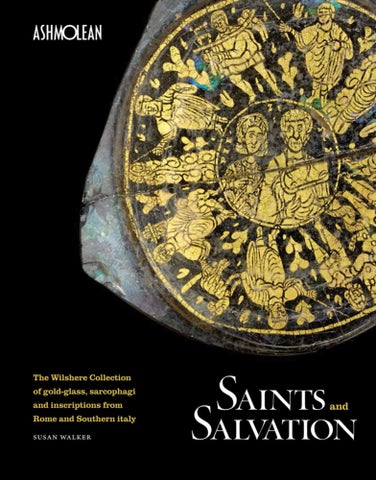
a shroud and rests against a rocky hill instead of his tomb – an iconography unique to the glasses and perhaps intended to balance the scene of Moses striking the rock.10 Next Christ heals the paralysed man, who stands up and carries his bed on his back (Matthew 9: 1–8; Mark 2: 3–5; Luke 5: 18–20) as he does on the glass in New York (Morey no.448). The final two scenes illustrate Old Testament events: Moses, whose appearance is identical to that of Christ, strikes water from the rock (Numbers 20: 8–22),11 and Abraham, about to sacrifice his son Isaac, hears God’s voice and sees the sacrificial ram (Genesis 22: 1–19).12 While the scenes are not laid out in a specific order, their selection and relationship to one another are significant, and serve to connect the Old and New Testaments through typology. Moses’ appearance as a prophetic, salvific figure prefigures the birth of Christ,13 as Isaac’s near-sacrifice prefigures his crucifixion,14 while Christ appears three times as magician (echoed by Moses-as-magician), creating a visual rhythm that drives the exegesis of the images. Based upon the use of manganese alone as a decolourant, the choice of iconography and the slight roughness of its style, this oval glass dish was probably made in the middle years of the fourth century. Its shape and potential size suggest that the dish may have been designed for serving fish, though there is no reference to fish in the iconography of the gold leaf. Endnotes
also widely known in funerary contexts, not least catacomb paintings (see further below).4 Written within the central medallion, the inscription addressed to a single individual exhorts the deceased to celebrate his or her future eternal life in heaven.5 Several other gold-glasses preserve similar iconographic programmes, including another Wilshere glass, cat.23, and glasses in the Cimitero di Panfilo in Rome (Morey no.224), the St Ursula plaque in the British Museum, very like cat.23 in composition (Morey no.347 = Howells 2015, no.17), the Petit Palais Collection Dutuit in Paris (Morey no.420) and the Metropolitan Museum of Art in New York (MMA inv. 16.174.2, Morey no.448, who reports that it was found in the catacomb of San Callisto). The Vatican and New York glasses are the closest in size to the Wilshere glass (respectively 10.5 cm and 10.2 cm in diameter). The New York glass is laid out in a similar fashion to the Wilshere glass and also features a married couple in the central medallion, although the Wilshere glass depicts more scenes. However, when combined with the bust portraits in the centre, the sequence of scenes on this glass not only represents scenes of salvation. It
132
Saints and Salvation
also replicates the miracles of deliverance invoked by the prayer used in the ritual for the committal of the deceased’s soul, the Commendatio animae.6 Scholars have previously noticed the general correlation between the prayer and early Christian artworks, including the gold-glasses, but have not specifically connected this group of glasses with Old and New Testament scenes to the text of the prayer.7 While the earliest textual evidence for the prayer does not appear to predate the fourth century, the Wilshere glass and related works must be taken as evidence for the use of a version of the prayer in practice in Rome in the fourth century. The glassess also offer proof of the prayer’s flexibility, presenting different combinations of scenes of salvation in a different order than in the Commendatio prayer. The biblical scenes around the edge are consistent with other early Christian narrative cycles in the catacombs, including catacomb paintings and sarcophagi,8 as well as on other gold-glasses. At the bottom of the glass Christ appears as a magician, redeeming Adam and Eve, whose sin of eating from the Tree of Knowledge is represented (Genesis 3).9 To the right, Christ resurrects Lazarus ( John 11); he is wrapped in
1. For a complete oval glass vessel from the Fayum, Egypt see above, Fig.2.3.8a: Corning Museum of Glass CMG 75.1.113. 2. For example Morey 1959: nos. 1, 7, 9, 39, 41, 43, 59, 91–4, 98–9, 113, 225, 259, 315–6, 337 etc. Wedding gifts: Painter in Harden 1987: 281, no.156, where Eros appears between a man and a woman. Howells 2015: 122–3, no.36 offers a cautious reading. 3. Cameron 1996: 298; Reinsburg 2006: 75–85 for the depiction of marriage on sarcophagi. See above, p.00. 4. Meredith 2015. 5. Ferrua 1974 discusses the formula. 6. See above, p.00. 7. For example Bisconti 1996, 92; Vanni 2003, 133. 8. For example the Sarcophagus of Adelphia. See above, chapter 5, fig.2.2.2. 9. Also on Morey 1959: nos. 47, 420. On Christ as magician see Mathews 1993: 54–91; Jefferson 2014. 10. For example Morey 1959: nos. 44, 108, 157, 260; also Partyka 1993, 69. 11. Also on another Wilshere glass, AN2007.35, and Morey nos. 142–3, 312, 421. 12. Also on Morey 1959: nos. 71, 349, 395, 436; generally see Smith 1922; Jensen, in Spier 2007: 78–83. 13. Matthews 1993: 54–91. 14. Tertullian, Adversus Iudaeos 10.6 and 13.20–2; Paulinus, Epistula 29. For other examples see Jensen in Spier 2007: 85 n.20.
Catalogue of Objects
Gold Glass ◆ Group 2 ◆ Decoloured with manganese only
The Wilshere Collection
133
a shroud and rests against a rocky hill instead of his tomb – an iconography unique to the glasses and perhaps intended to balance the scene of Moses striking the rock.10 Next Christ heals the paralysed man, who stands up and carries his bed on his back (Matthew 9: 1–8; Mark 2: 3–5; Luke 5: 18–20) as he does on the glass in New York (Morey no.448). The final two scenes illustrate Old Testament events: Moses, whose appearance is identical to that of Christ, strikes water from the rock (Numbers 20: 8–22),11 and Abraham, about to sacrifice his son Isaac, hears God’s voice and sees the sacrificial ram (Genesis 22: 1–19).12 While the scenes are not laid out in a specific order, their selection and relationship to one another are significant, and serve to connect the Old and New Testaments through typology. Moses’ appearance as a prophetic, salvific figure prefigures the birth of Christ,13 as Isaac’s near-sacrifice prefigures his crucifixion,14 while Christ appears three times as magician (echoed by Moses-as-magician), creating a visual rhythm that drives the exegesis of the images. Based upon the use of manganese alone as a decolourant, the choice of iconography and the slight roughness of its style, this oval glass dish was probably made in the middle years of the fourth century. Its shape and potential size suggest that the dish may have been designed for serving fish, though there is no reference to fish in the iconography of the gold leaf. Endnotes
also widely known in funerary contexts, not least catacomb paintings (see further below).4 Written within the central medallion, the inscription addressed to a single individual exhorts the deceased to celebrate his or her future eternal life in heaven.5 Several other gold-glasses preserve similar iconographic programmes, including another Wilshere glass, cat.23, and glasses in the Cimitero di Panfilo in Rome (Morey no.224), the St Ursula plaque in the British Museum, very like cat.23 in composition (Morey no.347 = Howells 2015, no.17), the Petit Palais Collection Dutuit in Paris (Morey no.420) and the Metropolitan Museum of Art in New York (MMA inv. 16.174.2, Morey no.448, who reports that it was found in the catacomb of San Callisto). The Vatican and New York glasses are the closest in size to the Wilshere glass (respectively 10.5 cm and 10.2 cm in diameter). The New York glass is laid out in a similar fashion to the Wilshere glass and also features a married couple in the central medallion, although the Wilshere glass depicts more scenes. However, when combined with the bust portraits in the centre, the sequence of scenes on this glass not only represents scenes of salvation. It
132
Saints and Salvation
also replicates the miracles of deliverance invoked by the prayer used in the ritual for the committal of the deceased’s soul, the Commendatio animae.6 Scholars have previously noticed the general correlation between the prayer and early Christian artworks, including the gold-glasses, but have not specifically connected this group of glasses with Old and New Testament scenes to the text of the prayer.7 While the earliest textual evidence for the prayer does not appear to predate the fourth century, the Wilshere glass and related works must be taken as evidence for the use of a version of the prayer in practice in Rome in the fourth century. The glassess also offer proof of the prayer’s flexibility, presenting different combinations of scenes of salvation in a different order than in the Commendatio prayer. The biblical scenes around the edge are consistent with other early Christian narrative cycles in the catacombs, including catacomb paintings and sarcophagi,8 as well as on other gold-glasses. At the bottom of the glass Christ appears as a magician, redeeming Adam and Eve, whose sin of eating from the Tree of Knowledge is represented (Genesis 3).9 To the right, Christ resurrects Lazarus ( John 11); he is wrapped in
1. For a complete oval glass vessel from the Fayum, Egypt see above, Fig.2.3.8a: Corning Museum of Glass CMG 75.1.113. 2. For example Morey 1959: nos. 1, 7, 9, 39, 41, 43, 59, 91–4, 98–9, 113, 225, 259, 315–6, 337 etc. Wedding gifts: Painter in Harden 1987: 281, no.156, where Eros appears between a man and a woman. Howells 2015: 122–3, no.36 offers a cautious reading. 3. Cameron 1996: 298; Reinsburg 2006: 75–85 for the depiction of marriage on sarcophagi. See above, p.00. 4. Meredith 2015. 5. Ferrua 1974 discusses the formula. 6. See above, p.00. 7. For example Bisconti 1996, 92; Vanni 2003, 133. 8. For example the Sarcophagus of Adelphia. See above, chapter 5, fig.2.2.2. 9. Also on Morey 1959: nos. 47, 420. On Christ as magician see Mathews 1993: 54–91; Jefferson 2014. 10. For example Morey 1959: nos. 44, 108, 157, 260; also Partyka 1993, 69. 11. Also on another Wilshere glass, AN2007.35, and Morey nos. 142–3, 312, 421. 12. Also on Morey 1959: nos. 71, 349, 395, 436; generally see Smith 1922; Jensen, in Spier 2007: 78–83. 13. Matthews 1993: 54–91. 14. Tertullian, Adversus Iudaeos 10.6 and 13.20–2; Paulinus, Epistula 29. For other examples see Jensen in Spier 2007: 85 n.20.
Catalogue of Objects
Gold Glass ◆ Group 2 ◆ Decoloured with manganese only
The Wilshere Collection
133