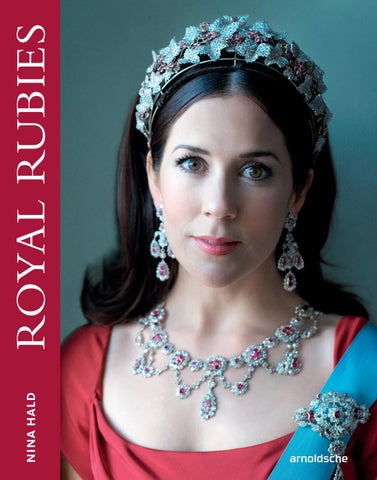
Learn more about the crimson-red gemstones that for millennia have been considered the most precious symbol of riches and love. Accompany us on an unforgettable journey into the center of the earth, where the rubies came into being millions of years ago. And learn what distinguishes rubies, sapphires, and spinels. Richly illustrated with gorgeous images of some of the world’s most beautiful gemstones.
ISBN 978-3-89790-518-4
ISBN 978-3-89790-518-4
9 783897 905184
ROYAL RUBIES
Today, the ruby set is worn at the grandest parties, so naturally the readers of the book are also invited to attend royal balls at the most festively decorated palaces.
NINA HALD
Follow us back in time, back to when the ruby set was made. Meet the royal ladies who have worn the set – and learn more of how the jewelry has been inherited from generation to generation in the royal families of Sweden and Denmark.
ROYAL RUBIES
Over the past few years, the royal ruby set as worn by Her Royal Highness Crown Princess Mary of Denmark has been restored and changed by Dulong Fine Jewelry. This book gives a closer look at the set. We get to peek over the shoulders of the goldsmiths as they have gently restored and changed it. In poetic and evocative images, the tales of goldsmiths’ traditions are told – a history which is also very much a part of the redesign of the jewelry – and hitherto unknown pieces from the set are discovered.
NINA HALD
A lady in red, on her way into the Royal Theatre under a heart-shaped wreath of red roses – wearing a 200-year-old royal ruby set, glittering in the evening sun. The stage is set – let the fairy tale begin.
i.
romance
ii.
transforming the royal ruby set – the work of the atelier
14
iii.
reminiscing – the history of the royal ruby set
66
iv.
rarities – rubies
88
v.
red – the cultural history of a color
104
vi.
queen of jewelry – jewelry for queens
120
vii.
rituals and regulations
132
viii. reshaping and refining the hair jewels
8
152
ix.
rendezvous with the rubies – a ring and a reprise
164
x.
dulong fine jewelry
172
xi.
literature
176
5
8
Photo: Steen Evald
I | Romance
i
Vanity turned into beauty, transformed into power. A woman in red, queen of hearts, on her way in to the Royal Theatre in Copenhagen, Denmark, wearing a 200-year-old ruby set under a flower wreath, made up of red roses, shaped as two intertwined hearts. The stage is set. Let the fairy tale begin. Splendor, elegance, and dreams – that is what defines the jewelry of a princess. The enjoyment, fascination, and enchantment that reside in gem-set jewels make us all dream of the life she is living. To admire the Crown Princess in her finery is also to live by proxy, to imagine how it would be if invited to a grand ball at the palace. The rare, the precious, and the beautiful are inextricably linked with a life of privilege. We do not
merely remember with our heads, but also with our hearts – and these are the reasons why the royal ruby set with its red and white colors are firmly imprinted on the collective Danish consciousness. Power, charisma, and loveliness are the three factors bound together in royal jewelry – a magical mixture of royal ornaments and decorations, dignity and refinement. Glittering beauty The rare and the precious remind us that another world exists – and this is why we develop a taste for the extraordinary and fantastic; it satisfies our longing for beauty. The fascination of gemstones, found in the darkest depths of the earth, yet glittering in the light of the sun, is several millennia old. Cutting techniques
9
The tiara of the ruby set before the alteration process began. Photo: Sara LindbĂŚk
14
I I | Transforming the royal ruby set – the work of the atelier
ii
–
Since royal jewelry is in continuous use, it is destined to be continuously changed – it is simply the fate of royal jewelry. The historic ruby set, today worn by Crown Princess Mary, saw the light of day in its first incarnation more than 200 years ago. In the 21st century, the set has been given new life and possibilities by Dulong Fine Jewelry. Here, the goldsmiths have gently restored and modernized the set, so it now also features new functional and flexible possibilities. The original look of the ruby set has been preserved, with great respect for its past idiom and appearance, but in a more wearable form for Crown Princess Mary. Though it may not cross the minds of many, jewelry – just like clothing – needs to fit the individual woman
properly. In addition to this, new pieces of jewelry have been added to the set. As objects, pieces of jewelry are marked by one limitation: they are worn on the body. That is why they need to fit the curves and contours of a body; the jewelry has to move with the body as the reification of emotional symbols. It requires a goldsmith with an in-depth understanding of his or her métier to give physical form to that kind of jewelry, because fundamentally some of the world’s hardest raw materials – diamond, rubies, and gold – are worked upon so they may appear soft and even floating. Technical challenges must be met together with aesthetic ones.
15
The necklace of the ruby set on the goldsmith’s work table. Photo: Sara Lindbæk
16
I I | Transforming the royal ruby set – the work of the atelier
The earrings of the ruby set after the alteration and adaption process – the ear-studs with a pair of the new pendants, here golden South Sea cultured pearls. Photo: Sara Lindbæk
Jewelry beautifies, decorates, and contains symbolic significance, because when worn at official events, jewels are signs – which is why the wearing and placing of them must be carefully considered. Necklaces are perhaps under the most restrictions, since no neck or set of shoulders are alike. Because necklaces are worn on the skin and because they need to move with the body, it is of paramount importance that they have a certain physical flexibility. That is also what defines the quality of the execution of a piece of jewelry. Earrings are another example; it is a question of matching the visual with the anatomical: a great deal depends on where the earlobe is pierced, and on the shape of the face and the jaw line, because only by taking these elements into consideration will the optimal effect be gained by the wearing of jewelry. The brooch is perhaps the easiest category, since it “just” fastens onto clothes. Queen Margrethe is known for experimenting with the arrangement of the jewelry Her Majesty wears, and in those footsteps the Crown Princess follows. Her Royal Highness has decided to go all-out with the ruby
set by having new pendant opportunities added to the jewelry – this for example allows for the necklace to be worn in a smaller version, or moonstone pendants to be added to the earrings. In addition, new combination possibilities have been added to the necklace, earrings, and brooch – South Sea,Tahiti, and freshwater cultured pearls, as pendants on the respective pieces of jewelry. In this chapter, we literally follow the main thread of change – the (metal) thread of the tiara – because it was this that started the alteration process of the set in the first place. The events Jewelry tells stories. If the gemstones are the voices, the design and the goldsmith craft are the characters and the drama. With royal jewelry, the gemstones and the design are usually on an equal footing. As in all stories, a narrative harmony is built up between the size and colors of the gemstones and the design, which is also displayed by metal settings. Settings play an important part in the overall design of jewelry because the gold and silver bring life to the gemstones of the ruby set.
17
The velour ribbon is gently removed from the frame by the goldsmith before work at high temperatures is begun. Photo: Sara LindbĂŚk
The restoration of the tiara began with a thorough examination during which all the parts were cleaned and polished. The velour ribbon was taken off the frame; then the 13 leaves and the 55 berries were de-soldered or otherwise dismantled. At this stage of the process, the goldsmith would constantly compare the ruby tiara with a prototype of the final form of the tiara. It may only take less than five seconds to de-solder a leaf, but it takes a long time, full concentration, and longterm preparation to decide which leaf to begin with; many options are constantly weighed during an alteration process. The basic shape was constantly taken into account, since there existed no regular system for the
28
I I | Transforming the royal ruby set – the work of the atelier
original placement of the leaves and berries. Dulong Fine Jewelry continuously tried to preserve and improve the intuitive balance and harmony of the tiara as it originally came into the atelier. This meant that every stage of the process was repeatedly considered and deliberated upon in the light of what was to come several steps ahead, so that all options were carefully considered before any new work was done on the piece. The tiara was shortened by 5 cm on each side, which involved the disassembling of a total of 13 leaves and 55 berries. The largest visual change was the removal of the upper middle leaf with the support thread at the back. At this point, the design work for the goldsmith began, with
Leaves and berries were de-soldered from the tiara; great concentration is required to carry out the planned work. The circumference of the tiara was reduced, and a new harmony of proportions had to be created in the sequence of leaves and berries. Photos: Sara LindbĂŚk
29
The goldsmith’s sketches for the work on the earrings. The three-part separation of the earrings is carried out in accordance with their original idiom so as to make the pendant system as invisible as possible.
46
I I | Transforming the royal ruby set – the work of the atelier
The top rosette of the earring has been detached. Photo: Sara LindbĂŚk
number of contexts and events. Multifunctional jewelry, for example a pair of detachable pendants for a pair of earrings, is an innovation from the 18th century. When the earrings of the ruby set were delivered to the workshop of Dulong Fine Jewelry, they were registered as ear-clips with omega back and lobe support, with a hook on a chain intended to go around the back of the ear. First, the chains and hooks were dismantled. The stud part was then laser-welded onto a clip system. Laser-welding was employed so the work could
be done in isolation and carefully alongside the existing soldering and gemstones on the jewelry. Then, the lower two-thirds of the earrings were dismantled so they can be worn as desired. On the back of the ear-clip, a pendant system developed by Dulong Fine Jewelry was mounted. This allowed pendants to be attached directly onto the uppermost rosette. The rosette can also be worn alone, as an ear-stud. Finally, the middle and the bottom thirds of the earrings were taken apart, and yet another pendant
47
Queen Ingrid (1910-2000) and King Frederik 9. of Denmark (1899-1972). Photo: Rigmor Mydtskov
66
III | Reminiscing – the history of the royal ruby set
iii
–
As royal jewels, the ruby set is both important and valuable. The pieces function on several levels: the individual, the social, the cultural, and the nationalhistorical. On their own terms, royal jewels are an expression of the aesthetic tastes and fashions of the time they were made. As costly jewelry, they are part of the national history of a country because they are worn at significant events by important women. Family jewels have adorned brides on their wedding days but have also been bequeathed to princes if there were no female heirs. Impressive jewelry was (and is) conspicuous proof of royal dignity, the legitimacy of the family, and royal splendor in general. The jewelry is worn at the greatest
state dinners, galas, family events, and state visits. The jewelry reflects royal destinies throughout the centuries, and the jewels are often associated with highlights in the history of the royal families. Power, influence, and lineage can be documented in the history of the jewelry; the family pieces are inherited heirlooms and evidence of private gifts of love and public recognition. They mirror important events, triumphs, and romantic love. The jewelry is a way to keep a connection with past generations alive. The jewels, just like the personalities who wore them, are a part of history and proof of riches, rank, and fashion. As such, the jewelry accumulates its own history and, as a direct consequence, precious jewelry may also bestow status on the wearer. And that is why a crown princess of the 21st century
67
inheritance Queen Désirée of Sweden (1777-1860)
(1879-1952) when she married Crown
King Frederik 9.) on May 24, 1935.
left the ruby set to her daughter-in-
Prince Christian (1870-1947 – later
Dowager queen Ingrid gave the set
law, dowager queen Josefina (1807-
King Christian X) on April 26, 1898.
to Crown Prince Frederik (born 1968)
1876). Josefina bequeathed it to the
Queen Alexandrine later inherited
in a deed of gift, and Crown Princess
daughter of her son, Princess Lovisa of
the rest of the set after her mother-
Mary (born 1972) has periodically worn
Sweden, who married the Danish King
in-law’s death. The jewels were then
the ruby set since her marriage to
Frederik 8. (1843-1912) on July 28, 1869.
given to Princess Ingrid of Sweden
the Crown Prince on May 14, 2004.
The couple gave the diadem to their
(1910-2000) when she married Crown
daughter-in-law, Princess Alexandrine
Prince Frederik (1899-1972 – later
Photo: Sara Lindbæk
Jean-Baptiste Bernadotte (1763-1844)
Queen Désirée of Sweden (1777-1860)
King Oscar 1. of Sweden (1799-1859)
Queen Consort Joséphine (1807-1876) – originally of Leuchtenberg
King Charles 15. of Sweden and Norway (1826-1872)
King Frederik 8. of Denmark* (1843-1912)
Queen Consort Lovisa (1828-1871) – originally of the Netherlands
Queen Lovisa (1851-1926) – originally of Sweden
King Christian X of Denmark (1870-1947)
Queen Alexandrine (1879-1952) – originally of Mecklenburg-Schwerin
King Frederik 9. of Denmark (1899-1972)
Queen Ingrid (1910-2000) – originally of Sweden
Queen Margrethe 2. of Denmark (born 1940)
Prince Henrik (born 1934)
Crown Prince Frederik (born 1968) * Most Danish kings have chosen to use
Arabic numerals – not Roman ones.
76
III | Reminiscing – the history of the royal ruby set
Crown Princess Mary (born 1972)
The Bernadotte family: Désirée, Jean Baptiste, their son Oscar (Napoleon’s godson) and his wife Joséphine of Leuchtenberg (grandchild of Empress Joséphine). F. Westin: Bernadottska familjetavlan. Photo: Erik Cornelius/Nationalmuseum, Stockholm
Josefina, Princess Lovisa (1851-1926), married the Danish Crown Prince Frederik (1843-1912; later King Frederik 8.). During the wedding festivities, dowager queen Josefina decided to give the ruby set to Lovisa as her wedding gift. Dowager queen Josefina wrote “The Danish colors for Lovisa” in her last will and testament. The ruby set was given from grandmother to granddaughter seven years prior to dowager queen Josefina’s death. In 1898, the Danish Prince Christian (1870-1947; later King Christian X), the son of Crown Princess Lovisa and Crown Prince Frederik, married Duchess Alexandrine of Mecklenburg-Schwerin (1879-1952). Crown Princess Lovisa had a diadem made from some of the brooches of the ruby set for her son’s wedding; this diadem was then given to Princess Alexandrine as a wedding present, and it was described in newspapers as having been seen on the gift tables laid out for public viewings. Of course, it was of great importance that a
bride was given jewelry, both as part of her wedding trousseau from home, but also by her in-laws as a welcome, a sign of appreciation, and a helping hand, since they knew what would be expected in the new busy social life of Princess Alexandrine. However, most of the ruby jewels – the necklace, earrings, and brooches – Crown Princess Lovisa chose to keep for herself. As queen, Alexandrine would wear the diadem as a headband; the rest, King Christian as son inherited after the death of his mother, Queen Lovisa, in 1926. As queen, Alexandrine did not seem particularly enthusiastic about jewelry; it is a fair assumption to make that she did not alter her jewelry as much as other Danish queens did. In 1935, the Swedish Princess Ingrid (1910-2000), great-great-great-granddaughter of Queen Désirée, received the ruby set as a wedding present from her in-laws, King Christian X and Queen Alexandrine, upon Ingrid’s marriage to Crown Prince Frederik
77
Dress made of mint-colored silk, designed by Ole Yde, Yde Copenhagen, and worn for Prince Joachim’s and Princess Marie’s wedding in 2008. The two-piece dress is meant for grander occasions because it has been composed around a corsage that is suitable for wearing orders. Draped corsage top with butterfly sleeves and a skirt with flounces. The wearing of the ruby set – the tiara, the brooch, the earrings without pendants, and the bangle – with a pastel-colored dress demonstrates that rubies work well with all dress colors. Photo: Jens Dige, Polfoto
134 VII | Rituals and regulations
Boss cocktail dress, knee-length, silk stretch. 2004. The ruby set brooch is placed high, on the Empire waistline, because the draping of the dress favored this position. By Queen Ingrid’s time, the pendant of the brooch could already be detached if desired. A brooch usually completes a jewelry set – but the brooch of the ruby set is so beautiful that the Crown Princess has chosen to wear it by itself for some occasions. Vogue Australia Cover, December 2004
pieces of jewelry may look in a glass display case, their aesthetic language does not really come alive until they are worn and seen in context with dresses. For that very reason, jewelry holds far greater importance than other art genres, since for example a painting “only” hangs on a wall. A piece of jewelry demands a woman’s personal stance, even a kind of commitment, as it is worn on her body; as artistic decorative objects, jewels are always both complex and demanding.
aspects must play a part in the design of a dress. Several centuries ago, the relatively heavy brooches were sewn directly onto the clothes; today, the brooches will usually have been fitted with pins on their backs. Because necklaces and brooches are worn on the front of a woman’s body, they attract the eyes of spectators first. But brooches do not necessarily have to be worn in front; Crown Princess Mary has also worn brooches in her hair, on the side of her dress, and at her waistline.
Dresses are designed specifically for the largest pieces of jewelry. A necklace may determine the neckline of a dress, and the pins of brooches and orders may require reinforcement where the pins pierce the fabric – all
Finally, Her Royal Highness has brought back a tradition dating from the 1620-1630s by wearing a large corsage ornament on the middle of her bodice, as seen on the cover of Australian Vogue.
135
The goldsmith is adjusting the placement of the ruby redcurrant clusters, experimenting with different options. Photo: Sara LindbĂŚk
162 VIII | Reshaping and refining the hair jewels
The ruby set as it looks today, after the second alteration process, which Dulong Fine Jewelry completed in 2017. Photo: Sara LindbĂŚk
163
Halo ring made of 18 karat white gold set with 17 brilliantcut diamonds. The diamond in the center weighs 0.80 carat; the two diamonds on the sides each weigh 0.40 carat. The 14 minor diamonds weigh a total of 0.14 carat. Photo: Steen Evald
172 X | Dulong Fine Jewelry
x
Since 2005, the Danish company Dulong Fine Jewelry has created collections of jewelry using only the finest materials. The company was founded as a unique partnership between jewelry artist Marianne Dulong and renowned stylist Anja Camilla Alajdi. Today, the company is considered to be amongst the most exclusive jewelry companies in Denmark, focusing on outstanding goldsmith craftsmanship and luxurious creations. Anja Camilla Alajdi and Marianne Dulong share a passion for contemporary jewelry design. From the very beginning, their vision has been to create jewelry
for independent, quality-conscious women interested in fashion. Dulong Fine Jewelry is sold through flagship stores in the Danish capital, Copenhagen, and the city of Lyngby, Denmark, as well as at select retailers throughout Scandinavia; the goldsmith atelier is located north of Copenhagen. All Dulong Fine Jewelry pieces complement each other across the collections. Distinctive fit and the way a piece of jewelry becomes the individual wearer are of importance for the two designers, and for those reasons,
173