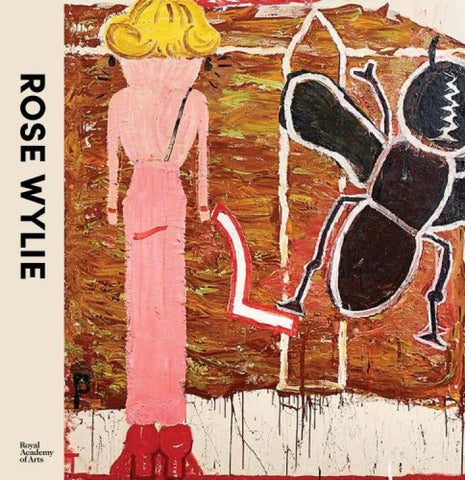
First published on the occasion of the exhibition ‘Rose Wylie: The Picture Comes First’ Royal Academy of Arts, London 28 February – 19 April 2026
Contents
Supported by
David Zwirner
With additional support from Christian Levett and Musée FAMM Jake and Hélène Marie Shafran and The Magic Trust
This exhibition has been made possible by the provision of Government Indemnity. The Royal Academy of Arts would like to thank HM Government for providing Government Indemnity and the Department for Culture, Media and Sport and Arts Council England for arranging the indemnity.
DIRECTOR OF E XHIBITIONS
Andrea Tarsia
E XHIBITION CUR ATORS
Katharine Stout Tarini Malik with Colm Guo-lin Peare
E XHIBITION ORG ANISATION
Guy Carr with Rourke Bonar
All works by Rose Wylie OBE RA copyright © the artist, 2026 Copyright © 2026 Royal Academy of Arts
EDITORIAL NOTE
Any copy of this book issued by the publisher is sold subject to the condition that it shall not by way of trade or otherwise be lent, re-sold, hired out or otherwise circulated without the publisher’s prior consent in any form of binding or cover other than that in which it is published and without a similar condition including these words being imposed on a subsequent purchaser.
Dimensions of all works of art are given in centimetres, height before width.
All Rights Reserved. No part of this publication may be reproduced or transmitted in any form or by any means, electronic or mechanical, including photocopy, recording or any other information storage and retrieval system, without prior permission in writing from the publisher. Royal Academy of Arts, Burlington House Piccadilly, London W1J 0BD www.royalacademy.org.uk
PHOTOGR APHIC AND COPYRIGHT CO - ORDINATION
EU Authorised Representative EAS Europe, Mustamäe tee 50, 10621 Tallinn, Estonia: gpsr.requests@easproject.com
E XHIBITION CATALOGUE
British Library Cataloguing-in-Publication Data. A catalogue record for this book is available from the British Library
Giulia Ariete
Royal Academy Publications Florence Dassonville, Production and Distribution Co-ordinator Carola Krueger, Production and Distribution Manager Peter Sawbridge, Head of Publishing and Editorial Director Copy-editing and proofreading: Susannah Lawson Design: Kathrin Jacobsen Colour origination and printing: Gomer Press, Wales
RA Rose Wylie_prelims 04.indd 4
All works illustrated are by Rose Wylie unless otherwise stated.
Quote from W. H. Auden, ‘Musée des Beaux Arts’, p. 23, copyright © 1939 by The Estate of W. H. Auden. Reprinted by permission of Curtis Brown, Ltd. All rights reserved. ‘Musée des Beaux Arts’, copyright 1939, 1940 and © renewed 1968 by W. H. Auden; from Collected Poems by W. H. Auden, edited by Edward Mendelson. Used by permission of Random House, an imprint and division of Penguin Random House LLC. All rights reserved.
President’s Foreword Acknowledgements
8
The Picture Comes First
11
7
K ATHARINE STOUT
Various Instances: Rose Wylie’s Relationship with Time
23
JENNIFER HIGGIE
‘Just Look at the Work!’
ILLUSTR ATIONS
On the cover: detail of cat. 61 Pages 2–3: detail of cat. 2 Page 6: detail of cat. 83 Page 9: detail of cat. 30 Pages 38–39: detail of cat. 1 Pages 46–47: detail of cat. 6 Pages 70–71: detail of cat. 24 Pages 94–95: detail of cat. 57 Pages 106–07: detail of cat. 67 Pages 126–27: detail of cat. 79 Pages 140–41: detail of cat. 82
31
FR ANCES MORRIS
Catalogue Plates
39
WITH S ECTION INTRODUCTIONS BY K ATHARINE STOUT
Endnotes Further Reading Lenders to the Exhibition Photographic Acknowledgements Index
ISBN 978-1-915815-22-4 ISBN 978-1-915815-31-6 (special edition) Distributed outside the US and Canada by ACC Art Books Ltd, Riverside House, Dock Lane, Melton, Woodbridge, IP12 1PE
152 153 154 155 156
Distributed in the US and Canada by ACC Art Books, 6 West 18th Street, Suite 4B, New York, NY 10011
09/12/2025 15:58
RA Rose Wylie_prelims 04.indd 5
09/12/2025 15:58
11
The Picture Comes First katharine stout
Early memories
FIG. 1 Detail of Park Dogs & Air Raid, 2017 (cat. 2). Oil on canvas, 393 × 331 cm (overall). Private collection
RA Rose Wylie_02_Katharine Stout essay 04.indd 10
09/12/2025 15:59
RA Rose Wylie_02_Katharine Stout essay 04.indd 11
In a world saturated with a fleeting array of images, Rose Wylie’s paintings have a singular ability to make you stop and enjoy the act of looking slowly and deeply. As we focus our gaze, a contrasting colour juxtaposition or use of bold outline draws attention to a particular detail; a motif out of scale with the other elements creates visual intrigue; painted words introduce a lateral reference. Wylie’s figurative pictures reveal the evidence of their own making with impasto areas of paint scraped back or accidental blobs and exposed areas of canvas left in situ, reminding us that the work is not in the servitude of representation, but exists as a formal picture plane that is an end in itself. Wylie’s works possess the ‘essential quality of being present’, an attribute of ‘The Painter of Modern Life’ assigned by Charles Baudelaire in his essay of 1860, reimagined for the twenty-first century.1 The artist’s memories offer a rich databank for her paintings, allowing Wylie to extract ideas from different time zones, often years later, and re-present them within a new context and in the here and now. These might recollect an artwork by a favourite painter from art history or an ancient civilisation; an arresting shot seen in a film; or an incident from her own life. She usually records these first in a drawing. The process of turning specific memories into paintings makes concrete something intangible and very personal. Often, they are retrieved through repetition in both drawings and paintings and are therefore secure in Wylie’s long-term memory, to be retained and accessed at will, as opposed to our more transitory working memories. In selecting these memories, Wylie comments, ‘I think it’s sifting. I sift. I go through it and think I remember certain things. It is the things I remember that I’m interested in. The memory may not be accurate but if I have a fond memory of something, the work I make gives me a chance to relate the work to the memory.’ 2 Wylie’s earliest childhood memories are of German bombers targeting different parts of London during the Second World War, including areas close to where she was living in Bayswater. The painting Park Dogs & Air Raid (2017; fig. 1 and cat. 2) reveals not only this specific memory, but also a childlike perspective and something of the excitement of this time. Children notice the small things and often have a skewed sense of scale and viewpoint, designating the size and order of things according to
09/12/2025 15:59
31
‘Just Look at the Work!’ rose wylie in conversation with frances morris
FM Rose (fig. 14), as an art historian schooled in the 1970s and 1980s, I was encouraged to remain at a distance from an artist’s biography. But so much of your work deals with your personal experiences, particularly your early life, that it feels difficult to remain at that remove. RW Well, I’ve always thought that it’s quite useful to remove yourself from the life of the artist: just look at the work! That’s not a very current way of thinking, because everyone likes to look at the context, which is hugely interesting and does give you all sorts of insights, but it’s not the final thing. FM Even so, as you’ve opened the door… in previous interviews you’ve described your childhood as Victorian. What did you mean by that? RW Well, I was the last child of parents who lived in the nineteenth century. My father was born in 1880-something, and my mother five or six years later. They were Victorians. My father worked in India, so they were in a sense colonial, but they weren’t the colonial type. FM And were you brought up with a set of Victorian values? RW Yes, moral, you know: ‘Don’t push yourself forward, be modest.’ A woman should be wellmannered; she should know how to be a proper wife. That’s what I meant by Victorian: ‘Don’t adorn yourself, you shouldn’t be wearing lipstick.’
FIG. 14 Juergen Teller, Rose Wylie, No. 19, Autre magazine, Sittingbourne, 2024
RA Rose Wylie_04_Frances Morris interview 06.indd 30
10/12/2025 14:58
RA Rose Wylie_04_Frances Morris interview 06.indd 31
Hence your love of lipstick? Do the thing you’re told not to. FM At the heart of this exhibition is a series of paintings from the 1990s – almost the earliest here – that leads us yet further back, to the 1940s, in the form of pictorial memories of your earliest childhood. How did the relatively privileged youngest child of the Head of Ordnance for the whole of India end up experiencing the Blitz from under a table-top shelter in central London? RW My brothers were at school in England, but my sisters were at school in France before the war. That’s why my mother left India, to collect them from Europe, because of the danger of invasion. My parents had a holiday house in England, in Hythe, the nearest coast to where Germany was going to invade. So my mother moved us to London, to Bayswater, where we stayed with my greataunt. That’s where the bombs fell. My mother had gone from the risk of invasion right into the heart of the Blitz. FM Why weren’t you evacuated? RW She didn’t believe in it. She was quite tough. She thought children needed to be with their mothers at a certain formative time and that was important. We had a Morrison shelter, we slept under the stairs. FM Was it exciting? FM
RW
09/12/2025 15:57
47
‘Transformation, synthesis and specific’ ‘Wylie uses the words “transformation, synthesis and specific” to describe how she arrives at an image; she explains, “A painting is not finally what it does, or what it makes, or what it has, or what it means… it is. The painting is the meaning.”’ 2
The starting point for Rose Wylie’s paintings can come from a myriad of sources: a memory; an observed person; flora or fauna; an image encountered in print, on the internet or in a film; a favourite work from art history; or an artefact from a distant, ancient civilisation. This imagery is usually first captured in a drawing, Wylie’s daily practice of making pictorial records of an event, an encounter or an idea. Later, sometimes years later, a specific visual motif will find its way into a painting, often juxtaposed with a seemingly incongruous graphic companion or words. Through the careful process of rendering them in paint, Wylie takes these images beyond merely capturing a likeness and instead creates an arresting, original picture. RW & Bird (1996; cat. 11) and RW Party Clothes (Rose Wylie) (2016; cat. 10), painted twenty years apart, offer diverse self-portraits of the artist. In the first, the artist is reduced to a simple outline, including her 1950s-style bullet bra whose shape mirrors the beaks of the birds looming over her. In the later work, the dress’s padded shoulders emphasise another fashion style. For Wylie, it is the particularities of images that matter the most.
RA Rose Wylie_plate section_08.indd 46
09/12/2025 16:01
RA Rose Wylie_plate section_08.indd 47
09/12/2025 16:01
57
Room Project
As a young woman at Folkestone and Dover School of Art in the 1950s, Wylie studied anatomical drawing and figurative painting at a time when British neo-romantic painters dominated, and artists such as Picasso or Léger were an admired but distant avant-garde. Following a career break to raise three children, from the mid-1980s Wylie devoted herself to painting again, establishing a studio in her Kent house where she still works today. Room Project (2002–03; cats 14–17) reveals Wylie’s voracious ambition to create large paintings that present their own playful world, here populated by cats, paper dolls, Olympic swimmers and the artist wearing a favourite checked skirt. The year after their creation, these four paintings were selected for East International at Norwich Gallery, where they received significant attention from the art world.
RA Rose Wylie_plate section_08.indd 56
09/12/2025 16:01
RA Rose Wylie_plate section_08.indd 57
09/12/2025 16:01
76
77
27 Hazelnut Leaf, 2017 Watercolour on paper, 84 × 59.5 cm Courtesy the artist and David Zwirner
RA Rose Wylie_plate section_08.indd 76
09/12/2025 16:02
28
29
German Botanical Drawing, 2016 Coloured pencil on paper, 29.7 × 21 cm Courtesy the artist and David Zwirner
In a Cowslip’s Bell with Music, 2020 Graphite, coloured pencil and collage on paper, 29.7 × 21 cm Courtesy the artist and David Zwirner
RA Rose Wylie_plate section_08.indd 77
09/12/2025 16:02
93
50
49
Doesn’t Do You Justice, 2020 Graphite on paper, 30.3 × 21.5 cm Courtesy the artist and David Zwirner
Roy Oxlade, 2014 Etching, ink and collage on paper, 82 × 64 cm Courtesy the artist and David Zwirner
RA Rose Wylie_plate section_08.indd 92
09/12/2025 16:02
RA Rose Wylie_plate section_08.indd 93
51 Fluffy Head with Extra Arm, 2020 Graphite, coloured pencil and collage on paper, 29.7 × 21 cm Courtesy the artist and David Zwirner
10/12/2025 15:49
115
66 Snowwhite (3) with Duster, 2018 Oil on canvas, 183.5 × 320 cm (overall) Private collection
RA Rose Wylie_plate section_08.indd 114
10/12/2025 16:06
RA Rose Wylie_plate section_08.indd 115
10/12/2025 16:06
115
66 Snowwhite (3) with Duster, 2018 Oil on canvas, 183.5 × 320 cm (overall) Private collection
RA Rose Wylie_plate section_08.indd 114
10/12/2025 16:06
RA Rose Wylie_plate section_08.indd 115
10/12/2025 16:06
141
The Process Makes the Image ‘The strength that her figurative paintings can carry is not simply reduced to the physicality of gestural expression – they are metaphysically powerful too.’ 7
When making this series of four monochromatic paintings of animals in ginger, black, blue and red, Wylie abandoned the paint brush and painted directly with her hands, letting the process of manipulating her medium determine the image. Looming large at five metres wide each, the forms are reduced to the simplest means possible while still allowing the shapes to be recognisably a spider, a horse or an elephant. Unconcerned with representing the physical reality of a living animal, these paintings hover on the edge of figuration and abstraction, with the painted words just tipping each image into an identifiable picture. The thickly applied and occasionally smudged paint imbues these monumental works with a visceral, tactile presence that reflects the energy and enjoyment of their making. Frick (2025; cat. 85) was inspired by a drawing Wylie made of a light-blue chinoiserie ceiling at the Frick Collection in New York: the wash of luminescent paint evokes a gush of water, or of looking down on legs gently parted. She then painted a second version (the left-hand canvas), adding details from the ceiling. As with the earlier series, the process of painting had determined the image.
RA Rose Wylie_plate section_08.indd 140
09/12/2025 16:04
RA Rose Wylie_plate section_08.indd 141
09/12/2025 16:04
RA Rose Wylie_06_Endmatter 04.indd 160
09/12/2025 16:09