2
Robots pp1-9 Prelims Q6_SF.indd 2
02/09/16 17:26
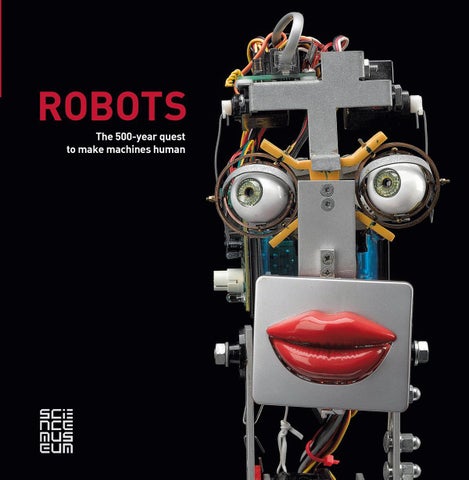
ROBOTS The 500-year quest to make machines human
Edited by Ben Russell with contributions from Owen Holland and Phil Husbands Phil Loring and Helena Moosberg-Bustness Andrew Nahum Andrina Richards Lever and Deborah Richards E R Truitt Judy Wajcman
Robots pp1-9 Prelims Q6_SF.indd 3
02/09/16 17:26
Robots pp1-9 Prelims Q6_SF.indd 6
02/09/16 17:26
Foreword VISITORS to the Science Museum are fascinated by robots.
but not completely machine. They are deeply rational,
Online, in the newspapers, at the cinema and on the TV,
but also have markedly magical qualities. What has
robots suffuse our popular culture as never before. The
happened with them in fact has often already been
Science Museum has mounted a series of short robot
explored in fiction. It is these qualities that make robots
festivals, in 2011 and 2013, and now is a timely moment
such an intriguing and uncanny subject for us.
for us to revisit this most beguiling of subjects. In 2013, I travelled to Japan and experienced at first
In considering this rich robotic landscape, we have to move beyond just presenting science and technology
hand the progress being made there in the fields of service
per se. Robots, perhaps more than any other technology,
and humanoid robotics. Now, popular expectations have
are deeply embedded in our cultural imagination. In this
never been higher, and robots appear to be on the cusp of
book we treat science as culture: we contemplate issues
escaping from the factory or laboratory, and entering our
of faith and imagination, spectacle and showmanship,
wider human world. The future is coming, and the Science
that are as relevant today as they have been historically.
Museum is uniquely well placed to present it. But, in
The Science Museum is dedicated to helping our
addition to conveying to visitors the scope of contemporary
visitors engage with and be inspired by the amazing
developments in robotics, here is also an opportunity to
science and technology that underpin our lives. Robots
explore a longer, more involved story. We are in a superb
are one of the most popular subjects that we could seek
position to take a historic view of robots, and in so doing
to interpret. I would like to extend my thanks to the
draw upon the abundant array of surviving artefacts,
many partner institutions, companies, organisations and
encompassing the robots imagined by sci-fi, the androids
individuals who have helped to make Robots possible.
of the enlightened 18th century and even earlier automata that were expressions of religious faith. These astonishing objects challenge our preconceptions of what a robot is, and delight us with their sense of spectacle, character and visual power. For me, one of the most interesting aspects of robots is their ‘liminal’ nature: that is, they exist in the grey area
Ian Blatchford
between different extremes. They are not quite human,
Director and Chief Executive of the Science Museum
7
Robots pp1-9 Prelims Q6_SF.indd 7
02/09/16 17:26
Robots pp1-9 Prelims Q6_SF.indd 8
02/09/16 17:26
Robots pp1-9 Prelims Q6_SF.indd 9
02/09/16 17:26
Robots pp10-115 Essays Q6_SF.indd 70
02/09/16 18:01
4 Robots in the family: Captain W H Richards and his mechanical men Andrina Richards Lever and Deborah Richards
THIS chapter explores the story of Captain W H Richards and his robots: Eric, made in 1928, and George, built in 1932. For a long time the story of this trio has been lost, and even now it survives only in fragmentary form. However, we two cousins, Deborah in the UK and Andrina in Italy, have grown up with a keen awareness of our shared family history, one that is to a large extent unique: Eric and George were among a handful of the very earliest robots, as understood in the modern popular imagination, to be built in the 20th century. Their story is an intriguing one, taking in not just technological innovation and a rich family story, but another enduring feature of the history of robots: their role as performers and objects of spectacle. In this 1928 image, Alan Reffell adjusts Eric’s knee, while in the background W H Richards works on some other components at his work bench.
OPPOSITE
Captain W H Richards as portrayed in the family archives, c.1914. His military career began in the army with the Devonshire Territorial Regiment, where he was known to be a fine marksman.
RIGHT
Robots pp10-115 Essays Q6_SF.indd 71
71
02/09/16 18:01
arms before sitting down again. In January 1932 they
George’s appearance differed from that of Eric: instead of
went from Paris to Berlin. There, in the Wintergarten,
the rather angular appearance of his predecessor, George
George shook hands with Hermann Göring and Joachim
was more carefully moulded and lifelike, with a well-
von Ribbentrop, ministers in the Nazi government of
rounded physique down to the details of muscles in his
Germany. George later appeared at Le Théâtre à Dix
chest and torso, and an aristocratic nose. To look after this
Heures in Brussels and went on to Munich, Hamburg,
robotic character, WE was offered the option of either a
Leipzig and Hamburg again before being shipped back to
percentage of the takings from the shows plus expenses,
London on the Auk. After a rest, WH, WE and George set
or a fixed salary of £6 per week plus expenses. He chose
off again for a tour around southern England, most
the latter to support his wife and six children while he, his
notably in Brighton, sponsored by the Daily Sketch. There
father and George the robot sought their fortunes touring
then followed a trip to Denmark, where they had two
the world.
meetings with the Danish royal family and appeared at
Family letters and a photo album provide details of
the Exhibition of Scientific Apparatus in Copenhagen,32
both European and Australian tours. George made his
where they were photographed with Prime Minister Sir
debut at the L’Empire Théâtre in Paris, where he was top of
Thomas Hohler and his wife Lady Hohler. In the Danish
the bill. Footage of that appearance is still available today,
town of Korsor, George, described to the police as ‘the
showing George standing on the instruction of a formally
mechanical man’ by the party’s interpreter, was arrested
dressed Master of Ceremonies, raising and lowering his
because ‘he’ had no passport.33
Robots pp10-115 Essays Q6_SF.indd 79
CAPTAIN W H RICHARDS AND HIS MECHANICAL MEN
that would allow him to be controlled from a distance.31
79
02/09/16 18:01
A rare postcard of George from 1931, sold as merchandise to spectators who saw him perform. Sometimes WH would autograph the postcards. The handwritten text reads: ‘Mechanical Man at the Colesium Industries Fair, 10th October 1931’. A handbill from c.1932 advertising George robot. It notes that he will ‘open and close doors, run vacuum cleaners ... turn on and off electric Light and absolutely scare away the wiliest of burglars’. WH poses with George outside a cafe in Berlin, during his 1932 visit.
BELOW
In 1935 the trio were travelling again, this time to Australia. On 2 August 1935 WH and WE set sail to Melbourne on the P&O steamship Baradine. It can only be imagined how Winifred, WH’s fairly new second wife, and WE’s wife, Rosina, felt, having been abandoned while their husbands travelled the world. WE, yet again, left Rosina to cope with six young children at home on her own. As a consequence, his relationship with his wife and daughters is remembered within the family as rather frosty.34 George made his first appearance in the southern hemisphere in Melbourne where he appeared at the Electrical Show from 15 September to 5 October 1935. A stamp was issued in his honour, before a final appearance in Sydney at Anthony Hordern’s department store on 16 April 1936.35 George continued to create a sensation with visitors, making statements on the contentious political issues of the day as war brewed in Europe and Asia, and also confessing to his unrequited love for the actress Mae West.36 WH, WE and George returned to a tense Europe in 1936, where talk of imminent war between Great Britain and Germany was very much in the air. However, they regarded their trip to
ROBOTS
Australia as a success: WH wrote on 10 January 1938 how
80
Robots pp10-115 Essays Q6_SF.indd 80
02/09/16 18:01
CAPTAIN W H RICHARDS AND HIS MECHANICAL MEN
Captain W H Richards presents George at the Wintergarten in Berlin, 1932.
81
Robots pp10-115 Essays Q6_SF.indd 81
02/09/16 18:01
A rear view of George, showing how his body was made from individual parts riveted together, and some of his internal workings. WH (above) and WE (below) posing in front of the Sydney Harbour Bridge during their tour of Australia with George, 1936.
he had ‘stayed in the country for eleven months and the
after his death, it is not possible to confirm this. There
financial returns were beyond my expectation.’
remains still a final twist in the tale of WH and his robots.
37
ROBOTS
When the Second World War broke out, George was
82
buried in a casket-like box under Cheam Motors in Surrey
Robert robot
to keep him safe.38 Unfortunately the garage took a direct
Early in 1952, publicity photos began to appear of a new
hit from a bomb during German air raids, and George was
actress, Diana Dors, with a robot named Robert, which
badly damaged, but not destroyed. Thereafter, the mystery
bore a remarkable resemblance to George.39 Even more
of what happened to him deepens. WH died suddenly on
remarkable were by-lines crediting Dennis Hamilton, at
Christmas Day 1948, taking many of his stories about the
that time the husband of the young Ms Dors, as being the
robots with him. Among the secrets that died with him are
inventor of the robot. Speculatively, it may be that, in the
what exactly happened to George and the collateral
physical upheaval of the Second World War, George found
materials and information that accompanied him in the
his way from the ruins of bomb-damaged Surrey into the
aftermath of the bomb. Presumably, he was recovered from
hands of Hamilton. With this stroke of luck, he proposed
the rubble somehow, otherwise there would be no record of
to kick-start Dors’s nascent film career by having her star
him having simply been badly damaged. WH’s personal
alongside Robert in a sci-fi film. Our fathers, George and
effects are presumed to have remained with his second
Peter Richards, met with the two several times in the early
wife, Winifred. However, as the family lost contact with her
1950s concerning the ownership of Robert, and plans for
Robots pp10-115 Essays Q6_SF.indd 82
02/09/16 18:01
Focus: Cygan, the mechanical man
CYGAN was created in 1957 by an Italian
whole series of prototypes using Meccano,
booked to appear at venues in Italy and Sound Activated Mobile (SAM), built by the UK, often with glamorous assistants, Edward Ihnatowicz, 1968. who would on his feet as he moved, [There are pose 5 images to choose from for this orspread, climb onto He shared a all ofhis thearms. same object]
gradually adding in advanced means of
magazine front page with Brigitte
control as well as scaling up his design,
Bardot and was hailed for ‘getting fresh’
before producing what is a truly
with performers from London’s
enormous machine, 2.5 metres tall,
Windmill Theatre, famous as a variety
and weighing almost half a tonne.
venue for its risqué performances.
engineer and keen aeromodeller, Piero Fiorito. Based in Turin, Fiorito built a
Cygan – sometimes referred to as ‘Gygan’
Behind the headlines, Fiorito
in early press coverage – was originally
also hoped that the principles
built to win a wager and went on to a
embodied in Cygan might be applied to
glittering career as a performer. He was
more prosaic tasks, such as handling
radioactive materials or working in nuclear reactors. His radio control was reputedly capable of operating at distances of up to 1.6 kilometres, so jobs like this would have been possible. Cygan with performers from the Windmill Theatre, London, August, 1958.
However, Cygan’s career gradually waned: he was moved to England and became the mascot for an Essex car dealership, before languishing out of doors at Southend Historic Aircraft Museum. He was
As well as walking, moving his arms and grasping objects, Cygan could turn his head and look up and down.
ROBOTS
ABOVE RIGHT
84
Robots pp10-115 Essays Q6_SF.indd 84
Cygan restored to his original glory in 2016. OPPOSITE
Object No: L2016-2153
eventually salvaged, passing through the hands of several antique dealers before being sold at auction in London. He has now been restored to life and, standing tall with his chest control panel sparkling ‘like a pinball machine’ once more, remains a vivid landmark from an era when robots on film, in comic-books, cinemas and theatres were truly the shape of things to come.
02/09/16 18:01
Robots pp10-115 Essays Q6_SF.indd 85
02/09/16 18:01
Lilliput, the first toy tinplate robot, Japan, 1938.
Focus: toy robots
SINCE the Second World War, robots
embodied both our robot fears and
have featured strongly in our dreams of
fantasies. Toy robots could wield guns or
tomorrow. We have imagined the shape
lasers, while ‘Atomic Man Robot’s’
of things to come, and robots have loomed
packaging portrayed a devastated city,
large, helping us, making life easier and
beneath a nuclear mushroom cloud. But
allowing us more leisure time, and more
conversely, many others made reference to
comfortable homes and lives. These
space exploration, or incorporated
dreams have been shared, not just by
domestic technologies like television
scientists and engineers, but by
battery-operated model was launched.
film-makers, authors, product designers
Two years later came a robot with radio
and consumers. One of the most
control. Manufacturers competed by
public mind that robots should have a
numerous products of their imaginings
introducing more movement, lights,
humanoid form, and that they should be
has been the toy robot.
sound, bright colours and stunning
tall, broad-shouldered and powerful – very
packaging. They made robots for
far from the actual shapes many robots
the toy robot industry. The first toy robot,
American companies such as Cragstan
were taking in factories and other places
‘Lilliput’, angular and bright yellow,
or Marx, in comparison to which the US
around the world.
was made there in 1938. Thereafter,
Ideal Toy Corporation’s ‘Robert the Robot’
companies like Horikawa and Yoshiya
of 1954 was rather sombre, perhaps
produced an immense variety of designs:
even a little crude.
Japan was, and still is, the centre of
early tinplate robots had clockwork
All of these toys helped reinforce in the
These toys helped mould peoples’ expectations of robots; they at once
ROBOTS
mechanisms, but in 1955 the original
screens or even motor car engines.
100
Robots pp10-115 Essays Q6_SF.indd 100
02/09/16 18:01
Robert the Robot, by the Ideal Toy Corporation, 1954.
BELOW
Object No: 2015-403
BELOW, RIGHT AND OPPOSITE
A selection of toy robots from Japan and Hong Kong, including ‘Star Strider’ and ‘Television Spaceman’, 1959–80. Object Nos [left to right]: 2015-432, 2015-451, 2015-409, 2015-438, 2015-418, 2015-412
Robots pp10-115 Essays Q6_SF.indd 101
02/09/16 18:01
6 H umanoid robots and the promise of an easier life Judy Wajcman
AS EARLY as the time of ancient Greece, we have been
of the classical Greek myth of Pandora, the first human
dreaming of robots. These robots have generally taken one
woman created by the gods. She is endowed with many
of two forms: the self-propelled helper, the mindless,
gifts including a mind, speech and strength, but is also
mechanical slave that relieves their masters of toil; and
‘seductively devious’, ultimately opening the jar from
the more complex humanoid machine that, as almost a
which all evil comes. Although written from within a
mirror to ourselves, possesses consciousness. This
patriarchal society in which slavery was common, the
dichotomy has persisted from the writings of Homer and
woes of mankind are attributed to this untrustworthy
Hesiod all the way through to the science-fiction narratives
female creation. In the films above, meanwhile, the
of the present day. But whereas before such creationary
female androids cunningly manipulate and outsmart the
powers could be imagined only in the realm of the gods,
innocent male protagonists, who have fallen in love with
recently we have begun to claim them for ourselves.
them. The human aspiration to fashion a subservient
Interestingly, despite this shift in who holds the power to create, the ideas behind them have remained remarkably similar. When viewing the science-fiction films Her (2013) and Ex Machina (2015), I was reminded
android is always fraught. Just as in the Greek myth, the female creation still cannot be trusted. So what does our contemporary fascination with humanoid machines tell us about our culture and the way it envisages the relationships between humans and nonhumans? Robots are not simply the product of
Pepper was launched by SoftBank in 2014. He is intended to be a robot companion, with an emphasis placed on his ability to perceive and respond to human emotions.
Robots pp10-115 Essays Q6_SF.indd 103
cutting-edge scientific or technological capabilities. Rather they always reflect the social relations of our society and our changing sense of self. The contemporary obsession
103
02/09/16 18:01
Life on the line: female workers assemble electricity meters, Cheshire, UK, 1946. Production line work has long consisted of simple and repetitive manual tasks, ripe for automation.
with robots and automation more generally embodies the
film, Modern Times (1936), have largely been replaced
desire to save valuable time by delegating labour, freeing
by millions of robots: dedicated, specialised machinery
us for life’s important things. The aim of these robots is
performing routine tasks such as spray painting.
thus to fulfil roles that are currently performed by people:
we saw the extent to which a machine could do a human’s
then that these machines are configured as stereotypical
job, an optimism grew in society. Surely if a machine could
human-like bodies. The future on offer by the evangelists
do some jobs, we would be able to work less? This idea
of Silicon Valley, of a world replete with sociable robots,
permeated the thought of many intellectuals in the early
may turn out not to be as radically different from the
20th century, with John Maynard Keynes famously
present as they claim.
foreseeing that, by the beginning of the 21st century, we
The social shaping of technology
needs. Keynes was right about the dramatic productivity gains and wealth creation unleashed by machines that
intertwined with technology. We live in a world of things
would automate millions of manufacturing jobs out of
that people have made. Mostly, we take that world for
existence. And he was right that the resulting productivity
granted. We interact with robots without even thinking
gains would supply consumer goods at a fraction of the
when we use automated tellers or checkouts in banks
existing work effort. But, although we live in an age of dizzying
pumps, and pay motorway tolls by machine. We use search
technological innovation, the promised leisure society has
engines like Google all the time without asking how the
not come to pass. Far from liberating humans from toil,
algorithms work or why the resulting page lists ten rather
long hours of work persist and have even been extended
than 30 items. We think about electricity only when the bill
by ever-present smartphones. Speedy Amazon deliveries
has to be paid, or when the supply fails; we walk around
are only possible because their employees are on call 24/7.
with artificial hips, hearing aids and pacemakers without
Instead of time being abundant, as a culture we have a
thinking of ourselves as cyborgs.
shared experience of temporal impoverishment. Chaplin’s
Technological developments have transformed
depiction of the worker literally fighting to slow down the
manufacturing, transportation, communication and
ticking clock still seems apposite. The iconic image that
medicine, saving vast amounts of physical effort and time,
abounds today is that of the digitally harassed citizen,
as well as providing mass, affordable consumer goods.
head over a screen, always pressed for time.1
Compare the way the iconic product of the 20th century,
ROBOTS
would have to work only three hours a day to satisfy all our
In reality, our everyday lives are already completely
and supermarkets, fill up our petrol tanks at self-service
104
As we began to optimise the production process, and
to serve, that is, in today’s service economy. It is no wonder
The fact that the digital revolution has not delivered
the automobile, is produced today. In the early 20th century
the good life has led to a profound questioning of the
Henry Ford’s renowned innovation, the automated
assumption that technological progress has its own
assembly line, revolutionised car production. This was
logic and historical trajectory. Known as ‘technological
achieved by rigorously breaking down car-making into
determinism’, this is the most pervasive idea about the
component motions and tasks, and then flowing the work
relationship between technology and society. It has several
past a stationary employee, who was required to endlessly
versions, but in its strongest version is the claim that
repeat exactly the same tasks, as if they were machines.
technological innovation is the most important cause of
Such factory workers, famously depicted in Charlie Chaplin’s
change in society. Key here is the idea that technology
Robots pp10-115 Essays Q6_SF.indd 104
02/09/16 18:01
The thrill of a show
Automaton spider, attributed to Tobias Reichel, Dresden, c.1604 This shiver-inducing spider was designed to scuttle across a table or cause a fright, having first been wound up so that the legs would be moved by a tiny cam mechanism. The spider was made during the lifetime of philosopher RenÊ Descartes. Descartes distinguished people from animals, controversially arguing that while we had both bodies and souls, animals had only their bodies – they were just automata.
BECOMING HUMAN: A VISUAL HISTORY OF ROBOTS
Object No: L2016-2147
136
Robots pp116-163 Catalogue Q5a_SF.indd 136
06/09/16 14:51
Automaton table clock, England, 1645 – 55 This clock is surmounted by a working figure of Father Time. Every 15 minutes, his right arm beats time on a sand-glass to the sound of a small bell as he looks around. Clocks were closely associated with automata, sometimes having mechanical figures marking the hours with miniature performances. Object No: L2016-2149
Robots pp116-163 Catalogue Q5a_SF.indd 137
06/09/16 14:51
Nao Evolution V5, by Aldebaran, France, 2015 Nao is the most widely used humanoid robot in the world. The friendly robot is a popular choice for creating applications and activities for children, especially in healthcare. Its widespread use with children raises a valid question: are robots, ruled only by their programming, the best role models for children? Do robots that ‘befriend’ children require a moral compass?
ROBOT PARTNERS
Object No: 2016-341
161
Robots pp116-163 Catalogue Q5a_SF.indd 161
06/09/16 14:52
Robots pp116-163 Catalogue Q5a_SF.indd 162
06/09/16 14:52
Robots pp172-176 Index Q1_SF.indd 176
05/09/16 10:05