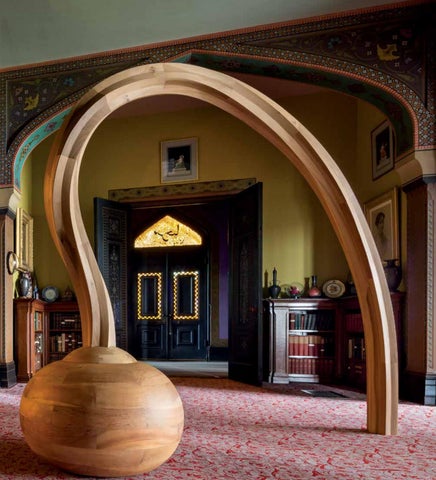
RIVER CROSSINGS CONTEMPORARY ART COME S HOME
by JASON ROSENFELD preface by Stephen Hannock foreword by Ken Burns essays by Marvin Heiferman Maurice Berger
THE ARTIST BOOK FOUNDATION boston new york london
★
4
CONTENTS Preface 7 Stephen Hannock Foreword 9 Ken Burns River Crossings: “an unbounded capacity for improvement by art” 12 Jason Rosenfeld The Changing Nature of Nature’s Image 22 Marvin Heiferman The Ghosts of the Hudson Valley 28 Maurice Berger
★
Thomas Cole National Historic Site Profile 34 Elizabeth B. Jacks and Kate Menconeri thomas cole site artist biographies with a rtwork narratives 36 Jason Rosenfeld Olana Profile: “Artists and Friends” 84 Evelyn Trebilcock, Mark Prezorski, and Rena Zurofsky olana artist biographies with artwork narratives 86 Jason Rosenfeld acknowledgments 112 Elizabeth B. Jacks executive director, thomas cole national historic site
Rena Zurofsky, interim president, the olana partnership
checklist of additional works by site: frederic edwin church, thomas cole, and other artists 114 index 116
Stephen Hannock, The Oxbow, Flooded, for Frank Moore and Dan Hodermarsky (Mass MoCA #196), 2013 (plate 15) on the east wall in the West Parlor.
6
PREFACE i have always been a fan of Kurt Vonnegut. The work and the man. His simple but profound observations have come to my rescue on many occasions. But it is perhaps his facility with time travel that I have employed most frequently. I have never visited Tralfamadore, but important conversations have taken place between my painter-self and the likes of Rembrandt van Rijn, J.M.W. Turner, Arthur Dove, Michelangelo Merisi da Caravaggio, and Jacob Lawrence. . . . And then Thomas Cole and Frederic Edwin Church. If Cole and I were on the west porch of his house in Catskill 150 years ago, along with his teenage student Church, we just might muse on the art we would find on his walls and dotting his lawn in the third millennium. Would the paintings and sculptures be “landscape” in nature? Would the new phenomenon of photography be dominant? As an artist who has been motivated by the Tonalists, Luminists, and earlier nineteenth-century American painters, the obvious place to start might be with the art that excites me now. For an artist who paints compositions with a horizon, I’m actually not inspired by many “landscape paintings.” I see my work more as set designs or cinematic “establishing shots” for diaries that will be written throughout a given composition. Artists of my generation and beyond frequently find their way into these diaries. Who is to say it wouldn’t be these artists occupying the walls of Cedar Grove and Olana in 2015? This is where Jason Rosenfeld and I began our effort to introduce the nineteenth-century American painters to works of art in 2015. Along the way, artists’ referrals and an appreciation for recent history helped fill in the rest (that is, before the Civil War it would have been impossible to convince Cole and the young Church, et al., that the slaves in America would be freed…and then in the early twentieth century that this little community downriver called Harlem would spawn a culture that would impact the entire world). I would personally like to thank Jock Reynolds for allowing the Yale University Art Gallery’s recently acquired Oxbow of mine to be loaned for this show with only a couple of months’ notice. This painting was the first domino in our succession of choices for both houses. The Oxbow, Flooded, for Frank Moore and Dan Hodermarsky (Mass MoCA #196) (plate 15) shows the same nook in the Connecticut River that was first drawn by Thomas Cole in 1833 and then painted by him in 1836 (fig. 1). And it was from this familiar starting point that the art was selected.
A special note: Frank Moore (plates 30 and 31) to whom my Oxbow painting in the show is dedicated, was one of the most renowned artists to assemble a major body of work while afflicted with fullblown AIDS. It was Frank who designed the AIDS ribbon. He is also the reminder that any discussion of art in the third millennium has to include recognition of the devastating impact that AIDS has had worldwide, and specifically on American culture. The kitchen alcove servants’ quarters in the basement of Cedar Grove struck us as an eerie reminder of the cots in Greenwich Village cold-water flats that were offered to sick friends early on in the 1980s. It is in this space that we set up our installation that includes two pieces by Frank Moore and Duncan Hannah’s Little Swing (plate 29) Last, profound thanks to Sara Griffen, now the retired director of The Olana Partnership, and to Betsy Jacks, the director of the Thomas Cole National Historic Site. It was their persistent velvet headlocks that left me with no other choice than to notify friends and acquaintances that this exhibition was an idea that should be brought to life. Henry Geldzahler used to tell us that there was no such thing as a good idea for a painting or a bad idea for a painting. Just good paintings and bad paintings. After too many years of chatter about whether contemporary art in these particular nineteenth-century homes is a good idea or a bad idea, the show is here. Let the discussion begin. Stephen Hannock North Adams, Massachusetts June 2015
7
32
THOMAS COLE NATIONAL HISTORIC SITE
KIKI SMITH (b. 1954)
Kiki Smith grew up in New Jersey, crossing the Hudson to New York City in the late 1970s. More recently she has moved to Catskill, New York, and has become a valued supporter of the Thomas Cole Historic Site. She is the daughter of the American sculptor Tony Smith (1912–1980), who is associated with the Minimalism movement. Her father’s preference for bronze is evident in Wolf with Birds III (plate 1), although this is not her most familiar medium. It is a bas-relief composition with a small wolf in right profile and two doves, in identical poses, flitting from lower left to upper right across the mammal’s body. Smith cast this sculpture in bronze with gold leaf, and tiny specks of red and other colors dapple its matte surface. Since the 1990s, Smith has been interested in depicting nature in her work, often in the form of finely designed etchings, woodcuts, photographs, and lithographs, among other media, and as in the art of Valerie Hegarty (plate 36), Maya Lin (plate 40), and Letha Wilson (plates 43 and 44) there is an environmental imperative in her productions. Birds have a symbolic
Kiki Smith, Wolf with Birds III, 2010 (plate 1) in the Staircase/Entry.
36
resonance for the artist, linked to the soul, “with associations ranging from the Holy Spirit to the fragility of the environment,” and the use of white birds that recall the image of the dove in Catholic art are consistent with a strain of religiosity that runs through her oeuvre.1 Fragility is less evident in the form of the wolf, whose claws are sharp and pronounced, and whose depicted hide is striated to convey a sense of coursing fur, but rough and metallic to the core, like a magnified etching. The sensitivity of the exquisitely naturalistic depiction is belied by the boldness of execution and expression in this prideful creature, calmly moving through space.
1. See material related to her exhibition at MoMA, New York, NY, in 2003–2004, Kiki Smith: Prints, Books & Things: http://www.moma.org/interactives/exhibitions/2003/ kikismith/flash.html.
PL ATE 1
Wolf with Birds III, 2010. Bronze with gold leaf, 44 1/2 x 54 x 2 1/2 in. (113 x 137.2 x 6.4 cm), unique. Collection of Maria and Conrad Janis. © Kiki Smith, courtesy Pace Gallery. Photograph: Kerry Ryan McFate, courtesy Pace Gallery.
37
THOMAS NOZKOWSKI
P LATE 7
Untitled (8–129), 2010. Oil on linen on panel, 221/8 x 281/8 in. (56.2 x 71.4 cm). Collection of the artist. © Thomas Nozkowski, courtesy Pace Gallery. Photograph: Kerry Ryan McFate, courtesy Pace Gallery. Thomas Nozkowski, Untitled (8–129), 2010 (plate 7) in the Sitting Room.
42
43
ANGIE KEEFER (b. 1977)
Artist, writer, editor, and co-founder with David Reinfurt (b. 1971) and Stuart Bailey (b. 1973) of The Serving Library,1 Angie Keefer was born in Huntsville, Alabama, and she lives and works in Hudson and Catskill. Her highly responsive artistic practice is resolutely inclusive, often favoring collaboration over individual exertions, sometimes through direct orchestration or enablement of other artists’ initiatives. This is most evident in the works she created with Kara Hamilton and Kianja Strobert (plates 23 and 24) for River Crossings. But there are two other installations at Cedar Grove that represent her own endeavors, and both metaphorically and literally deal with economic issues. In Area Variance (plate 21), Keefer painted the front facades of two connected houses on Columbia Street in Hudson with a tawny-gold, auto-body pigment. After the local council blocked a plan to tear down the houses and build new apartments, the owners unsuccessfully continued to seek an “area variance” in order to replace the dilapidated properties before inviting Keefer to use them as a canvas. The valuation of the work—consisting of a large-format photograph printed on Duraflex iridescent paper, mounted in a gilded frame, and lit by a sharply focused theater spotlight—is the most recent sale price of the property in Hudson. The rear-projected Fountain (plate 22) is controlled by live stock market data delivered via web server. Previously installed in the Whitney Biennial of 2014 and in landscape format, where it featured footage of a man-made waterfall in Zurich blended with stock imagery, this portrait-format iteration includes multiple views that Keefer shot of water coursing over Niagara Falls projected onto a transparent screen. As with Area Variance, the valuation of the piece is fluid, in this case symbolically equivalent in dollars to the total points of the Dow Industrial Average at the time of sale. The projection emulates abstract painting in glowing pixels, with Niagara’s flowing water running forward or backward, depending on whether commodities futures indexes are rising or falling. An essay titled “Futures,” which is rewritten and republished each time the work is exhibited, accompanies Fountain.2 The title Fountain is a loaded one in terms of the history of art, calling to mind Marcel Duchamp’s (1887–1968) reconfigured readymade urinal of 1917. It also is linked metaphorically with the dual roles of fountains in cities and gardens since ancient times— the propagandistic largesse of the powerful in supplying potable water to large populations in cities, as in Rome—and displays of aqueous aesthetics and dialogues of control at private residences such as Chatsworth in England and Versailles in France. The selection of Niagara as source for the imagery in Keefer’s Fountain is one that also celebrates American distinctiveness and was a prime subject in both Cole’s and Church’s art, and their own economic successes as artists.3
1. http://www.servinglibrary.org. 2. Angie Keefer, “Futures.” http://www.servinglibrary.org/read.html?id=150085. 3. See John F. Sears, Sacred Places: American Tourist Attractions in the Nineteenth Century (Amherst: University of Massachusetts Press, 1998).
P L AT E 2 1
Area Variance, 2014. Duraflex print, gilded frame, and attenuated spotlight , 30 x 40 in. (76.2 x 101.6 cm). Artist’s proof. Collection of the artist. Site-specific installation.
Conjoined houses, Hudson, New York, 2014. Photograph courtesy of the author.
58
PLAT E 22
Fountain, 2014. Projector, transparent rear projection screen, computer, and commodities futures indexes data; dimensions variable. Courtesy of the artist. Site-specific installation. Photograph courtesy of the author. 59
ROMARE BEARDEN (1911 – 1988)
Following an infancy spent in Charlotte, North Carolina, Bearden moved to New York City in 1914. He grew up there and also off and on in Pittsburgh, Pennsylvania, eventually graduating from New York University and beginning a career as a cartoonist. Establishing himself as a fine artist after wartime army service and studying in Paris, he lived on Canal Street from 1956 until his death. In 1968, he helped found the Studio Museum in Harlem. Prelude to Farewell (plate 26) was first exhibited at Cordier & Ekstrom Gallery in New York in 1981 as part of Bearden’s autobiographical series of collages, Profile/Part II: The Thirties. It represents the continued evolution of a mode of art making that Bearden had pursued for more than two decades, in its use of collaged fabric, papers, foil, and paint.1 Robert G. O’Meally has productively considered this work in terms of jazz elements in Bearden’s art, revealing the status of Harlem as long the “cultural capital of black America,” the personal history of the artist, and his investment in the community.2 In The Thirties, Bearden presented the story of the migration of blacks from the south to the north, underpinned with echoes of autobiography. Transport is a common theme, and in Prelude to Farewell there is a train visible through a window or in a picture on the wall—a symbol of the idea of flight and escape to a new life, while its implied sounds add a musical aurality to the work. Other characteristic Bearden motifs include the emphasis on domestic chores and ritualistic bathing, in “works concerned with rites of ablution and purification, with confronting the disorder of the world. . .”3 The writer Albert Murray’s accompanying lines in the catalogue read: “She came to the depot in her best dress to see me off. As the train began to move she ran alongside blowing kisses,” providing a sequel narrative to the represented image, with its perfectly measured composition featuring a burning stove, a totemic mother/conjur woman figure, and a modern Venus Anadyomene, these three main forms moving diagonally back in space to the right in a plunging perspectival cadence.4
1. Albert Murray, Romare Bearden Collages, Profile/Part II: The Thirties (New York: Cordier & Ekstrom, 1981). 2. Robert G. O’Meally, “‘We Used to Say ‘Stashed’: Romare Bearden Paints the Blues,” in Ruth Fine and Jacqueline Francis, eds., Romare Bearden, American Modernist (Washington, DC: National Gallery of Art, 2011), 64. 3. Ibid., 69. 4. Murray, Romare Bearden Collages.
66
Prelude to Farewell, 1981. Mixed-media collage, 49 x 371/4 in. (124.5 x 94.6 cm). The Studio Museum in Harlem; gift of Altria Group, Inc. 08.13.2. Photograph courtesy of The Studio Museum in Harlem.
P LATE 26
67
DUNCAN HANNAH (b. 1952)
2013 Guggenheim fellow Duncan Hannah produces meticulously painted canvases that approach the world with an illustrative eye. Influenced by the pop visuals of pulp novel covers, cinema one sheets, and a simplified aesthetic associated with outsider art, his works have a quietude and bear a vaguely English nostalgic air that lend them a timeless resonance. They productively lie somewhere between painters Edward Hopper (1882–1967) and Glyn Philpot (1884–1937), and illustrators of The Happy Hollisters and Nancy Drew books in the 1950s and 1960s such as Helen Stroud Hamilton (1921–2014) or William S. Gillies (1911–2000). People in Hannah’s paintings, even if recognizably based on the likes of Sean Connery or Monica Vitti, seem to be accessible, vulnerable, human. They do not seem to be acting. In Little Swing (plate 29), what appears to be a boy in shirt sleeves, cuffed khakis, and Oxford shoes leans back precipitously on the beginning of a down swing, gathering momentum as his legs kick out and the ropes bend under his forward motion. Framed against a lightly brushed blue sky, the boy seems impossibly elevated, with terra firma not in evidence. It is a deftly painted image of bodily release, at the moment when swinging one’s body hovers between downfall and impending uplift, defying gravity. Hannah designed the original Swing image for the Robert Rosenblum–curated Art Against AIDS benefits in New York in 1987 for the American Foundation for AIDS Research.1 The work was inspired by the African American spiritual “Swing Low, Sweet Chariot,” and its image of Elijah ascending to heaven on the wings of angels. Hannah thus envisioned an adult in a child’s swing ever ascending as a symbol of hope, at a time when a number of his friends were sick and dying in the early years of the epidemic.2 This is one of a set of small, similar paintings that have expanded upon the original work, and it is displayed in River Crossings in the basement kitchen alcove at Cedar Grove, with two works by Frank Moore (plates 30 and 31), who died of complications from HIV/AIDS.
Duncan Hannah, Little Swing, 1999 (plate 29) in the Kitchen Alcove.
1. http://www.nytimes.com/1987/06/05/style/artists-rally-to-fight-aids.html. 2. Communication with Duncan Hannah, June 1, 2015.
Little Swing, 1999. Oil on canvas, 14 x 11 in. (35.6 x 27.9 cm); framed: 17 x 143/4 x 1 1/4 in. (43.2 x 37.5 x 4.4 cm). Private collection.
72
PLATE 2 9
73
DON GUMMER
P LATE 34
In the Fold, 1994. Cast bronze and aluminum on concrete base, 90 x 76 x 72 in. (228.6 x 193 x 182.9 cm). Collection of the artist.
80
81
82
OLANA STATE HISTORIC SITE
83
CHUCK CLOSE (b. 1940)
Raised and educated in Washington State, Close came east in 1961 having earned a scholarship to the Yale Summer School of Art and Music in Norfolk, Connecticut. It was on a road trip that summer that he first visited Olana; seeking water, and finding himself stuck inland in northwestern Connecticut, he gravitated toward rivers like the Hudson.1 He subsequently moved to the Connecticut River Valley, teaching at the University of Massachusetts, Amherst, from 1965 to 1967, where he first started working with photography. Close adapted his characteristic large-scale, full-face portraiture technique to tapestries in 2005. Woven in an edition of 10 on a Jacquard Dornier loom in Belgium that has been programmed to accept a scanned image, they are comprised of nearly 18,000 Italian dyed-cotton warp threads in 8 colors and weft threads in 10 varieties. These combine optically to produce more than one hundred colors.2 The source image is a 24-by-20inch Polaroid that is then transformed into a digital “weave file” at Magnolia Editions in Oakland, California, so it can be understood by the loom programming.3 Close has also produced this composition across other media: as a more than six-foot-tall watercolor pigment print and in small-scale multiples using felt stamps and oil paints. With its shimmering, exquisite, light-responsive surface, the tapestry combines the medieval with the digital and is evidence of Close’s constant seeking out of new materials, methods, and effects. The artist’s remarkable project of unsparing self-revelation is now in its 48th year, eclipsing Rembrandt van Rijn’s (1606–1669) similar enterprise by seven years. Its modern introspective majesty matches the achievement of the Dutch painter, as Close continues similarly to document and share the transformations of a life. Chuck Close, Self-Portrait (Yellow Raincoat), 2013 (plate 35) on the Stair Hall wall. 1. Conversation with the author, April 10, 2015. 2. Lilly Wei, “Face Time,” in Chuck Close: Selected Paintings and Tapestries 2005–2009 (New York: PaceWildenstein, 2009), 8. 3. Nick Stone, Self-Portrait (Yellow Raincoat) (Oakland, CA: Magnolia Editions, 2013), http://www.magnoliaeditions.com/artworks/self-portrait-yellow-raincoat-2/. See also Stone, “Tapestries at Magnolia Editions” (2014), http://www.magnolia editions.com/wp-content/uploads/2014/12/About_Magnolia_Tapestries2.pdf.
Self-Portrait (Yellow Raincoat), 2013. Jacquard tapestry, 93 x 76 in. (236.2 x 193 cm). Private collection. © Chuck Close in association with Magnolia Editions, Oakland. Photograph courtesy of the artist and Pace Gallery.
86
PLATE 35
87
VALERIE HEGARTY (b. 1967)
Born in Burlington, Vermont, Hegarty received her BA at Middlebury, her BFA from the Academy of Art College in San Francisco, and her MFA from The Art Institute of Chicago. She has lived in Brooklyn since 2003, has served on the National Advisory Board for the preservation of Olana since 2010, and had a Yaddo Residency in Saratoga Springs in 2011. Her unique dialogue with past art involves meticulously re-creating famed American artworks from the nineteenth century, then despoiling them through fire and manhandling, making it appear as if they have been through a conflagration, or storm, or fusillade, or attacked by animals. She has shown her works at Marlborough Chelsea and in other gallery spaces, but they achieve an added potency when seen in museums, as in the period rooms at the Brooklyn Museum in 2013, or in a historic house such as Olana. In Picnic with Downy Woodpecker and Table and Chair with Pileated Woodpecker, Hegarty engages with a consistent theme: “the cyclical nature of the world’s fortunes, in which nations rise and fall.”1 But as in Cole’s and Church’s ruminations on faulty human endeavor, Hegarty’s work is about the possibility of rebirth amid destruction, though not necessarily a rebirth involving people. Picnic is Hegarty’s garish acrylic reproduction on canvas of Cole’s meditative A Pic-Nic Party (1846, Brooklyn Museum) treated with an intensified Thomas Kinkade palette, and here frame and canvas are seemingly shot full of holes in an arc rising from lower left to upper right. But then the culprit is revealed, at left, in the form of a faux-taxidermical downy woodpecker that is poking at the fake foam-core and papier mâché frame in its endless quest for insects. In the furniture piece, a crow-size pileated woodpecker, also native to the Hudson River Valley but threated with extinction, goes to town on a mahogany card table, as if these mechanical beings from nature itself are taking their revenge on human intervention into the environment and transformation of natural materials. In Hegarty’s work, often the materials of art, changed for human aesthetic delectation, are in chaotic and melancholy ways attempting to return to their natural state—frames transform into branches, metals return to ores in the form of rust, animals assist in this resilient process. The environs of the Hudson Valley, modern issues of conservation, and the art made in the region, have been key for Hegarty in developing these potent themes of constructed destruction.2
1. Elyse A. Gonzales, Ruins in Contemporary Art: The Stumbling Present (Santa Barbara, CA: Art, Design & Architecture Museum, 2013), 104. 2. See Autumn in the Hudson Valley with Branches, a Jasper Francis Cropsey-inspired work installed on Manhattan’s High Line in 2009–2010. http://art.thehighline.org/project/ valeriehegarty/.
88
Detail of Picnic with Downy Woodpecker.
P L AT E 36
Picnic with Downy Woodpecker, 2013. Canvas, stretcher, foam molding, acrylic paint, paper, glue, sand, gold foil, and feathers, 46 x 321/2 x 5 in. (116.8 x 82.6 x 12.7 cm); and Table and Chair with Pileated Woodpecker, 2013. Table: foam-core, acrylic paint, paper, glue, sand, and feathers, 36 x 32 x 24 in. (91.4 x 81.3 x 61 cm); chair: 36 x 19 x 17 in. (91.4 x 48.3 x 43.2 cm). Collection of the artist.
89
LYNN DAVIS (b. 1944)
Photographer Davis received her BFA from the San Francisco Art Institute, apprenticed under Berenice Abbott (1898–1991), and now lives and works in Hudson, New York. Water is a consistent motif in Davis’s large-format photographs, and the subject of her numerous solo exhibitions. Inspired by the themes and immersive sizes of Church’s paintings, Davis has pursued a project of visiting the sites of the artist’s travels and subjecting them to her own perspective and technical approach. Unlike Church, Davis works in a square format, and lets the natural scenery expand within these controlled proportions. In Horseshoe Falls, Ontario, Canada (plate 39), one of several images she has made around Niagara, Davis adopted her characteristically head-on position, avoiding the vertiginous aerial views of some of Church’s paintings, or the worm’s-eye view from terra firma of street photographers frequently adopted by Abbott. Imposing and timeless in their monochromatic stateliness, rigorously formatted in square compositions, Davis subjects the panoramic to the monumentally schematic, in works wherein perceptual proximity and scale are dissociated, spray renders the left and bottom edges incomprehensible, and the massive wall of water at right is blurred, its constituent shocks of foam unrecognizable. This work and her image Iceberg 29, Disko Bay, Greenland (plate 38) are installed in the East Parlor at Olana, the room best suited to hanging art in the house, and seen in collaborative company amidst Church’s sketches of his favorite motifs.
P L AT E 3 8
Iceberg 29, Disko Bay, Greenland, 2000. Silver gelatin print, 40 x 40 in. (101.6 x 101.6 cm), framed. Collection of the artist. © Lynn Davis.
Lynn Davis, Iceberg 29, Disko Bay, Greenland, 2000 (plate 38) in the East Parlor. 92
Horseshoe Falls, Ontario, Canada, 1992. Silver gelatin print, 45 x 45 in. (144.8 x 147.3 cm), framed. Collection of the artist. © Lynn Davis.
PL ATE 39
93
MAYA LIN (b. 1959)
Architect and sculptor Maya Lin grew up in Ohio and studied at Yale University where, as an undergraduate, she won the national competition to design the Vietnam Veterans Memorial in Washington, DC (1982), a project that shifted the culture of such monuments in its successful combination of simplified form, formal rigor, and the ability to connect with a broad public. Silver River–Hudson (plate 40) in the Sitting Room at Olana, represents recent work concerned with documenting and aestheticizing the course of rivers, as discussed in my essay in this volume (see pages 12 – 21). Lin notes that “We have chosen where we live due to our access to major waterways — and these places were also where there was a historic abundance of biodiversity — over time one sees a severe degradation of these once amazing estuaries and waterways — I create these silver works while simultaneously researching the ecological history of each place — creating timelines that span from the earliest recorded accounts of those places to the present day — incorporating these into my final memorial, What is Missing? asking and inviting people to share their memorial of each place from an ecological perspective — following a river back in time.” 1 Thus this piece is part of a larger project, ecologically based, and connected to the timeline of the Hudson stretching back to its earliest exploration, and then the influx of development that accompanied Cole, the Erie Canal, and Church upriver. Lin’s silvered bas-relief map peters away at the top, at the waterway’s origins at Lake Tear of the Clouds, and is redolent of the futility of Henry Hudson’s quest for the Northwest Passage in the early seventeenth century. In the lower section, as if encouraged by gravity, the pooling metal stretches into New York Bay past the Verrazano Narrows and into the Atlantic, and out Long Island Sound as far east as Orient Point. The work’s elegant, natural arabesques harmonize both with the craggy forms in El Khasné, Petra (1874) and the nonsensical scribblings meant to emulate Arabic script that Church painted in the decorative borders on the walls. If a line is traced from the underside of the top of the doorframe to the map, it falls onto the gentle curve of the Hudson to the south at Inbocht Bay and Silver Point, visible through the ornate neo-Persian window that Church included in the design of the room. Lin’s sculpture, placed in this orientation vessel of a house (and with Church’s compass in the floor of the piazza, just outside the Sitting Room), creates a moving sense of rootedness and calls to mind Thomas Cole’s sonorous lines from a poem of 1833: “The Hudson lies below, a mirror’d heaven; Stainless, save where the joyous hills are given With grassy slope, dark rock, and breezy wood In purple beauty to the wooing flood —” 2
94
P L AT E 40
1. Maya Lin, “Here and There,” in Maya Lin: Here and There (New York: PaceWildenstein, 2013), 13. 2. “Lines Written after a Walk on [a] Beautiful Morning in November,” dated Catskill, 1833. See Marshall B. Tymn, ed., Thomas Cole’s Poetry (York, PA: Liberty Cap Books, 1972), 62.
Maya Lin, Silver River– Hudson, 2011 (plate 40) in the Sitting Room.
Silver River–Hudson, 2011. Recycled silver, 81 x 45 x 3/4 in. (205.7 x 114.3 x 1.9 cm), overall installed. AP 2 of 2; edition of 3 + 2 APs. Collection of the artist. © Maya Lin Studio. Photograph: Kerry Ryan McFate, courtesy Pace Gallery.
95
WILL COTTON (b. 1965)
Cotton grew up in the Hudson Valley and has said that early experiences at Olana communicated to him that artists “could live in a total fantasy world of their own making.” This freeing revelation has played out in his art. After studying at Cooper Union and New York Academy of Art, he evolved a painting style wherein landscapes are formed of confections and baked creations, and are interspersed with people. Like the English painter Thomas Gainsborough (1727–1788) in the late-eighteenth century, who built miniature landscape dioramas in his studio using twigs, glass, pebbles, grasses, and broccoli for trees that he then transformed into paintings, Cotton bakes the materials that he then uses in his paintings. The results, carefully painted but with a
Will Cotton, Untitled, 2014 (plate 45) in the Corridor.
100
slight blur, as if seen through clouded glass, are not the trite subject matter of chocolate boxes, but rather grand style portraits such as the one on view in the corridor at Olana, hanging across the doorway to the studio from Charles Loring Elliott’s (1812–1868) portrait of Church (1865). With its tenebrist background and eruptive chapeau of macaroons, Cotton’s portrait (plate 45) bears a striking likeness to Baroque works from Europe and also Spanish and Portuguese colonies in America, wherein sitters would often be festooned with textured clothing and headgear, leavened with witty doffs of the cap to the performative samba-style aesthetic of Carmen Miranda.
Untitled, 2014. Oil on linen, 34 x 24 in. (86.4 x 61 cm). Private collection. Photograph courtesy Mary Boone Gallery.
PLATE 4 5
101
acknowledgments River Crossings: Contemporary Art Comes Home marks the first collaborative exhibition between the Thomas Cole National Historic Site and The Olana Partnership at the Olana State Historic Site. It has been a thrill for all of us at both organizations to work with so many dedicated and accomplished collaborators throughout the complex process of organizing and mounting this exhibition. The staff and trustees would like to express their profound thanks to the many people who have made this project possible. River Crossings stems from Stephen Hannock’s extraordinary vision, and we are forever in his debt for conceiving of this exhibition and pulling out all the stops to make it happen. He and his tireless co-curator, Jason Rosenfeld, have selected artists of the highest artistic merit and have created an exhibition that is both unprecedented and inimitable. We thank them from the bottom of our hearts for giving so much of their time, passion, and dedication. We are extremely grateful to all of the artists who participated in the exhibition. The artists include Romare Bearden, Elijah Burgher, Chuck Close, Will Cotton, Gregory Crewdson, Lynn Davis, Jerry Gretzinger, Don Gummer, Kara Hamilton, Duncan Hannah, Stephen Hannock, Valerie Hegarty, Angie Keefer, Charles LeDray, Maya Lin, Frank Moore, Elizabeth Murray, Rashaad Newsome, Thomas Nozkowski, Stephen Petegorsky, Martin Puryear, Cindy Sherman, Sienna Shields, Kiki Smith, Joel Sternfeld, Kianja Strobert, Letha Wilson, and Elyn Zimmerman. We have been inspired and humbled by your creativity and enthusiasm for this unique presentation. In addition to the artists, numerous collectors, galleries, and museums have also generously loaned artworks for River Crossings. For the loaned artwork, the related arrangements, and photography we thank Andrea Fisher-Scherer at the Artists Rights Society; Elizabeth A. Carpenter, Anne Collins Goodyear, and Frank H. Goodyear III at the Bowdoin College Museum of Art; The Brooklyn Museum; Beth Zopf, studio manager, Chuck Close Studio; Rebeccah Johnson, studio manager, Lynn Davis Studio; Russell Williams at DG Studio; Jeanne Englert, personal assistant to Martin Puryear; Putri Tan at Gagosian Gallery; Bruce Barnes, Sara Evans, Lisa Hostetler, and Joe R. Struble at The George Eastman House International Museum of Photography and Film; The Murray-Holman Family Trust; Patrick Lloyd at Higher Pictures; Maria and Conrad Janis; David Lachman; Stephan and Marian Loginsky; Alexandra Ferrari and Caroline Burghardt at Luhring Augustine; Matthew Marks Gallery; Heather Russell and Bruce Kriegel at Marlborough Gallery; Mary Boone Gallery; James Cabot Ewart at Maya Lin Studio; Pedro Antonio Guerrero Art Collection; Margaret Zwilling and Michael Plunkett at METRO Pictures; Elizabeth Moore; David Goerk, Raina Mehler, Lindsay McGuire, Britta Nelson, and Nancy Rattenbury at PACE Gallery; Jacob Meehan; Alex
112
Schneider and Eileen Jeng at Sperone Westwater; Colin Stair and Stair Galleries; Thelma Golden, Whitney Snyder, and Gina Guddemi at The Studio Museum in Harlem; Sydney Weinberg; Scott Speh, owner and director, Western Exhibitions; Brittni Zotos, studio manager, Will Cotton Studio; and L. Lynne Addison, Pamela Franks, Lisa Hodermarsky, Rachel L. Mihalko, Jock Reynolds, and David Whaples at Yale University Art Gallery. We would like to thank the wonderful professionals who helped make this exhibition a reality: Carla Rozman for graphic design; Goodman Media for public relations; AdWorkshop for digital outreach; and Peter Aaron for site photography. We would also like to thank Robin Key Landscape Design, George Lagonia Jr. Inc., Cherie Miller Schwartz, and Robert Silman Associates for ensuring the success of landscape installations. We would like to thank Mike Prudhomme and Patrick Terenchin for their astute help with installation at the Cole site, and photographers Michael Fredericks and Chad Kleitsch for their meticulous photographic work. For this excellent publication, we thank Leslie Pell van Breen and The Artist Book Foundation. We wish to recognize the support of Governor Andrew M. Cuomo; New York State Office of Parks, Recreation and Historic Preservation Commissioner Rose Harvey; Deputy Commissioner for Historic Preservation Ruth Pierpont; Regional Director, Taconic Region, Linda Cooper; Director of the Bureau of Historic Sites Mark Peckham; Capital Facilities Manager, Taconic Region, Garrett Johnson; Olana Site Manager Kimberly Flook; Interpretive Programs Assistant Paul Banks; and Park Supervisor Tim Dodge. We are grateful to the New York State Office of Parks, Recreation and Historic Preservation staff: Collections Manager Ronna Dixson and her staff members Hajime Stickel and Mary Zaremski; Furniture Conservator David Bayne; Paintings Conservator Mary Betlejeski; Senior Historic Sites Restoration Coordinator Chris Flagg; Decorative Arts Conservator Heidi Miksch; Grants Administrator, Taconic Region, OPRHP, Erin O’Neil; Paper Conservator Michele Phillips; Frames Conservator Eric Price; Michael Roets, scientist (archaeology); Textile Conservator Deborah Trupin; and Assistant Frames Conservator Abby Zoldowski. We are thankful to all of the staff of both institutions who worked together to bring this exhibition to fruition. In particular we would like to acknowledge the curatorial staff who went beyond the call of duty to bring all of the disparate pieces together in the most professional manner: Kate Menconeri, Curator at the Thomas Cole National Historic Site and The Olana Partnership’s Curator Evelyn Trebilcock and Landscape Curator Mark Prezorski. There are many staff who coordinated the colossal marketing and logistics efforts, including Development and Marketing Communications Manager Melanie Hasbrook and Thomas Cole Director of Education Melissa Gavilanes.
This work was only possible with vital support from Olana Associate Curator Valerie A. Balint, Thomas Cole Retail Manager Marie Spano, Thomas Cole Program Manager Alice Tunison, Thomas Cole Museum Educator Erin Dinan, Olana Archivist/Librarian Ida Brier, Olana Curatorial Assistant Andrea Nero, Thomas Cole Curatorial Assistant Kellan Rohde, Olana Curatorial Maintenance Robert Hills, and Caretakers Peter and Tone Noci. We thank Olana Development Consultant Tim Runion, Olana Head of Education Amy Hufnagel, Thomas Cole Executive Assistant Sheri DeJan, and Olana Executive Assistant Julia Thomas. Finally, we acknowledge Sara Johns Griffen, former President of The Olana Partnership, for shepherding River Crossings through its initial stages. The River Crossings exhibition and the companion publication were made possible by the generous support of many donors. Major funding for River Crossings was provided by The Moore Charitable Foundation, the New York State Council on the Arts, New York State’s Empire State Development and the I ❤ NY Division of Tourism under Governor Andrew Cuomo’s Regional Economic Development Council Initiative, Tiger and Caroline Williams, and The Bay & Paul Foundations. Additional support is provided by Ed Herrington, Inc., the Hudson River Valley National Heritage Area, the Village of Catskill, the County Initiative Program of the Greene County Legislature administered by the Greene County Council on the Arts, the Columbia County Tourism Department, Jennifer Krieger, and Chas Miller. The companion book and related public programs were funded by Tiger and Caroline Williams and the National Endowment for the Arts. Elizabeth B. Jacks, Executive Director Thomas Cole National Historic Site, Catskill, New York Rena Zurofsky, Interim President The Olana Partnership, Hudson, New York April 2015
Olana architectural detail
113