First published on the occasion of the exhibition
‘Richard Dadd: Beyond Bedlam’
Royal Academy of Arts, London 25 July – 25 October 2026
Supported by


With additional support from Colin McCorquodale
Miss Rosemary Lomax-Simpson
The Dr Lee MacCormick Edwards Charitable Foundation
Special thanks to Bethlem Gallery, Bethlem Museum of the Mind, Victoria and Albert Museum and Yale Center for British Art for their generous support of this exhibition.
This exhibition has been made possible as a result of the Government Indemnity Scheme. The Royal Academy of Arts would like to thank HM Government for providing indemnity and the Department for Digital, Culture, Media & Sport and Arts Council England for arranging the indemnity.
Copyright © 2026 Royal Academy of Arts, London
Any copy of this book issued by the publisher is sold subject to the condition that it shall not by way of trade or otherwise be lent, re-sold, hired out or otherwise circulated without the publisher’s prior consent in any form of binding or cover other than that in which it is published and without a similar condition including these words being imposed on a subsequent purchaser.
All Rights Reserved. No part of this publication may be reproduced or transmitted in any form or by any means, electronic or mechanical, including photocopy, recording or any other information storage and retrieval system, without prior permission in writing from the publisher.
Royal Academy of Arts Burlington House Piccadilly London W1J 0BD www.royalacademy.org.uk
EU Authorised Representative EAS Europe, Mustamäe tee 50, 10621 Tallinn, Estonia gpsr.requests@easproject.com
British Library Cataloguing-in-Publication Data
A catalogue record for this book is available from the British Library
ISBN 978-1-915815-19-4
exhibition curators
Nicholas Tromans
Sylvie Broussine with Rina Sagoo
exhibition organisation
Poppy Fairfax with Laura Laing
photographic and copyright co - ordination
Giulia Ariete
exhibition catalogue
Royal Academy Publications
Florence Dassonville, Production and Distribution Co-ordinator
Carola Krueger, Production and Distribution Manager
Peter Sawbridge, Head of Publishing and Editorial Director
Copy-editing and proofreading: Alison Hissey
Design: Maggi Smith
Colour origination and printing: Gomer Press, Wales
Distributed outside the United States and Canada by ACC Art Books Ltd, Riverside House, Dock Lane, Melton, Woodbridge, IP12 1PE
Distributed in the United States and Canada by ACC Art Books, 6 West 18th Street, Suite 4B, New York, NY 10011
editorial note
This publication includes historical terms and language that reflect common usage during Dadd’s lifetime. They are used here to maintain the historical accuracy of the material.
All works reproduced are by Richard Dadd (1817–1886) unless otherwise stated.
Dimensions of all works of art are given in centimetres, height before width (before depth).
illustrations
Page 2: detail of cat. 11
Page 7: detail of cat. 33
Page 8: detail of cat. 29
Pages 102–103: detail of cat. 33
Pages 105–106: detail of cat. 35
Page 152: detail of cat. 22
President’s Foreword
The Victorian painter Richard Dadd (1817–1886) has exercised a strong hold on the imagination of audiences in recent decades. Although he is known largely as a painter of fairy worlds, his art also encompasses portraiture, watercolours influenced by his Eastern Mediterranean travels, and scenes inspired by literature and legend. Many of Dadd’s works were produced while he was a patient at Bethlem and Broadmoor hospitals, where he spent most of his life. The first survey of his art since the 1970s, this exhibition brings together Dadd’s most impressive paintings, watercolours and drawings, enabling us to consider all aspects of his practice.
The Royal Academy is the show’s ideal venue, for Dadd made his name as a student of the Royal Academy Schools in the late 1830s. He exhibited a series of minutely executed fairy paintings of great imaginative power in the Academy’s Annual Exhibitions, drawing upon Shakespeare for his subjectmatter. His skill at rendering detail led him to be invited on an ambitious tour of the Eastern Mediterranean in 1842–43, and his sketchbooks reveal his exceptional powers of observation as he records the people, buildings and landscapes he saw on these travels. Dadd began to experience delusions during the long journey, and on his return to England he killed his father. He spent the remaining 43 years of his life in hospitals. Despite no longer having a formal audience, Dadd continued to make compelling paintings of extraordinary technical quality, based on his memories, his imagination and his carefully annotated sketchbooks and drawings.
The exhibition has been organised by the Royal Academy in collaboration with lead curator Dr Nicholas Tromans, specialist in Richard Dadd and nineteenth-century British art. We thank Dr Tromans for initiating the exhibition, for his thoughtful selection of loans and the rigorous research he shares in his insightful catalogue essay. We are also grateful to Dr Sarah Thomas, Dr Cora Gilroy-Ware, Professor Robert Howard and Natasha Fyffe for their invaluable contributions to this catalogue.
The exhibition would not have been possible without the remarkable generosity of our many lenders, to all of whom we owe our thanks. A special debt of gratitude is due to Bethlem Museum of the Mind, the Victoria and Albert Museum, and the Yale Center for British Art for their exceptional support. We are also indebted to Patricia Allderidge, whose enrichment of the scholarship around Dadd in recent decades has been invaluable.
We extend our thanks to all the Royal Academy staff who have lent their support to the project, chief among them Sylvie Broussine, Associate Curator; Rina Sagoo, Curatorial Assistant; Natasha Fyffe, Assistant Curator; Poppy Fairfax, Exhibitions Manager; Laura Laing, Assistant Exhibitions Manager; and Giulia Ariete, Rights and Reproductions Manager. Our thanks go also to Simon Wallis, Secretary and Chief Executive; Idoya Beitia, Deputy Director of Exhibitions; Julien Domercq, Senior Curator; and Joanna Weston, Senior Exhibitions Manager, for their support and guidance throughout. The Royal Academy’s Publications team, led by Peter Sawbridge, has overseen the creation of this catalogue, beautifully designed by Maggi Smith. We acknowledge warmly the support of former colleagues, among them Tim Marlow, Sarah Lea, Per Rumberg, Adrian Locke, Andrea Tarsia, Axel Rüger, Helena Cooper and Paulina Shearing. Finally, we thank the exhibition’s designer Eric Pearson, its graphic designer Patrick Morrissey at Unlimited and its lighting designer Satu Streatfield; their creativity and expertise have resulted in the exhibition’s elegant installation.
We would like to thank the Tavolozza Foundation and Cockayne – Grants for the Arts, for their support of this exhibition. Additionally we would like to thank Colin McCorquodale, Miss Rosemary Lomax-Simpson, and The Dr Lee MacCormick Edwards Charitable Foundation.
Rebecca Salter cbe pra President, Royal Academy of Arts
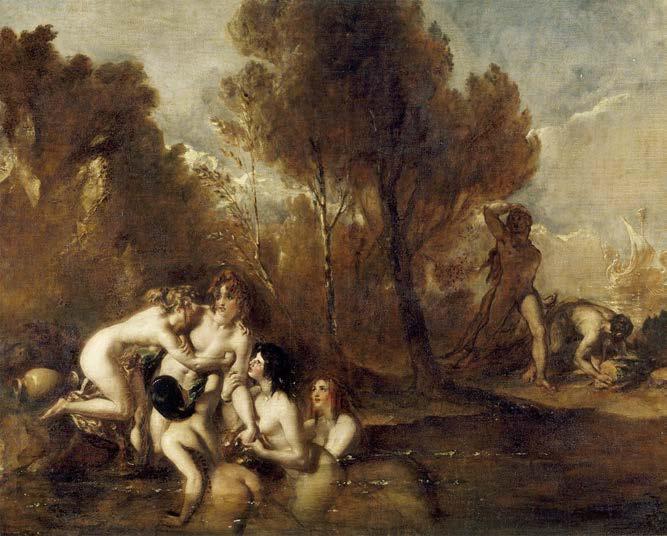
Fig. 33
William Etty, Hylas and the Water Nymphs, 1833. Oil on canvas, 88.3 × 111.8 cm. Anglesey Abbey, Cambridgeshire. Inv. NT 515509
Fig. 34
Henry Howard, Venus and Cupid, 1809. Oil on canvas, 91.4 × 71.8 cm. Yale Center for British Art, Paul Mellon Fund, B1984.19.3
in Hylas and the Water Nymphs (fig. 33), first exhibited in 1833. The integration of Etty’s patent eroticism into Dadd’s memories and academic precedents is surely behind Angela Carter’s description of his work as ‘the quaint pornography of never-never land’.1 4 Etty is responsible for the allegation that Dadd’s paintings are a particular kind of pornography, but the ‘quaint’ aspect perceived by Carter, and the sense that his works take place in a utopia, points to the influence of yet another predecessor: Henry Howard, Dadd’s teacher at the Royal Academy Schools. At one point, when Etty’s name was at its most contentious, Howard had been perceived as Etty’s rival. In 1821 a critic compared their nudes: ‘nakedness without purity is offensive and indecent, and in Mr Etty’s canvasses is mere dirty flesh… Howard, whose subjects… require naked figures, never disgusts the eye or the mind. Let Mr Etty strive to a taste equally pure.’ 1 5 Building on both, Dadd tempers Etty’s unabashed, potentially pornographic eroticism with Howard’s self-consciously chaste and incorporeal approach to the human form. In contrast to Etty, Howard established his reputation via his undeniable skill in drawing classical sculptures, faithfully replicating the lineaments of casts and marbles onto the painted surface. Stilted and plastic, his female figures, such as the half-draped goddess in Venus and Cupid (fig. 34), are at a distance from the bodies
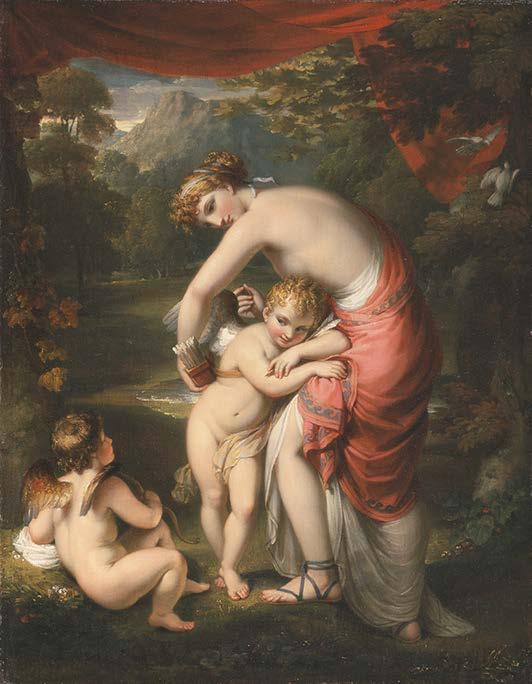
of actual living women. By the time Dadd showed Titania Sleeping, Howard’s figures were, because of their plastic incorporeality, dismissed as ‘tame commonplaces’: bodies that were too ‘pure’, not real, not human enough.1 6
Carter’s description captures the distance imposed by Howard between his figures and real human flesh, a distance Dadd preserves in his fairy scenes. Among the residual admirers of Howard’s art as the century progressed, his London studio was seen as a kind of ‘never-never land’. In 1835, a critic describes walking in from the ‘crowded street’ as a journey into an alternative universe, an ‘enchanted ground’ populated by creatures that seemed ‘to breathe a more ethereal atmosphere than that which clogs the aspirations of ordinary mortals’. 1 7 In addition to ancient sculptures, the chastened contours of his figures are indebted to his favourite Old Master, the seventeenth-century French painter Nicolas Poussin, who himself was known as a consummate painter of sculptural forms. In his Royal Academy lectures, Howard encouraged his students, including the young Dadd, to emulate Poussin in a language indicative of the nude’s alienation from living flesh, praising his figures as ‘fine instances of scientific ordonnance’. 1 8
Dadd’s time as a student at the Royal Academy Schools (1837–40) coincided not only with Howard’s stint as Professor of Painting, but with the opening
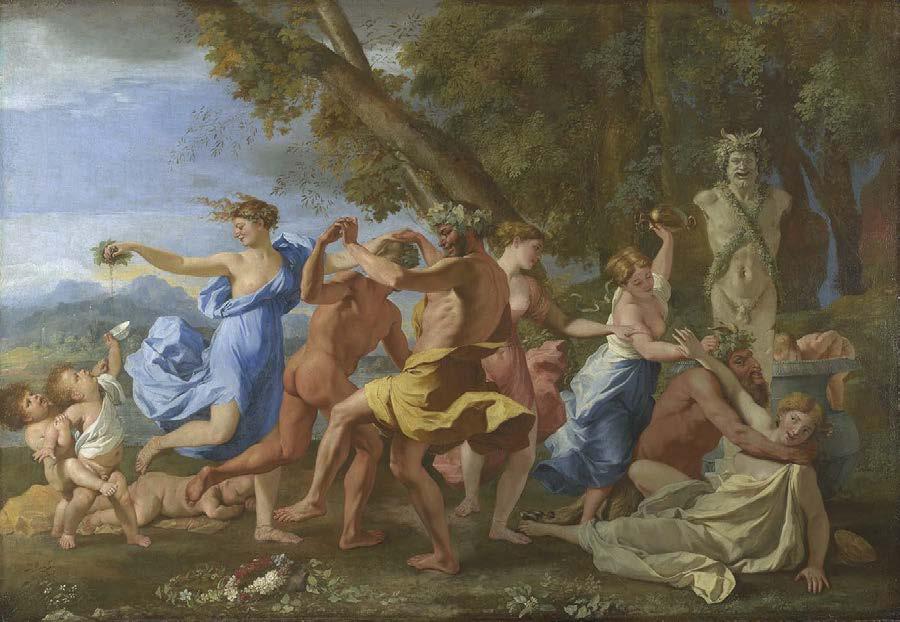
of the National Gallery. Interest in Poussin within British artistic circles was at its height during the time in which the foundations of this collection were being laid. Acquired in 1820, around the time of Maria Callcott’s widely read Memoirs of the Life of Nicholas Poussin, one of the objects in this burgeoning national hoard was Poussin’s A Bacchanalian Revel Before a Term (fig. 35), a work featuring a group of dancing nymphs and satyrs that sets a precedent for the fairy revellers in Titania Sleeping (cat. 11). Dancers in a similar circle, or ‘round’, to use Shakespeare’s word, recur in other early paintings by Dadd. In Poussin’s Bacchanalian Revel, the circle is loose and broken by the force of drunken movement; in Puck (cat. 10), the companion picture to Titania Sleeping, the circle is complete. A ring of naked bodies is dwarfed by the fairy servant. Crowned by the bell
of a convolvulus, Puck’s illuminated form serves as a kind of maypole. The Poussin circle – itself based on sculpted classical reliefs of Dionysian processions – is rendered tighter and neater as it is integrated by Dadd with Shakespeare’s words and other aspects of the painter’s visual inheritance.
Writing of the dancing round in Titania Sleeping, a critic in the Literary Gazette praised Dadd’s ability to make this topos appear fresh: somehow, his ‘conception of the fairy circle boasts of originality, even after the hundreds of times it has been painted’. 1 9 The originality this critic perceives in the work stems not from Dadd’s portrayal of the figures per se, but from the kinship between the painting and contemporary theatre, including the recent staging of A Midsummer Night’s Dream at Covent Garden, featuring Lucia Elizabeth Vestris – a celebrated