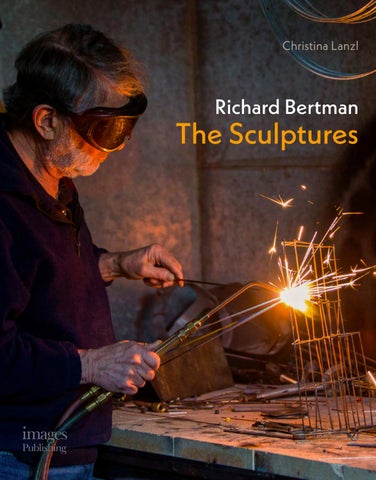
Christina Lanzl
Richard Bertman
The Sculptures
Contents 7 Acknowledgments 10 Foreword Mark Jarzombek 12 1. Introduction: Synthesis of Art and Life, Sculpture and Architecture 14 1.1 The Sculptures of Richard Bertman—Work of a Lifetime 17 1.2 The Artist and the Architect 18 1.3 Synthesis of Sculpture and Architecture 24 2. The Sculptures of Richard Bertman 32 2.1 Sculptural Beginnings of the 1960s: Small Welded Steel Rod Sculptures 44 2.2 From Line to Mass 68 2.3 Drawing the Figure in Space 107 2.4 Kinetic Sculptures 181 2.5 Wood Sculptures 208 3. Comic Relief: Humor, Puns, and Absurdities 213 3.1 Attempt at a Definition 216 3.2 Contextual Notes on the History of Humor in Art 222 Inventory of Sculptures 226 Bibliography 228 Credits 230 Author Biography 231 Index
6
Section Header
Introduction: Synthesis of Art and Life, Sculpture and Architecture
13
14
1.1 The Sculptures of Richard Bertman—Work of a Lifetime For over 50 years Richard Bertman has been sculpting, drawing and leading an architectural practice. Gradually assembling a lifetime’s work, Bertman’s sculptural creations encompass over 100 works from five decades. The sculptures bear testimony to a boundless energy and the creativity of a Renaissance man, both an artist and a renowned architect. Born 1934 in Cambridge, Massachusetts, Richard Bertman grew up across the Charles River in Brookline and studied at Harvard University, where he received his Bachelor of Arts in 1956, followed by a Bachelor of Architecture in 1961 from Massachusetts Institute of Technology, better known by its acronym, MIT. He completed his Master of Architecture at the University of California at Berkeley. To his peers Bertman was known as “the artist.” Bertman himself recalls that he decided to become an architect in 8th grade, however, he wanted to get a liberal arts education. He took Saturday classes at Boston’s School of the Museum of Fine Arts during high school. At Harvard College, the well-known Italian sculptor Constantino Nivola became Bertman’s first art instructor at Harvard, where he completed his Bachelor of Arts with a concentration in fine arts. 1 Bertman joined the national guard for six months to complete his military service while at MIT. 2 See the MIT digital archives for more information on György Kepes: http://act.mit.edu/people/director/ gyorgy-kepes. His six-volume Vision + Value anthology series is also available: http://act.mit.edu/ collections/visionandvalue
In 1956, he enrolled at the MIT School of Architecture and Planning.1 Among the inspirational teachers Bertman vividly remembers having an impact on his artistic inclinations was the Bauhaus-artist György Kepes (1906–2001) who taught art at MIT beginning in 1947, until his 1974 retirement.2 He launched the legendary Center for Advanced Visual Studies in 1968, today part of the MIT Program in Art, Culture and Technology. The master’s groundbreaking work includes kinetic
56
Benign Trophy (12), 1986 welded steel, 42 × 60 × 42 inches
2.2 From Line to Mass
Bertman’s first attempts at creating form from mass following his investigation of line appears in the form of animal sculptures. Fewer constraints—a semblance is not expected—afford the opportunity to discover form. Therefore, a series of animal characters, Web Footed Friend (11), Benign Trophy (12), and Honey (15), took shape in 1986/87. Picking up his welding torch again after the extended hiatus between 1965 and 1985, Bertman abandoned the linearity of his early abstractions. Benign Trophy, a wall-mounted moose head, sports a set of antlers, an obvious attribute of this cheeky hunter’s prize. Matching sets of antlers and ears in hammered steel sit above four segments of the same material that shape the moose’s face from the eyes to the nose and openings inserted for the eyes and nostrils. The wellcaptured paunchy head is clearly developed as a massive old bull’s head. Who would want to mount a taxidermied moose skull again after seeing this ingenious Benign Trophy? Bertman’s sculptured head eliminates the act of shooting the animal.
57
68
2.3 Drawing the Figure in Space I have always enjoyed drawing, using lines on paper, as a way of expressing myself. It was likely, therefore, that as I pursued sculpture I discovered I could actually draw, three dimensionally, in space, using steel wire and/or rod as a replacement for lines drawn on paper. I experimented with this possibility, first sculpting simple small heads, and figures. As I gained proficiency, there were larger and more complex configurations such as Waiting to Cross (13), George and Nelson (51), and the monumental Head of a Woman (58). Drawing in space had unforeseen complications. Gravity and stability were issues that subtly played an important form-giving role. A line drawn on paper doesn’t require the same physical needs as one suspended in air. The line formed by a curved steel rod in space requires being secured and structurally supported. Furthermore, although functional, any structural pieces added for support are lines themselves and need to be meaningfully integrated into the visual aesthetic. Every line in a composition is purposeful. Each line reinforces and supports the central intention of the desired result,
Section Header
otherwise the lines become unnecessary distractions. I grew to respect that to appropriately draw in space every piece of steel rod represents a line. Visual expression must be integrated with structural necessity. Drawing in space with wire appealed to me. Indeed, it was an extension of my enjoyment with sketching on paper. And, as I became more engaged, an intriguing perception became evident. The limited visual depth perception of the human eye, and a lack of scale giving cues within these three-dimensional wire objects, results in lines on differing planes that appear as being on the same plane. As one moves about, or observes a work from differing vantage points, the change in relationship between planes is not apparent, but what is perceived are new visual images produced by the new correspondence of lines on differing planes. An unexpected quality occurs which adds richness and vitality. It’s like Cubism in three dimensions as it enables people to perceive the changing overlap of lines on multiple planes simply as changing visual images. Richard Bertman on Drawing the Figure in Space
69
2.4 Kinetic Sculptures
Ode To My Erector Set (83), 2006 welded steel, motor, sprockets, chain // kinetic, 90 Ă— 36 Ă— 20 inches
165
166
CBT Architects. 111 Huntington Avenue, office tower (center), Boston, Massachusetts, 2001
Section Header 209
Comic Relief: Humor, Puns, and Absurdities
210
I’ve always believed that for any work to be visually pleasing it must not only be comprehensible but also stimulating. There seems to be a continuum in the degree of visual complexity associated with any kind of visual art that ranges from the most simple, clear, and ordered expression on the one hand to the most diverse, novel, complex, and energetic on the other. I strive to place my art, be it painting, sculpture, or architecture within this continuum. If I stray too far in one direction and my work becomes too simple, too ordered, or too predictable, there is a sameness that becomes boring and monotonous. If I move too far in the other direction, with too much diversity, too much novelty or too much unpredictability it can become uncommunicative, confusing and chaotic. Often humor, or an expression with unexpected and unanticipated outcomes provides a means for my work to accommodate this goal of being coherent and ordered on the one side, yet dynamic and delightful as well. Richard Bertman on Humor
This is a book of 100 works of art by Richard Bertman, a sculptor who can make a recognizable portrait of you out of what look like bent coat-hangers. Bertman creates a light-hearted society of quirky objects (many of which move by their own motors, like the Star Wars robot R2-D2), with which he casually explores some key themes of contemporary sculpture and architecture. —Robert Campbell, Architecture Critic Winner of the Pulitzer Prize for Criticism
A successful architect and concerned conservationist, Richard Bertman of the Boston firm CBT Architects needed another outlet for his creativity—a witty and off-beat creativity that would be unencumbered by the contracts, compliances, and compromises that beset contemporary architects. He turned, not surprisingly, to sculpture, to the making of forms in space. Christina Lanzl, in her thoughtful and contextual interpretations, which is the book’s narrative, has followed Bertman’s creative trajectory: first welded wire and rod standing abstract forms, then the witty welded wire portraits, his introduction of found objects, of motors to create robot-like forms, and, in many sculptures, more additions, such as sound and color. His Wimbledon is a funny, life-sized tableau of wagging onlookers at a tennis match; Monument to the Commuter (version 2) is a witty comment on a figure whose hand is carved as continuous with the steering wheel, and who hears the sounds of blasting car horns while barking commands to other drivers. Indeed, the later wooden sculptures emphasize the permeability between human beings and other once-living organic forms. The entire oeuvre is a delight to experience. —Patricia Hills, PhD, Professor Emerita Boston University, Department of History of Art & Architecture
Operating outside the demands of the art market has allowed Richard Bertman the freedom to pursue an idiosyncratic path in the pursuit of his sculpture. While his architectural practice certainly informs his approaches to line, mass, and form, the freedom from having to meet the specific demands of commissions has opened the door for Bertman to entertain a broad thematic range. In his art we find varied considerations of the role technology has played in reshaping contemporary life— often informed by his signature wit. Lanzl’s study of the unheralded sculptural output of a well-known architect offers both an introduction to a wonderful body of work and a useful model for cross-disciplinary scholarship. —John R. Stomberg, PhD, Virginia Rice Kelsey 1961s Director Hood Museum of Art / Dartmouth
$35.00 [USA] £25.00 [GB]