TIMELESS CONTEMPORARY ART
Everything connects to everything else.
Aboriginal peoples are well aware of this: everything, from the infinitely small to the infinitely big, is
LEONARDO DA VINCI
inhabited, linked, connected. The Universe resonates. Everything communicates and has an impact, like a butterfly flapping its wings.
Welcome to this exhibition of “timeless contemporary art” that takes us back to our origins, beyond space and time, and brings together the universal works of the Collection Bérengère Primat and the
The intelligence of the living eludes us. We are focused on the outside, we believe we are separated,
Dragonfly Collection.
fragmented, and experience “Dreamtime.” We turn our gaze inward, we awaken, and we remember our true Nature: the Self is Love, Pure.
The universe is a matrix. Its background is the living. In the arms of Mother Nature, we let ourselves be cradled, soothed like children, and we vibrate in unison It weaves subtle links between visible and invisible, microcosm and macrocosm, feminine principle and
with all of Creation.
masculine principle, inside and outside, inhalation and exhalation, cold and hot, shadow and light, material and immaterial, reality and fantasy, Earth and Sky…
We are both creator and creature.
The magic derives from these notes that echo one another, balance, harmonise, are amplified: Life. Musicality.
Reconnected to our uniqueness, we welcome our present: the Unity is rekindled.
Nothing is opposed in reality, everything is complementary. Droplets merge together to form the Source,
Resonances…
the sea of sounds, the ocean of vibrations. The One, the primordial sound, appears. GARANCE PRIMAT
Life weaves, develops, circulates; it flows, passes by. The sound is a vibration and echoes. The waves
FOUNDER OF THE DRAGONFLY COLLECTION
grow in a circular fashion, and the music of the spheres resonates endlessly. Life flows, a subtle matter. It is celebrated, drawn, danced, sung, played out! We aspire to embody the immaterial and to transform the material in order to extract all the light of the Worlds, the quintessence. Between terrestrial and universal matrices, composed of water, earth, fire, air and ether; it is the tree of Life. We must take great care of it in order to fully welcome it and elevate ourselves towards all its branches.
8
9
A TRUE STORY
We often hear that “we” — meaning settlers, or Westerners, children of the cyber age — are in need of new stories. We need stories of our place in the biosphere, stories of the human organism as a living moment in connection with its environment. We need stories of justice that enlarge our thinking, stories of relationships to places that enlarge our thinking. In settler societies we need enlarged conversations with Indigenous people, not only because we share our homelands with them, but equally because in many areas they already have more expansive and connective concepts of the relationships between humanity and biosphere [. . .]. We are in need of true stories. DEBORAH BIRD ROSE ANTHROPOLOGIST, EXCERPT FROM THE ECOLOGICAL HUMANITIES IN ACTION: AN INVITATION, 2019
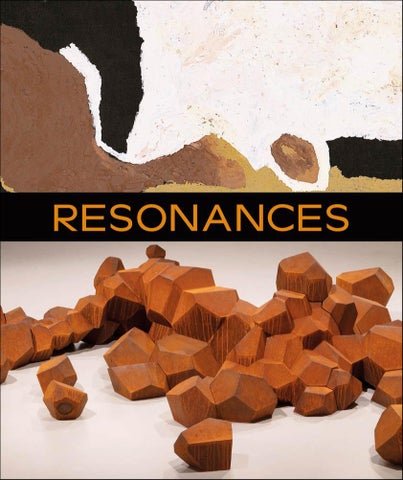
The exhibition Resonances stemmed from the idea of building bridges between Collection Bérengère Primat and the Dragonfly Collection. Both are connected by a strong spiritual dimension and convey a message shared by sisters Garance and Bérengère Primat, which celebrates the intelligence, beauty, and unity of the living. The Dragonfly Collection includes works by modern and contemporary Western, African, Asian and Australian Indigenous artists, as well as many objects and minerals. Today, the Collection Bérengère Primat comprises more than nine hundred works of art, hence forming the most important collection of contemporary Aboriginal art in private hands in Europe. Combining these two collections fuels a universal topic: being in the world. These works, most of which have nothing in common, whether country of origin, horizon, or culture, will trigger a vibration. Challenging categorization by type, the exhibition focuses on the intrinsic connections between the works. We have created an unrestricted score — for solos, duos, trios, and quartets — that highlights what is deeply rooted in Australia: life is a series of connections. People aren’t merely human beings: they are systems that don’t exist beyond a relationship with their environment, which defines them and changes them
10
Detail 83 11
through interactions, in any form, with others, throughout their lives. For Aboriginal people, there is no
TALES OF THE EARTH AND THE SKIES
limit between the Sky and the Earth: life is a circle. And this freedom opens up new spaces in us — like the music that guides us, enshrouds us, impels us towards the elsewhere. This analogy isn’t coincidental,
The earth is matter, and it offers itself to our gaze: the surface of the Earth, the surface of the Moon,
since each Aboriginal work of art hails from a song from the Dreamtime. Before it is painted, a canvas is a
the star-studded sky. Visitors plunge into “Récits de terres et de ciels”. The title pays tribute to Jean
dance, a scansion, a rhythm, a breath, a voice narrating the ancestors’ journey, celebrating the sacred time
Dubuffet, who travelled across Algeria and the South of France in search of virgin land. Artists remind us
when beings were protean, transitioning from plant to animal, then to human, and changing yet again, to
of the primary surface’s complexity, rich with pigments, fertile and diverse. They raise the earth so as to
travel the Earth and bring to life its streams, reliefs, caves, depositing the secrets of life in them. Aboriginal
place it level with our gaze, to help us face that which we constantly tread. Raw earth removed from the
art is the oldest pictorial tradition. Sixty-thousand-year-old motifs have remained intact on rock; today,
ground resonates with Rover Thomas Joolama’s work, which uses ochres, natural pigments and resinous
these very motifs are still produced. Since the 1970s, as they transcribed their mythology onto long-lasting
binders. Here he painted a large black surface surrounded by white dots, verging on abstraction. Is it the
media, Aboriginal artists have shared their rich and abundant knowledge. Aboriginal painters are custo-
night, his territory, the sanctuary of a ceremony? Admittedly, the motifs carry an intrinsic meaning, but
dian bearers of Dreamtime stories, as are the artists from the Dragonfly Collection: lifeblood flows. They
the picture is symbolic and depends on the personality of the painter. The dot, a recurring motif of desert
explore increasingly miscellaneous media, avoid being confined by a specific know-how. Their pieces are
Aboriginal practice, is made with a stick covered in paint. According to Kandinsky, “the geometric point
suffused with chemistry, meditation, combining technological and traditional materials.
is [. . .] the ultimate and most singular union of silence and speech” (excerpt from Point and Line to Plane, 1926). This epiphany by the Russian artist offers a wonderful echo to help us probe this mysterious and
Resonances brings together those bearers of dreams.
powerful motif.
The exhibition is an odyssey towards the primordial woman-man, the first Being whom we discover
In Aboriginal art, primary elements are ubiquitous. Noŋgirrŋa Marawili has painted on tree bark the
buried and who becomes incarnate at the outcome of the tour. Let us reconnect with our ancestral
movement of water and wind, the power of the air, and the invisible forces that bring the land to life.
memory for the visit. The Aboriginal’s vision of the world is entirely imbued by the Dreamtime, the time
Terrestrial and celestial attraction. Visitors are propelled into the sky by Clifford Possum Tjapaltjarri,
of the eternal present when past and future meet, allowing the living and the beyond to converse, fauna
another Aboriginal master. He makes the elements vibrate with his Star Dreaming (2001): his stars spar-
and flora to merge, minerals and stars to touch…
kle. The Milky Way is also revealed on burial poles. For Gulumbu Yunupingu, stars are symbols of the souls of the dead and of the journeys of ancestral beings, from the Dreaming until now. The three poles
I saw the universe, this place, the earth, the people and the stars and thought, “We are just like the
decorated with stars resonate with the one-of-a-kind photographs in the Red Light (2018–19) series by
stars. All gathered close together. We are really like one, as the stars.” We are so many together
Kiki Smith. These compositions, adorned with celestial motifs evocative of the sun and inspired by pre-
living on the earth. And the land, the sea, the sky are a continuum. Like one [. . .]. Your stars are
history and the Byzantine era, are engraved on photographic paper and seem to hail from another world.
like ours.
The German-born, New York–based artist creates complementarity where we are all too often tempted GULUMBU YUNUPINGU
to see antagonism. It is the main reason why we chose several of her works for this exhibition, along with
EXCERPT FROM COUNTRY OF THE DREAMING, 2017
the diversity of her creative media. Like the Aboriginal mythology conveyed by the artists, that which is usually divided in Western societies cohabitates at the heart of Kiki Smith’s work: man and animal,
The exhibition is structured around five sections. Since the idea is to open up spaces, the installation
male and female, the soul and the body, the individual and the collective, the real and the imaginary, the
is as spare as possible to allow visitors to wander about. The variety of works in terms of materials,
infinitely small and the infinitely big.
colours and formats creates an environment that lets them enjoy the spotlight. The walls are black,
12
ochre and red: the shades of the Australian desert. On the first floor, night has fallen, immemorial, a time
A round, full lunar surface, sculpted by Chinese artist Gao Weigang, lies on the floor. On it, one can
when the primordial Being was buried on the edge of the Earth. Visitors can stroll through “Récits de
see craters as glimpsed from a telescope. The piece, entitled Prophecy (2016), conveys the artist’s rela-
terres et de ciels» (Tales of the Earth and the Skies) and then “le Pouvoir de métamorphose” (Power
tionship with today’s world. Aware of environmental issues, he produces a body of work infused with
of Transformation). On the ground floor “Les secrets de la Terre Mère” (Secrets of Mother Earth) are
timeless poetry. This piece was on display at the exhibition Poussières d’étoiles (Stardust) at the Domaine
unveiled, followed by “Les Origines» (The Origins), while the light of day shines as “l’Être premier” (First
des Étangs, which for the first time showcased works from the Dragonfly Collection. Our purpose was
Being) is revealed.
to honour Hubert Reeves’ words, and to remind ourselves that we are all composed of celestial atoms.
13
the coloured ribbons on a small watercolour by Sol LeWitt entitled Squiggly Brushstrokes (1997), likely
The exhibition is part of a philosophical (led by Emanuele Coccia1 and Baptiste Morizot2) and anthro-
influenced by the ancestral know-how and the freedom with which contemporary Aboriginal painters
pological (Philippe Descola and Deborah Bird Rose) movement that aspires to decompartmentalise
appropriate codes. Both these organic and sensory pieces were produced the same year, 1997, naturally
knowledge, just as plants and animals invent new lifestyles in order to adapt to our profoundly changing
without any interaction between the artists — a coincidence, a resonance in any case.
world. In this respect, it is also an attempt to reflect on the devastating effects of the Anthropocene and on new definitions of animism. All the artists here are poetic adventurers: they challenge the
Stone figures share celestial references in The Moon Man and Moon Woman (1970) by Lame Toby
future of humanity, the territory, the flows. They renew with a fertile imagination in order to invent
Mungatopi (on loan from MAGNT, Darwin, Australia). We know the universal links that connect the moon,
the world to come, in order to “withstand disaster” (Isabelle Stengers3). Aboriginal painters contem-
fertility and motherhood. Aka, la fille du Diable (Aka, the Devil’s Daughter, 2018) is concealed in an altar-
plate the times we are going through from a broad, joyful and powerful perspective. We will try not
piece by French painter Jérémy Demester. Who is she, lost in the incandescence of these blazing oranges,
to plunder knowledge that is unfathomable to us. Resonances creates a new emotional and relatable
blues, reds and yellows? Demester works in layers and plays with secrets, like many Aboriginal artists
artistic mapping: a contemporary symphony. The artists, from all over the world, which we showcase
whose canvases are rendered hypnotic through these hidden layers. Its enigmatic title stems from the
at Fondation Opale, invite us to reconnect with what Aboriginal people have known for a long time:
tale “The Hour of the Devil” by Fernando Pessoa. This expression is borrowed from the gypsies, the com-
the land is the law, and we are never alone.
munity in which the painter grew up, and refers to the moon. Jean Arp has created Fleur de rêve au museau (Dream Flower with Lips, 1954), while Mabel Juli paints a rising crescent moon. These Moon Dreamings
INGRID PUX
(2000), like Mick Kubarkku’s, are evocative of the solar cycle, the movement of life, growth and decay,
CO-CURATOR OF THE EXHIBITION RESONANCES
mortality and rebirth. The moon, a star from the sea, watches over Mermaids (2000, 2002, 2007) by Owen Yalandja. They gently move around Salt of the Earth (2012) by Anselm Kiefer. In this book, no words appear, the pages are made of lead, simultaneously heavy and fragile, oxidised over time. The painted colour pigments change: the alchemy of knowledge, the vortex of knowledge, the seat of ultimate memory. Johnny Warangkula Tjupurrula’s cave also invokes memory, the memory of the first Being. His shelter, the memory of the first drawings, the first carvings that tell the story of life, pass it on and reinterpret it. Anish Kapoor also sculpts flowing lines in alabaster, three circles outlining his primordial cave. An allegory of alchemy, the piece induces the renewal required to preserve our world. The work of the British Indian is laid on the floor, like a threshold to be crossed in order to regain possession of oneself and open up to the Other. Concentric waves and lights take centre stage in Kulama (2018), a painting by Timothy Cook in which sacred and ancestral rites combine in a colourful and powerful whirlwind. Giuseppe Penone offers more vibrations and an imprint. The artist inlays his presence as a witness. In this huge drawing, he questions our position with regard to the earth we were given and the earth we will bequeath: inheritance, transmission — priceless values in Aboriginal mythology — using circles to illustrate the age of a tree. Propagation (2011), the title, highlights the activities of everyone. It questions us today; what one does or does not do has consequences. On the floor, the waves of the painting are propagated: the body paintings circulate, they spread like fire, clearing a path for the two brothers, until arriving at the salt lake Wilkinkarra and The Water Site of Mamara (2000). This radiant canvas by Tjumpo Tjapanangka plunges us into an ultimate contemplation. Resonances concludes with the marvel of being alive in this world.
18
NOTES
1 Emanuele Coccia, The Life of Plants: A Metaphysics of Mixture, 2016
2 Baptiste Morizot, On the Animal Trail, 2018 3 Isabelle Stengers, Résister au désastre, 2019
19
85 Owen Yalandja Yawkyawk / Mermaid, 2002 Natural earth pigments on wood Height: 178 cm
130
131
85 Owen Yalandja Yawkyawk / Mermaid, 2002 Natural earth pigments on wood Height: 178 cm
130
131
86 Owen Yalandja Yawkyawk / Mermaid, 2000 Natural earth pigments on carved wood Height: 183 cm 87 Owen Yalandja Yawkyawk / Mermaid, 2007 Natural ochres on wood Height: 196 cm
132
133
86 Owen Yalandja Yawkyawk / Mermaid, 2000 Natural earth pigments on carved wood Height: 183 cm 87 Owen Yalandja Yawkyawk / Mermaid, 2007 Natural ochres on wood Height: 196 cm
132
133
ď ´
89 Johnny Warangkula Tjupurrula Kalipinypa / Big Cave and Waterhole Dreaming, 1972 Synthetic polymer powder paint on composition board 61.5 x 46 cm
ď ľ
90 Anish Kapoor Chamber 3, 2016 Alabaster, gold leaf and pencil 95 x 61 x 58 cm Dragonfly Collection
136
137
ď ´
89 Johnny Warangkula Tjupurrula Kalipinypa / Big Cave and Waterhole Dreaming, 1972 Synthetic polymer powder paint on composition board 61.5 x 46 cm
ď ľ
90 Anish Kapoor Chamber 3, 2016 Alabaster, gold leaf and pencil 95 x 61 x 58 cm Dragonfly Collection
136
137
91 Timothy Cook Kulama / Yam Ceremony, 2018 Natural pigments on linen 200 x 200 cm
138
139
91 Timothy Cook Kulama / Yam Ceremony, 2018 Natural pigments on linen 200 x 200 cm
138
139
RESONANCES Presented at Fondation Opale, Lens / Crans-Montana (Switzerland) from June 14th, 2020 to April 4th, 2021
THE EXHIBITION
5 CONTINENTS EDITIONS
All rights reserved – Fondation Opale For the present edition
CURATORS
ART DIRECTION
Hervé Mikaeloff
Annarita De Sanctis No part of this book may be reproduced or utilised in
Georges Petitjean Ingrid Pux
© 2020 – 5 Continents Editions
EDITORIAL COORDINATION
Elena Carotti
any form or by any means, electronic or mechanical, including photocopying, recording or any information storage and retrieval system, without permission
PRODUCTION
in collaboration with
Fondation Opale
Lucia Moretti
CHAIRPERSON
PROJECT DESIGN AND LAYOUT
5 Continents Editions
Bérengère Primat
Lara Gariboldi
Piazza Caiazzo 1
DIRECTOR
EDITING
Gautier Chiarini
Charles Gute
in writing from the publisher.
20124 Milan, Italy www.fivecontinentseditions.com ISBN 978-88-7439-934-5 COPY EDITING
THE CATALOGUE
Nathalie Bizart
AUTHORS
TRANSLATION
Distributed in Italy and Switzerland
Jean-Hubert Martin
Aisling Halleman
by Messaggerie Libri S.p.A.
Georges Petitjean
COLOUR SEPARATION
Printed and bound in Italy in April 2020
Bérengère Primat
Pixel Studio, Bresso
by Tecnostampa – Pigini Group Printing
Distributed by ACC Art Books throughout the world, excluding Italy.
Hervé Mikaeloff
Garance Primat
Division, Loreto – Trevi
Ingrid Pux
for 5 Continents Editions, Milan