4
Contents Before You Dive In
6
Model and Roadmap at a Glance
20
Step 1:
Face Your Career Shifts
34
Step 2:
Reach Your Tipping Point
56
Step 3:
Close Your Chapter Well
88
Step 4:
Give Yourself a Pause
106
Step 5:
Know, Grow, Own You
126
Step 6:
Set Your New Course
158
Step 7:
Test. Learn. Repeat.
172
Step 8:
Bring Your New Crystal to Life
200
Epilogue
212
Endnotes
220
5
Step 8 Bring Your New Crystal to Life Step 7 Test. Learn. Repeat.
Step 6 Set Your New Course
Step 5 Know, Grow, Own You
Step 4 Give Yourself a Pause
Step 3 Close Your Chapter Well
Step 1 Face Your Career Shifts
Step 2 Reach Your Tipping Point
Before You Dive In
7
Why career change is becoming the new normal The professional world you grew up in is not the same world you’re navigating today. We used to live in a time when a career meant stability, one career for life. You finished your studies, built experience in a job linked to them and stayed in more or less the same professional context until retirement. Maybe you switched employers, maybe you climbed the ladder, but the foundation of your career remained stable until you retired.
Today, the ground has shifted. In both our professional and private lives, tipping points now appear far more often. They are pivotal moments that put an end to how you were used to work and create an opportunity to do things completely differently. They tilt the balance and lead to a decision, forced or chosen, to close your current career chapter. As a result, careers now evolve in distinct phases rather than as one lifelong path. Each phase can represent a new professional version of you: sometimes a different type of organisation (for example, profit versus non-profit), sometimes a completely new way of working (doing versus teaching) or even a redefined idea of what you want to achieve in your career. Career stability is no longer the norm. Across Europe and globally, employment contracts are shortening, skills are disrupted faster and more people report reconsidering their professional path. These trends are confirmed by recent labour-market and workforce analysis.1-2 More than one force is at play. In today’s world, several streams converge:
External disruption (outside-in) Markets are disturbed, sectors reinvent themselves and technology, AI most visibly, reshapes tasks and roles. We’ve entered what is called a polycrisis3 or permacrisis rhythm, with ongoing turbulence in geopolitics, climate, energy, technology, cyber risks and many other domains continually rewriting the rules. Even if your job title survives, its contours no longer stand still. We are navigating a confusing transitional phase in the world around us.4
8
Professional system shifts (organisational context) Organisations react to these disruptions, often transforming the system you work in. We see this through, among others, consolidations, restructurings, new technological models, geographic shifts and an explosion of startups in emerging niches. More changes will follow. These shifts create new roles and sunset old ones, reshaping your career whether you asked for it or not. Internal evolution (inside-out) As you grow and invest in yourself, your professional energy drivers and priorities evolve. What energised you five years ago may now feel constricting. In addition, impactful life events such as illness, caregiving, becoming a (grand) parent, the empty nest, a new partner or divorce can reorder what matters. Demographic evolution (societal context) Another force at play is demographic change. These demographic trends are well-documented5 and show that longer life expectancy and shrinking working-age populations lead to longer working lives. As careers stretch across more decades, people naturally begin to look at their professional life in phases rather than as one continuous line.
All these forces create separate shifts and soon you will learn how to recognise them in your own career. When these forces intersect in your life, they impact your professional world and often also your personal life, creating a tipping point. In this book, the focus lies on navigating the change in your professional life.
When your career chapter closes: Forced or chosen? At some moment, all those shifts accumulate and one final factor tips the balance. That’s the tipping point. It can arrive with a loud bang or it can slip in quietly. Either way, the feeling is unmistakable: there comes a moment when you can’t keep doing your job in the same way, either because you no longer can or because you no longer want to. A decision is due.
Reshape Your Career
9 Do you choose the closing or is it forced on you? You might wonder: what brings you to the point where a career chapter comes to an end and you start questioning what comes next? The answer is twofold. Sometimes the closing of your career chapter is forced upon you. Other times, you decide yourself that it’s time to let go. Later, we’ll explore the different types of tipping points in detail. For now, here is a brief introduction to the distinction between a forced and self-chosen decision to close your current career.
When life forces your hand Sometimes you don’t get to choose. A sector is disrupted. A dismissal pulls the ground from under your feet. A new technology replaces your job. Or a personal life event forces you to stop your current career. When a career-change process begins with a forced closing, the emotional weight makes it even harder. You will find tips on how taking a pause and creating mental closure become essential. But here is what I want you to remember: even if the decision to end your current career wasn’t yours, the decision about how you shape your next one is entirely yours. You may not have chosen the ending, but you can choose the beginning that follows. This book will show you how to walk through that process.
When you choose to let go For others, the impulse comes from within: a quiet restlessness, a growing sense that your current career no longer fits you. It can arise from success, yet you find yourself asking if this is really it for the rest of your career. That inner questioning can slowly build until it reaches a tipping point, a moment where you realise that continuing in the same way is no longer an option. The choice you face first is not how to build your new career, but whether you are ready to fully let go of your current career chapter. You must choose: Continue? You may stay, but with meaningful adjustments. Close? You may feel the pull to reshape your career entirely. Before You Dive in
10 In the latter, the closing of your current career chapter is not imposed, it is a conscious choice. And that choice can feel daunting. Letting go without yet knowing what comes next can feel like stepping into the dark. That uncertainty holds many people back from making the change they want. I would like to take away that brake. Because I strongly believe that if more people understood how to navigate a career-change process, far more would dare to choose it. This book shows you how.
Who this book speaks to Career change is no longer limited to one group or one age. Today, professionals of all kinds find themselves navigating career changes. The core roadmap in this book applies broadly across sectors, roles and stages of life. At the same time, your context matters. To help you recognise your own situation, where relevant, you’ll find Deep Dive sections: short, focused pieces with specific tips, examples and reflections tailored to two contexts:
The entrepreneurs (working for your own account) I use the term entrepreneur in the broadest sense for: Business owners, whether in the commercial or non-profit sector, started via acquisition, founding or succession. Self-employed practitioners working on their own account across many sectors, for example, doctors, physiotherapists, psychologists, lawyers, accountants, architects, electricians, consultants, coaches, creatives, journalists, … and many more.
If you are in this entrepreneurial group, a career change carries an additional layer of complexity. Your professional shift is often intertwined with the future of your company, your clients and, if relevant, your team. Sometimes the best long-term path for you is no longer tied to the business you built. At other times, the best strategic choice for the business, selling, merging or handing over,
Reshape Your Career
11 may no longer be tied to you, leaving you with the task of reinventing your own career. These Deep Dives will highlight those specific challenges and offer targeted guidance to help you navigate them. CONSULT THE DEEP DIVES MARKED ENTREPRENEURS
The professionals (working within an organisation) Some of you work within an organisation, as professionals with a contractual role in a company or public institution. This group includes businesspeople and professionals in various sectors: from business, education and healthcare to the military, public service, sports, media and beyond. Whether you’re a manager, a teacher, a copywriter or a nurse, you may face disruption that forces change or you may simply feel a growing urge to redesign your career on your own terms. This book will help you navigate both situations.
CONSULT THE DEEP DIVES MARKED PROFESSIONALS
A note for students and early-career professionals I also see a growing number of students thinking consciously about how to design their first career. That first step into your working life is already a tipping point, as you close your chapter as student. Instead of rushing in, you can pause and design that first career chapter intentionally. From Step Five onward, this book will give you tools to do exactly that.
Why the entrepreneurial mindset matters Whatever stage of your career you are in and whatever path you are considering, one element will strongly influence how you navigate moments of change: an entrepreneurial mindset. This has nothing to do with whether you own a business or not. Many employees, teachers, healthcare workers, artists and civil servants think entrepreneurially without ever calling themselves
Before You Dive in
12 entrepreneurs. What matters is how you approach change. An entrepreneurial mindset is a way of thinking and acting when the path ahead is uncertain: You take ownership of your future instead of blaming circumstances. You start from what is possible, not from what has been lost. You stay curious, willing to test, innovate and redesign. You keep moving, even when setbacks come. My own entrepreneurship professors Crijns6 and Dillen7 characterise entrepreneurship as the drive for autonomy, perseverance and a strong resistance to accept what others call reality. This spirit turns tipping points into beginnings rather than dead ends. With it, you can orchestrate change instead of being dragged by it. Note that this book has no intention to push you toward radical change. Its purpose is to help you make a well-grounded decision about your professional future, whether that means continuing with adaptation or a more in-depth career reinvention. Because what matters is finding the best fit for you.
What if stability is key for you? In fact, a radical career change isn’t the right path for everyone and that’s perfectly fine. If stability is an important value for you, continuing your career with adaptations may be the better fit. Still, when the shifts in and around you accumulate and push you into a tipping point, you will inevitably need to question your current career. The key is then to acknowledge how deeply those shifts affect you and what level of adjustment feels right. You may find that smaller adaptations, rather than a full reinvention, are enough to restore energy and alignment. I remember a teacher who loved painting in her free time. Her career didn’t shift overnight; it evolved gradually. She reduced her teaching hours and built a side profession around her art, selling her work and offering workshops.
Reshape Your Career
13 Not every career change must be drastic. What matters is making a conscious, grounded choice about what’s best for you. So I encourage you to read this book with an open mind to discover inspirations and new perspectives for your journey.
Write your story I didn’t write this book to tell my story. I wrote it to help you write yours. And yes, this is meant metaphorically. But at the same time I encourage you to literally capture your own reflections in writing as you move through your career change. Create a space for it: a notebook, journal or digital file. Writing things down will help you notice your own shifts, track your learnings and later revisit insights when you’re in a different step of your journey. To support you, you’ll regularly find short check-in questions throughout the book, marked with . Use them as a moment to pause, reflect and write down what resonates. . So let’s begin with your first check-in. Which mindset resonates most with you right now? Do you crave stability? Do you resonate with the entrepreneurial mindset? There is no better or worse. What matters is recognising yours, because understanding your mindset will help you navigate your career change in the way that fits you best.
Before You Dive in
14
Why I wrote this book As said before, this book is not about my story. However, I will briefly introduce myself, so you understand why I wrote it. And at the end, I will share my new career chapter. I’m living proof that an entrepreneurial mindset can come in many forms. I grew up in a world far away from business ownership. We didn’t have much financially, but my mother compensated with love, perseverance and care. I quickly realised that education and hard work would be the foundation for my independence. So I took responsibility for my own path. You could say I developed an entrepreneurial mindset the hard way. In my first ten professional years, I worked as a professional within commercial organisations: first as a logistics planner, stepping up to logistics manager and later as a business consultant. Work was about building financial stability and continuous learning. I was fascinated by optimising how companies operated. I was constantly drawn to ideas, improvements and smarter ways of working. I liked to understand processes and systems and then rethink how they could work better. But after some years, I felt a growing tension. As an employee, I was expected to stay within the box, while my mind wanted to think beyond it. I wanted to shape, not just follow. That friction became my own early tipping point: a realisation that, if I wanted to create the kind of workplace I’d love to work in, I needed to take ownership at a higher, strategic level. But how? So, I decided to follow a part-time MBA to learn more about this strategic business level, with the intention of becoming a senior partner as consultant. My husband was very supportive and with a one-year-old at home, I combined study with a full professional workload. However, during this International MBA at Vlerick Business School, a conversation with a professor opened my eyes to a career path I had never considered: entrepreneurship. Until then, I had never personally known an entrepreneur apart from the owners I worked for. But that spark of possibility, combined with the confidence boost from the MBA, gave me the courage to take the leap together with a fellow MBA colleague.
Reshape Your Career
15 At 30, I became an entrepreneur through acquisition; we took over a small existing company in joint ownership and reshaped it for growth. For those who ask where our own capital came from: there was none. Without going into technical details, it was a very risky move, financed through substantial loans and guarantees. For the next two decades, my professional life became do-do-do, go-go-go, leading and growing businesses through innovation, disruption and change. And just after starting as an entrepreneur, I became pregnant with my second son. But I was so full of adrenaline and conviction that I could combine it all, which worked thanks to the support at home of my husband and family. I loved the business owner-manager thrill. My drive was to turn every challenge into improvement and every disruption into opportunity. I learned what it means to steer through crises, to innovate under pressure and to make the hard strategic calls when the market demands change. Those years also deepened my conviction that entrepreneurship is not just about business, it’s a way of life. It’s about seeing a road ahead amid uncertainty and creating a path where none exists. But as much as I loved business growth, another side of me, the passion for human growth, kept calling. I was fascinated by the person behind the professional. I invested in personal development myself and we introduced soft-skills training across the organisation. In my own agenda, I shifted more and more time to mentoring managers, supporting teams and deepening relationships with clients. Still, I often felt that those two sides, the business race and human depth, competed for space. Then, after two decades, came a new tipping point. Looking back, many shifts had been building up, some obvious, others quietly gaining weight in the background. Our sector was entering a wave of consolidation and with the disruption of COVID, that evolution accelerated. In parallel, family events reshaped my priorities and years of self-development made me question whether the professional role that once energised me was still the best fit. Strategically, the right move for the company I was leading was to integrate into a larger group. It was the best decision for the business, but it meant closing my chapter as co-owner and CEO.
Before You Dive in
16 The hardest part wasn’t the decision itself; it was letting go of the identity I had carried for nearly twenty years. I was no longer “the owner-manager of…”. Closing that chapter felt like dismantling a part of myself. That experience changed me. I discovered that while there was plenty of guidance on business change such as strategy models in times of disruption and organisational change models, there was almost nothing on personal career change at this depth. I found no roadmap for individuals facing a radical change in their professional life. And in countless conversations, both with entrepreneurs and professionals, I heard the same hesitation: “I don’t want to let go of my current career because I’m afraid to take the plunge without knowing how to go through this process.” It struck me: people do not stay because they don’t want to change; they stay because they don’t know how to change. And that uncertainty holds them back. With my passion for personal growth, it became clear to me that I could create impact by supporting others in their career-change journey. But I wanted to do this in a scalable and easily accessible way. So I decided to build a structured roadmap where none existed. Drawing on my genuine curiosity about what people’s real stories are, I studied dozens of cases, interviewed people in or after their career change, explored which business models could add value and dived into literature and online sources (see Endnotes). Along the way, I noticed something important: every source offered pieces of wisdom, but each covered only a fragment of the journey. I found tips on closing a career from Hall & Stokes,8 but only in a retirement context. Some guidance on building a new professional identity came from the rare career expert Ibarra.9 I gained insights on rediscovering yourself from the human development field. Business models offered learnings in innovation and behavioural change. And above all, real-life cases revealed the practical do’s and don’ts. It wasn’t that I invented the content of each step. My added value was connecting the dots, using my skill to bring order to complexity and combining insights from different sources into one coherent structure. Over time, an integrated framework
Reshape Your Career
17 emerged to me: a roadmap to reshape your career and a model highlighting the different career elements. To validate it, I tested it, mirrored it against real-life cases, sparred with experts and refined it until it became the eight-step roadmap and career model presented in this book. Those I disclosed it to were positive about how it brings structure and clarity while still honouring the emotional reality of change. Their responses confirmed the need for rational guidance in this chaotic personal journey, much like business models bring clarity to organisations navigating transformation. As in business, every disruption forced me to rethink, pivot and explore new ways. Those moments were rarely comfortable, but often the most fertile. That is the mindset I bring to this book. When disruption strikes, through market forces, personal circumstances or inner evolution, you can take control and redesign your own professional future. You can reshape your new career. This book can show you how.
How this book is structured This book is built around the eight-step career-change roadmap: a structured yet human-centred process that guides you through each step of reshaping your career. Every step is unfolded in its own chapter and represents a distinct phase you are encouraged to move through. Each chapter brings together two layers: The content: what the step means, why it matters and how you can navigate it, enriched with reflections, pitfalls to avoid, self-care tips and support elements. Elena’s story: a narrative thread that brings the step to life, illustrating how a real career-change journey might look and feel. At the end of each chapter, you’ll find a set of key takeaways. I highlight the core, the importance and the pitfall of the step, as well as the role of your wing(wo)men.
Before You Dive in
18 For those who like to learn through stories: Meet Elena Elena’s journey reflects the many career-change stories I’ve encountered over the years. Through her experience, you’ll see how each step of the roadmap can unfold in real life: the uncertainty, the difficult choices, the rebuilding and the victories. Her story is there to make the eight-step roadmap tangible, practical and relatable. Elena is not a real person. Her story is composed from numerous real-life sources: interviews, case material and elements of my own experience. Rather than sharing individual stories, I chose to bring their essence together into one in-depth narrative. The emotions, challenges and breakthroughs you’ll read are real; the specific details have been deliberately fictionalised to protect privacy. Although Elena’s perspective is that of an entrepreneur, her journey serves primarily as an illustration of the career-change roadmap. It helps make the steps concrete and understandable, also for professionals working within organisations. Throughout this book, you’ll also encounter shorter examples from other career contexts, ensuring the insights remain relevant regardless of your background. Read Elena’s story as a guide alongside the eight-step roadmap, helping you navigate your process more intuitively as you shape your next career chapter.
Reshape Your Career
19 Before you turn the page, a quick check-in.
Do you recognise yourself in that mix of doubt and possibility that comes with a career tipping point? Do you feel the pull to move forward, but also the weight of uncertainty holding you back? If so, you are not alone. This book is written to give you clarity, perspective and structure to support your career-change process, at your own pace. You don’t need all the answers today, only a willingness to begin. Take a deep breath. Let’s start.
Model and Roadmap at a Glance
21
Model and roadmap at a glance Before we start with Step One, here’s the bigger picture. This book brings together two simple but powerful elements:
A.
The Career-Crystal™ Model to Visualise Your Career
W
W
HE
HY
RE
YO U
HO
W
W
WH AT
HO
This is a simple visual that captures your professional life through six interconnected elements. You already have a Career-Crystal shaped by your past or present. This book supports you in consciously reshaping it into a new, more aligned Career-Crystal, one that fits your new tomorrow.
B.
The 8-Step Roadmap to Reshape Your Career
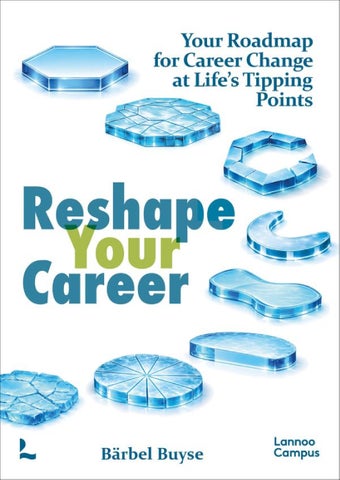
A practical, structured eight-step process that guides you in changing your career, from old to new, step by step. This roadmap, symbolised on the cover, represents your structured path to reshape your career with clarity and confidence. The steps start from the bottom and build up to the top. Don’t worry, we’ll keep things practical and concrete. The model and roadmap are designed as working tools, to help you see where you stand, what’s next and how to move forward. You’ll find both visuals in the fold-out flaps for easy reference as you move through your career-change journey. Model and Roadmap at a Glance