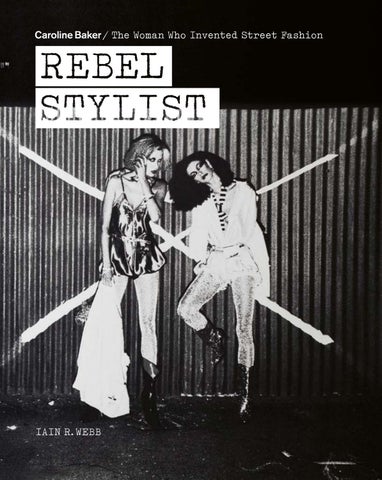
Caroline Baker / The Woman Who Invented Street Fashion
IAIN R.WEBB
CONTENTS
6 9
FOREWORD by CB / Rebel Style INTRODUCTION by IRW / Rebel Rebel
i / Caroline Baker with daughter Elodene - Nick Knight, i-D, October 1985
18 22 32 48 53 66 72 86 98 118 129 140 157 168 177 187 196 216 224 235 246 254
ONE / Rebel Women TWO / Army Dreamers THREE / Punk Rocks FOUR / Reggae Boys FIVE / Pirates and Buffalo Gals SIX / Really Saying Something SEVEN / Anachronism in the UK EIGHT / Belt and Braces NINE / Men Swear TEN / Be a Sport ELEVEN / It’s a Wrap TWELVE / We Are the World THIRTEEN / Get Knitted FOURTEEN / Tits Up FIFTEEN / Up Yours SIXTEEN / Under Where? SEVENTEEN / The Way We Wore EIGHTEEN / Modern Times NINETEEN / Pin-Ups TWENTY / Lace and Fineness TWENTY-ONE / Old Romantic TWENTY-TWO / Fierce Glamour
268 270 272
INDEX PICTURE CREDITS ACKNOWLEDGEMENTS
CAROLINE BAKER
FOREWORD Rebel Style
WHO AM I? I was born in Argentina. My British parents had emigrated during the recession that hit Britain after WWI and settled in the countryside at the foothills of the Andes, running a fruit farm and vineyard. Our way of life was thoroughly British; every evening listening to the BBC World Service, our pink house surrounded by a green lawn with rose bushes. I was educated at English boarding school in Buenos Aires, but my parents worried I would have no future in Argentina, so they sent me to England to stay with relatives. In those days girls were usually sent to finishing schools to be polished off as perfect housewives. Further education was not the norm. No one had ever mentioned working for a living, a career, so off I went on board the Blue Star Line ship to a new home, a huge blank canvas of the future lay ahead. I was a total fashion addict from an early age. I have always been fascinated by fashion and design, the way I looked and the clothes I wore. Growing up in the countryside and at boarding school with no television or magazines, occasional trips to the cinema and reading the British Buenos Aires Herald newspaper that covered fashion news from Paris were my only sources of fashion info. My parents were into very elegant classic British style. Dad was totally the Duke of Windsor and mum followed the styles of the day influenced by Her Majesty The Queen. We used a dressmaker to make special outfits but generally, when not in school uniform (navy pleated tunic over a white shirt and green-and-blue striped tie), at home on the farm I lived in jeans and white shirts. I arrived in London with hair backcombed into a beehive, black eyeliner, circle skirt with frothy net petticoats making it stick out nicely, my feet squeezed into stilettos, only to discover that was ‘out’ and now it was the Mary Quant dolly bird look: little shift dresses and flat shoes. With no money for trendy clothing, I got inexpensive versions of the new looks at C&A. Biba boutique was the holy grail.
I got a diploma in shorthand and typing at secretarial college and got straight to work earning my living. After joining a temp agency, I was sent to work for Shirley Conran, home editor at the Observer magazine. Shirley took me on as a secretary/assistant and so I fell into the media world and all things to do with design, interiors and architecture. The art director at the Observer introduced me to Molly Parkin, who was looking for an assistant to help her with home and interiors, having just been given the role of home editor on top of her fashion editor role at Nova. So, I became Molly’s assistant, working with her team, organising and building sets for her fashion stories. I had the address book with all the contacts. Soon after I joined, Molly Parkin left Nova, and editor Dennis Hackett called me into his office and said, “You look like you know all about fashion.” At that time, I was a Twiggy clone with a Vidal Sassoon all-fringe five-point short haircut. He offered me the job of fashion editor, responsible for producing at least eight to ten pages of fashion per issue. Never having done a fashion story before, I was thrown in the deep end. The editor insisted our fashion pages had to be different to all the other women’s fashion magazines. Nova was a new style experience for ‘liberated’ women, so I began exploring alternative sources for clothing. Army surplus, leg warmers and tights from ballet shops, waiters’ and chefs’ clothing, menswear (especially second hand), and even hospital gowns became material for my fashion pages. It was at Nova that I developed what became known as street style. I would make the clothes (not necessarily made for a female figure) fit by using belts, braces and men’s waistcoats. I would style them in a very natural, girly way, very much against the perceived ‘toys for boys’ image of women: a very painted, made-up lady. Nova folded at the tail end of 1975, a victim of the economic recession. Freelance fashion editing had only just started and I contributed to British Vogue, French Elle, Italian Grazia and Donna, German Stern and other titles that approached me from around the world. Alternative fanzines and magazines were launched. Terry Jones, who was art director at British Vogue at that time, launched i-D and I worked on many of the early issues. I also contributed to The Face, Ritz and Deluxe. Of course, these jobs never paid. You did it for the love of it. I did a few fashion stories for British Vogue
6
but the editor Beatrix Miller decided I was not right for that magazine, which didn’t surprise me anyway. I felt very much the odd one out there, with no money, no posh daddy, no designer outfits. The end of the ’70s was a very turbulent time for me, with lots of changes going on. Unemployment, homelessness, general confusion and rebellion all rolled into one. In 1976 punk exploded and I became a devoted fan of the DJ dub hybrid versions of reggae, so much so that I went to Jamaica with a friend who was recording out there. I liked it so much I tried to get a job at The Gleaner newspaper. I had bought myself a good camera and had the idea of doing photo reportage focusing on fashion, but alas that was not to be, as recession and unemployment in Jamaica made it impossible. I returned to London as a Rasta girl, with my hair in rags (my version of dreadlocks), wearing voluminous skirts and trainers. I was living in World’s End, Chelsea, just around the corner from Vivienne Westwood’s shop, and ended up working as her assistant on the Pirates collection, followed by the Nostalgia of Mud collection. I also helped Malcolm McLaren on photography/styling with his launch of the band Bow Wow Wow. I restarted my fashion styling career at British Cosmopolitan, where I spent three years working with really cool photographers. The arrival of Japanese designers Rei Kawakubo, Yohji Yamamoto and Issey Miyake in Paris and their shapeless, loosefitting, jet black style, was not popular at Cosmo. I can’t do things just for sex. There is a political content running through everything I do and it just didn’t fit in with their ‘dress for men’ approach. I would always stick big boots and a man’s shirt on. After endless arguments with the editor, I resigned. The birth of my daughter in 1984, and a mortgage, introduced new responsibilities. I had to refocus my style: be more serious, less rebellious, while still trying to keep my free spirit. I joined the Sunday Times Magazine and started doing a lot of advertising work with photographers I had got to know at Nova, including Oliviero Toscani with whom I collaborated on the United Colors of Benetton international advertising campaign. I joined the Lynne Franks Agency and did commercial work, including styling fashion shows for Katharine Hamnett, John Rocha, Ghost, and Jeff Banks’ ByMail catalogue, which brought fashion into the home shopping arena. There were advertising campaigns for Next, Bally, Hermès, Jaeger and many others. I continued to challenge perceptions of what
�
REBEL STYLE
women could wear, whatever their age, and embraced ideas of feminism, multi-culturalism and identity politics. My vision is always open and I’m always taking in new information. I think people are so original. I’m very much a street person, out and about and travelling by tube. I love the contact with people that brings me. This book, concentrating on my REBEL STYLING, is a collaboration with Iain R. Webb, a friend and fellow rebel in the fashion world. Our conversations that follow, both verbal and visual, explain WHY I DID WHAT I DID. Caroline Baker, March 2021
7
iv / Ku Khanh, Deluxe, Autum n 1977 – outtake
8
INTRODUCTION Rebel Rebel
IN SEPTEMBER 1981, only a short time after being appointed fashion editor of Cosmopolitan magazine, Caroline Baker handed in her notice to the editor, Deirdre McSharry. Baker wrote: ‘There is no point in working for you if after weeks of time and energy put into a session, pictures get rejected… I feel I am probably too modern for Cosmopolitan, my attitude is one of equality, and to me it’s the clothes that are important... Fashion is male and female equality… This is a modern approach, and is the only way I can work.’ On the reverse of this typed letter McSharry scribbled: ‘Do come and talk. I wouldn’t dream of letting you go and I love 99% of all your pix!’ Baker did not leave, remaining for another three years. The rest, as they say, is (fashion) history. Since the start of her career in fashion media in the late 1960s, rebel stylist Baker has earned endless accolades, with fashion aficionados describing her as ‘a true original’, ‘innovator’ and ‘idol’. In a profile in 10 Magazine (2010) Richard Gray dubbed her ‘a progenitor’, adding: ‘her influence on successful (contemporary fashion) stylists – Sophia Neophitou, Katy England, Carine Roitfeld and Katie Grand – is incalculable.’ Baker’s work with the Italian fashion company Benetton has been acclaimed as ‘the stuff of styling legend’ and is still inspiring the latest crop of fashion students – tomorrow’s visionaries. From her first forays into the fashion world at Nova in 1967 to her last hurrahs at YOU magazine in 2013, Baker steadfastly communicated the same message, over and over, to her readers: ‘Today’s fashion depends more upon the way an outfit is put together than upon the clothes themselves’, read the caption to a fashion story called ADDING UP TO SOMETHING GOOD in Nova, March 1973. For Baker, fashion has never been about wait lists or must-have labels, but always the individual interpretation. In the debut issue of i-D magazine in 1980, Baker incited readers with a similar if more rampant rallying cry: ‘i-D counts more than
9
CAROLINE BAKER
�
CAROLINE BAKER
REBEL WOMEN
�
REBEL WOMEN
Donna, December 1983 – January 1984
3 / Katharine Ham nett (centre front) – Oliviero Toscani,
I first became aware of Caroline from her work on French Elle (pages 74-75); a specific image from a shoot she did, all in white cotton at the seaside in France haunted me and inspired me for years. What she did during her time at Nova, working with Harri Peccinotti and other photographers, was ground-breaking. I decided to collaborate with her after Joseph Ettedgui did a shoot with her to launch Chinese Laundry, a shop he opened specially for our collection. Caroline styled several of our fashion shows and when I published a magazine called Tomorrow, which was a mixture of fashion and politics, she did a fashion spread for me that we shot at Leighton House with all the clothes sourced from Oxfam charity shops (see page 243). Our working process was easy, instinctive, inspiring and incredibly smooth the whole was greater than the sum of the parts. Lovely. What makes her a successful collaborator? Caroline has a deep understanding of the meanings of clothes. She has flawless taste and fabulous imagination. There was never a cross word. Katharine Hamnett, November 2019
Ku Khanh, 1976 – unpublished Polaroids
1–2 / Vivienne Westwood (left) and Malcolm McLaren with Caroline Baker (right) –
At the time of the Pirate Collection, Caroline came into the Worlds End shop talking in her light, silvery voice, white teeth and whites of her eyes rolling. She’d just come back from the Seychelles on a shoot - light tan and freckles with a brown pencil line across her nose from ear to ear. Light brown hair in a soft styled ’40’s perm. So pretty, wearing a navy blue buttoned-up men’s gabardine. The next day she came to see me, she was dressed like slapstick with her hair in a centre-parting; it looked painted on, and exaggerated red peekaboo lips - right up and over. Striped shirt, white jacket, trousers. She began styling my clothes. As a punk I began myself drawing on make-up, we drew sideboards and moustaches on our pirates and Caroline added gold cigarette paper pressed round the two front teeth (see page 58) which she took as a tip from her boyfriend, Tony, who was a DJ. She was really into styling things by tying things on, sweaters round necks, sashes. She loved wearing things half on, half off. She loved our falling-down stockings. I have the most fantastic pictures we did together with [photographer] Robyn Beeche. Caroline and I did a lot together; she became one of my best friends. She even lived with me once. Vivienne Westwood, September 2020
20
21
CAROLINE BAKER
�
CAROLINE BAKER
REBEL WOMEN
�
REBEL WOMEN
Donna, December 1983 – January 1984
3 / Katharine Ham nett (centre front) – Oliviero Toscani,
I first became aware of Caroline from her work on French Elle (pages 74-75); a specific image from a shoot she did, all in white cotton at the seaside in France haunted me and inspired me for years. What she did during her time at Nova, working with Harri Peccinotti and other photographers, was ground-breaking. I decided to collaborate with her after Joseph Ettedgui did a shoot with her to launch Chinese Laundry, a shop he opened specially for our collection. Caroline styled several of our fashion shows and when I published a magazine called Tomorrow, which was a mixture of fashion and politics, she did a fashion spread for me that we shot at Leighton House with all the clothes sourced from Oxfam charity shops (see page 243). Our working process was easy, instinctive, inspiring and incredibly smooth the whole was greater than the sum of the parts. Lovely. What makes her a successful collaborator? Caroline has a deep understanding of the meanings of clothes. She has flawless taste and fabulous imagination. There was never a cross word. Katharine Hamnett, November 2019
Ku Khanh, 1976 – unpublished Polaroids
1–2 / Vivienne Westwood (left) and Malcolm McLaren with Caroline Baker (right) –
At the time of the Pirate Collection, Caroline came into the Worlds End shop talking in her light, silvery voice, white teeth and whites of her eyes rolling. She’d just come back from the Seychelles on a shoot - light tan and freckles with a brown pencil line across her nose from ear to ear. Light brown hair in a soft styled ’40’s perm. So pretty, wearing a navy blue buttoned-up men’s gabardine. The next day she came to see me, she was dressed like slapstick with her hair in a centre-parting; it looked painted on, and exaggerated red peekaboo lips - right up and over. Striped shirt, white jacket, trousers. She began styling my clothes. As a punk I began myself drawing on make-up, we drew sideboards and moustaches on our pirates and Caroline added gold cigarette paper pressed round the two front teeth (see page 58) which she took as a tip from her boyfriend, Tony, who was a DJ. She was really into styling things by tying things on, sweaters round necks, sashes. She loved wearing things half on, half off. She loved our falling-down stockings. I have the most fantastic pictures we did together with [photographer] Robyn Beeche. Caroline and I did a lot together; she became one of my best friends. She even lived with me once. Vivienne Westwood, September 2020
20
21
CAROLINE BAKER
�
CAROLINE BAKER
ARMY DREAMERS
�
ARMY DREAMERS
5–6 / Helmut Newton, Nova, March 1975
26
27
CAROLINE BAKER
�
CAROLINE BAKER
ARMY DREAMERS
�
ARMY DREAMERS
5–6 / Helmut Newton, Nova, March 1975
26
27
8 / Ku Khanh, Deluxe, Autum n 1977 - outtake
8 / Ku Khanh, Deluxe, Autum n 1977 - outtake
CAROLINE BAKER
Be a Sport
CB: PHOTOGRAPHER HANS FEURER had found this trampoline down by the beach so we had the girl jumping up and down all day.(fig. 1) The sports influence coming in was seen as a bit shocking but now it’s the way everybody dresses. Now they call it ‘athleisure’. There was this lovely shop on the King’s Road, Acme Attractions, and they had all this really wonderful American sportswear, which I absolutely loved. I loved the uniforms that were worn in sports. I really loved American football with the big shoulders and the letters and numbers. I still do. I think it’s the graphics. I think they’re fantastic. And the colours. POW! Then modern sportswear, like you see the skiers wearing. I think it’s unbelievable, so cleverly designed. I wanted some of that look in my daily life and then suddenly found that there were these guys, John Krivine and Steph Raynor, who owned Acme Attractions, who were buying a whole lot of second-hand stuff in the US and bringing it to England. I’ve still got some of the huge T-shirts with all the logos on them. Also, American sports had begun to appear on our TV so we began to be familiar with the look. I was very drawn to the sportswear thing. For Vogue we did an American Graffiti-style shoot, featuring a teenage Cameron McVey, now musician and record producer. At the time he was the photographer’s assistant (figs 2–3). For another sportswear shoot that I did with [photographer] Ku Khanh I used tracksuits and rugby shirts, all those lovely stripes. Sadly it was never published so I made it into a photo collage for a magazine I was trying to put together.(fig. 5) I loved it when Bob Marley was wearing all that Adidas stuff. The stripes up the leg. It was just amazing. The anti-fashion, anti-beauty movement was something I was very involved in with photographers like Hans Feurer and Harri Peccinotti and later with Mark Lebon. We would go on photographic shoots and we might have a make-up artist but we’d want the natural look. I was totally against that made-up look that was all
over mainstream magazines with the glossy lipstick and the set hair and the eye shadow and this perfect doll-like woman. I was really anti that and was really into being completely natural and so I wanted that look for the models when I was on a shoot. I would feel very strongly about how the model would look on the page because she would have to be, have to look like all these things that were seething inside of me, the anger that I didn’t want to be this sex symbol. I just wanted to be a natural woman competing in the world with equal rights with men. All of us living together and doing things together and not having to be an object. Not having to be a wife, not having to be a mother, which was what you were supposed to do as a woman in those days. As one of the contributing founder members of i-D, every now and again I was invited to contribute a page, so I would submit a picture. I had wrestled with the idea of why women have to shave all the time so I thought, ‘How fantastic, let’s do a picture with a girl showing her hairy armpits’.(fig. 7) The girl we used in the picture wasn’t a model. She was a dancer, Gaby Agis, at that time part of Michael Clark Company, and she didn’t shave her armpits or legs. The look was inspired by the dance studio and swimwear. I used a regular swimming costume but I dropped it off one shoulder. I loved putting swimsuits on top of T-shirts and I always loved the long, over-theknee stockings and footless tights. But, this kind of typical feminist image was something I could only do for i-D magazine. I couldn’t really do pictures like this for anybody else. What I loved most about sportswear was the layering. The way that, following their warm-up, the competitors take off all the layers when they go and do the sport. The same with ballerinas, which was how I got into the leg warmers. When I was styling, it would be all about the layers. I’d have the underwear rolled down and I’d have two or three vests on the model and I’d roll them all up so I could get stripes of colour.(figs 8–10) I work with the clothing as a kind of an art form for photography. That was when sportswear began to come into fashion. Now, everybody does this kind of clothing, which is very much the American thing, isn’t it? The sweatshirt. The pull-on pants. The hoodie. It’s become today’s uniform.
118
BE A SPORT
1 / Hans Feurer, Nova, October 1971
TEN
�
119
CAROLINE BAKER
�
GET KNITTED
CAROLINE BAKER
�
GET KNITTED
2 / Harri Peccinotti, Nova, August 1971
CAROLINE BAKER
�
GET KNITTED
CAROLINE BAKER
�
GET KNITTED
2 / Harri Peccinotti, Nova, August 1971
CAROLINE BAKER
Pin–Ups
CB: I LOVE DECORATING CLOTHES. Pin, pin, pin. Butler & Wilson[jewellery designers]loved me. At Nova, they’d suddenly have an empty page or two in an issue so the editor would ask me to do these double-page spreads.(fig. 2) I’d always be having to think up an idea for a double-page spread. I might do a shoe on a spread. I might do eyeliner or nail polish (see back endpapers). Just one image across a double-page spread. The editors loved those. It was all very spontaneous. Dream something up. Make it happen. Shoot it. It’s in the magazine. It’s just so different now. It’s become such a formula now. When you realise the freedom we had then. It was fantastic. You know, I really dressed the person. I’d pin things together to hold them up because I’d probably cut the legs or arms off and rolled it up and it kept falling down, so then I put a button on or a badge or a safety pin to hold it in place. Instead of having a naked arm I would pin it so there would be a wrinkled sleeve. Little details like that. I would always love just doing things like that and then, in a way, it became what the photographers that I worked with expected of me. I was very well known for all my funny styling. I would look at the model and I would always feel, ‘Oh, she needs a belt’. I still have a lot of those belts. I had a suitcase of things to add to clothes because I would always need a ribbon or a beret or a brooch or an eccentric shoe. I was really not into high heels. I just loved decorating the clothes and was very well known for it. I would look at a picture and think, ‘This needs something, somewhere, it needs a highlight, it just looks a bit boring’. That was my styling thing. That’s what Michael Roberts picked up on with that hilarous shoot in Tatler.(fig. ii) I just really enjoyed it when I would dress somebody. Actually, fashion was theatre for me. I’d look at the model and think, ‘Oh, wouldn’t it be nice if I tie something around her arm, or I’m going to dangle something from there, a charm.’ You’ll notice I often use a lot of belts and things around the neck. All these things were in my styling suitcase. I had a friend who had
a styling suitcase that was just full of fake Chanel jewellery because that was the sort of work she did. I never got into that. I loved the New Romantics and the Blitz kids. All that extravagant make-up and the wild hairstyles. All the glittering jewels. We all got inspired. The look was very pretty, very sweet. I called the story I did for The Face ‘ROCKoco’.(figs 5–6) Bling with sportswear. At YOU magazine we did a big story on the bling because it became the total bling thing.(fig. 8) Absolute fashion. It was everywhere. But my bling has always been there.
224
1 / Eamonn J. McCabe, i-D, October 1985
NINETEEN
�
PIN–UPS
12 / Saul Leiter, Nova, December 1971 - outtake
12 / Saul Leiter, Nova, December 1971 - outtake
CAROLINE BAKER IS THE ANTIDOTE TO HIGH FASHION. Acknowledged as the original fashion stylist, she is credited with challenging the status quo of the industry and society at large, and introducing street fashion to the mass market. In the 1960s and ’70s she was the legendary fashion editor of Nova magazine. Her work has also appeared in Vogue, Tatler, Elle, Cosmopolitan, Ritz, The Face and i-D. Featuring original and unseen imagery by: Guy Bourdin, Terence Donovan, Saul Leiter, Sarah Moon, Helmut Newton and many more.
Manolo Blahnik:
‘Caroline was a seminal force in fashion… What she was doing, was the start of what is now known as “street style”.’ Vivienne Westwood:
‘Caroline was really into styling things by tying things on… wearing things half on, half off. We did a lot together, she became one of my best friends. She even lived with me.’
ISBN: 978-1-78884-148-1
9 781788 841481
55000 £35.00/$50.00
www.accartbooks.com