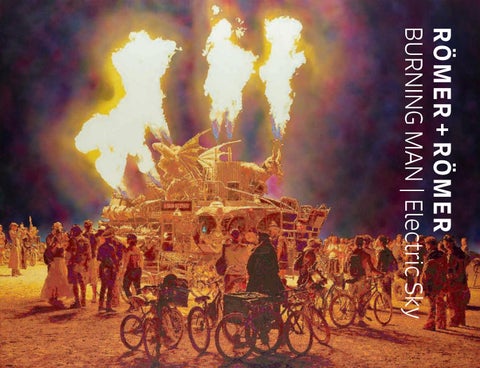
R ÖM E R + R ÖMER BURNING MAN | Electric Sky
Ludwig Seyfarth Tanzen im Licht der Punkte: Römer+Römer und ihre Bilder vom Burning Man Festival 4
Wenn verschiedenfarbige starke Lichter aus einer dunklen Umgebung herausstechen, denkt man zunächst an die nächtliche Neonbeleuchtung einer Großstadt. Dies mag manchen Betrachter*innen der Bilder, die Römer+Römer auf Grundlage ihres Besuches des Burning Man Festivals gemalt haben, auch so gehen. Was auf ihren Gemälden so grell leuchtet, dass man sich häufig geblendet fühlen würde, wäre es eine echte und nicht eine gemalte Lichtquelle, sind die oft originellen und technisch komplexen Illuminationen, die das Festival in großer Zahl zu bieten hat und mit denen die Teilnehmer unter anderem ihre fantasievoll gestalteten Art Cars ausstatten. So sind auf dem Bild Art Car Skeleton vier große, an einem wohnwagenartigen Gefährt befestigte Scheinwerfer wie gigantische Sonnen direkt auf die Betrachter gerichtet. Immer wieder tauchen Leuchtbänder oder Displays in den Bildern auf. Electric Sky zeigt ein großes Display aus LEDs (light-emitting diode), das wie ein künstlicher Sternenhimmel über den Festivalteilnehmern thront. Auf dem Rundbild Electric Cloud wird die Wolkenform eines vertikal aufgestellten leuchtenden Displays von der Silhouette einer einsamen Tänzerin optisch durchschnitten. Manchmal nur einzelne Menschen, manchmal kleinere Gruppen, aber stets locker und nicht gedrängt, verfolgen die Aktivitäten, stehen oder tanzen um die oft technisch aufwändig ausgestatteten Installationen. Der Bildraum ist eine kleine Bühne mit wenigen Akteuren, wie bei Black Rock Bandits Raccoon, wo sich mehrere Akteure schattenhaft vor dem Licht bewegen. Die Leuchtbänder folgen einer geometrischen Konstruktion oder bilden eine Zeichnung im Raum; das Licht am Himmel wirkt wie eine Bühnenbeleuchtung.
Auf LED Bus bilden die Lichtbänder, welche die Umrisse eines offenbar auf einem doppelstöckigen Linienbus basierenden Art Cars aus der Dunkelheit hervortreten lassen, einen dynamischen Kontrast zu der Rundform des Bildes. Mit unterschiedlichen Bildformaten richten Römer +Römer den Blick entweder auf einzelne Details oder lassen die Augen der Betrachter panoramatisch entlangschweifen. Das gilt etwa für G, wo das extreme Breitformat dem dargestellten, wie ein langer Zaun oder eine Wand aufgestellten LED-Display folgt. Hier gibt es keine menschlichen Akteure. Es ist ein fast abstraktes Bild, mit dem Römer+Römer an ihre ungegenständlichen Anfänge anknüpfen: Strukturen und Muster aus Punkten reiner Farbe brachten sie direkt auf die Leinwand. Dieses Prinzip, dem sie bis heute generell treu bleiben, lässt bei den gegenständlichen Motiven an die Auflösung des Motivs in einzelne Flecken oder Punkte bei den Impressionisten und Pointillisten denken. Die abstrakten Bilder legen andere kunsthistorische Vergleiche nahe, etwa zu Victor Vasarelys Op-Art oder zu den Strukturen auf den Gemälden und Siebdrucken Almir Mavigniers, die vor meist schwarzem Grund zu sehen sind. Die Farbpunkte, die im 19. Jahrhundert von naturwissenschaftlichen Theorien über die Farbe, beispielsweise beim Neo-Impressionisten Georges Seurat durch die des Chemikers Eugène Chevreul, inspiriert wurden, standen vor dem lebensweltlichen Hintergrund der beginnenden Elektrifizierung. Verschiedenste elektrische Beleuchtungstechniken sind spätestens in den 1960er Jahren aus dem Alltag nicht mehr wegzudenken, als etwa die Künstler der Gruppe ZERO selbstgesteuerte Lichtquellen in ihren Reliefs und Objekten einsetzten. Zur selben Zeit begann die Op-Art, optische Effekte neuer Lichttechniken in der Malerei und Grafik zu reflektieren.
Für helles sowie weithin sichtbares und vor allem farbiges Licht, das auch die nächtliche Dunkelheit taghell durchdringen konnte, stand lange Zeit die Neonröhre. Sie kommt auch seit den 1960er Jahren als Material in der Bildenden Kunst zum Einsatz, entweder direkt als Röhre ihre Lichtwirkungen im Raum einsetzend wie bei Dan Flavin oder als geformte Röhren, die Figuren oder Wörter bilden, wie beispielsweise bei Bruce Nauman. In vielen Bereichen des Alltags, zunächst vor allem bei elektronischen Geräten, ist die Neonröhre zunehmend durch die LED ersetzt worden. Diese, Anfang der 1960er Jahre erfundene, nicht Wärme abstrahlende und digital optimal steuerbare Leuchtdiode war zunächst nicht in allen Farben herstellbar. Erst als in den 1990er Jahren auch grüne LEDs erhältlich sind, kommen sie als Leuchtmittel umfassend in Gebrauch. Neben ihrer Verwendung in digital gesteuerten Systemen stehen die aus vielen einzelnen Dioden bestehenden LED-Displays auch deshalb fast signethaft für das digitale Zeitalter, weil ihre Rasterstruktur die digitale Auflösung von Bildern in einzelne Pixel direkt zu veranschaulichen scheint. In der Analogie von Pixel und Leuchtdiode lässt sich die zeitgenössische, technisch-wissenschaftliche Grundlage für die Maltechnik der Römers sehen. Sie spielt für die Künstler damit eine ähnliche Rolle wie einst Chevreuls Farbtheorie für Seurat. In die Malerei „übersetzt“, wird aus der Analogie von Pixel und einzelner LED jedoch eine andere: die zwischen dem gemalten Farbpunkt und dem LED-Licht, das er motivisch darstellt. Mit der „Übersetzung“ digital gesteuerter Lichtinstallationen in die Malerei führen Römer + Römer auch gewissermaßen einen Paragone-Streit weiter, der in der Geschichte der modernen Malerei anstelle der klassischen Konkurrenz zwischen Malerei 5
und Skulptur getreten ist. Es ist der Versuch, die Intensität des natürlichen oder künstlichen Lichtes mit malerischen Mitteln wiederzugeben. In einem Kinderbuch über Vincent Van Gogh, das ich in meiner Jugendzeit besaß, gehörte zu den erdachten persönlichen Erlebnissen des Malers, dass ihm immer wieder vorgeworfen wurde, die von ihm gemalte Sonne würde ja nicht wirklich strahlen. Die gigantischen leuchtenden Wirbel, die auf Van Goghs Sternennacht von 1889 zu sehen sind, hätten in der Realität allerdings mindestens die Lichtstärke der Scheinwerfer des Art Car Skeleton. Van Goghs Fantasiehimmel entfernte sich vom realen Stand der Beleuchtungstechnik, die Camille Pissarro in impressionistischer Manier wiedergab, als er 1897 den Boulevard Montmartre bei Nacht ins Bild setzte. Wenn man die Darstellungsweise von Römer + Römer mit der urbaner Szenerien um 1900 vergleicht, steht sie eher Künstlern näher, die Elemente des Impressionismus mit der narrativen Linie des Realismus verbinden. Hier wäre beispielsweise Hans Baluschek zu nennen, der 1914 einen Berliner Rummelplatz bei Nacht malte. Die differenziert wiedergegebene gelbliche Beleuchtung eines Karussells und der am Bildrand zu sehenden anderen Jahrmarktstände kontrastiert mit der nächtlichen Dunkelheit sowie mit der meist dunklen Kleidung der im Vordergrund stehenden Menschen. Vergleichbar erscheint vor allem das Bild der Römers Rabid Transit: Das helle gelbe Licht mehrerer Feuersäulen, die für einen kurzen Moment senkrecht aus einem surreal ausstaffiertem Art Car hervorschießen. Die teilweise neben ihren Fahrrädern, mit denen sie das ausgedehnte Festivalgelände durchqueren, stehenden und das Geschehen verfolgenden Menschen sind in ein mildes bühnenhaftes Leuchtlicht getaucht, das die Umrisse weniger auflöst als die Plastizität der Körper leicht modelliert. 6
Solche momentanen Ereignisse gehören zum festen Repertoire des Burning Man Festivals, das nicht immer ganz ungefährlich ist. Bei den Kämpfen in einer Arena, die dem Dome aus dem Spielfilm Mad Max Beyond Thunderdome (1985) nachempfunden ist – nur eines von vielen cineastischen Zitaten vor allem aus dem Science-Fiction-Genre – kommt es manchmal auch zu ernsten Verletzungen. Wie ein archaisches Ritual wirkt es, wenn die auf eine geodätische Kuppel gekletterten Zuschauer die mit Keulen oder Stangen aufeinander losgehenden Kombattanten anfeuern. Römer+Römer haben es auf den Bildern The Climbing Spectators und Fight at Thunderdome aus unterschiedlichen Perspektiven eingefangen. Sie gehören zu den vielen klein- oder mittelformatigen Bildern, die den Fokus wie mit dem Teleobjektiv auf einzelne Momente richten, während viele größere Bilder eine gesamte Szenerie in panoramatischer Breite vorführen. Auch mit den unterschiedlichen Bildformaten und Perspektiven vermitteln Römer + Römer eine Art erzählerisches Panorama des Burning Man Festivals. Daneben steht das letztlich auf den Impressionismus zurückführende Bestreben, Wahrnehmungseindrücke wie feine Differenzierungen der Lichtwirkungen so direkt wie möglich einzufangen. Jedem ihrer Bilder liegt ein längerer Prozess mit mehreren Übertragungsschritten zugrunde. Zunächst entstehen zahlreiche fotografische Impressionen. Aus den vielen Schnappschüssen werden diejenigen ausgewählt, die für eine Umsetzung als Gemälde geeignet erscheinen. Diese werden in einem ersten Schritt am Rechner weiterbearbeitet und dann vergrößert in Gemälde unterschiedlicher Formate übertragen. Anders als beim Impressionismus werden die einzelnen Bildpunkte nicht in reinen, sondern in bereits abgemischten Farben nebeneinander gesetzt, aber dabei fließende Übergänge
With their “translations” of digitally controlled light installations into painting, Römer + Römer also rekindle, to an extent, and further develop the paragone debate which, in the history of modern painting, has taken the place of the classical competition between painting and sculpture—namely that regarding attempts to portray the intensity of either natural or artificial light with painterly means. In a children’s book about Vincent Van Gogh I possessed in my youth, one of the imagined personal experiences of the painter was that of being confronted with the notion that his painted sun did not shine any real light. The gigantic swirls to be seen on Van Gogh’s Starry Night from 1889, however, would have had at least the same level of luminosity in reality as the headlights of the Art Car Skeleton. Van Gogh’s phantasy sky diverged from the real state of the time’s lighting technology, itself represented in the Impressionist manner by Camille Pissarro in his depiction of the Boulevard Montmartre at night from 1897. When comparing the representational methodology of Römer+Römer to that employed depicting urban scenes around 1900, the couple would appear more closely related to artists who tended to conjoin elements of Impressionism with the rather narrative line of Realism. One such artist who would come to mind here is Hans Baluschek, who, in 1914, painted a Berliner Rummelplatz [Berlin Fairground] at night. The nuanced yellow lighting of the merry-go-round and the other fair stands seen at the picture’s edge are contrasted with the nocturnal darkness and the mostly dark clothing of the standing figures in the foreground. Particularly comparable here would be the Römers’ painting Rabid Transit. The bright yellow light of divers pillars of fire flame forth for a brief moment from a surreally outfitted art car. Accompanied here and there by the bicycles they use to traverse the extensive festival grounds, the figures standing 10
in the foreground and following the goings-on are all steeped in a mild, stage-like lighting, which rather subtly models the plasticity of the bodies more than it dissolves the outer contours. Momentary occurrences such as this one belong to the standard repertoire of the Burning Man Festival, which is not always without perils. Indeed, serious injuries are at times suffered over the course of fighting bouts, for instance, held in an Arena modelled on the dome from Mad Max Beyond Thunderdome (1985)—only one of many cinematic citations, often appropriated from films of the science-fiction genre. It is altogether akin to an archaic ritual when the spectators, having climbed atop a geodesic dome, begin to cheer on the combatants as they rush at each other armed with cudgels or rods. Römer+Römer have captured this from varying perspectives in their paintings The Climbing Spectators and Fight at the Thunderdome. These are among the numerous smaller or midsized formats which, like telephoto lenses, focus the gaze upon single instances, whereas many larger formatted paintings present an entire scenery in panoramic breadth. Viewed together, the various formats and perspectives employed by Römer + Römer have also produced a kind of narrative panorama of the Burning Man Festival. Alongside this, there is the aim, finally recalling Impressionism, to capture immediate perceptual impressions and the fine nuances of the plays of light as directly as possible. Each of their paintings is created in a long process involving numerous working steps for translating the images onto canvas. Firstly, a number of photographic impressions emerge. From amongst the snapshots, those images that would lend themselves to translation into painting are then selected and edited in a first working step on the computer, before finally being transferred into enlarged paintings of various formats. In contrast to the working methods of the Impressionists,
communitas in which participants come together in a flow of community and transformation. This utopian quality in the paintings of Römer + Römer reflects what Jill Dolan calls the “utopian performative” moment illuminating Black Rock City as an enormous utopian canvas. During moments of communitas, a community moves towards feelings of possibility, hope, and political agency (Dolan 2005: 477). It is in these charged moments of performative encounters that the possibility of a better world takes shape. In Utopia in Performance: Finding Hope at the Theatre, Dolan does not propose a “real” utopia 4 but rather how utopia might be “imagined or experienced affectively, through feelings, in small incremental moments that performance can provide” (ibid.: 459–460). She argues that utopia is not something that is sustainable but occurs in fragmentary “utopian moments” often found embedded within performance. This theory allows us to see festivals—in this case, Burning Man—as brief, fleeting utopian encounters in which a community performs its ideal world. As a momentary utopic landscape, Black Rock City provides a potent space where new forms of economic and political possibilities are rehearsed and enacted. The Gift Economy The governing principle of the gift economy—banning any type of vending, advertising, buying, or selling of anything within Black Rock City aside from ice and coffee at Center Camp—exemplifies the utopian ideal of a commerce-free world. Harvey, who died on April 28, 2018, drew his philosophy of the gift economy from Lewis Hyde’s The Gift (1983), which distinguishes between a gift and a commodity exchange. 5
4 The term “utopia” was coined in 1516 by
Sir Thomas More in Utopia, blending two Greek words “topos," or place, and “u," which means “no” or “not.” Thus, “utopia” can be translated as “noplace” or “nowhere”. Since the 1680s, the United States has been the site for the founding of hundreds of utopian communities, both religious and secular. The West Coast, in particular, has been rich in such experiments since the 1850s, and Burning Man, originating on Baker Beach in San Francisco (and moving to the Black Rock Desert in Nevada in 1990), is a quintessential example of a Californian utopian community. American literary historian Louis Parrington points out that many of the men who have been called “utopians” might more accurately be called social planners (Parrington 1964: 4–5). Burning Man’s founder Larry Harvey could be considered a social planner, a community architect with a vision of a new model for society. Harvey wants participants to return home with the confidence that they can radically change the “real” world by extending Burning Man’s ten core values into the everyday—radical inclusion, gifting, decommodification, radical self-reliance, self-expression, communal effort, civic responsibility, leaving no trace, participation and immediacy.
73
According to Hyde, a gift establishes a permanent bond between two people, while the sale of a commodity does not necessarily leave a connection (ibid.: 56). A gift, when given without the promise of anything in return, creates a communal bond, which Hyde likens to a river (ibid.: 4). Should the flow of the gift halt, the chain of the gift economy is broken. Harvey believes gifting is the tissue that holds the Burning Man community together (Van Rhey 2002). Burning Man does not pretend to be self-sustaining and in fact celebrates its ephemerality and disappearance as a radical act. Perhaps it is its inherent ephemerality that makes this experiment such a success. For Harvey, Burning Man has already moved beyond the desert into the “default” world, creating and transforming communities in significant ways through art and a renewed understanding of artistic community, collaboration and civic responsibility. Burning Man rehearses and stages an alternative model of how the world “should” be within the limitations of the actual world. In 1999, Larry Harvey proclaimed, “Burning Man is not just an event. This has become a movement.” Rachel Bowditch (Ph.D.), author of On the Edge of Utopia: Performance and Ritual at Burning Man, is a theatre director, an Associate Professor, and Director of Graduate Studies in the School of Film, Dance and Theatre in the Herberger Institute for Design and the Arts at Arizona State University and has been attending and researching Burning Man since 2001.
74
5 When I asked Larry Harvey in an interview in
2004 how the concept of the gift economy emerged, he said it evolved organically, with no plan or theory attached. At first, there were sporadic attempts to sell things, but those failed because no one bought anything; everyone came over-prepared with food, water and other necessities. As the event grew, further attempts at commerce were made, but they too failed. In 1997, the Black Rock City LLC realized that this failure was in fact a blessing and then incorporated a “no-vending” policy into its by-laws. The no-vending policy went hand-in-hand with the adoption of the gifteconomy philosophy. The simple decision to ban vending has had a central impact on the formation and development of the Burning Man culture and ethos.
Works Cited Bakhtin, M.M. Rabelais and His World. Bloomington: Indiana University Press, 1984. Bowditch, Rachel. On the Edge of Utopia: Performance and Ritual at Burning Man. London: Seagull Books, 2010. Csikszentmihalyi, Mihaly. Beyond Boredom and Anxiety: Experiencing Flow in Work and Play. San Francisco: Jossey-Bass Publishers, 1975. DeVaul, D.L., Beaulieu-Prévost, D., Heller, S.M., and the 2017 Census Lab. (2017). Black Rock City Census: 2013–2017 Population Analysis. Black Rock City Census. Copyright © 2018 DeVaul et al. Date accessed: October 2nd, 2018. https://drive.google.com/file/d/1hbZtR38TiEq DgA28STIFwS5Ae1r4WrYP/view
Dolan, Jill. 2005. Utopia in Performance: Finding Hope at the Theatre. Ann Arbor: University of Michigan Press, 2005. Harvey, Larry. “Desert Civilization”. Burning Man Summer Newsletter, 1999. Harvey, Larry. Interview with author. Black Rock City, Nevada. 31 August, 2004. Hyde, Lewis. The Gift: Imagination and the Erotic Life of Property. New York: Random House, 1983. Melville, Keith. Communes in the Counter Culture; Origins, Theories, Styles of Life. New York: Morrow, 1972. Parrington, Vernon Louis. American Dreams: A Study of American Utopias. New York: Russell & Russell, 1964. Roszak, Theodore. The Making of a Counter Culture: Reflections on the Technocratic Society and its Youthful Opposition. Garden City, NY: Doubleday, 1969. Turner, Victor. The Ritual Process: Structure and Anti-Structure (The Lewis Henry Morgan Lectures) New York: Aldine de Gruyter, 1969. Van Rhey, Darryl. 2002. “An Economy of Gifts: Interview with Larry Harvey.” What is Burning Man?
Canopy Bed Art Car (Ausschnitt / detail) Öl und Acryl auf Leinwand / ○⁄ 120 cm Oil and acrylic on canvas / ○⁄ 47 in