Museum of Arts and Design New York (ed.) JEWELRY STORIES Highlights from the Collection 1947–2019 ISBN 978-3-89790-602-0 Susan Cummins / Damian Skinner / Cindi Strauss IN FLUX American Jewelry and the Counterculture ISBN 978-3-89790-597-9 Danner Stiftung / Die Neue Sammlung — The Design Museum (eds.) JEWELRY ISBN 978-3-89790-585-6 Beatriz Chadour-Sampson RINGS OF THE 20TH AND 21ST CENTURIES The Alice and Louis Koch Collection ISBN 978-3-89790-516-0 Wilhelm Lindemann
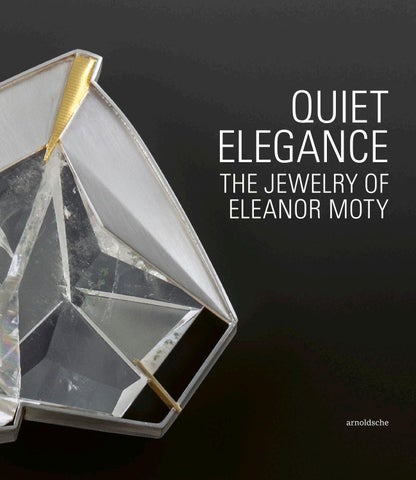
Eleanor Moty is a seminal figure in the field of contemporary international studio jewelry. In a career that has spanned more than fifty years, she has been both a dedicated practitioner and a devoted teacher who has inspired succeeding generations of artists, collectors, and fellow professionals. She began to attract national attention in the late 1960s and early 1970s for her experiments with photo etching and electroforming metal. Later, mid-career, Moty made what seems like an abrupt shift in style and focus, with more abstract works whose designs were inspired by the natural inclusions within the non-precious stones used in their fabrication. While her works have been published in prominent books, catalogues, and journals internationally, this monograph is the first comprehensive in-depth examination of her career from its inception in 1966 through the present day.
BERND MUNSTEINER Reflexions in Stone ISBN 978-3-89790-203-9 Wilhelm Lindemann
Authors: Bruce Pepich, Matthew Drutt, Helen W. Drutt English Editor: Matthew Drutt
MUNSTEINER — THE YOUNG GENERATION Tom + Jutta Munsteiner ISBN 978-3-89790-374-6
www.arnoldsche.com
Eleanor Moty_cover_final_03112020.indd
1
9 783897 906082 >
arnoldsche
ISBN 978-3-89790-608-2
QUIET ELEGANCE THE JEWELRY OF ELEANOR MOTY
Selected books on contemporary jewelry by
QUIET ELEGANCE
THE JEWELRY OF ELEANOR MOTY
arnoldsche
Trained as an artist/metalsmith, Eleanor Moty received her BFA from the University of Illinois at Urbana-Champaign and her MFA from Tyler School of Art, Temple University, Philadelphia. Her pioneering work in the late 1960s and the 1970s in photofabrication (photoetching precious and non-precious metal) resulted in articles and workshops in which she introduced the processes to the field of jewelry and metalsmithing. Early work included small hollowware forms as well as jewelry. In the late 1970s, Moty returned to traditional metal techniques and focused on brooches. Selecting one-of-a-kind stones with unusual characteristics or striking inclusions, Moty creates sculptural brooches which evoke images of landscape and architecture. She writes, “Landscape continues to have a subtle influence on my work. This stems from my childhood on a farm in Illinois, where the horizon line was always visible and the texture and color of the land constantly changed with the plantings and seasons. References to architecture also come into play with subtle changes of planes and spatial illusion. Each piece evolves from the energy and intrinsic beauty of the stone and intuition.” Eleanor Moty lives in Tucson, Arizona, and is Professor Emerita of the University of Wisconsin-Madison, where she taught jewelry and metalsmithing from 1972 to 2001. For more than five decades, her work has been exhibited in museums and galleries nationally and internationally. She is the recipient of the Master of the Medium award from the James Renwick Alliance, Smithsonian Institution, Washington, DC, is a Fellow of the American Craft Council, and was designated Master Metalsmith in 2012 by the Metal Museum, Memphis, Tennessee, and honored with a retrospective exhibition there. In 2020 she was the recipient of the Society of North American Goldsmiths’ Lifetime Achievement Award. Her work can be found in permanent museum collections in the US and abroad.
03.11.20
17:28
Eleanor Moty_layout final_30102020.indd
16
30.10.20
17:03
ELEANOR MOTY JEWELRY
Eleanor Moty_layout final_30102020.indd
17
30.10.20
17:03
Eleanor Moty_layout final_30102020.indd
6
30.10.20
17:03
QUIET ELEGANCE
7
THE JEWELRY OF ELEANOR MOTY Bruce W. Pepich
Eleanor Moty is internationally recognized for her groundbreaking work in the field of art jewelry. In a career that has spanned more than fifty years, she has been a major proponent of altering the way the public thinks of jewelry and personal adornment both as aesthetic objects and as vehicles for self-expression on the part of the artists and the people who wear their work. She began to attract national attention in the late 1960s and early 1970s, as an undergraduate- and graduate-level student, for her experimentations with photoetching and electroforming metal. Later, in mid-career, Moty moved away from creating organic, technically driven pieces to fabricating breathtakingly beautiful brooches that focus on formal design concepts that explore ways to make gemstones and metal equal partners in adornment. An American original, Moty grew up in the countryside on the western edge of the Chicago suburbs. In the 1950s and 1960s, the city’s sprawl dropped off at the farmland from which numerous suburbs were slowly emerging. However, the pace of this development meant one could still live a rural life relatively close to the city’s center. Growing up as the child of immigrants provided her with a slightly different background from the suburbanites she met in high school. Life on a working farm instilled a strong sense of personal responsibility in Moty and also made her comfortable with the variety of tools needed and the kinds of problem-solving called for in a small agricultural enterprise. Her parents lived the twentieth-century version of the life of nineteenth-century settlers who came to the Midwest and became farmers.1 Moty became a pioneer in her own right, helping lead the way in creating handmade jewelry that is recognized as a legitimate contemporary art form. Familiarity with tools and being self-reliant served Moty well in her undergraduate studies at the University of Illinois at Urbana-Champaign and during her work on her Master of Fine Arts degree at Tyler School of Art and Architecture at Temple University in Philadelphia. As she became interested in making jewelry, she also began to think about how to inject narrative content into pieces through the addition of photographic images and to make more unconventional organic forms and intriguing raised surfaces by electroforming metal. With photoetching, a piece of metal is coated with a photosensitive resist. The photograph is prepared as a high-contrast transparency—black and white with no gray tones—and exposed to the metal via contact printing with a high-intensity light source. After treatment with a solvent, the representation remains on the surface as a pattern for plating or etching. Electroforming is a process in which a heavy layer of metal is built up, one atom at a time, creating form and surface dimension simultaneously, often resulting in an elaborately textured surface.2 These two areas of interest were so new in the field at that time that one could not readily study them in art departments. Moty had to conduct her own research, often in combination with fellow students in engineering and scientific departments, and alongside art faculty members.
Eleanor Moty_layout final_30102020.indd
7
30.10.20
17:03
24
Amethyst Fibula, 1969 Sterling silver, bronze, copper electrodeposition, amethyst crystal 3” × 3” × 1” Collection unknown
Eleanor Moty_layout final_30102020.indd
24
30.10.20
17:03
25
“Prairie House” Pin, 1969 Photo-etched bronze, sterling silver, copper, bronze 1 ⅞” × 2 ⅛” × 3⁄₁₆” Collection of the artist
Eleanor Moty_layout final_30102020.indd
25
“Mother” Portrait Brooch, 1969 Photo-etched copper, sterling silver, bronze, copper ca. 1 ¾” × 1 ⅜” × ⅛” Collection unknown
30.10.20
17:03
34
“Dual Image” Brooch, 1974 Photo-etched sterling silver, quartz crystal, obsidian star 2 ¾” × 3” × ½” Collection of Robert L. Pfannebecker
Eleanor Moty_layout final_30102020.indd
34
Plexiglas and Crystal Choker, 1972 Sterling silver, photo-etched sterling silver image, fine silver electrodeposition, quartz crystals, Plexiglas 7” × 7” × 2” Collection of Robert L. Pfannebecker
30.10.20
17:03
35
“Landscape” Handbag, 1973 Sterling silver, brass, bronze, gold, copper, silver photo-electroplated image, ivory, agate 4” × 5 ¼” × 2” Whereabouts unknown “Landscape” Handbag, 1973 (back view) Photo-printed leather
Eleanor Moty_layout final_30102020.indd
35
30.10.20
17:03
46
Crystal Brooch, 1978 Sterling silver, 14K gold, smoky quartz crystal 3” × 3 ¼” × 1” Whereabouts unknown
Eleanor Moty_layout final_30102020.indd
46
30.10.20
17:03
47
Crystal Brooch II, 1979 (front and back) Sterling silver, 14K gold, smoky quartz crystal 2” × 2 ¾” × ¾” Racine Art Museum, Gift of Karen Johnson Boyd
Eleanor Moty_layout final_30102020.indd
47
30.10.20
17:03
53
“Interrupted Vertical” Brooch, 1990 Sterling silver, 22K gold, 18K gold, rutilated quartz, topaz 4” × 1 ⅜” × ½” The Museum of Fine Arts, Houston, Helen Williams Drutt Collection, museum purchase funded by the Caroline Wiess Law Foundation, 2002.3975
Eleanor Moty_layout final_30102020.indd
53
30.10.20
17:03
54
“Triangle” Brooch, 1984 Sterling silver, 18K gold, rutilated quartz, topaz 2 ¾” × 3 ½” × ½” Private collection
“Vision” Brooch, 1984 Sterling silver, 18K gold, rutilated quartz, topaz 2” × 2 ½” × ½” Collection of Robert L. Pfannebecker
Eleanor Moty_layout final_30102020.indd
54
“Wedge” Brooch, 1984 Sterling silver, 14K gold, rutilated quartz, topaz 2 ½” × 3” × ½” Collection of Jan Marshall Fox
30.10.20
17:04
64
“Pathways” Brooch II, 1992 Sterling silver, 18K gold, 14K gold, rutilated quartz, Malaya garnets 5 ¼” × 1 ¼” × ½” Eleanor Moty Studio
“Formal” Brooch, 1991 Sterling silver, 22K gold, 18K gold, limonitic topaz, citrine 5” × ¾” × ⅜” Private collection
“Crystal Fragment” Brooch, 1992
“Spiral” Brooch, 1993 Sterling silver, 14K gold, limonitic topaz, topaz 4 ⅛” × 1” × ½” Collection of Marlin and Regina Miller
“Tremor” Brooch, 1994 Sterling silver, 22K gold, 18K gold, 14K gold, limonitic topaz, topaz 3 ½” × ⅞” × ⅜” Eleanor Moty Studio
“Focal Point” Brooch, 1995
Eleanor Moty_layout final_30102020.indd
64
Sterling silver, 14K gold, tourmalinated quartz, tourmaline crystal 4 ¾” × 1 ½” × ½” Metal Museum, Memphis, Gift of the artist 2018
Sterling silver, 22K gold, 18K gold, rutilated quartz, citrine 3 ¾” × ⅞” × ½” Eleanor Moty Studio
30.10.20
17:04
65
Eleanor Moty_layout final_30102020.indd
65
30.10.20
17:04
76
Opal Brooch, 2002
Opal Brooch II, 2005
Sterling silver, 22K gold, 18K gold, opal, labradorite, Biwa stick pearl 3 ¼” × ⅞” × ¼” Private collection
Sterling silver, 22K gold, opal, Biwa stick pearl, labradorite 3 ¼” × 1” × ¼” Collection of Karen Henrietta Keland
Eleanor Moty_layout final_30102020.indd
76
30.10.20
17:04
77
Pietersite Brooch, 2000 Sterling silver, 22K gold, pietersite, labradorites, black paper Micarta 4 ¾” × 1 ¼” × ⅜” Philadelphia Museum of Art, Gift of Helen W. Drutt English in memory of Oppi Untracht, 2008
Eleanor Moty_layout final_30102020.indd
77
30.10.20
17:04
78
Eleanor Moty_layout final_30102020.indd
78
30.10.20
17:04
THE ROAD LESS TRAVELED
79
Matthew Drutt
Had Eleanor Moty any idea of the grudge match percolating between the crafts and the fine arts in America almost precisely at the moment that she decided to go to school to study art, she might well have chosen a less Sisyphean path and followed her initial inclination to study a more mainstream artistic discipline, like painting. But as with other fateful twists and turns that have helped shape her career, a combination of serendipity, opportunity, and her determination to succeed in the face of discouragement steered her towards a career as a metalsmith. And going against the grain was already inscribed in Moty’s character, not for the sake of being contrary or rebellious but rather as a byproduct of being raised by a mother who believed that her daughters should become self-sufficient and empowered by becoming properly educated in a field of study in which they could discover and embrace a sense of purpose. For a girl raised in the American Midwest in the 1950s, that formula should have read something more like: go to school, learn something, meet a guy, get married, and start a family. Indeed, her oldest brother chided her and her sister, Joyce, for dreaming of becoming artists instead of something more “suitable” for young women, such as being secretaries or studying home economics.1 But their mother was, as Moty once put it, a dynamo, and she was steadfast in her belief in a woman’s need to be educated and independent. This ethos served as an enduring guidepost for her, and her sister, both of whom not only embarked on paths that deviated from conformist views of a woman’s place in society but further led them to pave their way towards leadership roles in their chosen fields by applying themselves to the dictums of discipline and excellence that they had been taught to adhere to in all walks of life by a parent who had been deprived of the opportunity. In hindsight, her timing was impeccable, for studio jewelry was in the nascent stages of becoming arguably the most exciting area of the crafts in terms of a both technical and aesthetic revolution, but it badly needed new talent to fulfill a mission that was being formulated by a very small but select group of artists who were transforming the discipline alongside innovators in fiber, wood, and clay in the United States. There were still relatively few academic environments—university-level institutions—where crafts held sway among the fine arts disciplines. The University of Illinois Urbana-Champaign was already on its way to becoming one of them when Moty arrived there in 1963.2 From more humble beginnings,3 it had developed a reputable curriculum and talented staff who could nurture students who wanted to become artists, and not just commercial artists but people who envisioned a studio practice and a teaching career as a viable path forward. The faculty in crafts was initially modest, but under the leadership of ceramist Donald Frith, it was transformed from its mundane origins in teaching clay modeling as occupational therapy into a serious and dynamic department that eventually included all areas of the crafts by 1968.4
Eleanor Moty_layout final_30102020.indd
79
30.10.20
17:04
106
“Constellation” Brooch, 2010 Sterling silver, 22K gold, quartz with pyrite crystal inclusions, diamonds, black paper Micarta 2 ⅛” × 2 ⅝” × ⅜” Tom Munsteiner, lapidary artist Collection of Karen Henrietta Keland
Eleanor Moty_layout final_30102020.indd
106
“Counterpoint” Brooch, 2013 Sterling silver, 22K gold, 18K gold, quartz with negative crystal, Biwa stick pearl 3 ¼” × 1 ¼” × ⅜” Tom Munsteiner, lapidary artist Keland Family Collection
30.10.20
17:04
107
Pyrite Brooch, 2012 Sterling silver, 14K gold, slate with pyrite inclusions, pyrite crystal, black paper Micarta 3 9⁄₁₆” × 1 1⁄₁₆” × ¾” Collection of Karen Henrietta Keland
Eleanor Moty_layout final_30102020.indd
107
30.10.20
17:04
94
“Shadow” Brooch, 2006 Sterling silver, 18K gold, quartz 2 ½” × 1 ¾” × ⅜” Tom Munsteiner, lapidary artist Collection of Caroline and Roger Ford
Eleanor Moty_layout final_30102020.indd
94
30.10.20
17:04
95
“Shadow” Brooch, 2006 (back)
“Mitre” Brooch, 2006 Sterling silver, 22K gold, 18K gold, tourmalinated quartz 2 ⅜” × 1 ¼” × ⅜” Tom Munsteiner, lapidary artist Collection of Caroline and Roger Ford
Eleanor Moty_layout final_30102020.indd
95
30.10.20
17:04
126
“Circle” Brooch, 2016 Sterling silver, 18K gold, agate, black paper Micarta 1 ¾” × 2 ¼” × 5⁄₁₆” Dieter Lorenz, lapidary artist Collection of the artist
Eleanor Moty_layout final_30102020.indd
126
30.10.20
17:05
127
“Estuary” Brooch, 2016 Sterling silver, 22K gold, dendritic quartz, black paper Micarta 1 ¾” × 2 ⅜” × 7⁄₁₆” Dieter Lorenz, lapidary artist Eleanor Moty Studio
Eleanor Moty_layout final_30102020.indd
127
30.10.20
17:05
132
“Precipice” Brooch, 2014 Sterling silver, 22K gold, quartz crystal 2 ½” × 2” × ½” Tom Munsteiner, lapidary artist Collection of the artist
Eleanor Moty_layout final_30102020.indd
132
30.10.20
17:05
133
“Nacreous” Brooch, 2020 Sterling silver, 22K gold, 18K gold, rutilated quartz, Biwa stick pearl 2 ¼” × 2 ¼” × ½” Stone by Philipp Munsteiner Eleanor Moty Studio
Eleanor Moty_layout final_30102020.indd
133
“Philmun” Brooch, 2017 Sterling silver, 18K gold, rutilated quartz 2 1⁄₁₆” × 1 7⁄₁₆” × 5⁄₁₆” Stone by Philipp Munsteiner Eleanor Moty Studio
30.10.20
17:05