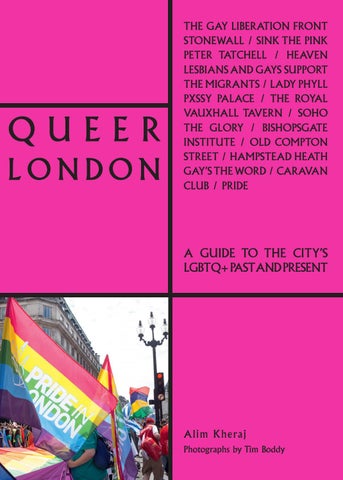
QUEER LONDON
THE GAY LIBERATION FRONT STONEWALL / SINK THE PINK PETER TATCHELL / HEAVEN LESBIANS AND GAYS SUPPORT THE MIGRANTS / LADY PHYLL PXSSY PALACE / THE ROYAL VAUXHALL TAVERN / SOHO THE GLORY / BISHOPSGATE INSTITUTE / OLD COMPTON STREET / HAMPSTEAD HEATH GAY’S THE WORD / CARAVAN CLUB / PRIDE
A GUIDE TO THE CITY’S LGBTQ+ PASTAND PRESENT
Alim Kheraj Photographs by Tim Boddy
NIGHTLIFE
NIGHTLIFE
BARS
E A S T LONDON
DALSTON SUPERSTORE 117 Kingsland High St, Dalston, London E8 2PB dalstonsuperstore.com Dalston Kingsland Overground Dalston Superstore isn’t so much a bar as it is a lifestyle. Opened in 2009 by Dan Beaumont, the man behind monthly cult Hi-NRG night Disco Bloodbath at the now shuttered Joiner’s Arms, and Matt Tucker and Dan Hope, whose weekly Trailer Trash party was at On the Rocks (now Basing House in Shoreditch), it took the lineage of LGBTQ+ venues like the George and Dragon and club nights like Richard Mortimer’s infamous Boombox and ran with it. Superstore embodies alternative queer nightlife, and in those first five years the venue was, in Beaumont’s words, ‘achingly fashionable’, drawing a crowd of artists and creatives, who, to this day, are the bedrock of the venue’s success. The parties that Superstore hosted also separated it from the clubs and bars of Soho – lesbian nights, trans and non-binary nights, bisexual parties and events for queer people of colour were regular occurrences, creating an environment that was truly inclusive. That attitude has only solidified in the subsequent decade, and Superstore is now the heart of East London’s vibrant queer scene. Loud and proud on Kingsland Road, it’s still a liberated, hedonistic and decadent nightlife spot, throwing some of the most legendary parties in the city. No matter what you’re into, you’ll find it at Superstore. Want Bollywood? They’ve got you covered. What about classic pop
or techno? Head down to the sweltering basement club and you might find both! Like Alice tumbling into Wonderland, you don’t always know what you’re in for, and that’s part of the appeal. However, it’s diversified, too. Open seven days a week, during the daytime the space welcomes people to grab a coffee or lunch, or just to hangout and use it as a place to work (no hidden desk charges, either). Food, which is incredibly good value, is also served in the evenings and on weekends, when you can pop down for one of the iconic Drag Brunches (it’s brunch but with drag queens!) Superstore also acts as an exhibition space, celebrating the work of LGBTQ+ artists and creators, and fledgling drag performers and DJs are often given the chance to develop and grow there. They host regular charity events, promoting and fundraising for queer organisations. What really makes Dalston Superstore, though, is the people. Sure, it might be the coolest queer bar in London, but the regulars, performers, DJs, bar staff and bouncers all resist pretension and form a real community. This energy enters you the moment you step through the door, infusing every interaction you have, be it with your friends, strangers or potential lovers. You’ll be BFFs with someone for the night, only to forget their name the next morning; or you’ll take someone home thinking it’s a one-night stand and end up happily married. Superstore is more than just a 2,000 square foot bar in Dalston: it’s also a live, beating organism that feeds, protects and nurtures London’s LGBTQ+ community.
5
BARS
THE GLORY 281 Kingsland Rd, Haggerston, London E2 8AS theglory.co Haggerston Overground
have become highlights of the queer social calendar. It’s not just performance: in the past, the Glory has hosted HIV/AIDS awareness events, events about queer history and talks centred on LGBTQ+ activism. For any person who feels ostracised by London’s gay
Before LGBTQ+ visibility went semi-mainstream and
scene, the Glory offers a place all queers can call
attitudes towards queer people shifted more positive,
home.
the humble gay bar offered a refuge for LGBTQ+ people. They weren’t just drinking dens or a place to
THE GRAPES
hook up, but community spaces providing support
76 Narrow St, Poplar, London E14 8BP
and information, as well as a safe space to socialise.
thegrapes.co.uk
For some reason, over the last two decades the
Limehouse Overground/DLR
holistic nature of queer venues started to dissipate. But with the sharp decline of LGBTQ+ venues in the
There has been a pub where the Grapes sits since
capital over the last decade, and with a rise of anti-
1583, and the current building dates back to 1720s.
LGBTQ+ rhetoric and hate crimes, queer venues are
It’s not an LGBTQ+ venue, but it is LGBTQ+ friendly,
once again becoming hubs for the community. This
mainly because the venue is owned by British actor
is personified by the Glory, a pub opened in 2014 by
Sir Ian McKellen and director Sean Mathias. The pub
iconic London drag performers Jonny Woo and John
quiz, hosted every Monday, is legendary, and Sir Ian
Sizzle. On the surface, it’s just another gay boozer, and
is known to drop in to take part.
it’s a good one, too: there’s ample seating, including sofas, a nice selection of beers, cocktails and an
THE KARAOKE HOLE
outside smoking area. The bar staff are convivial
95 Kingsland High St, Dalston, London E8 2PB
and the prices aren’t absurd. On the weekends, the
thekaraokehole.com
basement fills up with queers getting their groove on
Dalston Kingsland Overground
at one of the inclusive and diverse club nights. That isn’t to say that things are sedate upstairs: the main
From the creative minds behind Dalston Superstore,
bar is always rammed, perfect if you don’t mind
the Karaoke Hole is one of London’s more unique
squishing and sweating with a bunch of queer folx.
spaces. Described as an ‘LGBTQ+ powered venue’
The Glory is far more than a pub, though. Since it
(meaning zero tolerance on homophobia, transphobia
opened in late 2014, it has become one of London’s
or harassment), the K-Hole, as it’s lovingly referred to,
premiere queer performance spaces, offering one of
is a chaotic karaoke bar with a difference. Instead
the city’s most exciting fringe events programmes.
of private booths, singers get up on stage and sing
Woo and Sizzle are open to, and often foster, new
their favourite songs in front of a live audience – aka
talent. Many a drag king or queen, cabaret star and
other punters. Each night a different drag performer
thespian in the making has made their debut on
will host, singing songs, manning a smoke machine,
the Glory’s charming, if admittedly battered, stage. The
telling jokes and generally encouraging drunk people
annual Man Up! drag king contest and LIPSYNC1000
to sing Celine Dion songs. The drinks aren’t too
7
BARS
pricey and there’s a good variety, including cocktails,
of the footie, the Old Ship hosts weekly cabaret
most importantly, inclusive nature of the Adelaide; this
slightly worn venue for a plethora of events, including
which is handy if you’re considering getting up on
and drag shows, drawing some of the city’s best
venue is capital ‘Q’ Queer, welcoming people of all
drag, karaoke, cabaret and more. In 2020, the pub
stage. Though people there are receptive to anyone
queens like Baga Chips, Charlie Hides, regular dame
sexualities and gender identities and presentations.
was closed for refurbishment, and all their LGBTQ+
who has the chutzpah to sing, even if that person is
Saucy Sophie and Maisie Trollette, who at age 86
The door staff come with this in mind, too, and if
activity was moved to The William Morris Bar and
tuneless, you do get some incredible vocalists. If
is the UK’s oldest working drag performer. There’s
there’s any homophobic or transphobic nonsense
Kitchen in Walthamstow.
you’re lucky, you might even find someone performing
a real community to the Ship, too: the pub has two
it’s swiftly dealt with. If all that doesn’t sell it, the gay
‘…Baby One More Time’ with the full choreography.
gay football teams and a ladies’ dance troupe, and
rumour mill has it that Bjork once huffed poppers here
THE WHITE SWAN
Be warned: it does all get a bit disorganised,
regularly hosts charity events for St Joseph’s Hospice
in the basement bar at a party.
556 Commercial Rd, Limehouse, London E14 7JD
especially later in the night. But usually by then you’ll
and the LGBTQ+ homeless charity, akt. The Old Ship
be pissed and sharing a bottle of Prosecco with
is keeping the Docklands’ queer history alive.
bjswhiteswan.com THE STAR OF BETHNAL GREEN
Limehouse Overground/DLR
359 Bethnal Green Rd, Bethnal Green, London E2 6LG
someone you’ve just met, planning to make your popstar dreams come true by singing a duet of ‘(I’ve
THE QUEEN ADELAIDE
starofbethnalgreen.co.uk
Something of an East End institution, the White Swan
Had) The Time Of My Life’.
483 Hackney Rd, London E2 9ED
Bethnal Green Tube
(previously BJ’s White Swan) was standing before
thequeenadelaide.com THE OLD SHIP
Bethnal Green Tube
17 Barnes St, Limehouse, London E14 7NW
Shoreditch and Dalston blossomed into a queer Like a lot of venues, the Star of Bethnal Green only
playground. Previously associated with geezers and
rolls out its rainbow flag for specific nights, but those
amateur male strippers, the pub was fairly seedy,
oldship.net
They say the best things come in small packages, and
nights are some of the queer scene’s cult favourites:
with soft-core videos playing on screens in what
Limehouse Overground/DLR
that’s certainly true for this beloved East London haunt.
Douche Bag served up alternative pop and electro
was a stark and fairly uninviting establishment. That
After the closure of the iconic queer pub The George
with a helping of hot boys, while Unskinny Bop, ‘a
being said, it always drew crowds, with things getting
The Docklands have always been a queer person’s
and Dragon, owners Liliana and Richard packed their
queer disco for fatz, fagz and freakz’, centres queer
riotous on the weekends. It was allegedly the place
playground. In the 20th Century, The Prospect of
things, including the oversized benched seating, and
womxn. Unfortunately, Douche Bag is coming to
where comedian Michael Barrymore came out, and
Whitby in Wapping was known to draw sailors and
moved down the road to occupy this lithe pub that’s
an end, although resident DJ Mike Menace can be
was frequented by Sir Ian McKellen. In 2014, however,
labourers who fancied themselves a feller, while the
filled with character. On the red walls there’s an array
found playing tunes all over the shop, from the RVT
it was given a camp facelift that would leave Cher
Shadwell Park Stairs in the Rotherhithe Tunnel had a
of ephemera, including a cut out of Elvira, a sun with a
to Dalston Superstore. Unskinny Bop, thankfully, still
jealous. The pub was completely refitted, restructured
reputation in the ‘30s for being a cruising spot. That’s
smiley face, a poster of Divine and copious amounts of
calls the Star of Bethnal Green its home. A word of
and even extended with the addition of the neon-lit
not to mention the countless Molly houses, which
fairy lights. Towards the rear, there’s a small bar offering
warning, though: after you’ve had a few drinks, be
Funky Basement Club. Following its comeback,
in the 17th and 18th Centuries drew all sorts of men
your usual fare, and even some diverse non-alcoholic
careful not to fall off the venue’s stage (it’s easier than
the White Swan began hosting cabaret, karaoke
who performed unspeakable deeds. It shouldn’t be
bevs for any non-drinkers. On the weekends, if you
it sounds…)
and drag shows, as well as club nights playing a
surprising, then, that tucked away on a corner just up
venture back past the loos (which leave something
from Limehouse station is an unassuming LGBTQ+
to be desired) and descend the stairs, you’ll find a
THE VICTORIA
the weekends. Notably, it was the home of anarchic
friendly pub that dates back to 1820. Managed by
labyrinthine basement club. One room is filled with
86 Hoe St, Walthamstow, London E17 4QH
queer party Cybil’s House, an inclusive celebration of
John Fell, who previously ran the now shuttered
antique furniture; another filled with seats, the walls
facebook.com/victoria.walthamstow
LGBTQ+ weirdness featuring dancing, performances
Booty’s Riverside Bar, the pub is a proper East End
mirrored; and in the final room, sweaty bodies brush
Walthamstow Central Tube
and general madness. Open until 2am during the
boozer. Its charming frontage is like something ripped
up against each other on the dancefloor. You’ll also
from a soap opera, but inside things are a little more
find a bar downstairs and alternative stairs that lead
This proper old-school boozer is the definition of a
raucous reputation remains, and unlike accusations
subversive, with rainbows and kitschy knick-knacks
up to the street. The Queen Adelaide doesn’t have a
local LGBTQ+ pub. During the week, you’re more
levied at other queer East London venues, there’s
accompanying the traditional wood panelling. Out
formal event structure: one Saturday night might be
likely to find straight blokes drinking beer in here,
no pretension or trendy affectations. Also, if you cop
magazine once described it as feeling ‘like a John
queer country themed, while the following week could
but on the weekend the space is invaded by local
off with someone, you can head next door to Sailors
Waters film set in Middle-earth’. Likewise, instead
be Britney vs. Christina. That’s the ramshackle and,
queer folk who descend on this well-loved and
Sauna for a bit of fun.
8
mixture of pop, house and commercial dance on
week, and even later on weekends, its pre-facelift
9
THE JOINERS ARMS AND A HISTORY OF GAY NIGHTLIFE IN EAST LONDON
fuelled by the creative energy of the city’s East End —
eventually reared their head. In 2014, after successfully
has emerged as a grittier, fashion-forward and often
battling the council to keep its late license, the Joiners
outrageous hotbed of gay night life.’
Arms lost its war against property developers, shutting its doors for the final time in January 2015. The Nelson’s Head
The Nelson’s Head on Horatio Street completed the
befell a similar fate after rent increases forced them to
trifecta of the Joiners and the George, what later became
close, as did the George and Dragon. Battye and Sanguino
known as the ‘Shoreditch Triangle’. Opened in 2007, the
managed to relocate, moving further down Hackney Road
pub had an early license, which meant that on Sunday
to the Queen Adelaide, while the team from the Nelson’s
morning, queer folks would drop in to continue the party,
Head set up shop south of the river in Kennington.
be that from the Joiners, the George and Dragon or There have been queer venues in London’s East End
‘00s. In 1997, the Joiners Arms opened on Hackney
further afield. A few years after they opened, however,
The Joiners, however, wasn’t so lucky. Nevertheless,
for decades, operating both in and out of the shadows.
Road. According to its manager, the late David Pollard,
these drop-ins became unmanageable. The pub began
a community group, Friends of the Joiners Arms,
But unlike places like Soho, the history of these spaces
the pub was the first gay venue to open under Tony
opening at a respectable 10am, although Sunday nights
successfully convinced Tower Hamlets council to stipulate
isn’t as well preserved – partly because, historically, East
Blair’s just-elected Labour government. Grotty and rough
remained popular.
that any new development built in the space must include
London hasn’t been the most affluent or well-off area of
around the edges, it wasn’t anything to look at, and in
the city; and partly because, like so much of queer history,
that first year Pollard operated a darkroom on the pub’s
Around this time, the LGBTQ+ scene was also spreading
25 years. These closures were also offset by the arrival of
it just wasn’t documented due to fear of persecution. Of
first floor. He later cleaned things up, albeit only slightly.
up Kingsland Road and into Dalston. Vogue Fabrics, later
the Glory, the queer cabaret pub from Jonny Woo and
course, the East End had its fair share of Molly houses
In 2002, the George and Dragon popped up just down
renamed vFd, opened in 2007, and in 2009 Beaumont
John Sizzle. Similarly, parties like Sink the Pink, Savage,
(gay brothels) and cruising spots, and according to Matt
the road. Run by Richard Battye and Liliana Sanguino,
and Matt Tucker and Dan Hope, who ran TrailerTrash,
Mariah & Friendz, Chapter 10, Knickerbocker and,
Houlbrook’s book Queer London: Perils and Pleasures in
this fairly traditional boozer was transformed into a queer,
established Dalston Superstore, which soon became
most recently, Adonis, started to provide an alternative
the Sexual Metropolis, 1918-1957, the sheer amount of
kitschy fantasy, decked out with antiques that belonged
the most fashionable place in the area. In 2010, Wayne
to the queer club, making room for LGBTQ+ people in
men living in the lodging houses in the docklands meant
to Battye’s late grandmother. The George and Dragon
Shires, who has been a feature on the underground queer
traditionally heterosexual spaces or unusual venues. As
that homosexual relations were almost an inevitability.
even had its own exhibition space, the White Cubicle
scene since 1989, opened his own venue, East Bloc, just
for the return of the Joiners Arms? At the time of writing,
toilet gallery in the ladies’ loos. Founded by Pablo Leon
off Old Street roundabout.
the pub’s original building still sits empty on Hackney
In terms of pubs and clubs though, the East End’s history
de la Barra in 2005, it exhibited work by the likes of
is murky, although there definitely are examples dotted
Wolfgang Tillmans, General Idea, SUPERM (Brian Kenny
throughout the 20th Century. The Railway Tavern pub in
and Slava Mogutin) and Terence Koh.
Limehouse, known locally as Charlie Brown’s (named after the pub’s landlord), was in operation from around
Such creativity spread out into the rest of East London’s
1840 to 1990 and it did draw a queer crowd. Likewise,
queer scene. In 2006, Richard Mortimer, the founder of
there are reports of drag acts performing at the Royal
fashion magazine Ponystep, began his über-trendy party
Oak on Columbia Road between the 1940s and 1960s.
Boombox at Hoxton Bar and Grill, which drew an eclectic
Indeed, two performers, Lil and Maisie, regulars. Had they
mix of fashionistas, musicians and artists, while nights like
been alive today, Lil may well have identified as gender
Gutterslut and underground electronic rave TrailerTrash
nonconforming or trans. Things become a bit clearer
gave things a little bit of edge. In 2007, Dan Beaumont,
in the ‘70s and ‘80s: pubs like the Arabian Arms (now
Charlie Porter and Dave Kendrick began Macho City, a
Metropolis Strip Club) and the George IV in Limehouse
Hi-NRG disco party at the Joiners Arms every Thursday,
were known for their cabaret and drag shows, while the
and by 2009 Gay Times magazine had dubbed this ‘the
London Apprentice on Old Street, which was gay pub
most exciting gay venue in the UK’. Soon creatives like
from the ‘70s to the ‘90s, was famous. Indeed, the L.A.
Alexander McQueen, Rufus Wainwright and Christopher
was where the Terrence Higgins Trust’s first meeting was
Kane were dropping in to this grotty, anarchic, unassuming
held, and the venue even boasted a basement club called
and electric queer pub. As the New York Times put it:
The Toolbox, which drew a leather and ‘macho’ crowd.
‘Soho and Vauxhall may be the heart of London’s Queer
The area really came out the closet in the ‘90s and the
as Folk-watching, muscle-boy scene. But Shoreditch —
10
a pub that should be run as an LGBTQ+ venue for at least
Road. Thankfully, no matter what developers turn the Still, the forces of gentrification and redevelopment
space into, the Joiners will eventually return.
Sink The Pink have been ‘queering the norm’ with their outrageous parties, fabulous performances and genderfuck antics since 2008. Founded by best friends Glyn Fussell and Amy Redmond in response to the lack of truly inclusive and exciting nights out in London, the night has grown from its cult beginnings at the Bethnal Green Working Men’s Club to selling out shows at London’s Troxy, Roundhouse and Brixton Academy. Those initial nights in East London were chaotic, anarchic and insane amounts of fun. Featuring performances from drag artists, heady pop tunes and a crowd of people dressed up in all manner of spangled outfits, it regularly reached capacity, providing the city’s misfits with a space that they could explore their gender identities and sexualities through unbounded self-expression. The move to the Troxy only extended this, offering bigger performances, guest sets from pop legends and a truly bacchanalian queer fantasy. Sink The Pink is more than just legendary club nights, though. Over the years, they have become a collective melting pot of creatives, artists, choreographers, performers and designers, whose skills and talent have diversified what STP has to offer. This includes annual pantomimes, festival appearances and their ‘Sink The Pink Street Party’, a day-long jamboree of queer artists, popstars and drag in Finsbury Park. Sink The Pink even has its own spin offs, like cult dance party Savage Disco, which ran at Metropolis Strip Club between 2014 and 2019, and Mighty Hoopla, a 25,000 capacity festival dedicated to pop music and LGBTQ+ inclusivity. The Sink The Pink team have performed all around the world, from Sao Paolo to New York, worked with brands like Hunter and YSL, and collaborated with popstars such as Years & Years, Little Mix and actual Spice Girl Mel C, who went on tour with the collective’s drag performers in 2019. Sassy, fierce and fabulous, Sink The Pink have changed queer London for the better.
SINK THE PINK