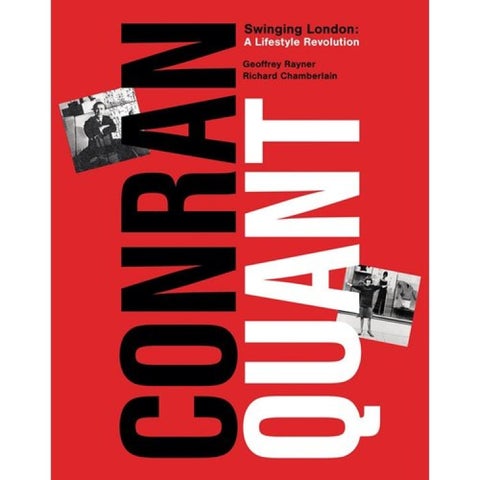
Table of Contents
Introduction
Mary Quant: Beginnings
Enter Alexander Plunket Greene.
A Landscape of Pleasure: Coffee Bars, Bistros and Brasseries Books and Cooks
Mary Quant: Bazaar No.1
Bazaar No.2: The Conran Connection Harbingers of ‘Pop’
Terence Conran: ‘Meetings with Remarkable Men’ Terence Conran: The House & Garden Connection
Terence Conran: Early Exhibitions and Initial Recognition Terence Conran: ‘Basket Weave’ and Other Projects Bernard and Laura Ashley: Urban Ruralism Mary Quant: Empire 1961–1970.
Terence Conran: Habitat 1964–1970. Valediction
2
Often called the ‘Youth Quake’, the ‘Pop’ revolution’s primary forms of expression were fashion, music and art, with fashion and music setting the pace. The opening of the revolutionary young fashion designer Mary Quant’s boutique, ‘Bazaar’, in November 1955, was a seminal moment in the evolution of the cultural and social phenomenon that subsequently became known as ‘Swinging London’.
Quant’s friend and associate, the enterprising young designer, future retail entrepreneur and restaurateur, Terence Conran, was also at the forefront of this growing desire amongst the young for fundamental change. Conran eventually realised his vision of bringing the ‘Good life’ to Britain when he set up Habitat in 1964, a new type of ‘lifestyle’ store, which, at its inception, had something of an egalitarian idealism about it. 3
MARY QUANT
TERENCE CONRAN
directly inspired and set the pace of international avantgarde style, something which has since become a leitmotif of British fashion. Her first collection for J.C. Penney’s, designed expressly for the youth market, was launched in early 1962, amid great acclaim and much American razzmatazz, at the British embassy in Washington D C. For the remainder of the 1960s Quant was one of the most sought after fashion designers in the United States, seen as part of the ‘British Invasion’ with a status similar to that of The Beatle’s and The Bazaar. Rolling Stones. Quant’s enormous popularity in the United States endorsed her fame worldwide and her ‘Mod’ fashions Fashion was then largely determined by male couturiers have since become icons of the era, an inextricable part of the for their mainly middle aged elite clientele. The needs of popular image of the 1960s. the average young woman were hardly, if ever, considered. Since at least the mid 1950s skirts had been worn Teenagers, a distinctly new life form from a world as alien at least on the knee, if not an inch or two above, by more to the fashion establishment as the planet Mars, were not adventurous teenage girls and young women, particularly art considered at all. It was this situation that Quant was, almost students and jazz and Rock ’n’ Roll fans. Quant would have unwittingly, preparing to take on when she opened Bazaar. been well aware of this popular street trend and, from at least With the establishment of Bazaar, Quant irreversibly altered 1964, began to enthusiastically take skirt lengths ever higher the traditional approach to both fashion design and retailing. until they reached the extreme of the ‘Micro Minis’ of the Quant soon came to late 1960s. the conclusion that she would Between 1964 and 1966, not only have to design, but “What a great many people still don’t realise Quant concentrated on realising also make the stock herself, is that the Look isn’t just the garments you the total Quant Look, launching or find others prepared to wear. It’s the way you put your makeup on, ranges of tights, pantyhose and body make it for her. She installed the way you do your hair, the sort of stockings stockings, ostensibly to counteract the a couple of sewing machines you choose, the way you walk and stand ... more adverse aspects of wearing ever in her small flat and found a shorter skirts, to which she soon after professional dressmaker to All these are part of the same feeling.” added her new range of unstructured work alongside her. underwear. In 1964 she collaborated Grey flannel, rough textured tweeds and oddly with the hairdresser Vidal Sassoon when he recreated the coloured cotton or wool jersey were used to realise radically classic 1920’s ‘Bob’ as the ‘Five Point’ cut, an elegant close plain and unadorned designs. Unstructured tunics or simple cut geometric ‘wash and go’ hairstyle which potentially freed pinafore dresses with dropped waistlines, often worn with women from the drudge of elaborate perms, hair rollers and coloured stockings, were decidedly ‘in’. Importantly, all were spray-on lacquer. But probably the most adventurous of her completely inappropriate attire for well-heeled ladies. This excursions to the further reaches of the fashion universe was was probably the first time that youthful ‘street fashion’ both the launch in 1966 of the Mary Quant range of cosmetics.
Habitat’s ethos was light and bright with the ‘free to browse’ and ‘serve yourself ’ ambience of the then relatively new phenomenon of the supermarket. The store’s revolutionary overall style was derived from that of a wholesale warehouse, in particular, one located amid the bustle, colour and movement of a traditional marketplace. Above all, informality was the word. Displays of household goods and kitchenware, punctuated by heaps of brightly coloured enamel teapots, Habitat. mugs and saucepans, were cheerful, colourful, intriguing, 1964-1970. thought provoking and generally stacked high and plentifully, with little or nothing held in reserve in stockrooms. Like Quant, Terence Conran spent much of the late 1950s and As the 1960s, that extraordinary decade drew to a early 1960s extending and consolidating the various components close, the dazzling brio, verve and extreme chutzpah which of his nascent empire. Conran Fabrics and the Conran Design characterized it began to wane and the sharply defined vision Group were added to Conran Contracts in 1956. The Design and almost missionary fervour of many of ‘Pop’ culture’s Group worked across the board, from graphic, product and leading proponents began to dissipate. Yet throughout the era furniture to exhibition and interior design, a diversity of talent Conran’s friendship with Quant and Plunket Greene remained which eventually enabled Conran to realise his personal vision as strong and as mutually influential as ever. This was made of the good life through the vehicle of Habitat. very apparent at the opening of the first Habitat store on the The same aspirational young cohort who wore Quant’s 11th of May, 1964, when most of the women present, both staff clothes generally shared a new irreverent view of the world and guests, wore Mary Quant dresses. Habitat subsequently and were beginning to lead a very different way of life to that hosted at least one fashion show for Quant. of their parents and grandparents , one indeed very similar to Even as late as 1971, photographs in the Habitat Conran’s own. They were the target catalogue show a vanity unit in group Habitat was primarily intended Conran told the London Times: the ‘Serendipity’ range of bedroom for, ‘switched on people’, young, affluent “We see ourselves as the Mary furniture blatantly decked out with and largely urban, the readers of the Mary Quant’s ranges of make-up, the new colour supplements and lifestyle Quant of the furnishing world.” unmistakable black, white, and silver magazines such as Nova and patrons of packaging embellished with her daisy the bistros and brasseries then mushrooming around London. logo prominently to the fore. Yet this example of friendly Selecting the stock for Habitat must have been pure product placement makes no mention of Quant’s name, it just joy for Conran. Conran was strongly influenced by memories wasn’t necessary, the daisy said it all to the ‘Pop’ generation. of his first ‘overwhelming’ encounter in 1953 with daily life in This remarkable symbiosis of the Habitat brand with the France. He especially remembered the joy he had experienced Quant is indicative of the powerful position they then jointly at the ‘plenty’ of those ironmongers shops in France back in held in the public’s mind in relation to the lifestyle revolution the early 1950s and also of the French warehouses he had and deep cultural changes their work and ideas had such a visited in his search for products; he wanted to try to recreate major part in bringing about in the 1950s and 1960s and that feeling in Habitat. which continue to shape the way we live now.
4
5
An early cabinet designed and made by Terence Conran,1952. Part of his first independent range of furniture.
A cabinet designed and made by Terence Conran, c1953- 1954, from his second range of furniture.
A group of enamelled tin ware retailed by Habitat c19641966. The tray designed by Juliet Glyn-Smith, 1965.
The C8 ‘Cone’ chair, designed by Terence Conran, c1952. Part of his ‘Basketweave’range.
6
7
“I brought Butterick paper patterns and cut out pieces where I didn’t want them and added more paper where I did...I had to sell one day’s output before I had the money to go out and buy more material...”
‘Shimmy’, a ‘Pop’ textile designed by Natalie Gibson for Conran Fabrics. 1967. This textile was part of a range exclusively created for Habitat.
A printed cotton textile designed by Terence Conran for David Whitehead Ltd. c1952.
8
Group of ‘Op Art’ PVC handbags, Mary Quant, 1965.
9
Black and White ‘OP Art’ PVC Jacket. Mary Quant for Alligator Rainwear, 1965.
Smock dress, printed cotton twill, Laura Ashley, c1965.
Black and White ‘Op Art’ PVC Coat. Mary Quant for Alligator Rainwear, 1965. The ‘Basic’ dress, cotton twill, Laura and Bernard Ashley, c1961. Laura Ashley’s first dress design. The textile’s stripes devised and printed by Her husband Bernard.
10
11
www.accartbooks.com 12