09_Dessins_bis.indd 30-31
23/05/2017 09:52
09_Dessins_bis.indd 30-31
23/05/2017 09:52
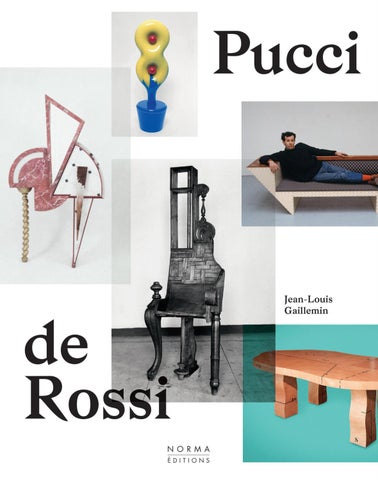
Jean-Louis Gaillemin
Pucci de Rossi
Hermaphrodite, trône, 1975, bois. Hermaphrodite, throne, 1975, wood.
Antoni Gaudí, coiffeuse pour la chambre de la comtesse Güell, 1888. Antoni Gaudí, coiffeuse for the bedroom of Countess Güell, 1888.
52
02_Gaillemin2-12mai.indd 52-53
« Je distinguais, à présent, un extraordinaire piétinement sur les marches de mon escalier, sur les parquets, sur les tapis, un piétinement non pas de chaussures, de souliers humains, mais de béquilles, de béquilles de bois et de béquilles de fer qui vibraient comme des cymbales. Et voilà que j’aperçus tout à coup, sur le seuil de ma porte, un fauteuil, mon grand fauteuil de lecture, qui sortait en se dandinant. Il s’en alla par le jardin. D’autres le suivaient, ceux de mon salon, puis les canapés bas et se traînant comme des crocodiles sur leurs courtes pattes, puis toutes mes chaises, avec des bonds de chèvres, et les petits tabourets qui trottaient comme des lapins. » Certains artistes commencent parfois à se jouer du vocabulaire formel existant avant de découvrir leur voie. Comme Gaudí, qui invente pour la comtesse Güell une coiffeuse qui se tord de rire, entraînant dans son hilarité un cadre qui peine à se retenir. Le ballet des cinq petits pieds, l’un d’entre eux cambré sur son mollet, l’autre twisté et offrant à son propriétaire les commodités d’un petit plateau, rivalisant de cocasserie. Chez Pucci, le cocasse peut laisser place à l’inquiétant. Comme ce Belphégor, diable hautain (il faut gravir trois marches pour l’atteindre) et mélancolique, aux jugements sans appel. Parfois, des dossiers très élevés et évidés leur donnent un côté fantomatique, à la manière de la célèbre chaise Hirondelle de Mackintosh, auréolant la tête des bourreaux de Salo. Quant à Hermaphrodite, il accomplit cette incarnation du meuble poussée jusqu’à la « perversité polymorphe ».
one was straight and the other curved, or one curves toward the outside and the other curves toward the inside.” Unfortunately, his ideas were not illustrated by Hogarth, who knew how to analyze with so much irony the beauty of a chair leg, the profile of a candle-holder or the subtleness of the intercostal muscles. ANTHROPOMORPHIC FURNITURE
These dislocations and drolleries express an uncommon vitality. The seats can’t stand still. On the drawings, the structures are crossed by fluid forms; struck by a cramp, a Chippendale leg becomes taut, its lion’s claws have dropped their ball. The seats become animated, their backs, their legs and their arms start to move. An Art Nouveau curve balances a molding with a right angle, improbable compartments with their knobs act as the left arm. Under the undulating seat are four disparate legs: a baroque scroll, a baluster and two geometric volumes. Asymmetrical, dislocated, lop-sided, the monster leaning on its crutch seems to raise its shoulder to start a burlesque dance or to flee, like Dr. Frankenstein’s creature or the furniture of Maupassant’s short story “Qui sait?” that escapes from the house: “I could distinguish now an extraordinary pattering upon the steps of my grand staircase, on the waxed floors, on the carpets, not of boots, nor of naked feet, but of iron, and wooden crutches, which resounded like cymbals. Then I suddenly discerned, on the threshold of my door, an arm chair, my large reading easy chair, which set off waddling. It went away through my garden. Others followed it, those of my drawing-room, then my sofas, dragging themselves along like crocodiles on their short paws; then all my chairs, bounding like goats, and the little footstools, hopping like rabbits.” Certain artists sometimes began by playing with the existing formal vocabulary before finding their own way. Like Gaudí, who for the countess Güell invented a coiffeuse that shook with laughter, carrying along in its hilarity a frame that had trouble restraining itself. The ballet of five small legs, one of them arched on its “calf,” the other twisted and offering its owner the convenience of a small tray, vied with each other in humor. In Pucci, the humorous can give way to the disquieting. Such as that Belphégor, a lofty and melancholic devil (you have to go up three steps to reach it), with its final judgments. Sometimes, the very high and carved-out backs give the seats a ghostly air, like the renowned Swallow chair by Mackintosh, circling the head of Salò’s executioners with a halo. As for the Hermaphrodite, it incarnates a piece of furniture pushed to the point of “polymorphic perversity.” The breast and the phallus, the uncertain seat, the threatening arms are less an invitation to sit down than an “inclination of the body” (to use the formal vocabulary of the courts)
53
23/05/2017 09:42
Pucci de Rossi
Pucci de Rossi et François Arnal dans l’atelier rue Keller à Paris, 1980. Pucci de Rossi and François Arnal in the studio, rue Keller in Paris, 1980.
Jacques Mizrahi, lampe Tertiaire créée pour l’Atelier A, vers 1970, acier patiné. Jacques Mizrahi, Tertiaire lamp created for Atelier A, ca. 1970, patinated steel.
voisinent avec des surfaces plus polies ; ici et là, dérisoires et touchants, quelques ornements rocailles ou baroques ayant perdu de leur superbe sont « mis au coin ». Au plafond, un fronton amputé rappelle les couronnements architecturaux des armoires et puis, inévitables, presque obsédants, les balustres chiriciens qui jouent le jeu de la fonction ou font semblant. Et comme sur les meubles, les bois de raccordement exploitent les accidents du collage pour former des lignes organiques qui viennent jouer avec les angles droits des casiers. Les portes, plus plates, encouragent ces jeux linéaires qui prennent, comme dans la maison de Pucci, des allures spectrales.
Roy Adzak, fauteuil-sculpture Fesses, années 1970, résine. Roy Adzak, Fesses, armchair-sculpture, 1970s, resin.
Archizoom, canapés Superonda, 1967. Archizoom, Superonda sofas, 1967.
58
02_Gaillemin2-12mai.indd 58-59
FORMATION ET INFLUENCES Mentor et maître de Pucci, Brooks Walker, sculpteur new-yorkais, s’était établi à Vérone. De formation classique, passionné par les techniques, les usages, il avait le don de métamorphose : « Il m’a appris beaucoup plus que toute école aurait pu le faire, c’était une encyclopédie vivante des savoirs. À une époque où les artisans travaillaient dans leur vitrine, il était capable par exemple de passer des heures à regarder un bijoutier travailler ou, sur la route, des cantonniers. C’était un “spectateur de tout”, il m’a donné les clés grâce auxquelles j’ai pu voir “à travers l’époque et l’objet”, je pouvais distinguer un objet spatial dans un radiateur (les ailes, le bouton c’était la tour de contrôle, etc.), un fil de fer trouvé au hasard me conduisait, sous la lumière, vers d’autres mondes. » Autre modèle, un restaurateur antiquaire installé en bas de chez lui et qui l’initie au travail du bois, aux techniques d’assemblage et de traitement des surfaces. Pucci est également très au fait de la recherche contemporaine. La Biennale de Venise, les galeries de Milan sont l’occasion de découvertes stimulantes. Dans un domaine artistique proche de ses préoccupations, c’est à Milan, en 1963, à la galerie L’Apollinaire que Pierre Restany organise la première exposition des nouveaux réalistes et publie son manifeste. « Le lieu commun, l’élément de rebut et l’objet de série sont arrachés au néant de la contingence et au règne de l’inerte, l’artiste les a faits siens... » À Milan toujours, en 1970, les nouveaux réalistes organisent une série de manifestations pour fêter le dixième anniversaire de leur mouvement. En Italie, dans les années 1960 déjà, le design industriel s’est remis en question. Une critique du good design qui se veut radicale et inventive avec les groupes Strum, Superstudio et Archizoom. Ironie, poésie,
furniture, the connecting pieces of wood make use of the randomness of the collage to form organic lines that play with the right angles of the compartments. The flatter doors encourage these linear games that, as in Pucci’s house, take on ghostly appearances. TRAINING AND INFLUENCES Brooks Walker, Pucci’s mentor and master, lived in Verona. A sculptor with classical training, originally from New York, passionate about techniques and uses, he had the gift of metamorphosis: “He taught me a lot more than any school could have done; he was a living encyclopedia of knowledge. In a period when artisans worked in their shop window, he was capable for example of spending hours watching a jeweler work or, outside, road menders. He was a ‘spectator of everything,’ he gave me the keys thanks to which I could see ‘through the period and the object,’ I could distinguish a spatial object in a radiator (the blades, the knob was the control tower, etc.), a wire found by chance led me, when I looked at it under a light, to other worlds.” Another model was an antique restorer whose shop was just downstairs and who initiated him into woodworking, assembly techniques and surface treatments. Pucci also kept very much abreast of contemporary research. The Venice Biennale, the Milanese art galleries were the occasion for stimulating discoveries. In an artistic field close to his concerns, it was in Milan, in 1963, at the L’Apollinaire gallery, that Pierre Restany organized the first exhibition of the New Realists and published his manifesto. “The shared place, the discarded element and the series object were snatched from the oblivion of contingency and the reign of inertia, the artist made them his own…” In Milan, in 1970, the New Realists organized a series of events to celebrate the 10th anniversary of their
59
23/05/2017 09:42
Jean-Louis Gaillemin
Pucci de Rossi
Dans l’entrée des bureaux de Vente Privée, lustre en fil de fer barbelé, 2000.
Table troglodyte, 1995, bois.
In the entrance of the office of Vente Privée, barbed-wire chandelier, 2000.
Table troglodyte, 1995, wood.
Dans la salle de réunion des bureaux de Vente Privée, table Diamant, plateau en marbre noir, piètement en bronze. In the meeting room of the office of Vente Privée, Diamant table, black marble top, bronze base.
Dans le restaurant des bureaux de Vente Privée, Table mascaron, 2013, plateau de marbre, piètement en bronze. In the restaurant, Table mascaron, 2013, marble top, bronze base.
142
02_Gaillemin2-12mai.indd 142-143
Détail des pieds de la Table mascaron. Detail of the bronze base of the Table mascaron.
143
23/05/2017 09:44
Pucci de Rossi 05
06
01
02
07 08
[ 01 ] Disc I, sculpture Laiton, d. 50 cm [ 02 ] Lit Jasmin Bois —› p. 64 [ 03 ] Porte II Bois, 220 × 105 cm 03
[ 04 ] Déchirures, sculpture Métal [ 05 ] Hommage à Man Ray, sculpture Truelle et clous
[ 06 ] Isle, sculpture Laiton et cuivre, 60 × 40 cm [ 07 ] Modellini, sculpture posée sur la table Tex Mex Métal
09
10
[ 08 ] Polaroïd, sculpture Plomb [ 09 ] Spoons, sculpture Métal [ 10 ] Two Forms in Movement, sculpture Laiton
04
212
08_raisonne_12mai.indd 212-213
213
23/05/2017 09:49
03
01
02
03
03
03
[ 01 ] Visage, sculpture Verre CIRVA, Marseille [ 02 ] Plat Verre CIRVA, Marseille [ 03 ] Les Inflatables, sculptures Verre soufflé, h. 40-60 cm environ CIRVA, Marseille —› p. 118-119
292
08_raisonne_12mai.indd 292-293
293
23/05/2017 09:53
03
01
02
03
03
03
[ 01 ] Visage, sculpture Verre CIRVA, Marseille [ 02 ] Plat Verre CIRVA, Marseille [ 03 ] Les Inflatables, sculptures Verre soufflé, h. 40-60 cm environ CIRVA, Marseille —› p. 118-119
292
08_raisonne_12mai.indd 292-293
293
23/05/2017 09:53
Pucci de Rossi 02
06
01
03
07
08
04
[ 01 ] Lampe XXIV Cuivre [ 02 ] Lampe XXV Zinc Néotù, Paris 05
[ 03 ] Lampe XXVI Bois et métal
08_raisonne_12mai.indd 320-321
[ 08 ] Mondo, buffet Bois
09
2004
[ 04 ] Lampe colonne IV Bois
[ 09 ] Aïoli, photophore Aluminium poli et verre sable, h. 24 cm Ardi, Paris
[ 05 ] Table basse X Bois Made, Paris
[ 10 ] Chandelier Menora Aluminium
[ 06 ] Lotus II, table basse Acier et époxy Made, Paris
320
[ 07 ] Table VII Bois Alice Alianca, Paris
10
321
23/05/2017 09:54
01
06 Pucci de Rossi
02
03
04
[ 01 ] Tabouret Hypnos et Thanatos I Bronze poli miroir double face Hypnos / Thanatos, h. 47,5 × d. 27,5 cm « Noce de bronze », galerie Downtown François Laffanour, 25 novembre 20115 janvier 2012
05
[ 02 ] Tabouret Hypnos et Thanatos II Bronze à patine noire double face h. 47,5 × d. 27,5 cm « Noce de bronze », galerie Downtown François Laffanour, 25 novembre 20115 janvier 2012 [ 03 ] Tabouret Hypnos et Thanatos III Bronze à patine noire double face Hypnos / Thanatos, h. 54,5 × d. 28 cm « Noce de bronze », galerie Downtown François Laffanour, 25 novembre 20115 janvier 2012
340
08_raisonne_12mai.indd 340-341
Hypnos et Thanatos II, vase Bronze poli miroir double face Hypnos / Thanatos, h. 46 × d. 27,5 cm « Noce de bronze », galerie Downtown François Laffanour, 25 novembre 20115 janvier 2012 —› p. 151, 152 [ 04 ] Chaise Pantone Plastique Réalisée pour La Source [ 05 ] Suspension lumineuse Roue de bicyclette en porcelaine maintenue par trois câbles en acier Courtesy Tajan, Paris [ 06 ] Sic transit gloria mundi, paire de portières sculptées façon chambre forte Bois gainé de plomb à patine grise, revers gainé de spazmolla, 284 × 80 cm Courtesy Tajan, Paris
341
23/05/2017 09:55
REMERCIEMENTS ACKNOWLEDGMENTS Cet ouvrage n’aurait pu voir le jour sans le soutien de Mathilde de Rossi et de Vente Privée.com, monsieur Jacques-Antoine Granjon, président, Laure Druot, responsable des services généraux, Eddie Turcon, directeur immobilier du groupe. Nous remercions également : Galerie Downtown François Laffanour, François Laffanour, Nasolo Rakoto Galerie Anne de Villepoix, Anne de Villepoix Galerie Cat-Berro, Francis Cat-Berro et Véronique Sainten Twenty First Gallery, Renaud Vuaillat, Julia Caldwell Tajan, Paris, Jean-Jacques Wattel, Catherine Chabrillat, Jessica Remy-Catanese Sotheby’s, Paris, Cécile Verdier, Nathalie Petit, Pia-Camila Testa Piasa, Paris, Cécile Demtchenko Woringer, Estelle Laporte. Nous remercions par ailleurs les photographes : Antoine Baralhé, Gérard Bonnet, Maurizio Brenzoni, Stéphane Briolant, Stephen Clément, Marie Clérin, Jacques Delacroix, Dominique Feintrenie, Anne Garde, Jean-Pierre Godeaut, Anne-Sophie Granjon, Rodolphe Hammadi, Irina Ionesco, Jean-François Jaussaud, Louis-Michel Lauprete, Luciano Luise, Adriano Masson, Yann Merlin, Éric Morain, Tiziano Rovere, Hervé Sellin, Brice Vandermeeren, Deidi von Schaewen. Et toutes celles et ceux, amis, collaborateurs, connaissances, collectionneurs, mécènes, qui ont participé à la redécouverte de l’œuvre de Pucci : Montserrat Alvarez, maître Jean-Claude Binoche, Mattia Bonetti, Ronan Bouroullec, Antoine Broccardo, Alexandre Canévet, Giovanni Dusi, Giovanna Reni Erminero, maître Bertilla Ferro, Mark Fischer, Diane Fraser, Jean-Luc Gaüzere, Bradley Hutchinson, Claude Jasmin, Évelyne Jasmin, Christophe Joron-Derem, John Krich, Golda Laurens, Pierre Le Tan, Ernest et Montserrat Lehmann, Adriano Masson et Giovanna Baccini Masson, Paolo Mezzelani, Sébastien Moinet-Bechar, Anne-Marie Nicol, Cybèle, Éva et Tania Plank, Alessandra Ricelli, Donatella Righetti, Maya de Rossi, Gabriel Rummonds, Tommaso Tuppini, Olivier Urman, Élisabeth Vedrenne, Christine et Julien Vernière, Giorgio Vigna, et tous ceux qui ont souhaité garder l’anonymat.
Achevé d’imprimer en mai 2017 sur les Presses de Re.Bus, Italie
12_Biblio.indd 352
23/05/2017 09:39