A Land Which Reached for the Sky: How Photography Shaped Our Understanding of the American City
Alexander Moore
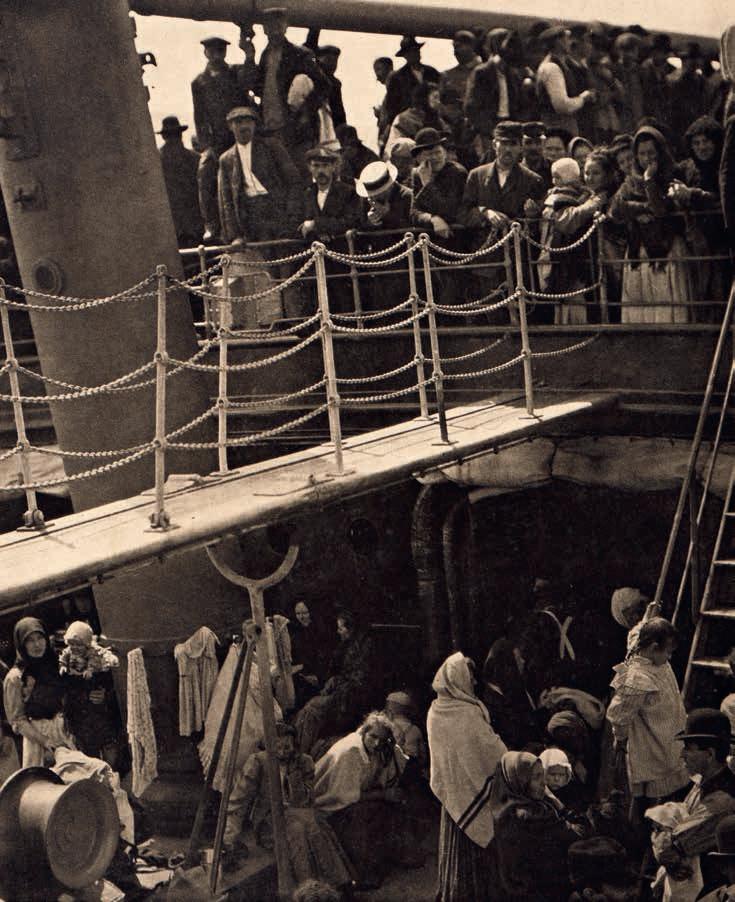
The Steerage [cat. 1] was taken aboard the Kaiser Wilhelm II during a transatlantic crossing, looking down from an upper deck towards the segregated space reserved for steerage passengers. As Stieglitz recalled:
Coming to the end of the deck, I stood alone. Looking down, there were men, women and children on the lower levels of the steerage. The scene fascinated me. A round straw hat. The funnel leaning left, the stairway leaning right. White suspenders crossed on the back of a man, below a mass that cut into the sky, completing a triangle. I saw shapes related to one another, a picture of shapes and underlying it, a new vision that held me. I raced to the main stairway of the steamer, chased down into my cabin, picked up my Graflex, raced back again, worrying whether or not the man with the straw hat had shifted his position. If he had, the picture I saw would no longer exist. The man with the straw hat had not stirred an inch. The man in the cross suspenders, he too stood where he had been talking. No one had moved. I had only one plate holder with one unexposed plate. I released the shutter, my heart thumping. If I had captured what I wanted, it would be a picture based on related shapes and deepest human feeling. A step in my own evolution.4
Cat. 1. Alfred Stieglitz
The Steerage, 1907 Large-format photogravure on vellum 32.2 x 25.9 cm
What distinguishes The Steerage is not sentiment but structure. The photograph is organised around sharp diagonals, intersecting planes and repeated geometric forms: gangways, ladders, rigging, railings. Human figures are embedded within this framework rather than placed at its centre.The image holds together two registers at once. On one level, it is an unambiguous document of class division and enforced separation, made visible through the architecture of the ship. On another, it is a composition driven by form rather than atmosphere. Gone are the soft edges and tonal veils of Pictorialism. In their place is a clarity that allows social meaning to emerge through visual relationships. For Stieglitz, this represented a resolution of a problem that had been building for years.
Photography no longer needed to borrow the language of painting to think seriously about the world. This realisation found institutional form a few years later at 291, the gallery Stieglitz ran at 291 Fifth Avenue [fig. 4]. Initially conceived as a space for photography, 291 quickly became a site of confrontation between American audiences and European modernism. Beginning in 1908, Stieglitz exhibited drawings, prints and sculpture by artists largely unknown, and often unwelcome, in the United States. Among the most consequential of these exhibitions was the first presentation of work by Pablo Picasso in America, held in 1911.
“From 1893 to 1895, I often walked around the streets of New York, downtown near the East River, taking my hand camera with me. I loathed the dirty streets, and yet I was fascinated. I wanted to photograph everything I saw. Wherever I looked, there was a picture that moved me. The secondhand clothing shops, the rag pickers, the tattered and the torn all found a warm spot in my heart. Above all, there was the burning idea of photography, pushing its possibilities even further.”
Alfred Stieglitz, 1921
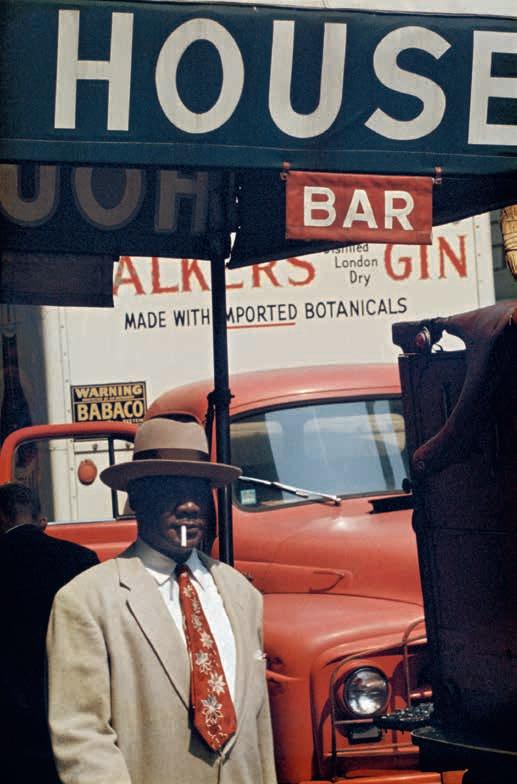
Others arrived as outsiders but returned repeatedly. Saul Leiter (1923–2013) worked largely in and around his home in the East Village, photographing the streets of downtown New York in close proximity to his apartment. His venture into Harlem [cat. 10] therefore represents a departure from his usual territory, but one that he would return to on occasion. By the 1950s and 60s Harlem was widely understood as a centre of Black cultural life, and Leiter appears to have approached it as a place of visual
Chromogenic print 34.3 x 22.8 cm
richness, producing an image that is markedly busier than his colour work of the previous decade [cats. 11, 54 & 55]. Across his work, Leiter used reflections, obstructions and shallow depth of field to fragment the street into planes of colour and light, so that the scene is never fully resolved. His images fracture space, layering the city into surfaces and intervals, suggesting that Harlem, like the city itself, could never be grasped in a single view.
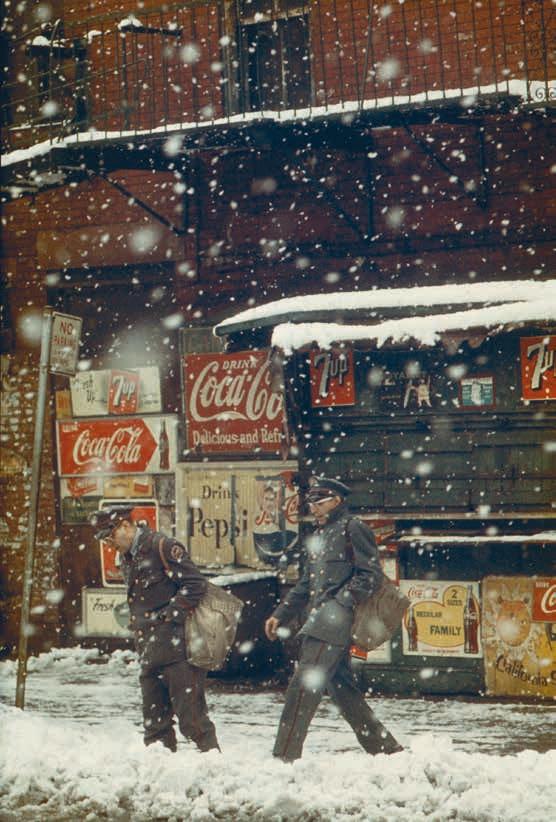
“I’ve always loved color. It seemed to me a perfectly normal, valid thing to do. There was for the longest time a prejudice against color in photography. But we live in a world of color. I never questioned its value.”
Saul Leiter, 2013
Cat. 11. Saul Leiter Postmen, 1952
Chromogenic print
48.2 x 32.6 cm
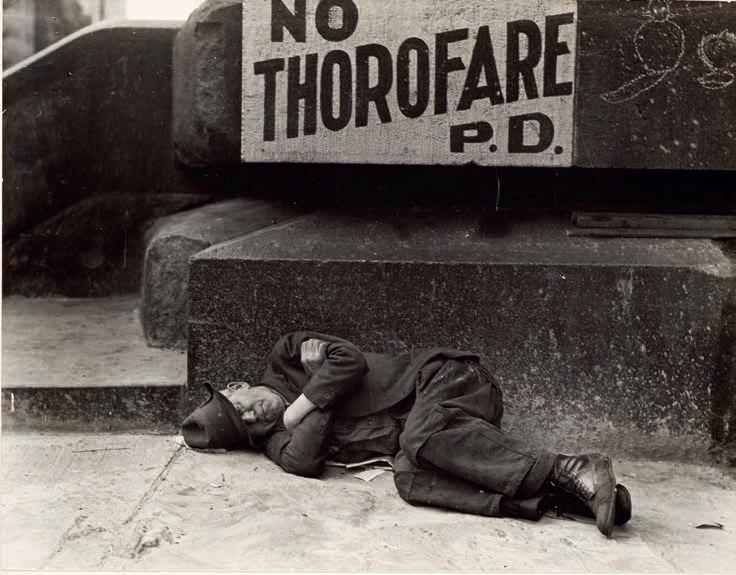
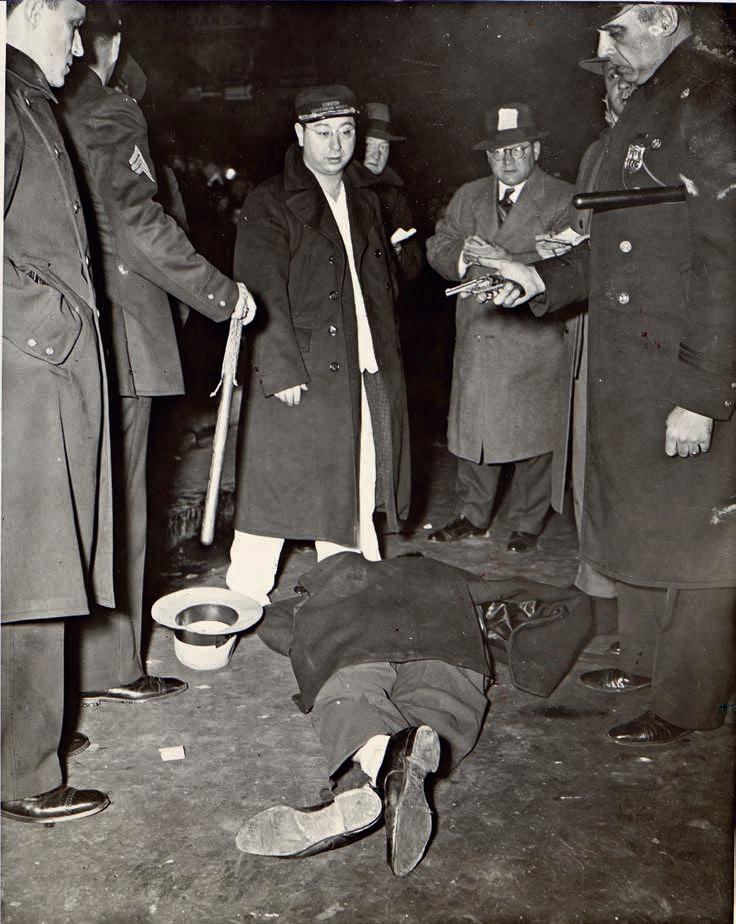
“To me a photograph is a page from life, and that being the case, it must be real. In my case a picture is never posed. The moment I get to the scene I start shooting. Sometimes I get there before the police, sometimes after them — but the picture must tell the story.”
Weegee, 1945
Cat. 45. Weegee (Arthur Fellig) Murder, 1945
Gelatin silver print
49.5 x 32.7 cm
Arthur Leipzig (1918–2014) was a Brooklyn–born photographer whose work focused on everyday life in the city during the 1930s–50s. After severely injuring his right hand whilst working at a glass wholesaler, he turned to photography to make a living and became a member of the Photo League.
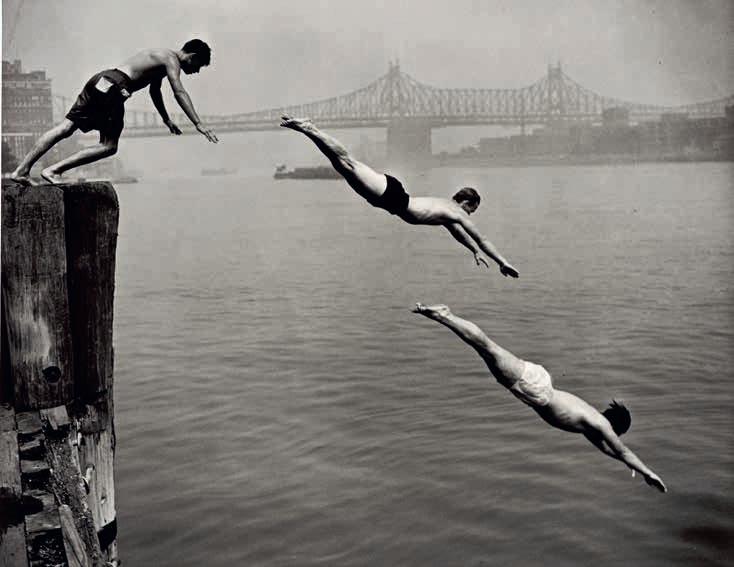
Divers, East River shows boys diving from a river wall along the Manhattan waterfront, with the Queensboro Bridge and Roosevelt Island (then known as Welfare Island) visible in the background. At the time, the island was dominated by hospitals, asylums and other municipal institutions. Leipzig captures a
moment of play set against the city’s infrastructure, reflecting how young New Yorkers claimed the river’s edge as a space of freedom within the modern city.
Reflecting on his career in 1995 Leipzig wrote: ‘While I know that the city has changed, that the streets are dirtier and meaner, the energy that I love is still there… Of course, the “good old days” were not all sweetness and light. There was poverty, racism, corruption, and violence in those days, too, but somehow, we believed in the possible. We believed in hope.’