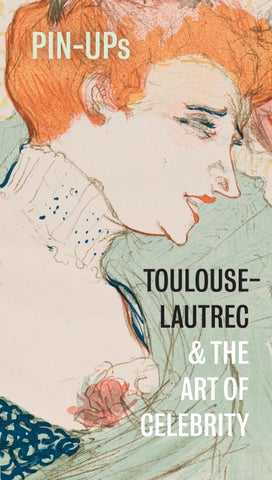
PIN-UPs
TOULOUSE– LAUTREC & THE ART OF CELEBRITY
AUTHORS’ ACKNOWLEDGEMENTS
The authors would like to thank the following individuals who have helped us in the preparation of this publication. We are especially grateful to Professor Richard Thomson for his expert guidance and generous sharing of information, Agnes Ness for her expertise in dance and performance and her enthusiasm for this project, and Julia Rosenthal for her benevolence and support. We are most grateful to Zorian Clayton, Helen Dawson and Sarah Grant at the Victoria and Albert Museum, Anne Dulau Beveridge, Malcolm Chapman and Lizzie O’Neill at the Hunterian, University of Glasgow, Colin Harrison at the Ashmolean Museum, University of Oxford, Emily Goalen at Aberdeen Art Gallery, Armita Bagherzadeh and Rhona Rodger at The Fergusson Gallery, Perth and Kinross, Jennifer Ramkalawon at the British Museum, Alastair Clark at Edinburgh Printmakers, and to our private lenders. Within the National Galleries of Scotland we wish to give thanks in particular to Julie Duffy and to our colleagues Dr Patricia Allerston, Christopher Baker, James Berry, Greta Casacci, Sam Drake, Graeme Gollan, Alice Tod, Charlotte Topsfield, Kerry Watson, Aidan WestonLewis and Graeme Yule. We also wish to thank the NGS Trading Company and Jennifer McIlreavy and the Publishing team for the management and production of this book and Robert Dalrymple for the outstanding design.
6
DIRECTORS’ FOREWORD
Renowned for his vibrant and ingenious posters of Paris’s Belle Époque, Toulouse-Lautrec was one of the greatest master lithographers of all time. His subjects were the celebrities of their day: music-hall and cabaret performers such as the cancan dancers La Goulue and Jane Avril, the singer and impresario Aristide Bruant, and his willowy muse Yvette Guilbert, who enjoyed international fame. The works in this exhibition span the breadth of Lautrec’s richly fertile career and celebrate the extraordinary visual power of the printed image at the end of the nineteenth century. In the 1890s, technological advances in lithography were pioneered not only by Lautrec but also by other Paris-based artists represented in the exhibition, such as Pierre Bonnard, Théophile-Alexandre Steinlen and the so-called ‘father of the poster’, Jules Chéret. We are extremely grateful to the very generous lenders who have made the exhibition possible. In particular, the show has benefited from the loan from a private collection of items relating to Yvette Guilbert and Aristide Bruant, which includes letters, manuscripts and memorabilia as well as a complete copy of the 1894 Yvette Guilbert album, Lautrec’s most important collaboration with the performer. We are also delighted to be able to collaborate with the Victoria and Albert Museum, London and the Hunterian, University of Glasgow. Pin-Ups is the first exhibition at the National Galleries of Scotland to focus on the work of Lautrec and provides us with an exciting opportunity to display works from our world-class collections of late nineteenth- and early twentieth-century French and British art. Special thanks are due to Hannah Brocklehurst, Curator of Prints and Drawings, who has overseen the whole project with great skill, and to Professor Frances Fowle for her contribution to the catalogue. We are also indebted to the Centre national du cinéma et de l’image animée (cNc) and to our sponsors, Aegon, for their most generous support. sir JohN leiGhtoN Director-General, National Galleries of Scotland christoPher Baker Director, European and Scottish Art and Portraiture, National Galleries of Scotland
7
10
TOULOUSE-LAUTREC AND THE WORLD OF CELEBRITY Frances Fowle Celebrity worship is not only a twenty-first-century phenomenon. Just as today’s stars and minor personalities court publicity, and willingly satisfy their fans’ desire to be shocked, delighted and horrified, this same need to remain constantly in the public eye motivated the world of entertainers in Paris in the 1880s.1 But – whereas the Kim Kardashians of today use Instagram, Twitter and other social media to expand their circle of admirers – singers, impresarios and cancan dancers in the 1880s were promoted through the new medium of the poster. Of all the designers who emerged during this period, Henri de Toulouse-Lautrec was undoubtedly the most gifted and sought-after. The secret of his success was to build up a close relationship with each of his subjects, with the aim of identifying a particular trait, catchline or physical characteristic. He then used his skills as a draughtsman to capture the individual character or ‘essence’ of each performer, which he translated into a series of enticing and memorable images of Paris’s ‘Belle Époque’.
Café culture
Detail from Henri de ToulouseLautrec, Moulin Rouge – La Goulue, 1891 (cat.2)
The new cult of celebrity grew up on the back of the popular café- concerts that sprang up along the Champs-Élysées and elsewhere in the 1850s and 1860s, and the music halls that dominated the landscape of Montmartre in the last two decades of the century. The café-concerts were initially small affairs and boasted at best a small stage for a singer or stand-up comic, as shown in the background of Édouard Manet’s Corner of a Café-Concert of 1878–80 (fig.2). The Folies-Bergère began as a department store specialising in bedding and expanded to include a salle des spectacles in 1863.2 Over the years, the larger cafés like the Alcazar added scenery, dazzling new electric lights, mirrors and tiers of boxes for the audience, and developed into more elaborate places of entertainment.3 A mix of social classes frequented the café-concerts, and over time the grander music halls attempted to discourage the poorer members of society. Some, including the Folies-Bergère, introduced a two-franc fee for entry, while others charged as much as three francs for drinks, and the Eldorado insisted on customers ‘refreshing’ their glasses at frequent intervals.4 The music halls paid their performers more generously than even the theatres: the singer Yvette Guilbert (fig.6) recalled that by moving from the Théâtre des Variétés to the Eldorado, she received a pay rise from 200 to 600 francs, even though a job in the theatre was considered more socially desirable.5 Photographs of the stars were disseminated through small cartes de visite, a process patented by André-Adolphe-Eugène Disdéri in 1854. In the 1860s, performers such as the cancan dancer Rigolboche (meaning ‘the joker’; real name Marguerite Badel) and the singer Thérésa (Emma Valadon) published their memoirs, producing the first celebrity biographies (often ghost-written by journalists), and the stars of the music halls such as Jane Avril and Yvette Guilbert followed suit.6 Thérésa’s memoir – which sold 60,000 copies in just a few months – emphasised her unschooled, natural style of singing. She often suffered from laryngitis and recalled how, performing at the Alcazar one evening, she had struggled to sing above the noise of the traffic in the Champs-Élysées.7 11
Fig.2 | Édouard Manet, Corner of a Café-Concert, 1878–80 Oil on canvas, 97.1 x 77.5 cm The National Gallery, London
In the mid- to late 1870s, Edgar Degas produced a whole series of images of Thérésa and her fellow performers, several in pastel on monotype. These show him experimenting with different gestures, effects of light and unusual viewpoints, as well as examining the relationship between the singer and the audience – all important models for Lautrec. One of the most striking was the pastel and gouache The Song of the Dog (fig.3), which shows Thérésa performing one of her hallmark songs, her coarse features blanched by the glare of the footlights. Like a cruel caricaturist, Degas worked in pastel to capture Thérésa’s most characteristic features, emphasising her plump body and animallike gestures, as she acted out the lyrics.
The music halls of Montmartre In the 1850s and 1860s, Paris underwent an extensive rebuilding programme under Baron Haussmann, who was appointed to the task by Emperor Napoleon III. When, in 1882, Lautrec moved to the city (later joining the studio of Fernand Cormon), he discovered broad boulevards, green spaces and bright electric lights. Over the next two decades, Paris’s population increased dramatically as rural workers migrated to the city in search of employment. This period also coincided with a new emphasis on leisure, a luxury that was no longer the privilege of the upper classes, but was becoming a novel reality for the petite bourgeoisie and even the poorer members of society. The egalitarian Third Republic, established after Napoleon III’s downfall in 1870, encouraged greater social fluidity – a phenomenon that, although resisted in other areas of activity, was evident at the café-concert and the dance hall. Lautrec came to love the narrow, winding streets and 12
bohemian lifestyle of Montmartre, where – previously a social outcast (he was mocked by many for his short stature, the result of two childhood accidents) – he was able to blend in with the demi-monde of the cabaret and the music hall. There was money to be made from the entertainment industry, and this period saw the emergence of a new breed of entrepreneurial music-hall director: men such as ‘Lorge’, who in 1862 transformed the Comédia theatre into the Eldorado music hall in the Boulevard de Strasbourg, arguably Paris’s most successful café-concert over the next half-century; or Rodolphe Salis, who established the trendy Chat Noir cabaret at 84 Boulevard de Rochechouart, Montmartre in 1881; or Aristide Bruant, star performer at the Chat Noir and later owner of the Mirliton nightclub, which opened in 1885.8 Both Salis and Bruant were skilled self-publicists and published journals to advertise their cabarets; Bruant was also among the first to commission Lautrec to portray him in the role of impresario (cat.26). Among the most successful of these entrepreneurial directors was arguably Charles Zidler, who not only set up the Jardin de Paris in 1885 but also, in partnership with Joseph Oller, established the world-famous Moulin Rouge dance hall on the Boulevard de Clichy in October 1889. The Jardin de Paris was on the current site of the Petit Palais museum, close to the Palais de l’Industrie, between the Champs-Élysées and the River Seine. In addition to a dance hall, it comprised a stage for acrobats, tumblers and other performers, a puppet theatre, a diorama and an entrance hall lined with fairground mirrors. The Moulin Rouge, by contrast, was situated close
Fig.3 | Edgar Degas, The Song of the Dog, 1875–77 Pastel over monotype on paper, 55 x 45 cm Private collection
13
to Montmartre and was distinctive for its hallmark red windmill and gigantic model elephant in the gardens, a relic of the Exposition Universelle of 1889 (fig.4). Zidler invited celebrities such as the raunchy Louise Weber, known as ‘La Goulue’ (‘the Glutton’), to perform at his music halls. He raised their public status, not only through publications such as Le Courrier français, but also by advertising their performances and posting marketing material in the vicinity of the music hall.9 Among the most successful and imaginative poster designers of the period was Jules Chéret, the so-called ‘father of the poster’, who was producing designs for the Ambassadeurs as early as 1881 and for the Moulin Rouge (cat.1) when it first opened in 1889.10 Chéret’s posters were striking and colourful, but the pretty, doll-like performers that inhabited them lacked any individuality.11
Marketing the celebrities Through developing close friendships with the stars of the music hall, Lautrec won their trust and also their commissions for posters to market their performances. It was a mutually advantageous collaboration, guaranteed to benefit both the designer and the performer. As a consequence, it was La Goulue who indirectly established his reputation as a colour lithographer par excellence. In 1891, he produced a poster of her and her dancing partner ‘Valentin le Désossé’ (‘Valentine the Boneless’, real name Jules Renaudin) at the Moulin Rouge (cat.2). Like Degas, Lautrec exaggerated each performer’s most distinctive features 14
Fig.4 | French photographer (19th century), The Garden of the Moulin Rouge, 1889 Photograph Private collection
in order to capture their ‘essence’. Although reduced to a sinuous silhouette, Valentin is easily recognisable by his top hat, distinctive profile – aquiline nose and prominent chin – and his gangly physique; while La Goulue is shown performing the high-kicking cancan, known as le chahut, for which she was so famous. Other star performers at the Moulin Rouge included Yvette Guilbert, who recalled in her memoirs that Lautrec preferred to depict the ‘smarter crowd’ who arrived for the quadrilles at 9.30pm.12 Of all Lautrec’s subjects, Guilbert had the longest and most successful career.13 Her somewhat emaciated features, long black evening gloves and loose-fitting V-necked costume distinguished her from her more fashionable and shapely contemporaries. She made a virtue of her poor singing voice, developing a distinctive diseuse delivery, half-spoken and half-sung, often in a highly suggestive manner, and she chose her repertoire carefully, favouring witty Montmartre songwriters and poets such as Léon Xanrof, Maurice Donnay and Aristide Bruant.14 She was brilliant at self-promotion and was immortalised not only by Lautrec, but also by Jules Chéret, Ferdinand Bac and Théophile-Alexandre Steinlen (cats 20 and 21), who designed publicity posters for her performances at the Concert Parisien, the Scala and the Ambassadeurs in the early 1890s. In July 1893, Lautrec produced a less-than-flattering chromotypograph of Guilbert for Le Figaro illustré. The performer rejected his poster design (now in the Musée Toulouse-Lautrec, Albi), but they nevertheless collaborated on several projects, the most important of which was the Album Yvette Guilbert of 1894 (cat.22). The album comprised a cover image and fifteen lithographic prints, accompanied by a text by the critic Gustave Geffroy. Lautrec based the lithographs on rapid sketches of Guilbert performing on stage, viewed from various angles, her features often distorted by the footlights – a technique that he had undoubtedly learned from Degas. The front cover signifies the star through her discarded black evening gloves, which, in their disembodied state, bear a decidedly unsettling resemblance to chickens’ legs. Fig.5 | Personalised Louis Vuitton travel trunk belonging to Yvette Guilbert Private collection
Fig.6 | Unidentified photographer, photographic portrait of Yvette Guilbert, c.1913. Photographic print mounted on card. Victoria and Albert Museum
15
20
ART, ADVERTISING AND THE CRAZE FOR PRINTS Hannah Brocklehurst
Henri de Toulouse-Lautrec’s brief career coincided with one of the most exciting periods in the history of Western printmaking. In Paris at the end of the nineteenth century, a new generation of avant-garde artists made techniques such as lithography, etching and woodcut central to their creative process, sparking a printmaking and collecting boom. The artist Camille Pissarro wrote in 1897: ‘Nobody here pays attention to anything but prints, it’s the rage, the young don’t make anything else’.1 Colour lithography, in particular, was championed as the defining medium of modern printmaking. From his first experiment with the technique in 1891 until his death in September 1901, Lautrec was one of the leading lithographers of the age, some even valuing his prints and posters over his paintings.2 In July 1881, new laws on the freedom of the press in France relaxed licensing and censorship regulations on printing, publishing and the display of commercial materials in public spaces. The subsequent decades witnessed a rapid surge in the use of print for advertising, and the boulevards of Paris became emblazoned with vibrant printed images – from illustrated book covers, magazines and sheet music displayed on kiosks and across pavements, to striking advertising posters pasted on walls, on specially designed poster columns (called ‘Morris pillars’), and even on pull-along advertising carts. It was the proliferation of huge lithographic posters which perhaps transformed the appearance of the city streets most dramatically, leading to descriptions such as ‘the outdoor gallery that’s always open’ and ‘the people’s Louvre’ (fig.10).3 Invented in Germany in 1796, lithography was a relatively young printmaking technique. The process relies on the basic principle that oil and water do not mix. In traditional lithography, the image is drawn in a greasy medium onto a specially prepared slab of perfectly smooth limestone and the surface treated with a mixture of acid and gum arabic. After the surface has been wetted, an oily printing ink is applied which sticks to the water-repellent greasy marks of the drawing but is repelled by the wet areas of stone. Paper is then placed against the surface of the stone and both are rolled through a press, so that the inked design is transferred onto the sheet. To make a lithograph using multiple colours (a chromolithograph), a different stone block is used for each colour in the design. The sheet is moved from block to block and must be precisely placed or ‘registered’, so that each colour is in the correct position in the final image.4 The technique was ideal for producing images inexpensively and in large numbers, and by the 1830s Paris was home to hundreds of lithographic printing workshops producing a variety of commercial material such as flyers, magazines, newspapers and posters. As the century progressed, the introduction of steam-driven mechanical presses enabled larger sizes and formats and ever bigger print runs. Detail from Pierre Bonnard France-Champagne, 1889–91 (cat.4)
Jules Chéret: the meeting of advertising and art Early posters were created primarily to provide information, and usually consisted of monochrome blocks of simple letterpress text in limited typography with the occasional addition of an illustration 21
made using woodcut or wood engraving.5 The advent of lithography enabled complex, multicoloured designs with hand-drawn lettering and visually connected image and text. Jules Chéret began making posters in the late 1850s and was the first designer to bring real artistry to the medium, his contribution to the graphic arts even earning him a prestigious Légion d’Honneur from the French government in 1890.6 Trained in both painting and lithography, he combined these disciplines to create posters which the writer Gustave Coquiot described as ‘artistic treats’.7 Chéret pioneered new developments in colour lithography, often using just three stones with careful overlaying to produce a spectrum of delicate colours and watercolour-like effects. His posters were unquestionably artistic, but he also understood and celebrated their commercial function, creating images that were eye-catching and had popular appeal. A beautiful example of the artist at the height of his powers, La Loïe Fuller of 1893 (cat.18) shows the dancer Loïe Fuller in full length, engulfed by swirling drapery. The striking image is composed of clear, radiant colours, minimal background detail and hand-lettered text which is woven into the overall design (in this case, the colour of the title is an exact match to Fuller’s hair). Another poster which typifies his style, Le Punch Grassot (fig.11), advertises a brandy cocktail, using an enticingly colourful image of the drink served by a smiling young woman (a generic type so frequently employed by the artist that they became known as ‘chérettes’), with a wasp waist and fashionable dress. Chéret’s achievements in poster design inspired other artists in Paris to take up and explore the medium, among them Eugène 22
Fig.10 | Unknown photographer Advertisements in Paris, c.1890 Photograph Private collection
Fig.11 | Jules Cheret, Le Punch Grassot, 1895 Colour lithograph on paper, 124 x 90 cm Buyenlarge Archive
23
PRINTMAKING IN PARIS
30
31
7
Camille Martin 1861–1898
L’Estampe originale. Cover for L’Estampe originale album V, 1894
Printer: Ancourt & Cie, Paris Lithograph in green, yellow, light and dark blue and red ink on paper, 61.1 x 90 cm The Hunterian, University of Glasgow: bequeathed by Rosalind B. Philip, 1958
The highly influential L’Estampe originale was published between 1893 and 1895 and was a series of nine portfolios of prints, issued every three months, each produced in an edition of 100. Masterminded by the art dealer and publisher André Marty (born 1857), who also issued the Café-Concert series (1893) (cat.28) and Lautrec’s 1894 Yvette Guilbert portfolio (cat.22), the project facilitated new levels of collaboration between the vanguard of artist-printmakers and professional printers. Aimed at serious collectors and sold on a subscription basis, L’Estampe originale published a total of ninety-seven fine-art prints (lithographs, etchings and woodcuts) by an eclectic mix of seventy- four artists from all the modern styles and artists’ groups of the fin de siècle. Marty recommended prints as an investment: ‘If one only has a few hundred francs to spend on a painting, it will be quite mediocre, signed by some obscure hack and in the future will only diminish in value. By contrast, however high the quality may be, an original print, that is to say an unpublished composition executed directly by the artist on copper, stone, or wood without the assistance of an unreliable intermediary, is always at a relatively modest price. For twenty francs, fifty francs at the most, one may acquire a work signed by a well-recognised artist and with a sure guarantee of increased value in the future.’† This version of the print belonged to the artist James Abbott McNeill Whistler (1834–1903) and was bequeathed to the Hunterian, University of Glasgow, by his sister-in-law, Rosalind B. Philip. HB
† Cited in Cate et al. 2000, p.19.
42
43
9
Pierre Bonnard 1867–1947
La Revue blanche, 1894
Printer: Ancourt & Cie, Paris Lithograph in black, grey and beige ink on paper, 80.2 x 60.2 cm The Hunterian, University of Glasgow
Bonnard produced this striking poster for the art and literature magazine La Revue blanche. The publication was founded in Liège in 1889 by the Nathanson brothers and moved to Paris in 1891. The white cover, which gave the journal its name, set it in opposition to a rival magazine, Mercure de France, with its distinctive purple cover. Thaddeus Nathanson’s wife Misia was the model for several posters, including this one and another designed by Lautrec the following year. Bonnard merely suggests the figures through silhouette and arranging blocks of dark and light. The letters of the title are playfully integrated, the ‘a’ even wrapping itself around the woman’s thigh. Bonnard was one of the group of artists known as the Nabis (Hebrew for ‘Prophets’), led by Paul Sérusier (1864– 1927) and Maurice Denis (1870–1943). They were inspired by Paul Gauguin’s (1848–1903) radical style of painting, known as Synthetism, distinctive for its simplification and emphasis on line and colour. Bonnard was additionally influenced by the flattened forms, unusual viewpoints and asymmetry of Japanese ukiyo-e wood-block prints, and was referred to by his fellow artists as ‘le Nabi très japonard’ (the ultra-Japanese Nabi). The Nabis advocated a more democratic approach to art and enthusiastically embraced the print medium, since it enabled them to reach a broader audience. FF
46
THE CELEBRITIES OF MONTMARTRE
18
Jules Chéret 1836–1932
La Loïe Fuller, 1893
Printer: Chaix (Atelier Chéret), Paris Lithograph in red, yellow, dark violet and black ink on paper, 124 x 84 cm The Hunterian, University of Glasgow
The American dancer Loïe Fuller (1862–1928) took Paris by storm when she debuted at the Folies-Bergère on 5 November 1892. Her innovative act, which included her trademark Serpentine Dance, was the height of modernity. Dressed in reams of white silk, with wands sewn inside the sleeves, she would swirl the fabric to create spectacular sculptural forms. The theatre was plunged into darkness, and multicoloured electric lights and images from a magic lantern were projected onto her costume. Fuller, who designed, choreographed and managed her entire act, also patented the technical stagecraft. Such was her success, Fuller was the only female entertainer to have her own pavilion at the Exposition Universelle in Paris in 1900. This hugely popular poster of the dancer was printed in four different colour combinations. Although it captures the romance and excitement associated with Montmartre, Chéret’s image, especially the exposure of her bosom and her figure beneath the costume, is not a truthful likeness of Fuller on stage. HB
64
22
Henri de Toulouse-Lautrec 1864–1901
Yvette Guilbert Album, 1894 Printer: Ancourt & Cie, Paris
a. Cover for Yvette Guilbert Lithograph in black ink on paper (pictured within original cloth portfolio), 38 x 41 cm
b. Page 4 of Yvette Guilbert Lithograph in olive green ink on paper, 38 x 41 cm Private collection
Yvette Guilbert appeared in Lautrec’s work more than any other entertainer. As well as song sheets, individual collector’s prints and a (rejected) poster project, he produced two albums of lithographs entirely devoted to depictions of the performer (see also cat.23). This first set, made in 1894, caused a sensation because there was then no precedent for producing an artist’s book after just one celebrity. The album comprised a cover and fifteen lithograph illustrations each set beside text by the critic Gustave Geffroy, mainly describing the café-concerts of Paris. It was published by Lautrec’s frequent collaborator André Marty and presented as a prestigious item for both collectors of prints and celebrity enthusiasts. Each set was signed by Guilbert herself, an innovation that, according to the newspaper Le Figaro, in itself made them ‘worth the price’.† Just 100 copies were made, each contained within a luxurious portfolio. Guilbert’s distinctive appearance made her easy to caricature – and, although initially displeased by Lautrec’s unflattering treatment – she decided to proceed with the project. The artist tried to capture her essence but, following the album’s publication, was accused of ‘pushing the cult of ugliness’, and Guilbert as ‘blinded by her love of publicity’.‡ In fact, both recognised the importance of a unique public persona and the crucial role of graphic art in disseminating that image. Few examples of this album have survived in undamaged condition. HB
† Le Figaro, 16 August 1894. ‡ Both quotations from Jean Lorrain in Echo de Paris, 15 October 1894, cited in Frey 1994, pp.390–91.
72
a
B
PIN-UPs
TOULOUSE-L AUTREC & THE ART OF CELEBRITY Henri de Toulouse-Lautrec is one of history’s most brilliant poster designers who chronicled Paris’s famous music hall celebrities of the late 19th century. Many of his finest graphic works were startlingly modern images of the stars of the legendary bohemian night clubs of Montmartre: the Moulin Rouge, Le Chat Noir, Les Ambassadeurs and the Folies-Bergère. Including less familiar lithographs, as well as some of the most iconic images of the period, Pin-Ups brings together works by Lautrec and his key contemporaries in Paris including Jules Chéret, Pierre Bonnard, James Abbott McNeill Whistler and Alphonse Mucha, who helped bring artistic and cultural significance to the world of popular advertising. Pin-Ups also features British artists who were drawn to the dynamic café culture of Paris, such as Walter Sickert, Arthur Melville and John Duncan Fergusson. ISBN 978 1 911054 21 4
9 781 9 1 1 0542 1 4