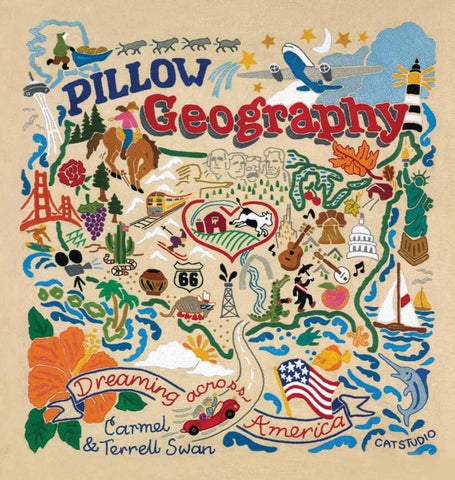
Pillow Geography Dreaming Across America Carmel and Terrell Swan
New York
Pillow Geography Dreaming Across America Carmel and Terrell Swan
New York
Contents
Louisiana 110
Pennsylvania 190
Maine 112
Rhode Island 194
Maryland 116
South Carolina 198
Alabama 14
Massachusetts 118
South Dakota 200
Alaska 16
Michigan 128
Tennessee 202
Arizona 18
Minnesota 132
Texas 208
Arkansas 22
Mississippi 134
Utah 216
California 26
Missouri 138
Vermont 220
Colorado 56
Montana 142
Virginia 222
Connecticut 64
Nebraska 146
Washington 226
Delaware 66
Nevada 148
West Virginia 228
Florida 68
New Hampshire 150
Wisconsin 230
Georgia 80
New Jersey 152
Wyoming 234
Hawai’i 86
New Mexico 154
Washington DC 240
Idaho 94
New York 158
Route 66 242
Illinois 98
North Carolina 172
Indiana 102
North Dakota 178
Iowa 104
Ohio 180
Kansas 106
Oklahoma 184
Kentucky 108
Oregon 188
Foreword 9
Meri Stevens
Author Introduction 11
Carmel and Terrell Swan
Appendices 245 Our Process 247 Index 250 Photography Credits 250 About the Authors 254 Acknowledgments 255
Introduction
C
I haven’t been everywhere, but it’s on my list. —Susan Sontag
armel always says she was practically born on a plane, happily flying from Honolulu to San Francisco in the overhead swinging baby bassinet
(yes, they did exist), while Terrell’s first trip was overseas on a ship to Europe before he could walk. In fact, his first word uttered was fingerhut (thimble in German). Our lives separately and together have been spent in numerous planes, trains, and automobiles, filled with friendship, music, adventure, and wanderlust. In fact, we’ve always felt how auspicious it was that we fell in love on a road trip back in the summer of 1985, which took us from the amazing arch formations of Utah, wiggling up the breathtaking mountains and down the wildflower-filled canyons of southwest Colorado, and into the truly enchanting land of New Mexico. (Traveling for some may be tiring and tedious, but for us, it’s our briar patch.)
To create art that celebrates our joy of traveling across our homeland —well, that’s winning the lottery for us. Bringing these designs to life through the artisanship of hand embroidery is our passion. Our life’s work is to keep this venerable technique alive and remembered in this age of mechanical and technological advancements. Many hands have created and touched every embroidered pillow: from ours sketching the outline concepts, our artists refining the drawing, our design team tweaking and coloring the final art, the embroidery sample makers, the production artisans, the washers, ironers, quality controllers, sewers, finishers, receivers/shippers—on and on it goes from one hand to another, to present and offer one pillow. All these hands give their very best efforts. As you might imagine, to realize a collection of this magnitude has been a very long labor of love, joy, and endless research. We like to say that they are textile heirlooms. We like to think that they are emissaries of good will. We hope you can spend some time to read about our pillow journey and how a design gets brought to life—you’ll find this toward the back of the book in the Our Process section. It’s pretty amazing, actually. As we write this, in the early autumn days of 2018, the population of the United States of America is 327,325,517. Sounds like a lot of folks, doesn’t it? And it is! And yet we can still get lost in the 3.8 million square miles of mountains, plains, valleys, and sea coasts that we are lucky enough to call home—our America. We are obsessed with finding the graphic essence of those 3.8 million square miles and have rendered them so far into 180 designs totaling 72,000 square inches (and we are not even close to being done!). We’ve spent our whole lives, especially the past twenty years, visiting, researching, and designing those 180 pillows featured in this book:
catstudio creators, Carmel and Terrell Swan
11
tates—We have been to 49 of the 50 S (Alas, Terrell is still planning on taking Carmel to Alaska to fulfill her desire to see the aurora borealis.) • Cities—Currently we have designed 67 and have visited 61 of them (tip o’ the iceberg!) • Regions and Resorts—44 are illustrated, and we’ve been to 39 (many more to come) • National Parks—We feature 10, and we’ve been to 9 (there’s 48 more to do—wow) • Ski Resorts—Of the 9 rendered, we’ve been to 8 (just starting…get the wax!) •
We believe there are two great truths about America: the first is that it has incredible geographical diversity. We quite literally have everything here: from the great heights of the Alaska Range—home of mighty Denali—to the soft, worn folds of the Appalachians; from the Great Lakes, which are really more like inland seas, to the expansive continental rivers that cross our country; from the hottest, most arid deserts, to the primeval rain forests of the Hawaiian Islands and the Pacific Northwest; from the Great Plains of the heartland that feed the entire world, to our over 95,000 miles of shoreline—this magnificent geography is our blessing, our treasure. The second great truth about America is that we are undeniably a unique blend of cultures. We are truly a melted crayon mosaic of everyone who ever lived here or came here and everything brought with them that became integrated into their new lives in the New World. It is what makes up who we are, how we think, what we eat, the sound of our lives’ musical soundtrack, the sports we play, the clothes we wear. (And isn’t it funny how this American web of multiculturalism points us to how we are actually connected to the rest of the world, not separate from it! And that realization in itself is great). No matter the distance traveled for amazing and dazzling thrills experienced abroad, when we alight on home turf, we breathe that sigh of gratitude in knowing, that yes, here is our comfort and familiarity, here is the place we belong, our home. This book is our valentine to America, and the art featured within these pages are our homage to everyplace and everything and everybody that makes us uniquely us. So, please come along on our magic carpet dream across America . . . . . . one pillow at a time. —Carmel and Terrell 13
Alabama T
alladega, Tuscaloosa, Tuskegee: such lyrical, romantic American Indian names—and,
actually, Alabama does come from the Alibamu tribe. To us, though, the state brings another Native American association when we think of Alabama—a whole slew of blues and country music, like “Sweet Home Alabama” (Lynyrd Skynyrd), “Stars Fell Over Alabama” (the great, the incomparable Ella Fitzgerald), and “I’m So Lonesome I Could Cry” (Hank Williams). Whether you’re lonesome or not, Alabama’s Love for thy Neighbor runs deeper than Lake Martin. If you need a cup of sugar, or a place to see the football game, you’re in luck! We showed three delightful ladies this design when it was in progress, and though they loved it, they wanted to know why their hometown of Dothan was not included. “It’s the peanut capital of the world, afterall!” We checked it out, and sure enough, discovered that in the middle of their town was a fifteen-foot-tall giant peanut! Which is kind of perfect when you realize that the area is also where the great George Washington Carver grew and promoted peanut production, eventually making peanut butter a staple across the country, which brings us full circle, as peanuts are Native American plants.
Birmingham Nicknamed the “Magic City” because of a growth spurt in its population at the turn of the twentieth century, today Birmingham has a magical vibrancy that makes it a hub city of the New Deep South. Culturally diverse in every way imaginable, Birmingham is the educational mecca for the state. It is also gloriously green, with beautiful botanical gardens and a world class zoo and more city parks than we ever thought you could cram into one place! 14
15
Florida W
hat is a more iconic image for the state of Florida than the flamingo? And yet for more than two hundred years, the Florida flamingo has
been an object of controversy. It’s true. During the 1800s, zoologists disagreed about the origins of the long-legged wading birds, some believing they were a true native species, others convinced they were migrants from the Caribbean. Prized for their beautiful pink feathers, by 1900, flamingos had been hunted to extinction. Most of the birds that were occasionally sighted during the following decades were thought to be fugitives from captive flocks imported from Central America, but since 2014, ornithologists are convinced that 147 individuals sighted in a remote part of Palm Beach County are actually natives making a comeback. Pirates also made the islands of the Caribbean and the waters around Florida their favorite hunting ground, but because those waters were so treacherous with reefs, shoals, and extreme weather, many of them sank into the deep, where today treasure hunters search for pirates’ gold. The pirates’ flag, the Jolly Roger (white skull and crossbones on a black field), has been in use since the seventeenth century. It has undergone many incarnations (once it was a whole skeleton wielding a sword on a red field). Then, as now, ships’ flags were essential for identifying a ship’s origin and intention, whether it was a friend or a foe. But pirate ships usually carried a stock of various flags and would fly false colors or no flag at all until the ship they were pursuing was in firing range. When close enough, the Jolly Roger went up and a warning shot was fired to give the targeted ship a chance to surrender without a fight.
68
69
Daytona Beach Did you know that before the Daytona International Speedway was built in 1959, races were held on the beach? For more than fifty years, races were held on the hard-packed sand of the Old Daytona Beach Road Course. And to this day, after purchasing a pass, you can still drive on the beach as we thrillingly did! Attracted by its sandy beaches, a wonderful boardwalk complete with rides and arcades, a state-of-the-art water park, a beach-front bandshell that hosts free summer concerts, and of course, the biggest NASCAR race in the world, the Daytona 500, folks flock to this Atlantic Coast because every day feels like Spring Break when you’re in Daytona Beach!
Emerald Coast This coast got its name from the sugar-white sand beaches and emerald-green waters that stretch from the border of Alabama about one hundred miles east along the south coast of the Florida Panhandle on the Gulf of Mexico. (And yes, the sand really is so white it looks like fine white sugar!) Â
70
71
Florida Keys We stood outside the enchanting Hemingway House on Key West and imagined “Papa” with drink in hand, contemplating his new novel, To Have and Have Not. This was the writer’s home from 1931 to 1939 and is now a Designated National Landmark and museum. And of course we fell in love instantly (doesn’t everyone?), with the polydactyl cats that roam the house and garden. Given to Hemingway as a gift from sea captain Stanley Dexter, Snow White was Hemingway’s first kitten with extras digits (they usually occur on the front paws and look like thumbs or like the kitty is wearing mittens!) Today, between thirty to forty polydactyl cats live on the estate, entertaining the tourists.
While visiting The Keys, we stopped by the Hemingway house, and yes indeed, to our delight, we did see the famous kitties roaming around! Can you spot any in our photo? (Hint: one’s by the doorway next to Hemingway’s ghost.)
72
73
Jacksonville
Miami
The Florida manatee, an aquatic mammal that
Miami gets its name from a Native American tribe
is able to live in both fresh and salt water, is
that lived in the area in the 1600 and 1700s, the
thought to be the inspiration for the mythological
Mayaimi. It officially became a city in 1896, when
mermaid. Gentle, slow, and graceful in the water,
Julia Tuttle, a local landowner, convinced Henry
the charming manatee has no natural predators
Flagler, the railroad baron, to expand his Florida
but is endangered by collisions with boats or from
East Coast Railroad line to run to Miami, making
being entangled in commercial fishing gear.
it the only major city in the country to be founded
We love that the Jacksonville Zoo is so dedicated to the preservation of the state marine
by a woman. We took our friends, Jamal and Pravina
mammal that in addition to Manatee Critical
from Mumbai, on a trip to Miami, as they love
Care Center currently under construction, they
excitement, and this is one of the most exciting
have established the annual Jacksonville Manatee
cities in the country! It’s a mishmash of cultures
Festival, which helps educate the public about
and a delight to all the senses! We went exploring
these charismatic creatures by celebrating all-
in the areas where recent immigrants have
things manatee.
brought their fabulous food, music, and dance to the vibrant neighborhoods of Little Havana and Little Haiti. We lingered there for hours, sipping our Cuban coffees and entranced by live AfroIsland singers and musicians. We eventually moved on to the outdoor cafes of the gorgeously restored Art Deco Hotels in the fabulous South Beach District that pulsate with life long into the wee hours of the next day.
Left: Jamal, Carmel, and Terrell playfully surrendered to the intoxicating colorful Miami vibes.
74
75
Palm Beach We were visiting our friend Jaynce in seaside Sullivan’s Island, South Carolina, to work on our new Charleston design when we were inspired to pursue a meeting we had in New York City with the celebrity fashion icon and interior designer Iris Apfel. She had invited us to come visit her in Palm Beach, her sunny winter home. Giddy with excitement, we three jumped in a car and drove the 523 miles to Palm Beach. And that’s exactly how we got to do the Palm Beach design— thank you, Iris!
Iris and her beloved Carl with Carmel and her beloved Terrell enjoying the luxe Palm Beach culture.
76
77
St. Augustine As the oldest, continuously occupied settlement of European origin in the nation, founded in 1565, St. Augustine has been fought over many times during its first three hundred years! We are happy to report that since statehood in 1845, things have been a lot quieter! Now St. Augustine has become a mecca for tourists, history buffs, art lovers, golfers, sun worshippers, and treasure hunters!
Above: Driving around St. Augustine, we passed Ponce de León’s discovery. If only the fountain had been open when we passed by!
Tampa / St Pete You just have to love a town that has a Pirate and Treasure Hunters’ Museum and an annual Pirate Festival!
78
79
Montana M
ontana is known as “Big Sky Country,” “The Last Best Place,” “Land of the Shining
Mountains,” and “The Treasure State,” all nicknames that evoke a place of natural, glowing beauty. Think wide open spaces where pearly white clouds dot a sapphire blue sky, where pristine lakes sparkle like diamonds at the feet of majestic opaline snow-capped mountain ranges. This is where two of our glorious national parks are located: Yellowstone and Glacier. This is the crown in God’s country.
Glacier National Park Located in the state of Montana, on the US Canada border, at 1562.5 square miles, Glacier was established as a national park in 1910. On the Canadian side, its sister park, Waterton Lakes National Park, had been established in 1895. Together the two parks have become known as the Waterton-Glacier International Peace Park and were designated the world’s first international peace park in 1932 and in 1995 as World Heritage sites. Uniquely, Glacier has almost all of its original native plant and animal species, which is no doubt thanks to both its remoteness and the sparseness of its surrounding human population. It doesn’t matter where you come from, what you believe in, or who you voted for, when you see Hidden Lake for the first time (or fifth time), drive up the winding way to the Sun Road, or hike the High Line, being in Glacier will, quite simply, take your breath away.
142
143
Ski Montana Like everything else about Montana, the ski runs are big and long and the resorts are well off the beaten path. Helicopter skiing in the high backcountry is available if you want a unique experience in untouched, deep powder that’s far, far from everything. Winters in Montana can be magical, and Yellowstone in the snow is unforgettable.
144
145
Washington DC T
he donkey as the symbol of the Democratic Party dates to the 1828 presidential campaign
of Andrew Jackson. Jackson’s opponents began to refer to him as a jackass, which stuck and began to spread as a label for Jackson’s supporters, as well. Having a sense of humor about himself (unusual in a politician), Jackson decided to use the donkey on his campaign posters as a symbol of strength and stubborn resilience. But the donkey really gained traction in the 1870s when the political cartoonist Thomas Nash used it as the symbol for the entire Democratic Party. Nash also gave the Republicans their elephant by drawing a cartoon of the Democratic Donkey dressed in a lion skin, scaring off the other animals in the zoo. One of those animals was the elephant, who was given the label “The Republican Vote.”
240
241
“Travel isn’t always pretty. It isn’t always comfortable. Sometimes it hurts, it even breaks your heart. But that’s okay. The journey changes you; it should change you. It leaves marks on your memory, on your consciousness, on your heart, and on your body. You take something with you. Hopefully, you leave something good behind.” —Anthony Bourdain
Since 2000, the husband-and-wife duo, Carmel and Terrell Swan of catstudio have woven together their spirit of wanderlust and mutual appreciation for art, design, and craftsmanship into decorative textile-works inspired by vintage souvenir pillows of the 30s and 40s. Hand embroidered by skilled artisans in a process spanning months, the meticulously crafted pillows in the Geography Collection capture the whimsical essence of all 50 states across the United States, plus many cities, regions, resorts, and national parks.
Pillow Geography invites readers on a leisurely magic pillow ride from the rolling folds of the misty Appalachian Mountains all the way to sunny San Francisco through the Golden Gate Bridge, and everywhere in between. So settle in, get comfortable, and come dream across America . . . one catstudio pillow at a time.
Specifications: Specifications: Pillow Geography: Dreaming Across America Pillow Geography: Across America | Carmel Carmel and TerrellDreaming Swan | Decorative Arts/Interiors and Terrell2019 SwanRelease 2019 Release | Lifestyle? September 256 pages 12" | $75 | | July | 11 3/8| x$75 256 pages | with 11 3/8acetate x 12” | jacket Hardcover acetate jacket Hardcover four-color images | 205with 205 4-colorISBN: images | ISBN: 978-1-94386-48-8 978-1-94386-48-8 Published by G Arts www.glitteratieditions.com Printed and bound in China