10
Pablo Picasso, Dog, unsigned and undated, cut paper, 6 x 9.2 cm, Málaga, c. 1890. Picasso Museum, Barcelona. Bequest of Pablo Picasso, 1970.
AF_Picasso_V.12.indd 10
25/03/2024 08:27
11
To my mother, Maude Sykes
“‘I paint the way some people write their autobiography,’ Picasso once declared to Françoise Gilot. Likewise, Dora Maar—another of the artist’s mistresses—underscored that the transformations in Picasso’s style reflected transformations in his private life. When the woman would change, everything else would change: not just the art, but the house Picasso lived in, the poet he had around, the circle of friends, and the dog.” (John Richardson)
On 16 May 2023, an article in The Guardian revealed that a restorer at the Guggenheim Museum in New York had discovered, one hundred and twenty years after its creation, thanks to the latest imaging technology, under the repainted lower section of Le Moulin de la galette from the Justin K. Thannhauser collection, a small brown dog with a red ribbon around its neck, afterwards concealed by the artist. Picasso was nineteen years old when he painted this picture in 1900, but dogs had been part of his life and work since his childhood. In its collections of the painter’s childhood works, the Picasso Museum in Barcelona even has a cut-out paper dog that is remarkable––given that it was done by a nine-year-old boy–– for its realism and precision, right down to the hair under the nose (ill. p. 10). The model for the cut-out is not known; by contrast, that for the small picture painted in A Coruña in 1895, on a reused canvas representing Saint Anthony of Padua, is known indeed. The model in question is Clipper, a small spaniel crossbreed, which is often claimed, without certainty, to have been the first dog known to belong to Picasso in his adolescence (ill. p. 12).
AF_Picasso_V.12.indd 11
25/03/2024 08:27
14
Page 15 Pablo Picasso, Self-portrait with dog and caricatural head, pen and ink on paper, 11.5 x 13 cm, Paris, 1902. Picasso Museum, Barcelona. Bequest of Pablo Picasso, 1970.
AF_Picasso_V.12.indd 14
Pablo Picasso, Harlequin, child and dog, color lithograph, 88.3 x 65.9 cm, 1905. Musée d’Art moderne, Paris, from Two acrobats with a dog, 1905, gouache on board, 105,5 x 75 cm, MoMA, New York.
25/03/2024 08:27
AF_Picasso_V.12.indd 15
25/03/2024 08:27
AF_Picasso_V.12.indd 26
25/03/2024 08:27
27
Attributed to Henry-Louis Mermod, Picasso with his dog Elft on the beach, gelatin silver print, 12.8 x 17.7 cm, Juan-les-Pins, August 1931. Musée national Picasso–Paris, Paris. Bequest of the Picasso estate, 1992.
AF_Picasso_V.12.indd 27
25/03/2024 08:27
AF_Picasso_V.12.indd 40
25/03/2024 08:27
41
Kazbek was a splendid male with all the characteristic attributes of his kind: sleek fur with long silky fringes hanging from ears which were high on his head, and hanging also from his back legs, thighs and tail; eyes with extraordinarily long lashes; and what could be considered an aristocratic appearance, full of an elegance and a grace that was then––another quality–– projected onto his master, and which, naturally enough, made him look like a sculpture, as Brassaï noted: “Kazbek, that strange dog, always silent and somewhat sad, stretches out his skinny body (nearly reduced to a carcass) and his endless paws in a sculptural stance…” And Picasso asked the photographer: “Have you noticed that he can strike poses so extraordinary that one thinks of anything else but a dog? Look at him from this angle. Doesn’t he look more like a skate than a dog? Dora thinks he looks like a giant shrimp…” All of this is visible in the photographs by Man Ray and Brassaï taken in the Grands-Augustins studio, or those by Dora Maar taken in her apartment in Rue de Savoie during Picasso’s visits (ill. p. 42). The dog is also present in Picasso’s sketchbooks, such as the drawing in Carnet 43, dated late October 1939 to late September 1940 (ill. p. 43), or the one in Carnet 46, from May 1940 to February 1942.
Brassaï, Kazbek the Dog, gelatin silver print, rue des Grands-Augustins, 2 May 1944. Gilberte Brassaï collection, Paris.
AF_Picasso_V.12.indd 41
25/03/2024 08:27
52
Page 53 David Douglas Duncan, Picasso playing with Lump at La Californie, digital inkjet print, 60 x 50 cm, Cannes, summer of 1957. Musée national Picasso—Paris.
AF_Picasso_V.12.indd 52
Edward Quinn, Lump amid Picasso’s sculptures, La Californie, Cannes, 1957.
25/03/2024 08:27
AF_Picasso_V.12.indd 53
25/03/2024 08:27
AF_Picasso_V.12.indd 54
25/03/2024 08:27
55
Despite the name “dachshund,” which means “badger hound” in German, the only game Lump ever hunted at La Californie was a rabbit that Picasso cut out, put into a candy box full of sugar and gave him, for the dog to proudly devour (ill. p. 52). Lump took a liking to Yan, who was his complete opposite in terms of height and bulk (ill. p. 50), and quickly adopted his new master’s rhythm of life, following him everywhere, including where nobody except Jacqueline Roque was allowed to go: his studios. That was where between 17 August and 30 December 1957 he witnessed the creation of Picasso’s forty-five variations on Las Meninas, the famous painting by Velázquez now kept in the Prado Museum in Madrid. He had the honour of being represented on fifteen of them when Picasso, irreverently poking fun at his predecessor, replaced the great Estrela Mountain Dog, one of the oldest Spanish breeds, lying in a slumber in the foreground with its beautiful sheepdog’s coat, with Lump, a short-haired dachshund who thus became part of history… (ill. p. 56, 57). A few years later, Lump began suffering from hip articulation degeneration, an illness often encountered by dachshunds due to their long spines and short legs. Picasso put him into the care of a vet, and Duncan, once alerted, later went to fetch him, keeping the dog with him afterwards. In 1973, at seventeen years of age, and now back in the care of his first master, Lump died in the year of Picasso's death.
Jacqueline Picasso, Pablo Picasso with Claude, Paloma and Lump, La Californie, Cannes, 1957. Private collection.
AF_Picasso_V.12.indd 55
25/03/2024 08:27
56
AF_Picasso_V.12.indd 56
25/03/2024 08:27
57
Page 56 Pablo Picasso, Las Meninas, oil on canvas, 161 x 129 cm, 2 October 1957. Picasso Museum, Barcelona. Bequest of Pablo Picasso, 1968.
AF_Picasso_V.12.indd 57
Pablo Picasso, Las Meninas, oil on canvas, 194 x 260 cm, 17 August 1957. Picasso Museum, Barcelona. Bequest of Pablo Picasso, 1968.
25/03/2024 08:27
62
AF_Picasso_V.12.indd 62
25/03/2024 08:27
63
Page 62 Pablo Picasso, The Vauvenargues Buffet, oil on canvas, 162 x 130 cm, 18 February 1959 (II). Private collection.
AF_Picasso_V.12.indd 63
Pablo Picasso, Vauvenargues Buffet, oil on canvas, 55 x 46 cm, 21 June 1959. Private collection.
25/03/2024 08:27
70
David Douglas Duncan, “The Chicago Picasso – Picasso’s Afghan”, Tribune Magazine, pp. 14–15, printed
AF_Picasso_V.12.indd 70
on paper, 32.3 x 26.2 cm, 1 August 1967. Picasso archives. Musée national Picasso– Paris. Bequest of the Picasso estate, 1992.
25/03/2024 08:27
AF_Picasso_V.12.indd 71
25/03/2024 08:27
AF_Picasso_V.12.indd 72
25/03/2024 08:27
73
Pablo Picasso, Still life with dog, oil on canvas, 130 x 162 cm, 22 October 1962. Nahmad collection.
AF_Picasso_V.12.indd 73
25/03/2024 08:27
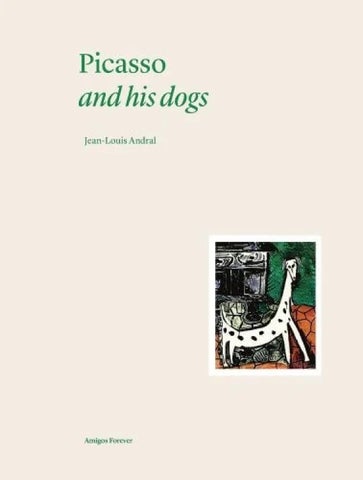
Forthcoming Yves Saint-Laurent and his dogs Joan Mitchell and her dogs Peggy Guggenheim and her dogs Andy Warhol and his dogs Series editor Martin Bethenod Editorial coordination Virginie Hagelauer With the assistance of Elisa Nouaille and Emma Gourault Page layout Annalisa Pagetti Revision François Grandperrin Translation Alexei du Périer Proofreading Ben Young and Helen Bell Photo-engraving Graphium ISBN: 9782376660897 © 2024 Éditions Norma 149, rue de Rennes, 75006 Paris, France www.editions-norma.com Printed in April 2024 by Graphius, Belgium Cover: Pablo Picasso, The Vauvenargues Buffet (detail), oil on canvas, 162 x 130 cm, 18 February 1959 (II). Private collection.
AF_Picasso_V.12.indd 80
25/03/2024 08:27