ONE PHOTO GRAPH There are photographs of those razzias: on the Jonas Daniël Meijerplein, where all those German soldiers are bullying Jews again. A frightened man in smart shoes, a long coat, a bow tie, is herded across the square, like a cow to the market to die. Three German soldiers stand by, a mocking laugh on his lips, a fourth German looks on, ashamed perhaps, hands on his hips. Imagine you saw that photograph of the man in the bow tie, and you suddenly realised, that it was your own father. Sometimes I find myself wondering what it’s like for the other son, when he sees: my father is that laughing man. Willem Wilmink (1994)
Razzia On 22 February 1941, Jewish men between the ages of 20 and 35 were rounded up by the Ordnungspolizei on the Jonas Daniël Meijerplein in Amsterdam. This first razzia to round up Jews in the occupied Netherlands was accompanied by violence and humiliation, and the following day further steps were
taken. A total of 427 Jews were transported from the Dutch camp in Schoorl to the Buchenwald concentration camp. Eventually they ended up in the camp at Mauthausen in Austria. Only two of them survived the war. NIOD
CONTENTS INTRODUCTION
6
1. JEWISH LIFE AND REFUGEES
13
2. INTIMIDATION
29
3. “FORBIDDEN FOR JEWS”
55
4. THE YELLOW STAR OF DAVID
77
5. JEWISH WORK CAMPS
99
6. THE JEWISH COUNCIL
115
7. PERPETRATORS
139
8. DEPORTATIONS
167
9. GOING INTO HIDING
197
10. WESTERBORK
235
11. EXTERMINATION
265
12. RETURN
281
LITERATURE
301
CHRONOLOGY
302
COLOPHON
304
INTRO DUCTION
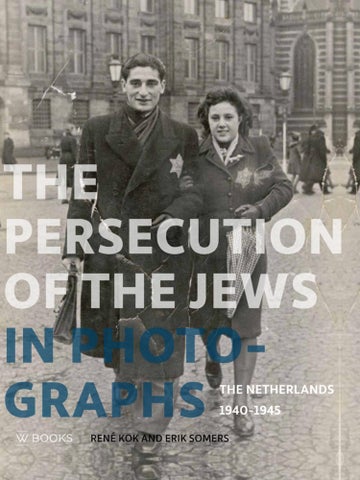
This is a remarkable photograph. “January 1943” – the date has been written on the edge of the photograph. Ralph Polak, aged 19 and Miep Krant, only 15 years old at the time, appear to be walking across the Dam in Amsterdam without a care in the world. A photographer who is photographing passers-by and offering the prints for sale, is taking the photo. The couple are in love. The two of them are making plans together for the time when the war will be over. However, the deportations of Jews to the camp in Westerbork in Drenthe are in full swing, and many of their friends and people from their area have already been taken away. The compulsory Stars of David on their coats symbolises the constant threat, but they will not allow some of their happy moments together to be taken away. Miep had lived in Amsterdam since 1942. She was forced to move to the capital from her home in Bussum, and went to live in the Rapenburgerstraat, where she got to know Ralph, the boy next door. Shortly after this photograph was taken, Miep was taken from her home during a razzia; she had always taken into account the possibility that this would happen and had a rucksack full of clothes ready by the door. She waited to be transported to the camp in Westerbork in the assembly area in the Hollandsche Schouwburg. Just before she left, Ralph, who worked for the Jewish Council in the Expositur department and was therefore in a good position to help, cleverly managed to get her released. Miep, her parents and her sister, went into hiding in Baarn, but the conditions in their hiding place soon deteriorated. At one point there were eleven people in hiding, all crowded together in a small attic. There was not enough food available, not enough ration coupons for food, and Miep became visibly weaker. She almost died of starvation and appendicitis, but as a Jewish person in hiding it was not possible for her to be admitted to a hospital. The Resistance provided her with a new identity and false documents so that she was able to receive medical treatment in the emergency hospital in Baarn. Ralph was caught during the last big razzia in Amsterdam on 29 September 1943. His exemption from being deported because he worked for the Jewish Council was no longer any use to him. On his way to Westerbork, he jumped from the train and went into hiding. Ralph and Miep survived the war and married after the liberation. They set up a successful textile business in Baarn. The photograph is intriguing because of its striking contrast. It shows a boy and a girl walking across the Dam – an everyday scene. The background has not changed, even today. All the same, the yellow Star of David, which Jews had to wear from 3 May 1942, does give the photograph a rather ominous feel. From a post-war perspective the photograph is not only an expression of the German persecution and terror, but also implies mass murder. Initially, nothing was known about the photograph or who the two young people shown were, other than the location, which is easy to identify, and at a glance the handwritten date can also be read as “1942”. The photograph was undoubtedly of great value to the couple in love. Its protective cover is virtually worn out because it was regularly taken out, and the picture itself has been visibly damaged. When Ralph and Miep were separated for more than two years while they were in hiding, the photograph was the only tangible proof of their love. When the background details came to light, it made the photograph even more meaningful. An investigation in the archive of images at the Jewish Historical Museum in Amsterdam produced the photograph by chance. The search that was made in different archives, by consulting online files and by asking all sorts of questions resulted in the reconstruction of this story. There are many of these stories, and the many apparently everyday photographs dating from the years of occupation and persecution form the starting point of The Persecution of the Jews in Photographs. The Netherlands.1940-1945.
< Amsterdam, January 1943. Ralph Polak and Miep Krant on the Dam. They were able to survive the war by going into hiding. Collection of the Jewish Historical Museum
An image engraved on the memory A striking number of photographs have survived illustrating the persecution of the Jews in the Netherlands, certainly when seen from an international perspective. There is no other country that was occupied by THE PERSECUTION OF THE JEWS IN PHOTOGRAPHS - INTRODUCTION
7
Nazi Germany in Western Europe where so many photographs relating to the persecution of the Jews have survived. Over the years, numerous works have been published on the persecution of the Jews in the Netherlands, with or without photographs. The images almost always serve to support or to illustrate historical accounts. The photographs themselves do not have central place. This is striking, because the memories of the most influential events from the period of the occupation are greatly enriched by the moving images. The photographs of the razzia on the Jonas Daniël Meijerplein in Amsterdam, the deportations from the Westerbork camp, as well as the photographic portraits of Anne Frank, are etched into our minds. How we remember or imagine the past, and in particular the persecution of the Jews, is determined to a great extent by impressive and moving photographs. Images contribute to a historical awareness and are an important factor in the creation of a collective memory. Vivian Uria, a photograph historian and chief curator of Yad Vashem in Jerusalem, expressed this as follows in 2018: “Visual documentation is one of the most important factors in shaping our historical awareness of the Holocaust. Alongside the archival documentation of the period’s events, and the research on these records, visual documentation has contributed significantly towards knowledge of the Holocaust, influenced the manner in which it has been analyzed and understood, and affected the way it has been engraved on the collective memory.” Visual history and research This book presents a visual history of the persecution of the Jews in the Netherlands for the first time. When choosing the images, our familiar principle was a guiding factor: an image had to appeal, evoke feelings, be disquieting, raise awareness and stir the conscience. It became clear that to an even greater extent than for other themes relating to 8
THE PERSECUTION OF THE JEWS IN PHOTOGRAPHS - INTRODUCTION
the Second World War, the tragedy of the persecution of the Jews is expressed in photographs which conceal a personal story. Photographs, in combination with the information which has been gleaned about the fate of the people depicted, provide histories with a real impact. Therefore the photographs in this book virtually only show people: victims and survivors, perpetrators, helpers and bystanders. This book is based on some intensive visual research in which numerous archives and private collections, both in the Netherlands and abroad, were consulted. As far as possible an attempt was made to discover the identities and the histories of the people who are photographed. Many of the photographs were taken in Amsterdam. This is not surprising: by far the largest number of Jews lived in the capital (more than 80,000), and in fact the persecution was concentrated there. Nevertheless, it is striking that no photographs were taken or have survived of the transportation of Jews from other large cities such as Rotterdam, Utrecht, The Hague, Groningen, and Enschede. Inevitably the compilation and selection of the photographs is based on subjective, personal interpretations and considerations. Writing history is a subjective matter and this applies to an even great extent for a visual history. A great deal depends on the interpretation and the choices which give added value to the photographs. A photograph as a factual representation is also linked to an interpretation of the past. In this respect, photography has its limitations: after all, photographs as such do not give any explanations for historical events and processes, nor can they shed any light on the background of what is shown in the image. Photographs as a historical source are simply too limited to do this. A photograph is always a record of a moment, which – no matter how penetrating and convincing it may often be – is not able to tell the historical story itself. It is not only the compilation of the visual material that is a subjective matter – taking the photograph is itself also subjective. No matter how faithful a representation may be to the truth, it is always the personal
< Amsterdam, 10 February 1941. Trouble broke out in the Jewish district of Amsterdam between Jews and Dutch National Socialists. The German press photographer and owner of the Amsterdam photographic press agency Stapf Bilderdienst, Franz Stapf, who was working in the Netherlands, hurried to document the commotion with his Leica camera. Stapf Bilderdienst, NIOD
> Westerbork, 1943. Life in the Westerbork camp was extensively photographed and filmed during the war. This was the work of the photographer and filmmaker Rudolf Breslauer, a German Jewish refugee. Wim Loeb, one of Breslauer’s colleagues, is touching up a photograph of the camp commandant Gemmeker in the photographic studio of Westerbork camp. Rudolf Werner Breslauer, NIOD
choice of the photographer to focus the lens and close the shutter at a certain moment. It is the way in which the photographer sees the picture. The photography is based on personal and sometimes on moral considerations, whether the photograph was taken by a press photographer or by an amateur. The historian and lecturer in ethics Gie van den Berghe described this process as follows: “When you record something, you take it from a larger whole. You select, frame and impose limitations on space and time. Photography means assigning significance, giving meaning, choosing sides (…). Every photograph is the record of a particular moment, the result of a choice and decision. Even if these take place in the blink of an eye or intuitively, they determine and define what is recorded and communicated. Photographs are fragments of reality. When this is done well, they provide a fragment of reality in such a powerful and symbolic way that it is expressed more clearly than it is in reality.” The way in which photographs are created and the way in which the images are then used and the context in which they are shown reveal “one” reality of the past. They form a visual historical record which requires a critical approach. Like historical documents, photographs of historical events should also be subjected to a critical source analysis. It is essential to examine the background of a photograph and to place it in a historical context to explore the motivation for taking it, and above all to look at the interests it serves.
past, but they were not given much room for using their own initiative in this respect. During the years of the occupation, press photography was carefully monitored and there was censorship. Guidelines were issued to determine what could and what could not be photographed. The result was that press photographers avoided recording things which were unpopular with the occupying forces. In this respect it should be noted that the occupying forces had forbidden the press, which had been forced into line, to publish any images of Jews or of “people of partial Jewish blood”. As a result of that measure Het Joodse Weekblad (the Jewish weekly newspaper which was published under the auspices of the Jewish Council) never contained current photographs either. The only photographs which were published during the occupation referring to aspects of the persecution were published in antisemitic brochures or in explicitly national socialist newspapers. Furthermore, photography was (and is) never sufficient as an independent means of propaganda; its significance lies above all in its connection with other means of propaganda. In this way photography can make a contribution to certain views, or as the American essayist Susan Sontag wrote: “Photographs cannot create a moral position, but they can reinforce one – and can help build a nascent one.” During the first stage of the occupation, the German propagandists wished to make a powerful impression by disseminating antisemitic propaganda. In the first place, it should be clear that Jews were not Dutch and were not considered as such by the occupying forces, or as the Reichskommissar Seyss-Inquart said in the Concertgebouw in Amsterdam on 12 March In the service of the occupying forces 1941: “The Jews are not Dutch people in our view. They are enemies with whom we can neither achieve a truce or peace. We will strike the Jews During the German occupation of the Netherlands, the medium of wherever we can.” Photographs with antisemitic captions were used that photography was used to contribute to propagating National Socialism, and photographers who worked for the occupiers or performed incidental year in the brochure De Joden in Nederland (The Jews in the Netherlands), amongst other places. This brochure, which “aimed to speak through its assignments contributed to this. Many press photographers tried to continue making a living as far as possible and worked as they had in the photographs”, was distributed amongst the population with an enormous THE PERSECUTION OF THE JEWS IN PHOTOGRAPHS - INTRODUCTION
9
< Amsterdam, 1943. During the war numerous portraits were made by professional photographers. It later became clear that these were the last, and in some cases the only photographs which survived of victims of the Holocaust. Hans and Ruth Abraham survived the war by going into hiding. A photograph was taken of the children just before they went into hiding, with all its dangers and uncertainties. Foto Raaij, collection of the Jewish Historical Museum
> Amsterdam, 1941. Entrance to the Jewish district near the Waterlooplein in Amsterdam. One of the snaps from the photo album from the Van Vliet family from Haarlem. During a day in Amsterdam they pose under the signs reading Joodsche Wijk (Jewish district) and “Für Wehrmacht Verboten” (no entry for the Wehrmacht), which were like a tourist attraction. The man on the right is carrying his camera case. Van Vliet German-Jewish album, NIOD prisoner and circulation. It compared Dutch Jews to so-called hideous “Untermenschen” Gemmeker personally commissioned the in black and white terms, and concluded that there was not a great deal of former professional photographer Rudolf Werner Breslauer to record life in the camp and the transportations to “the East” in photographs and difference from the Polish Jews in the ghettos. on film (see chapter 10). With their impact the photographs referred to above contributed to an important extent to the post-war image of the However, the antisemitic scope of the propaganda achieved nothing, persecution of the Jews in the Netherlands. In addition, they served as because the Dutch population did not prove to be receptive to its proof. Events which are known to have taken place because there are banality. Even for many of the Dutch sympathizers of National Socialism, reports or witness statements of them only appear to be truly proven this unrealistic approach to the Jewish section of the population went when they have been recorded in photographs. Some of the most too far. It resulted in a change of direction. The antisemitic propaganda became less vehement and more sophisticated. It soon became painfully extreme examples of the camera as a witness include the photographs clear that the occupiers did not actually need the propaganda to execute taken by Alberto Errera in the Auschwitz-Birkenau extermination camp at great risk to his own life (pp. 268-272). This Greek-Jewish prisoner worked its plan of persecution and the ultimate deportation of the Jews. in the Sonderkommando, a group of prisoners who were forced to work in and around the gas chambers. While the Nazis did everything they Witnesses could to erase all traces of the mass extermination at the end of the war, these photographs are clear proof that Jews were murdered in Auschwitz. The occupiers commissioned both German and Dutch photographers They are out of focus and were clearly taken in great haste, but show a to represent a number of the essential aspects of the persecution of cremation in the open air: the crematoria were no longer able to deal with the Jews. These photographs have been kept for a range of different the number of bodies. One photograph shows naked women who had to reasons, although that was often not the intention of the party that had wait outside before being taken to the gas chambers, the fate which was commissioned them. For example, the Aussenstelle der Sicherheitspolizei und des Sicherheitsdienstes in Amsterdam commissioned the Dutch national also suffered by the tens of thousands of Jews deported to the camp from the Netherlands. The negatives were smuggled out of the camp in a tube socialist photographic journalists Herman Heukels and Bart de Kok to of toothpaste with the aim of bearing witness to what had happened. photograph the notification of Jews in Amsterdam to be transported The photographs were intended to make the outside world realize what to the Judendurchgangslager Westerbork on respectively 25 May 1943 was happening in Auschwitz on a daily basis. However, they only became and 20 June 1943 (see chapter 8). A number of photographs of the first public after the war. event were published in the magazine Storm SS. accompanied by some painful text. Even in 2010, 250 photographs by the photographer and NSB member Bart de Kok, which had been lost up to then, came to light during Private life the conversion of a house in Amsterdam (pp. 70, 74 and 144). During the German occupation, many photographs were taken by It was certainly not the intention that some of the most iconic “ordinary” Dutch people who had a sense of history and decided to record photographs of the persecution of the Jews in the Netherlands – the events in photographs. Many of these photographs have survived and arrest of hundreds of Jewish men on the Jonas Daniël Meijerplein in have been placed in the archives. In the relatively prosperous 1930s in the Amsterdam on 22 and 23 February 1941, accompanied by a great deal Netherlands, members of the public took more and more photographs, of intimidation and humiliation – should ever be published. A Dutch and within a short space of time owning a camera became possible employee secretly made a set of extra prints of those photographs taken for large groups of Dutch people. They took snapshots for the family by a German and kept them as proof of the barbaric German behaviour photo album and to send to members of their family in other places, (see pages 46-50). Another remarkable series of photographs with a particularly to the many Dutch people who were living in the colonies strong visual documentary character are the photographs which were in the East and West. Many members of the public used a simple box taken in the Westerbork camp itself. The German camp commandant 10
THE PERSECUTION OF THE JEWS IN PHOTOGRAPHS - INTRODUCTION
camera, while the more advanced amateur photographers dug into their deep pockets to buy the latest cameras suitable for 35mm rolls of film. The photographic business, as well as the possibility of developing and printing photographs, increased enormously. Later, during the occupation, the increasing scarcity of materials such as rolls of film and photographic paper became an inhibitory factor. Nevertheless, many amateur photographers still had a roll of film in stock. They were forced to take photographs more selectively and the photographs were often only developed and printed after the war. The persecution of the Jews, the process from their isolation to extermination, was also recorded by amateur photographers. Admittedly there was no official prohibition on taking photographs until 20 November 1944, but taking photographs of things which the occupying forces didn’t like entailed many risks. For example, it was dangerous to take photos of the razzias. Nevertheless this happened, sometimes hastily from a porch or secretly through a living room window between the net curtains pulled slightly to one side. Technically these were not perfect, but they remain convincing and of historical value because of the way in which they were directly recorded. Family photographs, which were often collected in photo albums, have their own specific emotional importance. This applies particularly when the photographs are silent witnesses of Jews who were murdered in the extermination camps: records of people, both young and old, looking into the camera without a worry in the world and not knowing what was in store for them. Sometimes the photographs testify to a painful awareness of the impending doom, like the photograph with the text on the back: “A last photograph of us all together before going into hiding” (page 198). Or the photograph showing parents with their newborn child. The words on the border read: “Henriëtte, 6 weeks, 5 minutes before she goes into hiding from the Germans on 24-10-1942” (page 213). The NOID (formerly the RIOD) attached enormous value to amateur
photography in the Second World War from its very beginning. As soon as the institute was established during the days of the liberation in 1945, it appealed to the population to help document the years of the war and the occupation. It expressly also asked for photographs. In this way, thousands of amateur photos found their way into the rapidly growing archive of images of the National Institute for War Documentation at the time. The Jewish Historical Museum in Amsterdam also took the initiative to collect photographs of members of the public and in this way built up a valuable collection. Photographs of private individuals are still emerging from time to time today. Sometimes they have been cherished for decades because of their emotional importance, but equally often they are forgotten records in a shoebox which come to light when an attic is emptied, or an inheritance is left or a house is cleared. The Persecution of the Jews in Photographs. The Netherlands 1940-1945 The Persecution of the Jews in Photographs. The Netherlands 1940-1945 reveals a carefully considered selection of photographs which provide a visual history of the persecution, seen in a certain context. On 10 May 1940, the day that Nazi Germany marched into the Netherlands, there were 160,000 Jews living in the Netherlands, including the German-Jewish refugees. The German occupying forces introduced anti-Jewish measures very gradually. In the space of two years, a development took place in the Netherlands which had taken eight years in Germany itself. The first train with 800 Jews left Amsterdam for the Westerbork camp on 14 July 1942 and from there the deportations took place to the concentration and extermination camps. Altogether 107,000 Jews were transported from the Netherlands. 102,000 were murdered in the Nazi camps; 75% of the Jewish population, the highest ratio of Jewish victims in the countries occupied by Germany in Western Europe. It is a tragedy which has left profound traces in Dutch society. This book shows the visual testimonies. THE PERSECUTION OF THE JEWS IN PHOTOGRAPHS - INTRODUCTION
11
1. JEWISH LIFE AND REFUGEES The first train of a thousand German-Jewish refugees from Hitter’s Germany arrived at the Central Station in Amsterdam on 1 April 1933. The Social Democratic newspaper Het Volk reported: “Amsterdam – Holland! The promised land! No swastika flags, no Nazi soldiers, no all-encompassing fear or dread of acts of terror. The first impressions which the refugees experienced were quite pleasant: to be a country at last where they would be free again, where they would be human again!”
< Gezin Drachten, 1935. One of the many Jewish families in the pre-war Netherlands; Jacob and Rosette Turksma and their sons David (left) and Simon (right). Their daughter Betsie is shown in the middle. Jacob traded in second-hand goods and the family was assimilated in a predominantly non-Jewish environment. Every Saturday the Turksma family faithfully took the tram to the schul (synagogue) in Gorredijk. The two brothers both went to the state secondary school. David was 17 when he was arrested by the Dutch police on 12 November 1942 and taken to the Westerbork camp. Exhausted by forced labour, he died in Auschwitz on 28 February 1943. The other members of the family were offered addresses to go into hiding but did not accept them. On 14 May 1943 Simon and his parents were murdered together with 1,443 other Dutch people in the Sobibor extermination camp in Poland. Betsie, who had married in the meantime, had been gassed there two months earlier (also see pages 94/95). Collection of the Jewish Historical Museum
From the end of sixteenth century up to the Second World War, there was a large and flourishing Jewish community in the Netherlands. Most of the Jews lived in Amsterdam, but there were also many small Jewish communities in the provinces. At the beginning of the twentieth century, the Dutch Jews had managed to shake off the status of being foreigners, had abandoned Yiddish and had shed the strong ties with their belief. The closed character of the groups of the Jewish population had come to an end. In the 1930s, Jewry was characterized by a strongly integrated Jewish elite, a religious leadership attached to orthodox beliefs, and a gradually secularizing community. Although there was no strong antisemitism in the Netherlands, certainly not on the part of the government, there were broadly shared stereotypes in society with regard to what was considered “typical Jewish behaviour”. In addition to the tolerance and acceptance which existed in the pre-war Netherlands, there were also many sorts and gradations of anti-Jewish sentiments. Under these circumstances, most Dutch Jews retained an awareness of being Jewish, whatever that might mean exactly. From 1933 more than 34,000 German and Austrian Jews fled to the Netherlands as a result of the discrimination and violence of the Hitler regime, and more than 20,000 of them remained for quite a long time. The Dutch government refused to support these victims of National Socialism with any generosity; on the contrary, many Jewish refugees were sent back at the border as “undesirable immigrants”. Exceptions were made only for refugees who could show with some conviction that they could make a contribution to the Dutch economy or were in a situation that could be considered as being a danger to their lives. The policy on refugees was mainly to discourage them. The refugees were not to cost the Dutch state any money. Caring for them was left to the Jewish community. However, a large number of private individuals, as well as political and church organizations, were concerned about the fate of the Jewish refugees and worked hard to welcome them. In February 1939, the Dutch government commissioned the construction of the Central Refugee Camp at Westerbork, funded by the Jewish community. THE PERSECUTION OF THE JEWS IN PHOTOGRAPHS - JEWISH LIFE AND REFUGEES
13
14
THE PERSECUTION OF THE JEWS IN PHOTOGRAPHS JEWISH LIFE AND REFUGEES
Seder evening Amsterdam, 30 March 1934. A Jewish family is celebrating the Seder evening as the introduction to the Jewish Easter festival (Passover) which lasts seven days. As the oldest member of the family, the grandfather breaks the unleavened bread, also known as matze. The bread is a reminder of the fact that during the time of Moses the Jews had to flee from Egypt in such a hurry that there was no time to allow the bread to rise. The Seder evening is an evening on which food and drink and rituals have a great symbolic significance. The photograph was printed at the time in the popular weekly newspaper Het Leven, Geïllustreerd. Spaarnestad Photo
Passover Amsterdam, 4 April 1936. The traditional burning of leftover unleavened bread on Passover, the Jewish Easter festival, on the Waterlooplein. This square was the beating heart of the “Jewish corner”, as the district in the centre of the capital city was popularly known. At the turn of the century there was a great deal of poverty there. After the First World War many Jews moved into new and better houses in east Amsterdam, while the more prosperous families often went to live in the south of the city. The proletariat, which largely worked in the diamond industry and as street traders, stayed behind. Although there were also shopkeepers and prosperous people living in the district, poverty prevailed. Large families lived together, one above the other, in small dwellings. E.A. Hof, ANP Historical Archive
< Synagogue Amsterdam, 1940. Jewish believers leaving the New Synagogue of the Hochdeutsch community on the Jonas Daniël Meijerplein. This Jewish prayer and community centre, like other synagogues, was used as a place for reading and education, as
well as for religious meetings. The New Synagogue was designed by G.F. Maybaum, and consecreated on 25 March 1752. There was room for almost 600 men and 376 women. When the last Jews were transported from Amsterdam to the Westerbork camp at the end of
September 1943, the Germans shut the New Synagogue. During the Hunger Winter (1944-1945) people living in this district demolished all the galleries for firewood and many liturgical objects were stolen. In 1954 the ruined empty building was bought by the Amsterdam council.
After being thoroughly rebuilt, the Jewish Historical Museum started to use the synagogue in 1987. Stapf Bilderdienst, NIOD
THE PERSECUTION OF THE JEWS IN PHOTOGRAPHS - JEWISH LIFE AND REFUGEES
15
Fun on the beach Scheveningen, May 1933. A Whit weekend of fun at the Scheveningen seaside resort. In Germany Adolf Hitler had become chancellor and increased his power at enormous speed. The war seemed to be a long way away. The photo from this family album shows Ru Adelaar from Deventer, his wife Willy and their daughters Paultje, Emy and
Loes. Ru Adelaar (sitting at the front of the photo) had an agency business. During the occupation he worked for the department for travel permits of the Jewish Council in the town where he lived. At the beginning of 1943, Adelaar, his wife and youngest daughter were forced to move to east Amsterdam. During the big razzia on 20 June 1943 they were rounded up there
and transported to the Westerbork camp. The couple and Paultje, who was then ten years old, were then transported to Auschwitz, where they were murdered immediately when they arrived. Loes and Emy, who were adults by then, survived the war by going into hiding.
> Jewish market Amsterdam, 1940. There was a market every Sunday morning in the Nieuwe Uilenburgerstraat, situated in the “Jewish corner”. This market, which was also popular with non-Jews, sold second-hand goods, fish and other foodstuffs, including
the very popular “Jewish sour”. As a result of the economic crisis unemployment rose in the 1930s, and consequently there was a strong increase in the number of Jewish market traders and pedlars. Because of the great poverty amongst the potential clients and the extreme
competition amongst the market traders, the income was very low. The Nieuwe Uilenburgerstraat had been created in the 1920s when the slums of the Jewish district were cleaned up. According to the health committee, a large number of the houses had become uninhabitable
16
The Ghetto Fighters’ House, Israel / The Photo Archive
THE PERSECUTION OF THE JEWS IN PHOTOGRAPHS JEWISH LIFE AND REFUGEES
and could no longer be rebuilt. The council commissioned a block of flats, considered very modern for that time, to the west of this street. This photo was taken in a sidestreet of the Nieuwe Uilenburgerstraat, the Nieuwe Batavierstraat. Stapf, Bilderdienst, NIOD
THE PERSECUTION OF THE JEWS IN PHOTOGRAPHS - JEWISH LIFE AND REFUGEES
17
First intake Amsterdam, 1 April 1933. German-Jewish refugees arrive at the Central Station. Employees from the Committee for Jewish Refugees, identifiable by their armbands with a Star of David, supervise the first intake. In Germany, where Hitler had come into power two months before, the Nazi party, the NSDAP, organized a large-scale boycott action on that day against Jewish shopkeepers, doctors, and lawyers. This instilled fear in German Jews and persuaded a number of them to leave their country. More than a thousand refugees took the train to Amsterdam. The Jewish helpers accommodated them in guesthouses, and where necessary, provided financial support. However, because of the high unemployment in the Netherlands, there was no chance of finding work. Henk Valks, Spaarnestad Photo
18
THE PERSECUTION OF THE JEWS IN PHOTOGRAPHS JEWISH LIFE AND REFUGEES
THE JEWISH WORKING VILLAGE “If our work succeeds, the Jewish Working Village of Nieuwesluis will be commemorated in later years and happier times”. With these words, Professor G. van de Bergh, the chairman of de Stichting Joodse Arbeid (Foundation of Jewish Labour), officially opened the Jewish working village of Nieuwesluis on 3 October 1934. The working village in the recently drained Wieringermeer in North Holland consisted of a community building surrounded by residential barracks with the Oostwaardhoeve farm to the south. There was room for approximately three hundred men and women. On the day that it opened the first 150 residents started work in high spirits (photograph, bottom right). The aim of the Nieuwesluis working village was to provide safe accommodation for young German Jews. The intention was that they should emigrate to the United States or South America after training for two years to become farmers, horticulturalists, builders or tradesmen. The Foundation for Jewish Labour collected money in all sorts of ways to finance this project (photograph, bottom left), and the Dutch government supported the initiative in the hope of reducing the number of refugees in the Netherlands in this way. The land, more than 70 hectares, was loaned for a number of years, but there was no further financial support at all from the Colijn cabinet. Mussert’s National Socialist Movement (NSB) campaigned against the working village and the NSB press wrote scathingly about the “Jewish cuckoo’s egg” which had been laid in the Wieringermeer. It suggested that a “conscious Jewish effort was being made to appropriate half of North Holland”. In the end, almost 700 German/Jewish youngsters left the Netherlands after staying in Nieuwesluis on the way to a new future; approximately 200 of them reached the British mandate of Palestine, either legally or illegally. Spaarnestad Photo Steinweg album Jewish Historical Museum NIOD
THE PERSECUTION OF THE JEWS IN PHOTOGRAPHS - JEWISH LIFE AND REFUGEES
19
20
THE PERSECUTION OF THE JEWS IN PHOTOGRAPHS JEWISH LIFE AND REFUGEES
< A limited number Nijmegen, mid-November 1938 Six hundred Jewish refugees from Germany, including many children, arrive by train. Many of them are wearing a registration number. As a result of the Kristallnacht, a pogrom organized by the Nazis in the night of 9-10 November, a massive number of refugees had decided to leave. The Dutch government strengthened its anti-immigration
measures and decided to permit only two thousand refugees to enter. Only German Jews from the border area who were in serious danger of their lives, or those who had family in the Netherlands were welcomed. The government issued a statement on 16 November 1938: “Unjustifiably it seems that in some places abroad there is a idea that the Netherlands has opened up its borders to Jewish refugees. It goes
Bus journey The Hague, 12 December 1938. Jewish children from Austria arrive in the Netherlands. Austria had been annexed by Hitler’s Germany in March of that year (Anschluss) and virtually immediately afterwards, the Nazis started introducing anti-Jewish measures. In order to escape this persecution more than 600 children under the age of 18
without saying that this is not the case. Only a very limited number of refugees can be admitted”. In the end the Lower Chamber ensured that the quota for admission was made more flexible from two thousand to seven thousand refugees. Spaarnestad Photo
travelled by train from Vienna to Hook of Holland, where there was a ship waiting for them to take 500 to England, and accommodation had been arranged in the Netherlands for 62 boys and 40 girls. Wrapped up in blankets, they were taken by bus to The Hague. In the municipal bathhouse on the Nieuwe Haven, the exhausted and stressed children were given a short medical
inspection and a hot bath. The first place to welcome them in the Netherlands was a school in the Copernicustraat. There was a great deal of public interest when they arrived there at about midnight. Spaarnestad Photo
THE PERSECUTION OF THE JEWS IN PHOTOGRAPHS - JEWISH LIFE AND REFUGEES
21
Medical examination Naarden, 15 November 1938. Doctors examine 23 Jewish children from Frankfurt. The town council of Naarden made the former orphanage in the town available to receive the young refugees. During the night of 9-10 November 1938, the so-called Kristallnacht, the children lost contact with their parents and wandered about
22
aimlessly. In an explosion of hatred, 1,400 synagogues were set on fire and destroyed in Germany that night. The windows of 7,500 shops were smashed and Jewish houses, businesses, schools and even hospitals were destroyed. After a week, the children had to leave the orphanage in Naarden because the seventeenth-century building proved to be too small and
unsuitable for looking after them properly. They were subsequently admitted to the Central Israelite Orphanage in Den Dolder. Spaarnestad Photo
THE PERSECUTION OF THE JEWS IN PHOTOGRAPHS JEWISH LIFE AND REFUGEES
National collection Amsterdam, 3 December 1938. The people responsible for the collections receive their collection tin at the Artis Zoo. On this Saturday there was a large collection for Jewish refugees in streets and houses throughout the Netherlands. It was organized by the Dutch Institute of Youth Leaders, while the
collection itself was an initiative of the Protestant-Christian, the Roman Catholic and the Jewish Committees for Refugees. Three hundred mayors agreed to cooperate with the National Collection for those who were persecuted for their Belief and Race. The chief Rabbi of Amsterdam did not object to the organization of this collection on the Sabbath, the
weekly day of rest, but the Jews who were involved were not allowed to collect on that day. The prime minister H. Colijn limited himself to making a recommendation on the radio. After less than two weeks 200,000 guilders had already been collected. Spaarnestad Photo
THE PERSECUTION OF THE JEWS IN PHOTOGRAPHS - JEWISH LIFE AND REFUGEES
23
Refugee camp Amsterdam 1939/1940. A group of German/Jewish refugees pose in front of the office building of the Lloyd Hotel, a reception centre on the Oostelijke Handelskade, where they moved into the rooms of the hotel itself. The Lloyd Hotel had been established in 1915 by the Koninklijke Hollandse Lloyd (KHL) as an “immigration hotel” for receiving
24
immigrants from eastern Europe on their way to South America. During the economic crisis of the 1930s the KHL had to close down. From February 1939 the Amsterdam council took over the hotel and rented it to the Ministry of Home Affairs to receive Jewish refugees. There was room for about three hundred people. In order to keep the costs down, the refugees had to
organize the running of the place themselves. In July 1940 the last residents moved to the Central Refugee Camp in Westerbork. NIOD
THE PERSECUTION OF THE JEWS IN PHOTOGRAPHS JEWISH LIFE AND REFUGEES
JULES LOSZYNSKI (1909-1944) Because of the anti-Jewish violence in Nazi Germany, the recently married Jewish couple Jules Loszynski and his wife Ruth Reich decided to leave their home in Berlin and seek their future elsewhere. In June 1938, Loszynski returned to Amsterdam, where he had been born in 1909 and had lived for several years.
laundry, the kitchen and the camp administration. He kept his photos in two photo albums and added captions. Loszynski’s plans to apply for a visa to the United States were undermined by the German invasion in May 1940. However, he did succeed in getting a highly desirable job with the department for Travel and Removal permits of the Jewish Council. For the time being that exempted him Initially Loszynski and his wife (who travelled after him) moved in with the from being transported to Westerbork. However, on 3 October 1943, he Hirschbruch couple in the Biesboschstraat in Amsterdam and over the next and his wife were registered in the transit camp. On 11 January 1944 he four years they moved into four other houses there. Loszynski was a social was then transported to the Bergen-Belsen concentration camp situated in the north of Germany. Jules Loszynski died there on 3 December of and sporting man who built up his new life in Amsterdam with a great that year. His wife Ruth survived the horrors of the camp and returned to deal of energy. He worked as a welder and had a second job in the Lloyd Amsterdam, where she remarried. The photo albums of her husband Jules Hotel reception centre in the Oostelijk Havengebied. As a keen amateur have survived. photographer he took a series of photographs there recording the lives of the refugees, the arrangement of the dormitories, the tailor’s workshop, the Page from one of Jules Loszynski’s photo albums The photographer himself is shown below left. Private collection J. Weil
THE PERSECUTION OF THE JEWS IN PHOTOGRAPHS - JEWISH LIFE AND REFUGEES
25
Westerbork Central Refugee Camp Westerbork, 8 October 1939. “This arid, desolate plain must be one of the most depressing areas to be found in our country.” That is how a Roman Catholic member of the Lower Chamber described the location at Westerbork in Drenthe, intended as the transit camp for Jewish refugees in 1939. The fourth Colijn cabinet had decided in February of that year to
26
accommodate all the refugees from Germany in a single central camp, replacing the many small reception camps and centres. Not far from the German border, the Dutch state owned an area of heathland and peat bogs. The isolated position of the camp, which was at some distance from the village centre, was considered favourable. Above all, it was to be avoided that the refugees should form close links with the
local population. The government did not want to make any money available for this either. The camp was financed by the Jewish community in the Netherlands. NIOD
THE PERSECUTION OF THE JEWS IN PHOTOGRAPHS JEWISH LIFE AND REFUGEES
Barracks for single persons Westerbork, 1941. Sitting in front of the barracks for single men in the Westerbork central refugee camp, some German-Jewish refugees are reading the Berliner Zeitung am Mittag. Men aged between 15 and 21 were accommodated in these barracks. On the day of the German invasion, 10 May 1940, A.S. Levisson, the chief rabbi of Friesland and Drenthe, took the initiative to
send the residents of the camp to England. However, the plan failed and they did not get any further than Leeuwarden by train. After spending a month in the capital of Friesland, they were sent back to Westerbork on the orders of the German occupying forces. During the first two years of the occupation, very few noticeable German measures were taken against the German Jews staying
in Westerbork. The camp was not surrounded by barbed wire fences and there were no guards. Westerbork Camp Memorial Center
THE PERSECUTION OF THE JEWS IN PHOTOGRAPHS - JEWISH LIFE AND REFUGEES
27
2. INTIMIDATION Identification Amsterdam, 10 May 1940. In this photograph the Jewish press photographer Sem Presser has to show his papers to two members of the Civil Guard, dressed in old French army uniforms, on the Singel on the day of the German invasion. There was widespread fear of spies and traitors. Anyone could be considered to be a German spy or a Dutch traitor (“the fifth column”). From 1937 Presser was selfemployed and adopted the title General Dutch Press Photography Agency. In 1942 he went in hiding in Arnhem, and during the Battle of Arnhem in 1944 he started photographing again. He recorded the landings of the English parachutists and the subsequent fighting in the inner city of Arnhem. However, he never found the negatives he had hidden. After the liberation of the capital of Gelderland in April 1945, Presser left for the southern Netherlands, which had been liberated, where he was assigned by the Military Authorities as the war photographer with the staff of the General Dutch Photographic Agency (Anefo). On 5 May 1945 he was present during the negotiations for the capitulation between the Germans and Canadians in Hotel de Wereld in Wageningen. After the war Sem Presser became one of the leading press photographers in the Netherlands. Stapf Bilderdienst, NIOD
On 12 March 1941, Arthur Seyss-Inquart gave a long speech in the Concertgebouw in Amsterdam. The Reichskommissar for the occupied Dutch territories threatened: “The Jews are not Dutch for us. They are enemies with whom we neither want to have a truce or achieve any peace (...). We will strike the Jews where we can and anyone who sides with them will have to take the consequences.” After the German invasion the threat of the persecution of the Jews could be felt immediately, though the German approach seemed quite mild during the first months of the occupation. Hitler established a civil government in the occupied Netherlands with the Austrian A. SeyssInquart in charge. The Reichskommissar was given a double task: he had to ensure that the blood-related race should make a maximum contribution to the German war effort, and at the same time be made enthusiastic about the “blessings” of National Socialism. From the autumn of 1940 the German occupiers starting taking more and more measures to isolate the Jews, both at the social and economic level, exactly as they had in Germany. In November all Jews were dismissed from jobs in the civil service. Three months later, all the Jews living in the Netherlands were obliged to be registered. This meant that the “target” had been identified and the first step could be taken to their total exclusion from society. The acts of terror perpetrated on the streets by the Dutch National Socialists against the Jews became increasingly violent; it became commonplace for them to be threatened and attacked, and their property to be destroyed. Violent confrontations occurred particularly in Amsterdam. The paramilitary Defence Department (WA) of the NSB marched provocatively through the Jewish district of Amsterdam and forced hotels and restaurants to hang up signs stating: “Jews not wanted here”. They started to beat people up on the slightest provocation. During one of the many fights a man from the WA was fatally injured. In response, the German authorities closed off the Jewish district with barbed wire fencing very early in the morning. Following a series of incidents, the disgruntled SS leader Himmler gave orders from Berlin for several hundred Jewish men to be arrested and the first razzia to round up Jews in the occupied Netherlands took place on 22 and 23 February 1941. In protest against the violent action of the German police, a strike was organized in Amsterdam which spread to surrounding towns: the February strike. The Germans were totally astonished, but once they had got over their surprise they intervened violently. At the end of the second day of the strike, the resistance of the strikers was broken and order was restored. It was the first time that large-scale protests erupted against the German oppressors in an occupied country. THE PERSECUTION OF THE JEWS IN PHOTOGRAPHS - INTIMIDATION
29
“Jetzt haben wir sie endlich” (At last we’ve got you!) Amsterdam, May 1940. The original caption of this photograph released by the German propaganda makers on 4 June 1940 read: “Jetzt haben wir sie endlich” In Holland internierte Juden aus Deutschland, die über Berlin, Wien, Prag und Warschau nach Amsterdam gegangen waren, um von dort aus die Welt mit ihren Gruselmärchen zu überschwem- men. Diese Juden,
30
die Emigranten- presse leiteten, sind jetzt zum Teil in unsere Hände gefallen, die anderen haben sich rechtszeitig nach Paris und London in Sicherheit gebracht; aber auch dort werden wir sie finden und der gerechten Strafe für ihre völksvergiftenden Schmiererei- en zuführen!’ (“At last we’ve got you! Jews from Germany interned in Holland who went to Amsterdam from Berlin, Prague, Vienna, Warsaw to swarm over the entire world with
their grisly fairy tales. These Jews who led the surge of immigrants have now fallen into our hands to some extent, while others have sought security in Paris and London; but we will find you there and we will punish you justly for the poisonous and disgusting acts of your race!”) However, contrary to what this photograph suggests, the more than 20,000 Jewish refuges from Germany and Austria were initially
left alone. On the basis of their experiences in Nazi Germany they were constantly afraid that they would be persecuted again. The fact that Jewish aid organizations were allowed to continue their work by the occupying forces gave them some hope that they would be able to emigrate in the end to a country that was not involved in the war.
> First anti-Jewish measure Amsterdam, May 1940. A Jewish member of the Air raid precaution service tapes up a Jewish butcher’s shop window to limit the danger of flying shards of glass it if were bombed. The first official antiJewish measure in the occupied
Netherlands was to remove Jews from the Air raid precaution service. In a letter dated 1 July 1940 the Generalmajor der Ordnungspolizei Schumann informed the service that all Jews had to leave the service within two weeks. The reason for this was the active role which
Jewish members were believed to have played two days earlier in the anti-German demonstrations on the birthday of Prince Bernhard, who had fled to London together with his family and Queen Wilhelmina (Carnation Day).
THE PERSECUTION OF THE JEWS IN PHOTOGRAPHS - INTIMIDATION
PK-Weber-Scherl, NOID
N.V. Vereenigde Fotobureaux, NIOD