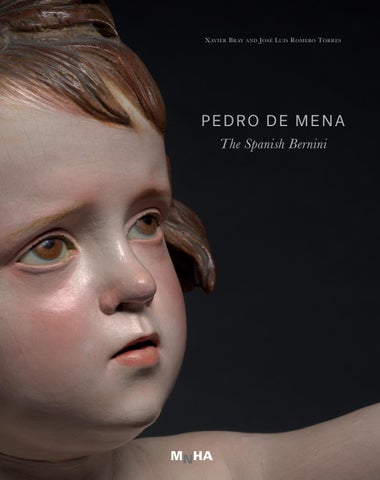
X avier B ray
and
J osĂŠ L uis R omero T orres
PEDRO DE MENA The Spanish Bernini
X avier B ray
and J osĂŠ
L uis R omero T orres
PEDRO DE MENA The Spanish Bernini
2
X avier B ray
and J osĂŠ
L uis R omero T orres
PEDRO DE MENA The Spanish Bernini
2
F O R E WO R D
Pedro de Mena y Medrano (1628-1688) is nowadays the most
San Diego Museum of Art and the Fitzwilliam Museum in
highly regarded master of Spanish Baroque sculpture, on a par
Cambridge are a direct consequence of the London exhibition
with his contemporaries, the great seventeenth-century painters
that attracted over 100,000 visitors. Recent studies by the Getty
Velázquez, Zurbarán and Murillo. He began his artistic training
Research Institute of the sculptures’ highly complex and unique
in the workshop of his father before joining the workshop of
assembling technique also largely contributed to the worldwide
Alonso Cano (1601-1667), another of the great Spanish sculptors
appreciation of this long overlooked Spanish art form.
and painters at the time. Mena’s style is much indebted to the latter – although more theatrical and naturalistic – but his
With the newly regained appreciation for Spanish Baroque
contributions to Spanish Baroque sculpture are unsurpassed in
polychrome sculpture well established, it is the great pleasure
both technical skill and expressiveness of his religious subjects.
of our museum to be able to show and promote the oeuvre of
His ability to sculpt the human body was remarkable, and he
Pedro de Mena, one of its most important representatives. In this
excelled in creating figures and scenes for contemplation.
context, the MNHA will organize, in close collaboration with its colleagues from Musea Brugge, a temporary exhibition entitled
As Director of the National Museum of History and Art
De Mena, Murillo and Zurbarán: Masters of the Spanish
Luxembourg (MNHA), I am delighted to present this revised and
Baroque at the Sint-Janshospitaal in Bruges in 2019 and in
augmented edition of Pedro de Mena – The Spanish Bernini. Indeed,
Luxembourg in 2020.
our museum recently had the opportunity to enrich its display with a selection of prestigious Spanish Baroque works through
Apart from the article by Xavier Bray, the present book also features
long-term loans from important private collections. Among others,
important contributions by José Luis Romeo Torres, curator of the
these works include key paintings by Francisco de Zurbarán,
monographic exhibition Pedro de Mena, to be held in Malaga in
Alonso Cano, Bartolomé Esteban Murillo, Jusepe de Ribera,
2019. Discussing Mena’s life and artistic career, his new comparative
Juan Carreño de Miranda, Antonio de Pereda and Francisco
studies highlight and contextualize the eight sculptures by Mena
Collantes. These outstanding loans also feature no less than
that are currently under the care of the MNHA.
eight polychrome sculptures by Pedro de Mena. Consequently, the MNHA probably holds the largest number of sculptures by this
The works kept at the MNHA have been beautifully
legendary artist on public display outside of Spain.
photographed by Dominique Provost in close consultation with Muriel Prieur, the head of the MNHA’s restoration department
These exceptional private collections were put together following
and an expert in polychrome sculpture.
the ground-breaking exhibition The Sacred Made Real curated by Xavier Bray, one of the two main contributors to the present
The revised edition of Pedro de Mena – The Spanish Bernini, first
book. Presented in 2010 at the National Gallery in London, this
published in 2014, is an important and indispensable guide and
blockbuster exhibition was a true revelation, not only for the
reference for connoisseurs of Baroque sculpture.
general public but for experts alike. Many curators, directors, critics, and collectors were until then unfamiliar with, or even unaware of, Spanish polychrome sculpture. Recent acquisitions
4
of the artist’s works by major museums such as the Metropolitan
Michel Polfer
Museum New York, the Hispanic Society of America, the
Director of the Musée National d’Histoire et d’Art Luxembourg
5
C O N T E N TS
5
Foreword
Michel Polfer
8
Pedro de Mena. The Spanish Bernini Xavier Bray
26
Biography
José Luis Romero Torres
38
The Malaga workshop José Luis Romero Torres
48
Pedro de Mena and the illegitimate children of Philip IV: Juan José of Austria and the Bishops Fray Alonso de Santo Tomás and Alonso Antonio de San Martín
José Luis Romero Torres
60
The legacy of Pedro de Mena José Luis Romero Torres
68
Eight polychrome sculptures by Pedro de Mena photographed by Dominique Provost at the Musée National d’Histoire et d’Art, Luxembourg José Luis Romero Torres
70
Virgin of the Immaculate Conception José Luis Romero Torres
92
Virgin and Child
José Luis Romero Torres
116
Infant Saint John the Baptist José Luis Romero Torres
134
Infant Christ of the Passion José Luis Romero Torres
152
Ecce Homo & Mater Dolorosa José Luis Romero Torres
180
Saint Francis of Assisi in Meditation José Luis Romero Torres
200
Saint Peter of Alcántara José Luis Romero Torres
228
Technique and polychromy José Luis Romero Torres
238
6
Selective bibliography
Finally, there is another version of the Virgen de Belén (fig. 73) in the parish church in Purchil which is not universally attributed to Mena in the literature due to its formal simplification. Mary Fig. 72 Pedro de Mena y
is shown seated with the Christ Child shown sitting on her leg
Medrano, Virgin and Child
and looking in a forward direction, possibly at the devotee or
(Virgen de Belén), Cuenca
spectator, unaware that his mother is looking at him.
Cathedral (the Child is now missing). Fig. 73 Pedro de Mena y Medrano, Seated Virgin and Child (Virgen de Belén),
Pedro de Mena and his wife Catalina de Victoria y Urquizar had fourteen children although only five were still alive on the artist’s death in 1688. One was a Jesuit, the other a canon of Granada Cathedral, and three daughters were nuns in the
polychrome wood,
Cistercian convent in Malaga. For many years Mena lived in a
Granada, parish church
context of family affection and would have been able to observe
of Purchil.
the maternal relationship and tenderness between a mother and child during the years of breastfeeding. There is no doubt that the artist was able to translate those gestures and expressions into
In general, the Virgin has features characteristic of Mena’s style:
Mary wears a tunic with splendid polychromy of a reddish-
the hair is arranged with a central parting that produces a simple
orange tone and finely delineated, gilded floral decoration. A
wave at the front of the head which frames the broad brow and is
small opening at the breast reveals her white chemise with a
tied up at the back, allowing the relatively small amount of hair to
black floral decoration at the neck that is also present on the
be adapted to the rounded shape of the skull. The eyebrows are
pleated sleeves. The body is partly enveloped in an ample
slightly arched and the eyes of the two figures are almond-shaped,
blue mantle that produces a striking interplay of undulating
lacking the natural lashes that would soften the expression. The
folds which combine with those of the small white sheet
nose is long and thin, and the mouth is closed, emphasising the
decorated with black lines and with those of the reddish-
fleshiness of the lower lip. With regard to the proportions of the
orange tunic. The way that these naturalistic folds spread out
face, Mena made this one longer in comparison to the earlier
in the lower part of the sculpture demonstrates the artist’s
versions. The flesh tones of the two figures are pale, with rosy
aesthetic abilities. Once again, this image reveals how Mena
cheeks that contrast with the chestnut coloured hair.
reproduced the textures of fabrics of his day with enormous sculptural quality.
In all his versions of the Virgen de Belén, Mena depicted Mary without
his carved images with the aim of humanising the divine mystery.
notes 1.
Lázaro Gila Medina, Pedro de Mena, escultor, 1628-1688 (Madrid, Arco Libros, 2007), pp. 129-139.
2.
María José Martínez Justicia and Domingo Sánchez-Mesa Martín, “Virgen de Belén”, in Pedro de Mena, 1628-1688 (Malaga: Consejería de Cultura, 1989), p. 116; José Manuel Martín García, “Virgen de Belén. Alonso de Mena”, in Et in Terra Pax, la Navidad en el arte granadino de la Edad Moderna. Siglos XVI al XVIII, exhib. cat. (Granada: Diputación, 2012), pp. 201-205; Lázaro Gila Medina, “Alonso de Mena y Escalante (1587-1646). Escultor, ensamblador y arquitecto: nueva aproximación biográfica y nuevas obras”, in La consolidación del Barroco en la escultura andaluza e hispanoamericana (Granada: Universidad, 2013), p. 11.
3.
Concepción García Gaínza, “Algunas anotaciones a Miguel de Zayas”, Archivo Hispalense 169 (1972): pp. 1-8.
4.
Ricardo Orueta y Duarte, La vida y la obra de Pedro de Mena y Medrano, Madrid,
a veil over her head, with the exception of the one in Cuenca. This
At a later date Mena executed his only known signed and
is also true of his father’s versions and those of Alonso Cano. Mena
dated Virgen de Belén (1683). It is in the sacristy of Cuenca
paid close attention to all the different viewpoints of the image as
Cathedral (fig. 72) and according to an engraved inscription
well as to some details that are barely visible. In the present work he
on a metal plaque Mena made it for the city’s bishop, Alonso
carefully executed the hair at the back through the soft waves of the
Antonio de San Martín, considered to be an illegitimate son of
brown locks as well as the detail of the green ribbon that ties it,
Philip IV. In that version (whose present location is unknown),
6.
Orueta y Duarte “La vida y la obra”, p. 142.
a notably modern solution. These elements and the naturalistic
the Virgin was standing and holding the nude Christ Child in
7.
María Elena Gómez Moreno, Escultura del siglo XVII, Ars Hispaniae collection
folds of the blue mantle at the back enhance the quality of the
her arms on a white sheet, the end of which was supported on
image in this part of the work, making it an important zone for
her outstretched arm, a composition similar to the one in the
aesthetic contemplation despite the fact that images of this type
image in Purchil (see fig. 68). The two sculptures are, however,
could not normally be seen from the rear as they were housed in
different in technique as the Cuenca version has the simplified
glass cases with a flat back that prevented this.
formal features characteristic of the artist’s work of the 1680s.
112
Centro de Estudios Históricos, 1914. Facsimile edition with prologue by Domingo Sánchez Mesa Martín, (Granada: Universidad y Colegio de Arquitectos, 1988); Ricardo de Orueta y Duarte, “La vida y la obra de Pedro de Mena y Medrano”, Museum (Barcelona) 4, no. 4 (1915), p. 142. 5.
Jesús Urrea Fernández, “Nuevas esculturas de Pedro de Mena”, in Pedro de Mena y su época (Malaga: Consejería de Cultura de la Junta de Andalucía, 1990), pp. 365-368.
(Madrid: Plus Ultra, 1963), p. 240; María Elena Gómez Moreno, “Pedro de Mena y los temas iconográficos”, in Pedro de Mena, 1628-1688 (Malaga: Consejería de Cultura, 1989), p. 81. 8.
José Luis Romero Torres, La escultura del Barroco, Historia del Arte de Málaga collection, vol. 10 (Malaga: Empresa Malagueña, 2011), pp. 80-81 and 84-85.
9.
José Luis Romero Torres, “Virgin and child”, in Pedro de Mena. The Spanish Bernini (Madrid: Coll & Cortés, 2014), pp. 78-91.
113
I nfa nt S a int John the
B a ptist
III 116
117
I nfa nt S a int John the
B a ptist
III 116
117
Fig. 99 Pedro de Mena y Medrano, Ecce Homo and Mater Dolorosa, ca. 1674-1685, parcel-gilt polychrome wood, New York, Metropolitan Museum of Art.
168
169
Fig. 99 Pedro de Mena y Medrano, Ecce Homo and Mater Dolorosa, ca. 1674-1685, parcel-gilt polychrome wood, New York, Metropolitan Museum of Art.
168
169
Fig. 102 Pedro de Mena y Medrano, Ecce Homo, 1676-1688, polychrome
Fig. 103 Pedro de Mena y Medrano, Ecce Homo, ca. 1679, polychrome
wood, Valladolid, Museo Nacional de Escultura
wood, Valladolid, Museo Nacional de Escultura.
The arms of the Ecce Homo are crossed in front of the torso, the
is also evident in the Ecce Homo in the Metropolitan Museum
hands held to one side, barely touching but crossed over at the
(see fig. 99) and in two more figures in the Museo Nacional de
Fig. 100 Pedro de Mena y Medrano, Ecce Homo, 1673, polychrome wood,
wrists. In a similar pose, but without the red mantle, are the
Escultura (figs. 102 and 103). The red mantles of the three latter
Madrid, monastery of Descalzas Reales (Patrimonio Nacional).
images in the convent of the Descalzas Reales, Madrid (fig.
figures also differ, either leaving one shoulder bare (as in the
100), the Museo Nacional de Escultura, Valladolid (formerly
Metropolitan Museum and the Museo Nacional de Escultura,
housed in the Museo de Artes Decorativas) (fig. 101), in Budia
no. CE1141), or covering both and knotted at the chest (Museo
(see fig. 98), and in the former convent of the Císter in Malaga
Nacional de Escultura, no. CE2882).
Fig. 101 Pedro de Mena y Medrano, Ecce Homo, ca. 1673, polychrome wood, Madrid, Museo Nacional de Artes Decorativas.
(see fig. 96a). The only difference between them is that the hands of the first three are limp, making it difficult to hold the
The third group, which includes the Ecce Homo and Mater
cane which symbolised the “sceptre” given to Christ, or else
Dolorosa presented here, are figures in short bust format, showing
the position of the right hand would have meant the cane was
the head and top of the chest, and focussing attention on the
hair, New York, The Metropolitan
held nearly horizontally. The Malaga figure’s right hand forms
face. They are simple compositions and make a powerful impact
Museum of Art.
a hollow in the correct position to hold the cane; the same pose
when viewed frontally.
(Overleaf) Pedro de Mena, Ecce Homo (detail), ca. 1670-1680, polychrome wood, ivory, glass, and
170
171
172
173
172
173
Fig. 104 Pedro de Mena y Medrano, Ecce Homo, polychrome wood, Seville,
Fig. 105 Pedro de Mena y Medrano, Mater Dolorosa, polychrome wood,
Fig. 107 Pedro de Mena y Medrano, Ecce Homo, ca. 1680-1688, polychrome
Fig. 108 Pedro de Mena y Medrano, Mater Dolorosa, ca. 1680-1688,
Palacio de San Telmo.
Seville, Palacio de San Telmo.
wood, Madrid, Coll & Cortés.
polychrome wood, Madrid, Coll & Cortés.
The catalogue of Mater Dolorosa figures by Mena has been
orientated to the front. The mouth is slightly open and the
increasing since the time of Orueta’s 1914 monograph.
eyes – either half-closed or fully open – gaze upwards with
Several of these are paired with Ecce Homos, such as the
an anguished expression, somewhere between desolation
sculpture in the church of San Pedro, Lima (Peru) which
and compassion. Some images of the Mater Dolorosa are more
previously belonged to the Jesuits; the one in the convent of
theatrical than others.
the Descalzas de la Piedad, Cadiz;4 the one in the church of the Palacio de San Telmo, Seville (figs. 104 and 105); another
Some of these features appear in the Mater Dolorosa presented
in the Museo Diocesano y Catedralicio, Valladolid (fig. 106);5
here. The dark red tunic, the white veil over the head, the
and, finally, one in a private collection (currently at Coll &
shoulders and top of the chest under the light blue mantle
Cortés, Madrid) (figs. 107 and 108). The other versions of
– all framing the Virgin’s flushed face. The modelling of
the Mater Dolorosa are single figures and housed in the church
the eyebrows, eyes, nose, cheeks, lips, chin, and neck are set
of San Nicolás, Madrid,6 the Dreifaltigkeitskirche, Vienna
against the semi-dark background created by the shadows of
(Austria),7 the Museo Nacional de Escultura, Valladolid
the veil and the outward flowing movement of the mantle.
(fig. 109), 8 the Fitzwilliam Museum, Cambridge (fig. 110)
These are carved in fine layers, where the edges alternate
and in a private collection (formerly on display at the Lázaro
between curved lines and the straight lines made by the fall of
polychrome wood, Valladolid, Museo Diocesano
Galdiano, Madrid). These depictions of the Virgin have both
the fabric. A common feature is the slight central peak formed
y Catedralicio.
young and mature faces but the compositions are always
by the veil or mantle, intensifying the upward gaze.
Fig. 106 Pedro de Mena y Medrano, Ecce Homo,
174
Fig. 109 Pedro de Mena y Medrano,
Fig. 110 Pedro de Mena y Medrano,
Mater Dolorosa, polychrome wood,
Mater Dolorosa, ca. 1670-1675,
Valladolid, Museo Nacional de
polychrome wood, Cambridge,
Escultura.
Fitzwilliam Museum.
175