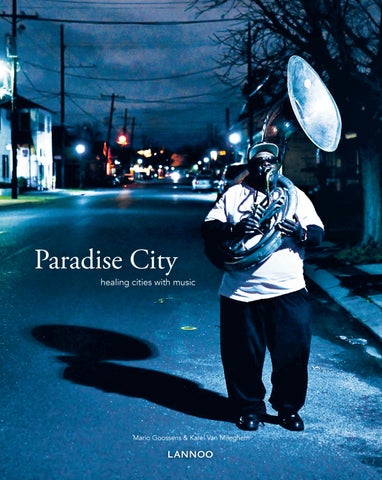
Paradise City
healing cities with music
Mario Goossens & Karel Van Mileghem
4 - Paradise City
Paradise City - 5
Contents Introduction
9
I. Port-au-Prince
12
Romel Jean-Pierre Abigaëlle Jose Sétoute Zikiki St. Eloi Yves-Marie Croicoux II. Belfast
20 26 32 38 42
Joby Fox
50
Terri Hooley
54
Therapy?
62
Marie Lacey
66
III. New Orleans
72
Mark “Tuba” Smith
80
Grandpa Elliott Small
88
Big Chief Howard Miller
96
IV. Kigali
102
Musekeweya
110
Jack B Hope Azeda
116 122
V. Hiroshima
130
Osamu Munakata
136
Tadakata Yanagawa
146
Shinji Okoda
150
Yuriko Hayashi
156
VI. Detroit
160
Bryce Detroit
168
Sacramento Knoxx
176
Simpson’s Record Shop
180
Nique Love Rhodes
188 Paradise City - 7
8 - Paradise City
30 - Paradise City
ZIKIKI ST. ELOI Zikiki lives in the slum of Carrefour Feuilles. He hails from an artistic family that has transformed their steep side street into a street of art. The walls are painted, the staircases are finished with mosaics, and there is a statue on the street of Jean-Jacques Dessalines, the first black leader of Haiti. The artistic vibe dispels the gloominess and roughness of this slum. The family promotes art and sports to help the neighborhood progress, and these efforts are appreciated — their street is named after the family: Imp. St. Eloi. One of Zikiki’s uncles is a soccer coach, and another teaches sculpture. His father is a painter, and Zikiki focuses on music. Climbing up the steep road, one finds a small plateau with a breathtaking view of the city and the Caribbean Sea in the background. If the neighborhood wasn’t so dangerous, it would be a tourist attraction. On the plateau Zikki’s family has built a small school for children from the neighborhood.
The earthquake was traumatic for Zikiki. When the trembling started, Zikiki was sitting in a taptap (a small bus with parallel benches), together with Mirla, the singer in his band. Suddenly, they felt the earth move. Mirla was about to jump off the bus, but Zikiki held her back. Had she jumped, she would have landed where two cars collided. Mirla was so impressed with Zikiki for saving her life that she later married him.
For Zikiki, art is a compass that leads children on the right path in a neighborhood terrorized by street gangs. Young rascals grow up into gangsters, gunshots are heard on a daily basis, and the residents live in fear. Gang wars sometimes rage so fiercely that school lessons have to be cancelled. Zikiki is angry at the government, which he holds responsible for sponsoring the gangs with money, weapons, vehicles and food. Haitians are responsive and take to the streets when they don’t like something. The government wants to confine protest and uses the gangs as a muzzle. Zikiki works hard to stop these fraudulent investments and to channel the money into education. He wants to expose children to a positive way of life before they are given weapons. “Once a kid gets his hands on a weapon, he will never give it up,” he says. Zikiki is convinced that an artist can gain respect from children and can offer them other options.
Once the taptap came to a halt, they continued on foot to Carrefour Feuilles. The house of Zikiki’s neighbor across the street had collapsed, and children were trapped in the debris. Zikiki and his friends, like possessed souls, began to dig, and they saved six children from the rubble. Two children had crawled under a cupboard for protection and were trapped. Their crying and calls for help were bone-chilling. Zikiki and his friends lacked the equipment to free them, and they had to give up on these children in order to help others.
32 - Paradise City
Port-au-Prince - 33
34 - Paradise City
Zikiki remained all night at the site comforting the children, their voices softly fading away until they became totally silent. That night had a severe impact on Zikiki. For six months, he suffered from a recurring nightmare: he attempts to pull the children from under the rubble, but they die. He is only 27 years old, yet already has a graying beard. Music helps to process the trauma. Zikiki realized that, like him, children in the
camps needed a positive diversion. That’s why he started music lessons, which led to the establishment of a small school. It annoyed him that lessons often had to be cancelled due to violence and danger in Carrefour Feuilles. As a positive voice of the neighborhood, Zikiki felt threatened by the gangs; he even considered hiring a bodyguard. He directs his pressing question to the greedy government: “How much more money do you need before you let us lead a dignified life?”
“Once a kid gets his hands on a weapon, he will never give it up.”
Port-au-Prince - 35
Belfast - 65
66 - Paradise City
Belfast - 67
68 - Paradise City
“Our choir represented the growing unity of this city.”
MARIE LACEY Marie Lacey grew up in east Belfast. Her family was proof that brothers and sisters can go in very different directions because of environmental factors. Although her parents were fairly neutral, Marie’s brother shifted towards stereotypical loyalist thinking: it is us against them. He joined one of the many Protestant marching bands, which represented the triumphant military character of Protestantism and British supremacy. Marie’s best girlfriend was shot down before her eyes at the age of 16, but she did not allow herself to be dragged in. She viewed her slain friend as a random victim in a world of “an eye for an eye and a tooth for a tooth.” Marie wanted to unite people. She was a singer, and from her perspective, a choir was the best way to unite people. In 2009, she established the Belfast Community Gospel Choir, the first and only multicultural choir in Northern Ireland. Not only were both Protestants and Catholics welcomed, but people of all color, religion and origin were able to audition. The only condition for joining the choir was to prove that you could sing. “We are the choir that rose out of the ashes. I had a real passion to create a choir that would represent the diversity of our city, the growing unity that is developing.” The choir got off to a flying start and became Marie’s full-time occupation. They sing at events and on festivals in Protestant and Catholic churches. They even sang for the Queen during her visit to the Titanic Museum in Belfast. Marie considers the Belfast Community Gospel Choir a family and an example of the new era in Northern Ireland. Sounds good.
Belfast - 69
190 - Paradise City
MARKED is an initiative by Lannoo Publishers. www.marked-books.com JOIN THE MARKED COMMUNITY on
@booksbymarked.
Or sign up for our MARKED newsletter with news about new and forthcoming publications on art, interior design, food & travel, photography and fashion as well as exclusive offers and MARKED events on www.marked-books.com.
Authors: Karel Van Mileghem & Mario Goossens Editing Dutch texts: Michaël Van Damme Translation: Bracha De Man Editing English texts: Melanie Shapiro Photography: Fabrice Debatty (all images, except p. 63 by Koen Keppens and p. 44, 47, 59, 64, 66, 68, 70, 76, 86, 87, 88, 91, 101 by Sofie Hendrickx) Graphic design: Nathalie Sternotte - oflua.com Special thanks to: Fabrice Debatty, Sofie Hendrickx & Leon, Nathalie Sternotte, Michaël Van Damme, Niels Famaey, Sarah Theerlynck & everyone at Lannoo, Olivier Goris & everyone at Canvas, Gerrit Kerremans, Radio1, Karl Everaert & everyone at Panasonic, Everyone at PIAS, Everyone at Connections, everyone at TV Connections, Peter Verstraelen, Herman Hulsens, Chris Dusauchoit, Lucas Van den Eynde, Joris Thys, Hendrik Smeyers, Janne Goossens, Hendrickx family, Van Mileghem family, Goossens family
If you have any questions or comments about the material in this book, please do not hesitate to contact our editorial team: markedteam@lannoo.com.
© Lannoo Publishers, Tielt, Belgium, 2019 D/2019/45/500 - NUR 640/653 ISBN: 9789401464963 www.lannoo.com All rights reserved. No part of this publication may be reproduced or transmitted in any form or by any means, electronic or mechanical, including photocopy, recording or any other information storage and retrieval system, without prior permission in writing from the publisher. #AREYOUMARKED
Paradise City Many cities around the world have been dealt enormous blows, both natural and man-made. Hurricanes, earthquakes, wars and bombs have all left their scars. Yet wounds can heal. Human nature knows how to crawl up from the bottom, sometimes thanks to music. Paradise City tells the story of Port-auPrince in Haiti (earthquake in 2010), Belfast in Northern Ireland (The Troubles), Kigali in Rwanda (genocide in 1994), New Orleans in the USA (Hurricane Katrina in 2005), Hiroshima in Japan (the atomic bomb in 1945) and Detroit in the USA (the decline of a city), based on portraits of unique people who, through music, have each tried to make their city a Paradise City. Musician and producer Mario Goossens (drummer in the rock band TriggerďŹ nger) and musician and director Karel Van Mileghem have based this book on a documentary series of the same name. With images by Fabrice Debatty.
www.marked-books.com www.lannoo.com
9 789401 464963