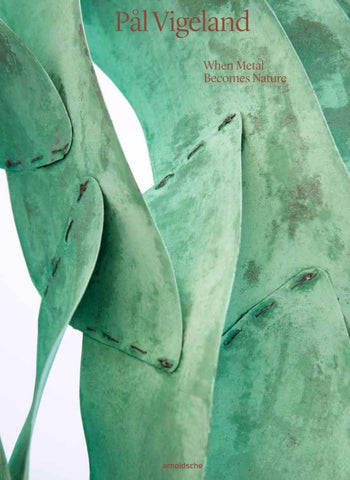
Pål Vigeland has worked as a metal artist for nearly fifty years. Everything he has ever made, from jewellery and plates to public commissions and sculptures, has always been characterised by precision and stringency. This book shows the continuities between Vigeland’s earliest years and the present while also offering many surprises about the changes that have taken place along the way. The intricate production methods that underlie Pål Vigeland’s latest works in tin are difficult to comprehend when standing in front of the finished pieces. Consequently one major contribution to this book is Guri Dahl’s photographs of the artist at work. Her many close-ups allow us to zoom in on the constructive processes and appreciate how exacting and time-consuming they really are. Pål Vigeland (b. 1944 in Oslo, Norway) studied at the Werkkunstschule, Schwäbisch Gmünd (Germany) and the Art Academy in Bergen (Norway). Employee as a designer in a silver-goods factory from 1968 to 1981. Own workshop from 1981 in Bergen, later from 2001 in Oslo. Solo and group exhibitions in Scandinavia and abroad. Commissions from churches and art in public spaces.
ISBN 978-3-89790-552-8
12122 Pål Vigeland Cover_02.indd All Pages
24.03.2019 17:21
Bikube 2007 32 × 58 cm Blikk fra makrellboks lokk/Metal from the lids of mackerel tins Aker ASA
26
vel så viktige var dei estetiske og meiningsberande aspekta. Eklektisismen rådde: Gamalt og nytt, kjent og ukjent, folkeleg og avansert blei blanda. På 1980-talet kalla ein gjerne slike blandingar av element frå låg- og høgkultur for urein kunst. Denne eklektiske holdninga finn vi att i Blikk-Fang. Materialet inneheld konkrete referansar til varelogoar og masseproduserte bilde, medan forma er abstrakt. Komposisjonen skapar orden og struktur i kaoset og kakofonien som alle blekkbitane representerer. Mengda av metallbitar talar i det heile sitt eige språk i Blikk-Fang. Dei er så mange at vi opplever dei meir som ein masse enn som einskilde delar. Emballasjen som var utgangspunktet, er oppløyst og er gjennom opphopinga blitt til noko anna. Denne måten å laga skulptur på er utbreidd i dag, og vi opplever denne typen skulpturar annleis enn den klassiske, slutta skulpturen. Dels krev den at vi går og står på nye måtar alt etter kor omfangsrikt verket er, og dels oppmodar den ikkje til berøring i form av klapp og stryk. Der den klassiske kunsten byggjer på ei forståing av verket som eineståande og originalt, inneber opphopingar ofte ein direkte eller indirekte kritikk av eit slikt «auratisk» kunstomgrep. Materiala i Pål Vigeland sine blekkskulpturar er produserte av ulike personar eller verksemder. Kunstnaren si rolle blir då å samla, arrangera og presentera dei på nye måtar. Ingen stiller lenger spørsmål ved legitimiteten i slike strategiar, men spør i staden kva funksjon gjenbruksmateriala får når dei blir forvandla til noko anna. Kanskje kan vi seia at dette har opna for eit nytt felt, der det ofte anonymt tenkte og skapte møtest med personlege og kunstnarlege innfallsvinklar. Det masseproduserte og det handlaga utgjer i dette universet inga motsetning, men har resultert i ein ny type fleirtydige objekt. Ei anna motsetning som denne typen verk stiller spørsmål ved, er inndelinga i nyttig og unyttig. Ein gong tente blekkboksane ein nyttefunksjon, men den var forgjengeleg. I bildekunsten talar ein ikkje om praktisk nytteverdi, så her tener gjenbruket ein heilt annan funksjon. Det var først etter at Pål Vigeland i 2001 hadde flytta frå Bergen og tilbake til fødebyen Oslo at han begynte med blekk. Tidlegare hadde han også brukt skrapmetall og ferdigpatinert kopar, men desse arbeida hadde blitt til ut ifrå heilt andre arbeidsprosessar. Flyttinga blei på fleire måtar eit vendepunkt i livet hans, og som kunstnar blei han dristigare og meir eksperimenterande. I denne publikasjonen blir vegen fram til den kunstnaren Pål Vigeland er i dag, gjort greie for. I den grundige artikkelen som professor emeritus i kunsthistorie, Gunnar Danbolt, har skrive spesielt for denne boka, får vi vita korleis det heile starta, og vi får
features of arts and crafts from this period onwards has been the use of double coding: it was no longer enough simply to design useful, utilitarian objects, one also had to develop their aesthetic and connotational aspects. Eclecticism prevailed: it became common to mix old and new, the familiar and the unfamiliar, the popular and the refined. In the 1980s such blends of elements from high and low culture were often referred to as impure art. This eclectic attitude is also evident in Blikk-Fang. The material carries references to specific branded products and mass-produced imagery, while the form of the work is abstract. The composition creates order and structure amid chaos and cacophony, as represented by the many small pieces of metal. The sheer quantity of metal components in BlikkFang carries a message of its own. They are so numerous that we tend to view them as a single mass rather than as separate parts. What started out as practical packaging has been transcended and turned into something else as a result of accumulation. This approach to making sculpture is now fairly widespread, and the way we look at such works differs from the way we look at classic, self-contained sculptures. For one thing, we have to find new ways to stand in front of them, depending on the size of the work, and for another, they do not readily invite us to touch them, either by patting or stroking. Whereas classical art generally conceptualises the work as unique and original, accumulations tend to imply a direct or indirect critique of such “auratic” conceptions. The material in Pål Vigeland’s tin sculptures was produced by many different people in countless factories. Here the role of the artist is to collect, arrange and pre sent the material using a fresh approach. The legitimacy of such strategies is no longer questioned, but what people do ask is what function re cycled materials serve when transformed into something else. It would be fair to say that this has opened up a new field, where objects of anonymous origin are combined with perspectives that are personal and artistic. In this universe there is no contradiction between the mass-produced and the handmade, which are synthesised instead into a new kind of polysignificant object. Another tension interrogated by works of this kind is the distinction between useful and useless. In the past, this metal served a useful, if transient, purpose as the material of various containers. In fine art, utility value is an empty concept, so here recycling serves an entirely different function. It was only after Pål Vigeland’s move from Bergen back to his hometown of Oslo in 2001 that he began to work with tin plate. By that time, he already had experi ence of using scrap metal and pre-patinated copper, but his earlier work processes had been very different. In many ways, his move to Oslo amounted to a turning point in his life, while as an artist he became bolder and more experimental. In this publication, we explore the path by which Pål Vigeland became the artist he is today. In an in-depth article written specially for this book, 27
Bolle med fire sømmer 1983 h 13 cm Kobber, messing/Copper, brass Privat eie/Privately owned
68
Bolle med søm 1983 h 13 cm Kobber, messing/Copper, brass KODE 1, Fine Craft and Design, Bergen
69
Fat svart sirkel med grønt øye 1996 Ø 60 h 8 cm Jern, bronse/Iron, bronze Privat eie/Privately owned
74
Fat med søm 1988 Ø 55 cm Kobber, messing/Copper, brass Privat eie/Privately owned
75
Salamander 1990 h 60 cm Messing/Brass Privat eie/Privately owned
111
Rød vase 1994 h 40 cm Messing/Brass Privat eie/Privately owned
Dåpsfat/Font 2001 Messing, forgylling/ Brass, gilding Hamardomen/ Hamar Cathedral
124
Vannmugge/Water jug 2001 h 26 cm Messing, forgylling/ Brass, gilding Hamardomen/ Hamar Cathedral
A
B
A Søyle 1996 h 220 cm Bly/Lead
B Spiral, detalj/detail 1996 h 250 cm Stål/Steel
140
Søyle 1996 h 220 cm Bly/Lead KODE Art Museums and Composers Home, Bergen
Makrellknute 2011 h 60 × b 80 Makrell bokser/Mackerel tins Orkla ASA
180
Forlokkende 2012 h 380 × 120 cm 1620 makrell lokk/ Mackerel-tin lids Orkla ASA
Pyton-egg 2015 h 50 × 70 cm Kobber/Copper Aker ASA
186
Kobber-Kongle 2015 h 70 × 55 cm Kobber/Copper Privat eie/Privately owned
187