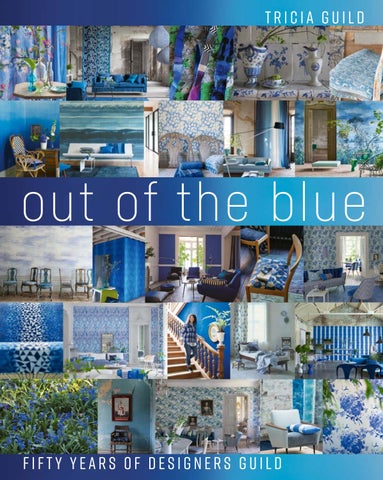
tricia guild
out of the blue
FIFTY YEARS OF DESIGNERS GUILD
out of the blue an unconventional approach making it happen travellers’ tales flower power bold and brave in the shade not so square an artist in the room by invitation inspiring others chronology
7
15
27
39
73
115
151
189
221
229
243
252
out of the blue an unconventional approach making it happen travellers’ tales flower power bold and brave in the shade not so square an artist in the room by invitation inspiring others chronology
7
15
27
39
73
115
151
189
221
229
243
252
out of the blue
out of the blue
out of the blue
out of the blue
Writing the introduction for a book that celebrates half a century of my work is a distinctly powerful, thoughtful and touching sensation. I am struck by how perfectly appropriate the title Out of the Blue actually is. My story did indeed come ‘out of the blue’! Looking back, however, the seeds of my career were present from the beginning. Some of my earliest memories are of colour. My grandparents were very keen gardeners and, as a child, I would often garden with them. I distinctly remember one sunny spring day, looking up through the lilac flowers of their wisteria, the sharp acidic green of the first leaves, to an endless blue sky, and being genuinely touched by its beauty. I have always felt a very strong connection with nature and remain as inspired by the landscape and what I see now, as I was then. My parents were artistic and forward-thinking; our home contemporary and filled with Heal’s furniture from the 1950s, black and white fabrics and a vivid turquoise geo carpet. I was fastidious about my bedroom, the colours and patterns. My destiny was already becoming clear. Whilst designing houses with Robin Guild in the late 1960s, I felt rather limited by the available fabrics. I was forever searching for a different language. My first trip to India was totally inspiring. The colours, landscape, dignity, architecture and soul touched my heart. The first collection of fabric and wallpaper was called Village, inspired by Indian block prints yet totally reinterpreted in a vivid colour palette that was both decorative and contemporary. I felt strongly that this style of decoration needed to be shown as a lifestyle and, with that in mind, opened the first Designers Guild store in Chelsea, on London’s famous King’s Road. I covered sofas, had cushions made, accessorised with Clarice Cliff ceramics and vintage furniture, and so the full story began.
8#
Tricia Guild OBE, 2013
#9
out of the blue
out of the blue
Writing the introduction for a book that celebrates half a century of my work is a distinctly powerful, thoughtful and touching sensation. I am struck by how perfectly appropriate the title Out of the Blue actually is. My story did indeed come ‘out of the blue’! Looking back, however, the seeds of my career were present from the beginning. Some of my earliest memories are of colour. My grandparents were very keen gardeners and, as a child, I would often garden with them. I distinctly remember one sunny spring day, looking up through the lilac flowers of their wisteria, the sharp acidic green of the first leaves, to an endless blue sky, and being genuinely touched by its beauty. I have always felt a very strong connection with nature and remain as inspired by the landscape and what I see now, as I was then. My parents were artistic and forward-thinking; our home contemporary and filled with Heal’s furniture from the 1950s, black and white fabrics and a vivid turquoise geo carpet. I was fastidious about my bedroom, the colours and patterns. My destiny was already becoming clear. Whilst designing houses with Robin Guild in the late 1960s, I felt rather limited by the available fabrics. I was forever searching for a different language. My first trip to India was totally inspiring. The colours, landscape, dignity, architecture and soul touched my heart. The first collection of fabric and wallpaper was called Village, inspired by Indian block prints yet totally reinterpreted in a vivid colour palette that was both decorative and contemporary. I felt strongly that this style of decoration needed to be shown as a lifestyle and, with that in mind, opened the first Designers Guild store in Chelsea, on London’s famous King’s Road. I covered sofas, had cushions made, accessorised with Clarice Cliff ceramics and vintage furniture, and so the full story began.
8#
Tricia Guild OBE, 2013
#9
out of the blue
12 #
out of the blue
# 13
out of the blue
12 #
out of the blue
# 13
out of the blue
an unconventional approach
The year is 1970 and it is the dawning of a brand-new decade – following hot on the heels of the ground-breaking cultural revolution and wild optimism of the ’60s. Robin Guild and his wife, Tricia Guild, were well-known London interior designers, operating from Robin’s ‘Interiors’ shop in Hampstead, where their clients numbered many of the movers and shakers of the day. They were fast gaining a reputation for being designers to watch and their work was lauded for its mix of modernity and innate good taste. The Guilds made it their business to know every creative outpost in the city. One of the places they discovered was a small store belonging to David Bishop, a New Zealander who had cut his teeth at David Hicks’ interior design practice. Bishop had set up his own decorating company on King’s Road in Chelsea, an area that had a less than salubrious reputation at the time. Bishop, on the other hand, was known among the cognoscenti as a man of exceptional taste and style. The Guilds would often visit the store, using his furniture and accessories in their design schemes for clients. Tricia was particularly taken with a small collection of early block prints that Bishop had brought back from a recent trip to India. Small-scale designs, rather earthy in colour and hand-printed on raw cotton, they had an engaging charm and she would use them regularly in interior projects. Following Bishop’s somewhat untimely death, his business was put up for sale. The Guilds decided to buy the company, relocating to Chelsea, where they were joined by Bishop’s young designer, Chris Halsey, a graduate of Hull Traders, a company known for the production of interesting and innovative fabrics. The new venture that would become Designers Guild had launched. Using and specifying Bishop’s Indian prints had inspired the young Tricia Guild, and her fascination with textiles, wallpapers and pattern began to flourish. Whilst she was enamoured with the scale and simplicity of the designs, she found the colours dull and a little dreary so she considered how she might reinvent them to create something fresher, clearer and more contemporary. The original designs had been hand-printed in India but Guild instinctively knew that this would not be commercially viable for their business. So, without any formal training, she tentatively began to feel her way and, with Halsey’s help, set about creating her own design language. They found a small screen-printing business that was based on an island in the middle of the River Thames, where the craftsmen agreed to produce small print runs of up to 30 metres. Carefully and with a discipline for which she would later become known, Guild put together a small collection of fabrics based on block prints but reinvented and reinvigorated in clear, fresh colours.
16 #
Preceding pages: the launch of the Designers Guild Homestore, 1996. This page: Tricia Guild in Kaffe Fassett knitwear, photographed with the Geranium collection, 1976.
From top: Designers Guild shopfront, 1977; the interior of 271 King’s Road, 1977; Tricia Guild, 1977; Tricia Guild at home in London, 1978.
# 17
out of the blue
not so square
Every time Tricia Guild embraces fresh new colours, drawing rooms up and down the country take note. Her ground breaking colour sense may shape trends, but Tricia Guild still does modern with a soft edge. Judith Wilson, House & Garden, 2000
212 #
Scenes and Murals, 2019.
# 213
216
216 #
Clockwise from top left: Murrine, 2017; Zardozi, 2018; Fitzrovia, 2019; Chandigarh, 2018.
Clockwise from top left: Casablanca, 2017; Murrine, 2017; Forsyth, 2016; Zardozi, 2018.
# 217
216
216 #
Clockwise from top left: Murrine, 2017; Zardozi, 2018; Fitzrovia, 2019; Chandigarh, 2018.
Clockwise from top left: Casablanca, 2017; Murrine, 2017; Forsyth, 2016; Zardozi, 2018.
# 217
Over 50 years, Designers Guild has evolved from a single shop on London’s King’s Road to a global brand that has shaped the way we view colour, pattern and texture in our homes. Out of the Blue celebrates the creativity and passion of founder and visionary, Tricia Guild, and charts the company’s history and
www.accartbooks.com
ËxHSLHSIy840743zv&:%:&:+:+
ISBN: 978-1-78884-074-3
£30.00/$45.00
archive with an inspiring sourcebook of carefully coordinated interior palettes.