OUT OF OFFICE
PASSION FOR GOLF
ARCHITECTURE & STRATEGY
THE INTENTIONALLY IMPERFECT GAME
PART I THE GAME

Golf is one of the few games that not only accepts its own imperfections, but actually preserves them on purpose. While most sports have spent decades trying to standardize their playing fields, minimize randomness, and make conditions comparable, golf has deliberately chosen not to go down that road. The differences between courses aren’t a flaw—they’re the foundation of the game.
Historically, you can trace this principle all the way back to the early links courses on the Scottish coast. Golf wasn’t designed there—it was just played wherever it was possible. Thin sandy soil, shifting winds, bumpy ground, and natural obstacles shaped the character of the courses. Instead of leveling the land, the game adapted to the landscape. That attitude is still around today and really shapes the spirit of golf.

This imperfection starts with the ground. On a links course, the ground is hard, sandy, and drains well. The ball bounces after landing, keeps rolling, and goes in directions the player never planned. On a parkland course, the ground is soft, grassy, and damp. The ball just stops where it lands. Two identical shots on two different courses can give you two totally different results. The player has to know what kind of ground they’re standing on—and adjust their game.
The imperfection continues with the weather. Golf is played in sunshine and rain, in calm and in storms, at ten degrees or thirty. There’s no stopping play for a little rain, no postponing because of wind. The conditions are part of the challenge. A course that feels friendly in calm weather can turn into a nightmare with a 40 km/h crosswind. Same eighteen holes, same scorecard, but a totally different game.
Other sports have found ways to deal with the problem of inequality. Indoor floors are calibrated. Swimming lanes are temperaturecontrolled. Running tracks are certified. Golf has refused to go down that road – and that refusal isn’t carelessness, it’s a philosophical choice. The game says: The world isn’t fair. The ground isn’t level. The wind doesn’t always blow from the same direction. And your job is to deal with it.
The rules also take this imperfection into account. The official rules of the R&A and the USGA aren't about eliminating luck completely, but about limiting it and putting it into context. A ball can bounce badly, get stuck in a divot, or be affected by the wind—all of that is just part of the game. Unlike in many other sports, there's no attempt to compensate for every little irregularity.
GOLF DOESN’T HAVE A PLAYING FIELD. GOLF HAS PLAYING FIELDS—THOUSANDS OF THEM, EACH UNIQUE, EACH WITH ITS OWN CHARACTER.
The rules of golf are uniquely honest in this way. They don’t say: We guarantee you equal conditions. They say: We give you a framework, and within that, you have to deal with uneven conditions. Your ball’s in another player’s divot? Play it as it lies. The wind changes between your tee shot and your buddy’s? Tough luck. The green is faster in the morning than in the evening because the sun dries the dew differently? Learn to read it.
This toughness might sound unfair. But it’s actually the opposite of random. It’s consistent. Golf says: We can’t control the conditions, so we don’t pretend we can. Instead, we accept that every round happens under different circumstances, and we judge players by how well they handle those circumstances. It’s not the best shot that wins, but the best adjustment. This openness means golf isn’t about perfect repeatability, but about adaptability. Success comes less from perfectly repeating an ideal movement and more from being able to handle changing conditions. Players have to make decisions, accept uncertainty, and live with results they can’t fully control.
That’s a fundamental difference from what modern sports science preaches. The sports industry—and the golf industry especially— pours billions into the idea of repeatability. Clubs are designed to forgive mistakes. Balls are made to fly straighter. Training methods are refined so your swing is always the same. All the tech in golf is aimed at minimizing the game’s imperfections. And yet, they’re still there. Because technology can improve the club, but not the decision of which club to use. It can make the ball fly straighter, but not predict the wind. It can make your swing more consistent, but not take away the pressure you feel on the 18th green when a putt decides your round. The imperfection in golf isn’t in the gear—it’s in the game itself. And it’s in the player.
This intentional imperfection also shows up in the design of many classic courses. Architects like Alister MacKenzie or Donald Ross stressed that a good golf course doesn’t have to be fair in the sense of predictable, but in the sense of honest. Holes can be confusing, greens can be deceptive, and shots can be punished if they land in the wrong spot.
MacKenzie put it like this: The best holes give players several ways to reach the goal and don't punish any of them across the board, but in a nuanced way. The safe route is longer, the risky route is shorter, and the punishment for failing on the risky route is proportional to the reward for pulling it off. That sounds simple, but it's actually the result of a mindset that doesn't see imperfection as a problem, but as a design principle.
A golf course that's fair in the sense of being totally predictable would be boring. If players always knew what to expect, if they could always make the right decision, if nothing unexpected ever happened—then golf would just be a logic puzzle to solve, not a game to play. It's the unpredictability that makes golf so addictive. Because you never know if your next round will be your best or your worst of the season. You never know if your next shot will be brilliant or a total disaster. Because the game always leaves room for something to happen that nobody saw coming.
There’s a second aspect of imperfection that goes even deeper than the outside conditions: the imperfection of the player themselves. Golf is a game where your body gives away what your mind is thinking. A nervous putt looks different than a relaxed one. A scared tee shot sounds different than a confident one. The ball doesn’t lie. It shows, with scary precision, what was going on inside the player at the moment of the shot. No other sport makes
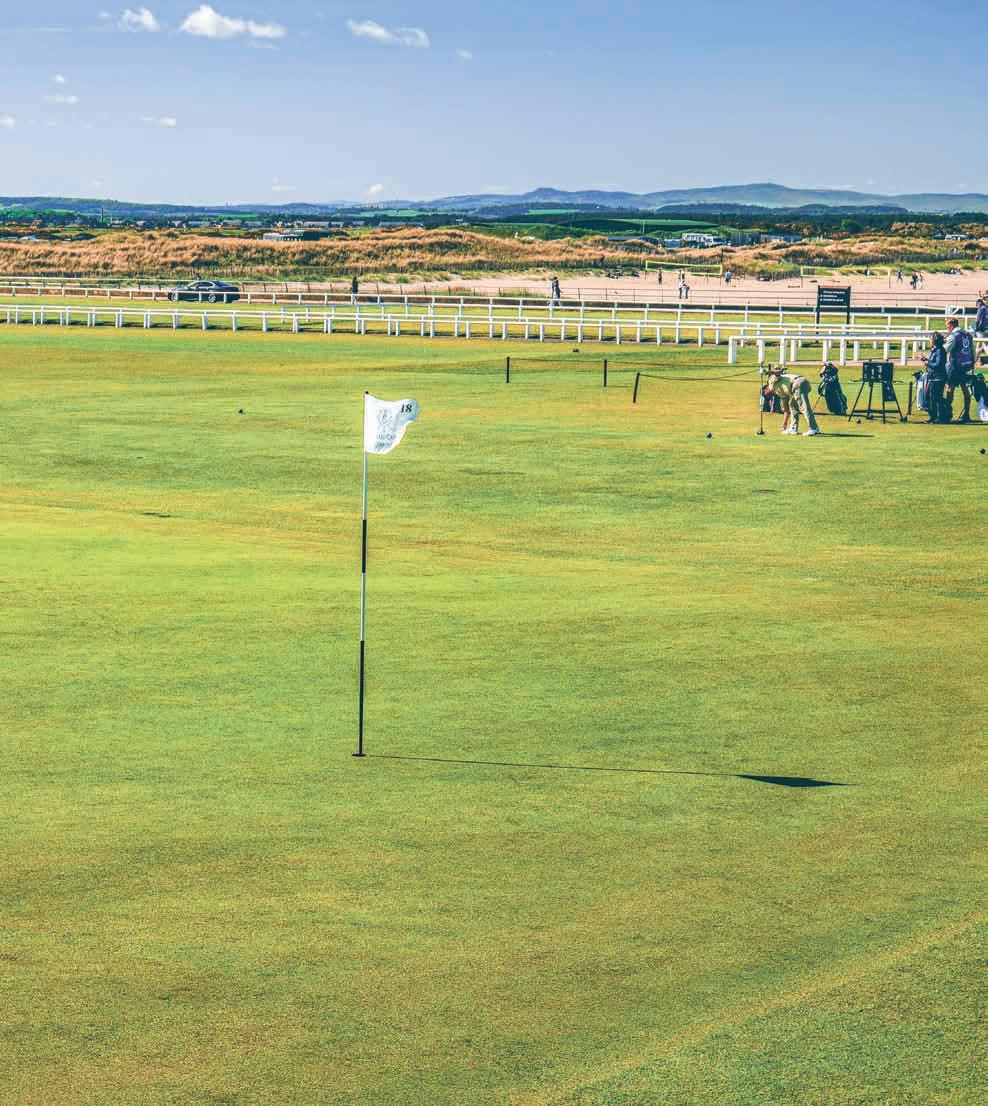
ST. ANDREWS OLD COURSE
There’s no course in the world that explains as much as the Old Course at St. Andrews. Not because it’s the oldest even though it probably is. Not because it’s the most famous—though nobody would argue with that. But because it shows what golf used to be, before it was ever designed.
The Old Course wasn’t built. It was found. In the dunes on the coast of Fife, on narrow, sandy ground between the town and the North Sea, a course developed over centuries that doesn’t belong to any architect. The holes don’t follow any symmetrical logic. The fairways are wide, but the greens are tricky. The bunkers are deep, steepsided and often invisible from the tee. Everything seems random—and in a way, it actually is.
(United Kingdom)
But it’s exactly this randomness that’s made the course fascinating for generations. Because what looks random is actually a natural architecture that’s more complex than anything a person could have designed. The double greens—seven out of eighteen holes share a green with another hole—create playing situations you won’t find anywhere else.
The 17th hole of the Old Course is the most famous hole in the world—and the least understood. A par 4 of 455 yards, bending slightly to the right, with a green that’s guarded by a deep bunker front left and a paved road behind the green. The tee shot goes over the corner of the Old Course Hotel, blind or semi-blind, depending on the tee position. The second shot has to be
a long iron or wood onto a narrow, flat green that doesn’t forgive mistakes. What makes the Road Hole so special isn’t its difficulty—even though it’s one of the toughest holes in championship golf. It’s the kind of difficulty. The hole doesn’t punish bad shots. It punishes good shots that go a meter too far. The difference between a birdie putt and a bogey from the Road Bunker is smaller than on any other hole in the world. The Road Hole is a hole that demands humility—and teaches it in the hardest way.


THIS BOOK LOOKS AT GOLF NOT AS A COMPETITION, but as a cultural phenomenon. At its core are the places, spaces and structures that shape the game: landscapes with their own character, courses defined by architectural logic, and rituals that have evolved over decades.
It is aimed at those who do not simply want to learn golf, but to understand it. In carefully curated chapters, the book leads from the origins of the game—at courses such as St Andrews Old Course, Prestwick and Royal Dornoch—through iconic venues like Augusta National and Pinehurst No. 2 to lesser-known favourites cherished by connoisseurs.
The perspectives of professional golfers are complemented by insights into golf travel and destinations where the game can be experienced in a particularly meaningful way, as well as chapters on etiquette and the unwritten rules that have always defined golf.
256 pages, 200 color photos
25 x 28 cm
€ 45,00 | $ 55,00 | £ 40,00
Publication Date: October 12, 2026
ISBN 978-3-7667-2937-8