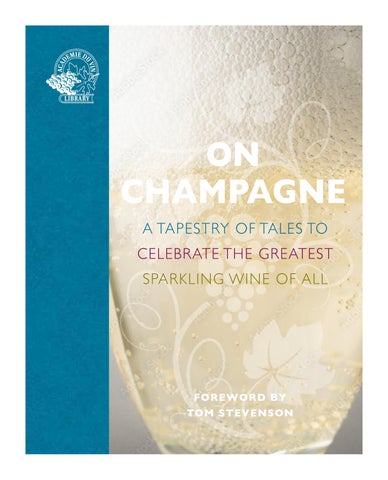
ON CHAMPAGNE A TAPESTRY OF TALES TO CELEBRATE THE GREATEST SPARKLING WINE OF ALL
FOREWORD BY TOM STEVENSON
Contents INTRODUCTION
SERVE IT WITH A SWAGGER
NINE ERAS OF CHAMPAGNE
Chalk About Champagne MARGARET RAND sums up the majesty of this place, this wine
The Cold, Singing Fire – No wine is more sipped, but less tasted… ANDREW JEFFORD explains why it’s worth paying more attention to champagne
1 The English Invent It three vignettes from STEPHEN SKELTON
ITS OWN KIND OF BEAUTY Blanc de Blanc or Blanc de Noirs? ESSI AVELLAN MW explains the differences between these two styles – with issues (and grapes) more complex than many might guess… Vintage or Non-Vintage? SERENA SUTCLIFFE MW on the glamour and the pulling-power of the champagne vintage Sugar Rush JANE MACQUITTY celebrates champagne, sweet to dry, in ‘all its drop-dead gorgeousness’ Rosé Champagne: Not just for Stage-Door Johnnies JAY MCINERNEY glances admiringly at the more expensive rosé champagnes. TBC
ON YOUR MARQUES… Vieilles Vignes Françaises FIONA MORRISON MW paints a portrait of Bollinger’s super-luxury blanc de noirs vineyard The Churchill Link PAUL BEAVER explains the UK’s famous link with Pol Roger Taittinger and the Five-Day Queen ADAM LECHMERE’S interview with the new head of this esteemed champagne house Let the Lees Linger TOM STEVENSON witnesses a bottle-ageing debate between two champagne titans, the winemakers at Dom Pérignon and Roederer
68
‘A Menace to Society…’ – Popping the cork safely… KELLI WHITE’S wry look at the theatre of uncorking champagne. Flutes or Coupes? Australian writer and wine merchant ROBERT WALTERS has other ideas... The Magnum Effect TOM STEVENSON compares champagne in magnums and standard 75cl bottles and finds the former format irresistibly better… Beyond the Ice-Bucket NATASHA HUGHES MW on Champagne’s major styles: best with food or for solo-sipping?
BETTER, BRIGHTER, BUBBLIER Champagne and Oak MARGARET RAND weighs up the complex, contradictory approaches to ageing champagne in oak. The Marriage of Age and Youth ANNE KREBIEHL MW time travels into the mystery world of champagne’s blend components. Cellar Under the Sea In 2010 a dive-team discovered 168 bottles of Veuve Clicquot champagne in a wreck at the bottom of the Baltic Sea. Does this method of storage beat all others? ESSI AVELLAN MW A Matter of Taste: the Art of the Blender:
2 France Perfects it: 17th-Century Beginnings HUGH JOHNSON 3 Le Déjeuner d’Huîtres (1735) TOM STEVENSON describes the first champagne to be captured in paint 4 Moët Gets Industrial (1741–1879) HENRY VIZETELLY is impressed 5 Good Times in the Belle Epoque (1871–1914) SERENA SUTCLIFFE MW captures the gaiety, prosperity and high living 6 The Roaring 20s? – Rise and fall in champagne fortunes: TOM STEVENSON 7 Escape from the Weinführer (1940–45): DON AND PETIE KLADSTRUP recall the bravery of those who saved champagne from Nazi greed… 8 Times of Recovery (1960s): EVELYN WAUGH on the new Golden Age as champagne reaches for the masses 9 Champagne, our social signifier JOE FATTORINI, champagne today…
DARE TO BE DIFFERENT Homage to the Widow ELIN MCCOY traces the role of women through Champagne’s history to the first female chefs de caves.
The Terroir Factor PETER LIEM explains the distinctive flavours and characters that come from each different champagne village. With maps from Charles Curtis MW The Greening of Champagne ELIN MCCOY traces the long-awaited recovery of Champagne’s vineyards and its tactics to mitigate climate change Still… For a Change – The Coteaux Champenoise, Champagne’s still-wine home, hides in plain sight – STEVEN SPURRIER (2019)
BLAME IT ON THE FIZZICS… GÉRARD LIGER-BELAIR explains the science: which, why and where are the best Bubbles
CHAMPAGNE ON THE MOVE (short pieces)
Champagne’s ‘Beneficial Pilgrimage’ – Champagne spreads mirth and lightheartedness on its global journey: HENRY VIZETELLY (1879) ‘Better Than Army Tea’ PETER CARRINGTON recalls the benefits of transporting champagne in a WW2 Sherman tank Champagne at 30,000 feet HUGH JOHNSON and OZ CLARKE Journey into Space Mumm’s gravity-defying Champagne bottle adapted for space travel
Small Steps Back to Burgundy WILLIAM KELLEY charts the growing importance of grower champagnes.
69
very greatest champagnes I have ever tasted, so while I might still side more with Lécaillon, I have to respect where Geoffroy is coming from. Besides, it is healthy for champagne, and good for its consumers, that two great chefs de caves of such similar philosophies should have strongly held opposing views on a subject as basic as ageing. If nothing else, it emphasizes the differences in their champagnes. Dom Pérignon P2 and P3 (formerly Oenothèque) are the epitome of the multilayered aromatic and textural complexity achieved through extended yeast contact, their very raison d’être, while the long-awaited, first ever, late release of Cristal will illustrate the virtues of combining 10 years on yeast with 10 years of post-disgorgement ageing. As divulged by Patrick Schmitt, editor of The Drinks Business, Lécaillon believes that a decade on yeast is the ideal period. Schmitt quotes Lécaillon’s confession that an extra three years’ yeast contact for Cristal ‘does not make a big difference’. These are, however, extreme champagnes in every sense of the word – so, what about most others? If I changed the emphasis of my opening question to: ‘What would be morebeneficial for most champagnes: an extra year on lees or an extra year post-disgorgement ageing?’ would that focus the mind? Notwithstanding that there are windows of opportunity for disgorging that open and shut, and every champagne is different – thus no single answer is applicable to all situations – I would still have to say that there is much less to be gained from an extra year on yeast. If we take a vintage champagne that is released at between five and seven years of age, I would much rather it received an extra year’s ageing under the ideal conditions of the producer’s own cellars before shipping. This would have a minimal effect on the ageing, in terms of either aroma or flavour, but it would have an immense impact on the mousse, making it softer and silkier, and this would result in more finesse. The higher the quality of the champagne, the slower it ages, thus the longer I would stretch the post-disgorgement ageing. The champagnes sold by most quality-conscious producers would easily benefit from an additional two years, and for vintages released at eight years or older, as much as three years would impart an even more luxurious texture.
CHAPTER THREE
SERVE IT WITH A SWAGGER It has been called ‘a menace to society’, but popping corks are more likely to herald delight than disaster… The Cold, Singing Fire – No wine is more sipped, but less tasted… ANDREW JEFFORD explains why it’s worth paying more attention to champagne ‘A Menace to Society…’ – Popping the cork safely… KELLI WHITE’S wry look at the theatre of uncorking champagne Flutes or Coupes? Australian writer and wine merchant ROBERT WALTERS has other ideas... The Magnum Effect TOM STEVENSON compares champagne in magnums and standard 75cl bottles and finds the former format irresistibly better Beyond the Ice-Bucket NATASHA HUGHES MW on Champagne’s major styles: best with food or for solo-sipping?
66
LET THE LEES LINGER
67
Andrew Jefford
The Cold Singing Fire Andrew Jefford asks us to treat champagne as we would any other wine, to taste it and savour its strangeness – to seek out the qualities that come from its muddy soils, dripping cellars and fretful seasons…
No wine is more sipped, but less tasted, than Champagne. For many of its drinkers, it’s a social marker. Clutching a flute of Champagne is a secular rite – to denote achievement, happiness, success, or to shine a light on any of the significant way-marks in life. What it actually tastes like is secondary, perhaps irrelevant. Indeed given its high acidity levels and ever-decreasing levels of dosage, I suspect that many of its brighteyed celebrants must secretly suffer it rather than relish it. To those who are interested in tasting Champagne rather than merely enacting a ritual, I’d say this. Notice what a strange sort of wine it is. As you hold it in your mouth, try to see the wine inside the bubbles, shocking though that experience may be. The greatest wines often have a kind of lovely unloveliness at their heart – the fierce tannins of the Langhe, the austerity of classic Médocain beauty, a mocking stony-sour slenderness in red Burgundy. So with Champagne, and Champagne’s structural acidity. It is unreasonable, and in and of itself, almost impossible to like. Visitors to the region who get a chance to taste the vins clairs (the still base wines) before blending will often find them painful, challenging, inscrutable and tooth-jangling. You can experience something of this for yourself by sampling a still Coteaux Champenois white wine. Only the ripest wines from the most favoured villages will be used; even so, it’s hard to call them ‘balanced’, or to see how they could justify their luxury pricing. Climate change, it’s true, is moving the regional fulcrum a little, thus balances are easing, but
68
SERVE IT WITH A SWAGGER
the acid challenge remains; indeed those whose lives are spent crafting Champagne struggle to find ways to nourish and retain acidity as the sinister warmth advances like an algal bloom. This might lead us to conclude that the beauty in Champagne is a matter of acquired externalities: the sinew of malolactic fermentation, the nutty resonance which comes with a little controlled oxidation (via cask fermentation), the tongue-teasing texture of tiny bubbles, the bready scents and creamy palate fullness of autolysis, the chamfering brought by the addition of finely judged dosage, the gathering harmony which is the legacy of cellar years. Those elements must constitute the secret, no? I don’t think so: these externalities can be mimicked by any skilled sparkling-wine craftswoman or craftsman anywhere. And they do; and they are. Other regions making Champagne-style sparkling wines nonetheless struggle to match the greatest Champagne (though both England and Tasmania glide impressively close). Either Champagne craftspeople are simply more skilled than everyone else – which seems improbable Life before bubbles... A lineup of vins clairs in Krug’s tasting rooms, Reims – these still wine samples represent the many vineyard enclaves that come together to create a grande marque blend.
The Cold Singing Fire
69
Gérard Liger-Belair
The Bubble Bursts In the few seconds after a champagne bubble is born, it will reach the surface of the wine: there, as it bursts into the air, it creates a tiny upward jet of liquid that tickles the tasters face leaving the first, minutest impression of the wine that’s about to be sipped. Gérard Liger-Belair explains this short and spectacular life…
Champagne physicist Gérard LigerBelair works on a glass of champagne in his laboratory in Reims, his mission to determine the exact role of bubbles in bringing the aroma and taste of champagne to our senses – put simply, he says, they act like ’tiny elevators’ lifting molecules of aroma to the surface of the wine.
Jet Drops, Sensation and Flavour Release Hundreds of bubbles are bursting every second during the first few minutes following the pouring of a flute of champagne; the liquid surface is literally spiked with these conical structures. Beyond aesthetic considerations, though, bubbles bursting at the free surface of the liquid impart a sensual feeling to sparkling wines, beers, and many other beverages. The characteristic ‘mouthfeel’ of champagne is an important part of drinking it and contributes to the pleasure of tasting. Jet drops are ejected up to several centimetres above the surface with a powerful velocity of several metres per second. In the very first few seconds after pouring, hundreds of bubbles are bursting every second at the liquid surface, and hundreds of tiny jet drops about 100 micrometers in size are launched – in the form of a refreshing spray that pleasantly tickles the tasters face. Indeed, if you wear glasses and take a sip from a freshly poured flute of champagne, you surely have noticed the light spray that forms instantaneously before your eyes. The few centimetres the liquid jets reach into height are just enough to reach our nocieptors (the scientific term for very sensitive nerves that act as pain receptors) in the nose; these are thus highly stimulated during champagne tasting, as are receptors in the mouth when bubbles burst over the tongue.
236
BLAME IT ON THE FIZZICS
In addition to these mechanical stimulations, bubbles bursting at the surface play a major role in flavour release. Many aromatic compounds in carbonated beverages show surface activity, including alcohols (such as ethanol, butanol, pentanol, and phenyl-2-ethanol), some aldehydes (such as butanol, hexanal, and hexenals), and organic acids (such as propionic and butyric acids). Bubbles rising and expanding in the liquid act like tiny elevators for surface-active and potentially aromatic molecules, carrying them along as they make their way up. Because of this, such molecules gather progressively in much higher concentrations at the surface o champagne than in the bulk of the liquid. Thus, when bubbles collapse at the free surface and cause jet drops, they radiate a cloud of tiny droplets into the air and over the tip of your nose, and these droplets contain a large concentration of potentially aromatic molecules. This fragrant event also creates the delightful and complementary effect of highlighting the flavours of champagne experienced on the tongue and
The Bubble Bursts
237