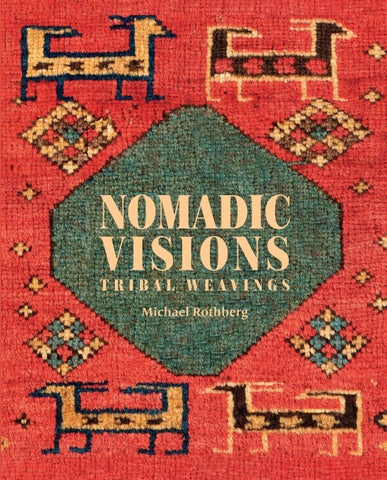
NOMADIC VISIONS
TRIBAL WEAVINGS Michael Rothberg
HPL NEARC
NOMADIC VISIONS TRIBAL WEAVINGS Michael Rothberg
CONTENTS
FOREWORD 7 PREFACE 8 ACKNOWLEDGEMENTS 11 INTRODUCTION 13
I. CONTEXT 17
EARLY RUG WEAVING 19 NOMADIC PASTORALISM 20 SHEEP, GOATS, AND OTHER ANIMALS 23 THE ROLE OF NOMADIC WOMEN 25 TRANSPORT BAGS 26 PERSIAN SADDLE BLANKETS 28 TRIBAL DESIGN ORIGINS 29 ASPECTS OF DESIGN 31 THE ROSETTE 34 SYMBOLISM 40 THE PLATES – OVERVIEW 41
2. TRANSCAUCASIA & NORTH PERSIA 45 2.1 TRANSCAUCASIA 46 HISTORY AND GEOGRAPHY 47 DESIGN TRADITION 48 TECHNICAL PROFILE 50 PLATES 1–26 52
2.2 THE SHAHSEVAN CONFEDERATION 86 HISTORY 87 SHAHSEVAN WOMEN 91 DESIGN TRADITION 91 TECHNICAL PROFILE 92 ARRANGEMENT OF PLATES 27–44 92 PLATES 27–44 94 2.3 PERSIAN AZERBAIJAN 120 HISTORY 121 THE TRIBES OF AZERBAIJAN 123 TECHNICAL PROFILE & DESIGN TRADITION 124 PLATES 45–71 126 2.4 THE KURDS 170 HISTORY 171 RELIGION & WOMEN 172 THE JAF KURDS 172 TECHNICAL PROFILE & DESIGN TRADITION 173 PLATES 72–94 176
2.5 varamin 210 THE TRIBES 211 ATTRIBUTIONS 212 WEAVING FORMAT & DESIGN TRADITION 212 TECHNICAL PROFILE 214 PLATES 95–110 216
3. SOUTH & EAST PERSIA 239 3.1 THE AFSHAR TRIBES OF KERMAN PROVINCE 240 HISTORY 241 DESIGN TRADITION 242 TECHNICAL PROFILE 244 PLATES 111–137 248 3.2 THE KHAMSEH CONFEDERATION 288 THE TRIBES 289 TECHNICAL PROFILE & DESIGN TRADITION 292 PLATES 138–154 294 3.3 THE QASHQA’I 320 HISTORY 321 ECONOMY 321 RELIGION 322 Qashqa’i WOMEN 322 DESIGN TRADITION 324 TECHNICAL PROFILE 325 PLATES 155–177 326 3.4 THE LURI 362 DESIGN TRADITION 363 TECHNICAL PROFILE 366 PLATES 178–194 368 3.5 THE ‘BALUCH’ 392 THE TRIBES 393 DESIGN TRADITION 395 TECHNICAL PROFILE 396 PLATES 195–205 398
TECHNICAL DETAILS & PRIOR PUBLICATION 414 NOTES 425 BIBLIOGRAPHY 428
FOREWORD
To my friend and fellow collector George Bernard Shaw supposedly said, ‘collectors collect,’ and while that comment can be taken to mean that no one knows why one collects, it is nevertheless recognized that putting a collection together takes vision, passion, commitment, determination, and insight. To those ends Michael Rothberg traveled extensively, attending all manner of exhibitions, conferences, auctions while also personally visiting countless dealers and collectors in pursuit of the best material afforded him. After several years it was evident that, within his acquisitions, ‘saddlebags’ had become an increasing and important part of his collection. In 1996 I asked him to curate an exhibition of these and other related small weavings to be hosted by The Textile Group of Los Angeles at Sotheby’s in Beverly Hills, in conjunction with the American Conference of Oriental Rugs (ACOR). There had never been an exhibition of similar weavings on this scale before. In that capacity he assembled over 150 exemplary examples from 19th-century Persia and the Caucasus, all loaned by West Coast collectors. It was seen by more than 300 people, who were pleasantly surprised by the scale, scope, and quality of the material. Needless to say, it was well received, and the reviews only punctuated this wonderful landmark achievement. The personal journey of collecting is a learning experience but curating an exhibition that explores examples outside one’s own collection takes on the added challenge of discernment and collaboration. Within that process one gains a heightened vision of what constitutes good, better, and best. Only through these experiences does one gain insight into one’s own collection and confidence to cull out the irrelevant from the relevant. Clearly the Rothberg Collection is representative of that process, given the high quality of material that is presented in this book. And so, the journey of collecting these wonderful weavings over these many years may be seen as a testament to Michael’s dedication and perseverance, and we share in the culmination of this journey, which is this book. Brian Morehouse, 2021
22
1. context
1. context
1.3 Qashq’ai Migration. Photo Roland & Sabrina Michaud, AKG Images. ‘One sees mostly women and children on these marches. The men are largely missing, as the main procession follows the valleys, while the flocks must seek higher ground… They [Ghashghais] follow ancient migration routes… moving the entire family and all its worldly possessions… three hundred miles or more… All the belongings are loaded on donkeys and camels. Chickens are tied on top of donkeys. Gay colored blankets and saddlebags make the camels look as if they were on dress parade.’ W.O. Douglas, Strange Lands and Friendly People, 1951.
the ‘Baluch’ tribes in Sistan (Khorasan Province) moves about on the desolate plains in a continuous search for arable pasture. Finally, there is the settled villager who, though no longer a nomad, maintains a small flock in nearby pastures and has also continued to weave rugs. All of these groups had two things in common: reliance on cereal for food, and reliance on adequate rainfall.18
SHEEP, GOATS, AND OTHER ANIMALS
To be a successful nomadic pastoralist requires both productive animals for subsistence (sheep and goats), and animals for transport (donkeys, mules, camels, and horses). Dogs are also needed to protect both the camp’s inhabitants and the sheep at night. After dogs, man’s oldest domesticated animals are sheep and goats, dating back to the Neolithic period in the Near East (circa 8500 bce). Originally valued as a source of meat, sheep and goats have been bred selectively over many centuries to produce wool and milk (goats), thus proving to have been of paramount economic importance. Having done fieldwork among the Basseri tribe in Fars Province, Fredrik Barth observed that the average household had about 100 sheep and goats, considered a minimum for economic independence, though up to 300 can be herded together. The following products represented a major store of value for the nomad: wool, goat hair, lambskins, butter, milk, and meat from male lambs. For the Basseri, goatskins held water and milk, and woven goat-hair tents repel water, retain heat in cold weather, and insulate during the warmer months.19 In the popular imagination, camels represent the very symbol of nomadism. The Assyrians recorded the existence of camels in the Zagros Mountains in the seventh century bce, and Luristan bronze artifacts of camels, datable to that period, support this conclusion. Richard Bulliet writes that in much of the Near East and Central Asia the camel replaced wheeled vehicles, which had been commonplace during the Achaemenid dynasty, sixth to fourth century bce.20 This can be attributed in part to the camel’s ability to travel in caravans where there are no roads, and also to the cost of their upkeep being relatively low. Used both for hauling heavy loads and for human transport, they were highly valued in many nomadic societies. As is well known, camels can travel for many days with minimal drinking water; it is less well known that they don’t store water in their hump, but nevertheless manage to conserve it.
23
24
1. context
What good is a saddlebag without an animal to carry it? The equine animal most closely associated with the utilitarian folk art pictured in this book is the donkey or, less often, the mule. These animals carried most of the transport bags shown in the later chapters of this book. As an indispensable part of the caravan, they carried all manner of goods, and also women and children. The typical Basseri family owned six to twelve donkeys.21 The donkey was so ubiquitous in ancient Persia that the measurement of its pace was used to estimate the time needed to travel a given distance: Apparently the unit of measure, the forsakh, represents how far a loaded donkey will travel per hour (about 6 kilometers). Robert Alberts’ description of 1963 is worth quoting: ‘The forlorn, diminutive donkeys of the village surely return noble service and dependability over a seven to eight year span. They may be fitted with woven saddlebags (khorjin) made by tribal women. No concern or admiration is lavished on them; and since they are relatively inexpensive to replace, there is little worry about their welfare, and they are quite literally worked to death.’22 The equine that was the most supremely valued in the Near East and in Central Asia was the horse. Scythian nomads from the Altai were said to have spent most of their existence on horseback.23 Centuries later, the horse was venerated by the Oghuz Turkmen and the Mongols, as well as the subsequent inhabitants of the Iranian plateau. In more recent centuries the horse was especially beloved by the Qashqa’i tribe, who were
1. context
1.4 Migration of the Qashqa’i tribe. Photo Robert Harding. National Geographic Image Collection, 256020. ‘All the morning we had passed a stream of thousands of sheep and goats… and donkeys and some ponies—they looked poor, but cheery enough—the men, wild ruffians—some armed—the women with long sidelocks—dark indigo clothing, mostly open in the front, showing the breasts—a few were pretty and mounted on mules or ponies with good carpets—favorite wives, doubtless.’ E.M. Durand, ‘Observing the Sagvand Migration’, 1899, cited by David Bradshaw, ‘The Luri Myth of a Golden Age’, in Tapper & Thompson 2002, p. 124.
major breeders (and exporters) of the animals. In general, the two beasts most worthy of respect and affection among the nomads were the horse and the camel. However, horses, unlike camels, require considerable maintenance, as well as access to suitable pasturage. For this reason, only the wealthiest nomads and villagers could afford to keep them. The typical Basseri family owned only three horses.24 Accompanying the Bakhtiari tribe in 1891, the pioneering traveler and photographer Isabella Bird observed that, ‘A Persian horse may be backed against any horse in the world for endurance, steadiness and sure-footedness, and is to his rider a friend as well as a servant.’25 Horses were usually ridden at the head of the caravan (by men). They were obviously a requirement for the not-infrequent raiding party, and they also played an important part in the wedding ceremony, when the bride was taken to the new husband’s tent (or other residence, if the people were semi-nomadic). Concluding this brief survey, the last animal essential to nomadic life is the guard dog. A study of the Boyr Ahmad tribe (Fars Province) in 1971 found that the dog was valued at an equivalent of as many as four or five sheep. Conducting research in the late 1960s, G. Reza Fazel observed that the nomads’ dogs were large and ferocious, well suited to guarding against sheep, thieves, and wolves. He further notes that, ‘while dogs are never pampered, petted or allowed into the tents, they are seldom neglected or mistreated.’26
THE ROLE OF NOMADIC WOMEN
All of the artifacts featured in this book were woven by women. They are the exclusive custodians of the tribe’s visual culture. Their textile art, in the form of bags and trappings, was displayed in the tent and on migration, expressing the family’s identity and status. Designs were transmitted from mother to daughter. From the mother, young women learned how to weave, and how to spin and dye the wool. Weaving was done on simple horizontal looms that are easily transportable.27 Tribal women were not veiled, mixed freely with men, and participated fully in economic life, and were thus more equal with their male counterparts than elsewhere in Iranian society.28 The center of domestic life was the tent. It consisted of a single ‘room’ with specific areas allotted to different activities, and some areas limited to either men or women. Most of the manual work in the camp was undertaken by women, who also performed most of the chores involved with the migration and decamping, such as setting up the tent. Typical
25
2. transcaucasia & north persia
Left: Carpet merchant’s shop in Tiflis, circa 1880, displaying rugs, gelims and bags from the Caucasus and Azerbaijan. Photo Dimitri Ermakov. National Museum of Georgia, Tiblisi, Ermakov Archive, 1603. What is true of Tabriz bazaars is true of all… For hours we wandered through rambling streets and alleyways… set out were all these exciting wares—rugs from the Caucasus, silver filigree from Isfahan and Damascus… turquoise from the mines of Khorassan… Against the universal dusty background are the warm, glowing tints of the carpet shops. The thrill of coming upon stacks of real carpets woven in the vegetable pigments of yesterday is like discovering a masterpiece in a provincial picture gallery. From the dimness of the covered bazaar one suddenly turns a corner to face the glorious flower garden of a Shirazi carpet, the deep blood-red of a Bokhara, or the brick-red medallions on the sapphire ground of a Caucasian rug.’ W.V. Emanuel, The Wild Asses, 1939. Top right: Caucasian border patterns.
and Otuz-iki Turkomans; in addition to these were the Yigirmi-dort Kurdish tribes.’77 Throughout the 19th century the various nomadic groups struggled to co-exist with the imperial powers. As the century progressed, many nomadic pastoralists assumed a more semi-nomadic existence, living in villages during the winter months and in highland encampments during the warmer months. John Wertime describes the Shirvan region as ideal for both nomadic pastoralism and agricultural activities: ‘As late as 1873 the following nomadic tribes had winter camps of more than 1,000 persons, according to historian D.I. Ismailzade: Tadar Hajialim, Marazlı, Arab-Hadim, Kuleni, Moghanli, Tekla-HajiMamed Hosein and Arab-Bala-Oglan…’78 It is instructive to list all of these tribes in order to give a sense of the near impossibility of attributing a given weaving to a certain tribe, as written records of such attributions scarcely exist. Accordingly, most of the attributions pertaining to individual pieces in this book are referenced to general, well-known regions within Transcaucasia, in keeping with the common practice of labeling rugs from this region. And some of these attributions are necessarily tentative.
DESIGN TRADITION
Caucasian rugs are known for their vibrant colors, clear lines, and geometric abstraction. The weavings in this survey conform to this profile. The design influences are numerous: ancient, indigenous motifs are present, together with the traditional artistic legacy of the Kurds, Central Asian Turks, and, later, Anatolian Turks and Persians. Knotted-pile rugs and saddlebags also carried patterns prevalent in Armenian embroideries, Persian silks, and local sumak bags. Some of the designs were borrowed from weavings outside of the Caucasus and from rugs made in urban workshops.
49
24
1. context
What good is a saddlebag without an animal to carry it? The equine animal most closely associated with the utilitarian folk art pictured in this book is the donkey or, less often, the mule. These animals carried most of the transport bags shown in the later chapters of this book. As an indispensable part of the caravan, they carried all manner of goods, and also women and children. The typical Basseri family owned six to twelve donkeys.21 The donkey was so ubiquitous in ancient Persia that the measurement of its pace was used to estimate the time needed to travel a given distance: Apparently the unit of measure, the forsakh, represents how far a loaded donkey will travel per hour (about 6 kilometers). Robert Alberts’ description of 1963 is worth quoting: ‘The forlorn, diminutive donkeys of the village surely return noble service and dependability over a seven to eight year span. They may be fitted with woven saddlebags (khorjin) made by tribal women. No concern or admiration is lavished on them; and since they are relatively inexpensive to replace, there is little worry about their welfare, and they are quite literally worked to death.’22 The equine that was the most supremely valued in the Near East and in Central Asia was the horse. Scythian nomads from the Altai were said to have spent most of their existence on horseback.23 Centuries later, the horse was venerated by the Oghuz Turkmen and the Mongols, as well as the subsequent inhabitants of the Iranian plateau. In more recent centuries the horse was especially beloved by the Qashqa’i tribe, who were
1. context
1.4 Migration of the Qashqa’i tribe. Photo Robert Harding. National Geographic Image Collection, 256020. ‘All the morning we had passed a stream of thousands of sheep and goats… and donkeys and some ponies—they looked poor, but cheery enough—the men, wild ruffians—some armed—the women with long sidelocks—dark indigo clothing, mostly open in the front, showing the breasts—a few were pretty and mounted on mules or ponies with good carpets—favorite wives, doubtless.’ E.M. Durand, ‘Observing the Sagvand Migration’, 1899, cited by David Bradshaw, ‘The Luri Myth of a Golden Age’, in Tapper & Thompson 2002, p. 124.
major breeders (and exporters) of the animals. In general, the two beasts most worthy of respect and affection among the nomads were the horse and the camel. However, horses, unlike camels, require considerable maintenance, as well as access to suitable pasturage. For this reason, only the wealthiest nomads and villagers could afford to keep them. The typical Basseri family owned only three horses.24 Accompanying the Bakhtiari tribe in 1891, the pioneering traveler and photographer Isabella Bird observed that, ‘A Persian horse may be backed against any horse in the world for endurance, steadiness and sure-footedness, and is to his rider a friend as well as a servant.’25 Horses were usually ridden at the head of the caravan (by men). They were obviously a requirement for the not-infrequent raiding party, and they also played an important part in the wedding ceremony, when the bride was taken to the new husband’s tent (or other residence, if the people were semi-nomadic). Concluding this brief survey, the last animal essential to nomadic life is the guard dog. A study of the Boyr Ahmad tribe (Fars Province) in 1971 found that the dog was valued at an equivalent of as many as four or five sheep. Conducting research in the late 1960s, G. Reza Fazel observed that the nomads’ dogs were large and ferocious, well suited to guarding against sheep, thieves, and wolves. He further notes that, ‘while dogs are never pampered, petted or allowed into the tents, they are seldom neglected or mistreated.’26
THE ROLE OF NOMADIC WOMEN
All of the artifacts featured in this book were woven by women. They are the exclusive custodians of the tribe’s visual culture. Their textile art, in the form of bags and trappings, was displayed in the tent and on migration, expressing the family’s identity and status. Designs were transmitted from mother to daughter. From the mother, young women learned how to weave, and how to spin and dye the wool. Weaving was done on simple horizontal looms that are easily transportable.27 Tribal women were not veiled, mixed freely with men, and participated fully in economic life, and were thus more equal with their male counterparts than elsewhere in Iranian society.28 The center of domestic life was the tent. It consisted of a single ‘room’ with specific areas allotted to different activities, and some areas limited to either men or women. Most of the manual work in the camp was undertaken by women, who also performed most of the chores involved with the migration and decamping, such as setting up the tent. Typical
25
50
2. transcaucasia & north persia
2. transcaucasia & north persia
weaving. Twenty of the pieces shown here have nine or more individual colors. Most of the weavings included in this chapter feature geometrical, over-all patterns. Of the others, seven are explicitly floral, and four display a medallion design.
TECHNICAL PROFILE
All of the examples have symmetrical knotting and woolen pile. All but one have natural ivory or tan woolen warps, not dark brown. Undyed cotton wefting exists in about half the pieces (14 of 26); otherwise, the wefts are wool, and double-wefting is the rule, except for six pieces that have more than two weft shoots. Knot counts are generally quite high, with an average of 70–80 per square inch, seven examples totaling over 90 knots per square inch. Selvages are most often single cord. When the color brown is used, it is often corrosive.
The current nomenclature relating to the classification of Caucasian rugs was based on certain regions of the Caucasus, not upon identifiable weaving tribes. This approach was first devised by the Russian scholar Latif Kerimov in the mid 20th century and was subsequently adopted by Ulrich Schürmann in 1964 in his influential book Caucasian Carpets. About twenty of the pieces shown here have been tentatively attributed to such familiar place names as Kazak, Talesh, Qarabagh, Ganja, Quba, Moghan, and Shirvan. Some fifteen of these could be described as having a Persian influence, with the rest reflecting a Kurdish or Turkish influence. In keeping with Transcaucasian sumak bag design, most of the bags depicted here have either a single main border, or no main border at all. Certain guard border patterns seen on Caucasian rugs also appear frequently on pile and sumak transport bags (see drawings on page 49). Also, in keeping with the carpets from the area, there is a preference for primary colors and the use of a large number of different dyes per
Above: Camel train, 1954. Warne Collection, (Prints & Photographs Division), Library of Congress MS4730, no. B-7. ‘The camel is a beast much prized by Eastern people; they call him Ship of the Continent upon the account of the great load he carries... They are taught to go with a kind of tune, ordering their steps by a cadence of the voice, either quick or slow.’ Sir John Chardin, Travels in Persia 1673–1677, 1927. Right: Detail of plate 11.
51
2. transcaucasia & north persia
Left: Carpet merchant’s shop in Tiflis, circa 1880, displaying rugs, gelims and bags from the Caucasus and Azerbaijan. Photo Dimitri Ermakov. National Museum of Georgia, Tiblisi, Ermakov Archive, 1603. What is true of Tabriz bazaars is true of all… For hours we wandered through rambling streets and alleyways… set out were all these exciting wares—rugs from the Caucasus, silver filigree from Isfahan and Damascus… turquoise from the mines of Khorassan… Against the universal dusty background are the warm, glowing tints of the carpet shops. The thrill of coming upon stacks of real carpets woven in the vegetable pigments of yesterday is like discovering a masterpiece in a provincial picture gallery. From the dimness of the covered bazaar one suddenly turns a corner to face the glorious flower garden of a Shirazi carpet, the deep blood-red of a Bokhara, or the brick-red medallions on the sapphire ground of a Caucasian rug.’ W.V. Emanuel, The Wild Asses, 1939. Top right: Caucasian border patterns.
and Otuz-iki Turkomans; in addition to these were the Yigirmi-dort Kurdish tribes.’77 Throughout the 19th century the various nomadic groups struggled to co-exist with the imperial powers. As the century progressed, many nomadic pastoralists assumed a more semi-nomadic existence, living in villages during the winter months and in highland encampments during the warmer months. John Wertime describes the Shirvan region as ideal for both nomadic pastoralism and agricultural activities: ‘As late as 1873 the following nomadic tribes had winter camps of more than 1,000 persons, according to historian D.I. Ismailzade: Tadar Hajialim, Marazlı, Arab-Hadim, Kuleni, Moghanli, Tekla-HajiMamed Hosein and Arab-Bala-Oglan…’78 It is instructive to list all of these tribes in order to give a sense of the near impossibility of attributing a given weaving to a certain tribe, as written records of such attributions scarcely exist. Accordingly, most of the attributions pertaining to individual pieces in this book are referenced to general, well-known regions within Transcaucasia, in keeping with the common practice of labeling rugs from this region. And some of these attributions are necessarily tentative.
DESIGN TRADITION
Caucasian rugs are known for their vibrant colors, clear lines, and geometric abstraction. The weavings in this survey conform to this profile. The design influences are numerous: ancient, indigenous motifs are present, together with the traditional artistic legacy of the Kurds, Central Asian Turks, and, later, Anatolian Turks and Persians. Knotted-pile rugs and saddlebags also carried patterns prevalent in Armenian embroideries, Persian silks, and local sumak bags. Some of the designs were borrowed from weavings outside of the Caucasus and from rugs made in urban workshops.
49
94
2. THE SHAHSEVAN CONFEDERATION
27 Khorjin front Shahsevan, Moghan plain 51 × 53 cm (1’8” × 1’9”) One of the salient features of this bag face is the exotic palette. The central octagon is in a shade of light bluegreen, while the panel at the top is in a light yellowgreen, with additional shades of apricot, yellow, gold, rust, and pink. The weave is fine at 115 kpsi, the pile is short and soft, and the wefts are in cotton. Shahsevan sumak bags with medallions similar to this example are more plentiful than pile bags in this design. A sumak bag face in the Marsh collection has an octagonal medallion with abstract animal figures inside the medallion drawn almost exactly as the one pictured here.129 There are two published examples also in knottedpile with a design nearly identical to the khorjin shown here. One was in the Bloom collection,130 and the other sold at auction.131 Both have a smaller central octagon, which allowed extra space for rows of animal figures or other ornaments. One other distinction is that the panel in green with the two mythological animals is completely enclosed in its own borders. However, in the example shown here, the green panel is not enclosed, and the second animal is depicted as moving beyond (and under) the side border, suggesting an indefinite continuation of the pattern.
An interesting variation on this theme is a pair of bags published by Peter Bausback that lacked a central medallion and the panel in green, but featured a wide border containing eight zoomorphic creatures drawn in the same style as pictured here. It is far from certain, however, that they were made by a Shahsevan weaver.132 All the medallions discussed above reflect an early Turkic design tradition. In the center is a boldly drawn ‘S’ dragon symbol in dark blue. In the corners are elaborate forms with animal heads that may represent some sort of animal-floral combination. The two mythological creatures in the green panels each ave two tails, a notched device in yellow inside their bodies, and a mysterious element on their backs. The rare example shown here has not been published previously.
50
2. transcaucasia & north persia
2. transcaucasia & north persia
weaving. Twenty of the pieces shown here have nine or more individual colors. Most of the weavings included in this chapter feature geometrical, over-all patterns. Of the others, seven are explicitly floral, and four display a medallion design.
TECHNICAL PROFILE
All of the examples have symmetrical knotting and woolen pile. All but one have natural ivory or tan woolen warps, not dark brown. Undyed cotton wefting exists in about half the pieces (14 of 26); otherwise, the wefts are wool, and double-wefting is the rule, except for six pieces that have more than two weft shoots. Knot counts are generally quite high, with an average of 70–80 per square inch, seven examples totaling over 90 knots per square inch. Selvages are most often single cord. When the color brown is used, it is often corrosive.
The current nomenclature relating to the classification of Caucasian rugs was based on certain regions of the Caucasus, not upon identifiable weaving tribes. This approach was first devised by the Russian scholar Latif Kerimov in the mid 20th century and was subsequently adopted by Ulrich Schürmann in 1964 in his influential book Caucasian Carpets. About twenty of the pieces shown here have been tentatively attributed to such familiar place names as Kazak, Talesh, Qarabagh, Ganja, Quba, Moghan, and Shirvan. Some fifteen of these could be described as having a Persian influence, with the rest reflecting a Kurdish or Turkish influence. In keeping with Transcaucasian sumak bag design, most of the bags depicted here have either a single main border, or no main border at all. Certain guard border patterns seen on Caucasian rugs also appear frequently on pile and sumak transport bags (see drawings on page 49). Also, in keeping with the carpets from the area, there is a preference for primary colors and the use of a large number of different dyes per
Above: Camel train, 1954. Warne Collection, (Prints & Photographs Division), Library of Congress MS4730, no. B-7. ‘The camel is a beast much prized by Eastern people; they call him Ship of the Continent upon the account of the great load he carries... They are taught to go with a kind of tune, ordering their steps by a cadence of the voice, either quick or slow.’ Sir John Chardin, Travels in Persia 1673–1677, 1927. Right: Detail of plate 11.
51
94
2. THE SHAHSEVAN CONFEDERATION
27 Khorjin front Shahsevan, Moghan plain 51 × 53 cm (1’8” × 1’9”) One of the salient features of this bag face is the exotic palette. The central octagon is in a shade of light bluegreen, while the panel at the top is in a light yellowgreen, with additional shades of apricot, yellow, gold, rust, and pink. The weave is fine at 115 kpsi, the pile is short and soft, and the wefts are in cotton. Shahsevan sumak bags with medallions similar to this example are more plentiful than pile bags in this design. A sumak bag face in the Marsh collection has an octagonal medallion with abstract animal figures inside the medallion drawn almost exactly as the one pictured here.129 There are two published examples also in knottedpile with a design nearly identical to the khorjin shown here. One was in the Bloom collection,130 and the other sold at auction.131 Both have a smaller central octagon, which allowed extra space for rows of animal figures or other ornaments. One other distinction is that the panel in green with the two mythological animals is completely enclosed in its own borders. However, in the example shown here, the green panel is not enclosed, and the second animal is depicted as moving beyond (and under) the side border, suggesting an indefinite continuation of the pattern.
An interesting variation on this theme is a pair of bags published by Peter Bausback that lacked a central medallion and the panel in green, but featured a wide border containing eight zoomorphic creatures drawn in the same style as pictured here. It is far from certain, however, that they were made by a Shahsevan weaver.132 All the medallions discussed above reflect an early Turkic design tradition. In the center is a boldly drawn ‘S’ dragon symbol in dark blue. In the corners are elaborate forms with animal heads that may represent some sort of animal-floral combination. The two mythological creatures in the green panels each ave two tails, a notched device in yellow inside their bodies, and a mysterious element on their backs. The rare example shown here has not been published previously.
130
2.3 PERSIAN AZERBAIJAN
48 Khorjin front North Persian Azerbaijan 56 × 56 cm (1’10” × 1’10”) The clarity of design and the artistic use of color are highlights of this bag face. The central star is effectively set off inside a luminous, light-blue octagon. In turn, the intense cherry-red medallion, outlined in light blue, is set off on a dark blue field. A replica of the eight-pointed star-in-octagon motif can be seen in a 13th-century east Anatolian carpet from the Vakıflar Museum.158 Except for the star, the interior of the medallion is similar to that in plate 45. Also similar are the four corner motifs and the ‘almond flower’ border pattern. Adding a tribal touch are four small golden goats placed outside the medallion. There may be a relationship between Azerbaijan medallion bags and Luri diamond medallion bags, as seen in plate 179. A few later examples of bags in this design are known.159
NOMADIC VISIONS Tribal Weavings from Persia and the Caucasus By Michael Rothberg © 2021 Michael Rothberg & The Near Eastern Art Research Center All rights reserved. No part of this publication may be reproduced or used in any form or by any means – photographic, electronic or mechanical, including photocopying, recording, taping or information storage and retrieval systems –without permission of the publishers. The right of Michael Rothberg to be identified as author of this work has been asserted in accordance with the UK Copyright, Designs and Patents Act 1988 isbn 978-1-898113-82-9 Published by Hali Publications & The Near Eastern Art Research Center Produced in the United Kingdom by Hali Publications Ltd., 7 Ability Plaza, Arbutus Street, London E8 4DT Edited by Daniel Shaffer & Brian David Designed by Anikst Design, London Photography by Don Tuttle, Emeryville, California Additional photography by Michael Rothberg Motif drawings by Misha Anikst Printed and bound by Graphicom, Vicenza, Italy
THE AUTHOR Born in 1943, Michael Rothberg grew up in central Illinois. In 1965 he graduated from the University of California at Berkeley, majoring in English Literature. In 1966 he married Kathryn Amy, and during 1967-68 the couple spent fifteen months traveling in Europe and the Middle East. Subsequent pursuits included stints in real estate and the securities market. In 1974 he published one of the first bi-monthly guides to fine wines. In 1980 he attended the International Conference on Oriental Rugs (ICOC III) in Washington, D.C., and for the next four years ran a gallery in San Francisco called INDIGO, specializing in antique textile art, including rugs. In the 1990s, together with Brian Morehouse, he established a vineyard in California’s Santa Ynez Valley specializing in varietals from France’s Rhone Valley. In the intervening years he has written a number of articles and reviews for HALI and Oriental Rug Review and was a featured speaker at all eight of the meetings of the American Conference of Oriental Rugs (ACOR). At ACOR 3 in Santa Monica in 1996 he curated the antique saddlebag exhibition upon which this book is based, and in 2004 at ACOR 6 in Seattle, he curated an exhibition of his own collection of antique Turkmen rugs. In 2019 he was presented with the Near Eastern Art Research Center’s Joseph V. McMullan Award. Micahel and Kathryn Amy Rothberg reside in Northern California. They have two daughters and two granddaughters.