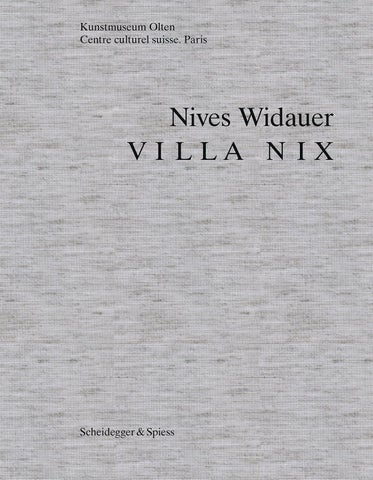
Dorothee Messmer, Claire Hoffmann, Katja Herlach VILLA NIX In the project Villa Nix by Nives Widauer, two institutions have taken a rather unusual approach. The Centre culturel suisse in Paris, under the curatorial lead of Claire Hoffmann, and the Kunstmuseum Olten, directed by Dorothee Messmer and Katja Herlach, decided to develop the projects they were each planning with the artist as a collaborative effort. Like the sections of this book, Nives Widauer’s two exhibitions in Paris and in Olten share close thematic and formal connections—and are, in fact, interdependent. Nives Widauer oriented both concepts around an imagined spatial dispositif, employing the Paris gallery and the seven rooms of the museum in Olten as the blueprint for a suite of imagined “living (quarters)” that begin with the Antichambre (or anteroom) in Paris and continue with Olten’s Villa Nix. Both the exhibitions and this catalog were planned jointly, and after the Parisian show closed, it moved in its entirety to Olten, where the works were integrated into the larger retrospective exhibition. The unusual curatorial arrangement fits with the artist’s practice: for many years, she has created series and sets of themes that, in her own words, “are each situated in inner spaces.” With its variety of “rooms” as well as the large entry hall dedi cated to the show from Paris, the Kunstmuseum Olten has made it possible to execute a long-envisioned exhibition concept. Having the “antechamber” in Paris as the overture or Act I of this project adds a special appeal for both the artist and the two institutions. “Nix,” Latin for snow, is an allusion to the artist’s first name Nives, which also means “snow” or “snow-white.” For years, this kind of wordplay with her first name has featured frequently in Widauer’s associative work and it holds special significance for the retrospective in Olten. This book, Villa Nix, which was likewise co-edited by the artist and the two institutions, occupies a central place in the 4
Studio, 2019
5
90
MeteoRita, 2017
91
Constellations, 2010 → pp. 91–94
90
MeteoRita, 2017
91
Constellations, 2010 → pp. 91–94
93
93
94
95
Moonstones, 2018 → pp. 95–98
94
95
Moonstones, 2018 → pp. 95–98
162
163
Body Talk, 2017–2019 ongoing → pp. 162–169
162
163
Body Talk, 2017–2019 ongoing → pp. 162–169
Déborah Laks L’exercice du sensible Les œuvres de Nives Widauer sont des points de rencontres. Le hasard des circonstances, des rencontres, des fonds de tiroirs et des souvenirs placent sur sa route des objets et des images dans lesquels, pour qui sait les écouter, des bribes d’histoires ré sonnent encore. Bien souvent, son travail consiste à d éfaire la gangue de banalité, de quotidien et de gestes normés cristallisée autour des objets par le temps de l’usage et de l’habitude. Elle cherche à atteindre ce qui, en eux, subsiste de particulier. Il s’agit de prêter attention, de suivre des pistes comme une véri table détective pour reconstituer des récits de vie, des biographies d’objets. Ceux-ci se racontent, tantôt au fil d’une estafilade sur le bois patiné d’un meuble, tantôt dans les mailles irrégulières d’un tricot; quelque chose apparaît dans le motif particulier d’un tapis, ou la forme d’une pierre, qui semble résumer une époque, un caractère, un usage. Ces traces ténues font signe, elles deviennent le lieu d’une confluence des temps et des sensibilités. Roland Barthes divisait le regard que l’on porte sur la photographie entre le studium, l’attention de l’étude, ce qui dans une image fait sens pour tous, apporte des informations objecti ves «mais sans acuité particulière», et le punctum, «ce hasard, qui en elle (la photo) me point (mais aussi me meurtrit, me poigne)».1 Nives Widauer crée véritablement une œuvre de punctum. Les objets et images qu’elle choisit et avec lesquels elle crée comme un dialogue possèdent cette force qui fait qu’un détail en eux vous saisit. Comme si ces supports recelaient une énergie, choisissaient de se signaler, ils se donnent à voir aux spectateurs comme ils se sont interposés sur la route de l’artiste. Dans cet échange avec les objets, Nives Widauer déchiffre parfois les histoires du bout des doigts, comme en braille sur les surfaces, les textures, le poids au creux de sa main. Son corps devient un outil de précision qui enregistre des détails avant même que l’idée ne lui vienne d’un usage, d’un récit ou d’une association. Si les objets parlent, c’est moins à l’esprit qu’à la main, moins à l’idée qu’au corps. Bien sûr leur voix est éraillée, les mots leur 172
Nothing is Like What the Memory of it Will Become, 2012
173
Exhibitions Nives Widauer. Antichambre Centre culturel suisse. Paris (5/18–7/21/2019) Concept Nives Widauer Curator of the exhibition Claire Hoffmann Direction Jean-Marc Diébold Production Celya Larré Installation Laetitia Favret, Guillaume van Roberge, Martin Lord Administration Dominique Martin, Thomas Weill Communication Léopoldine Turbat, Lola Besrest Visitor service assistants Rose Barberat, Geoffrey Peres, Lia Rochas-Paris, Tristan Savoy Centre culturel suisse. Paris 32–38 rue des Francs-Bourgeois, F-75003 Paris www.ccsparis.com Nives Widauer. V I L L A N I X Kunstmuseum Olten (9/21–11/17/2019) Concept Nives Widauer Curators of the exhibition Dorothee Messmer, Katja Herlach Assistance Stefanie Steinmann Installation Bianca Hildenbrand (lead), Pawel Ferus, Chris Hunter, Yolanda Ludwig, Marius Lüscher, Nico Müller, Sarina Scheidegger Administration Ines Henner Communication Katja Herlach Art education Yolanda Ludwig (lead), Chris Hunter, Marina Stawicki Visitor service assistants Fabienne Hoerni, Jeannine Hürzeler, Doris Kaufmann, Claudia Kissling, Maura Künzli, Angelika Zimmermann
Kunstmuseum Olten Kirchgasse 8, CH – 4600 Olten www.kunstmuseumolten.ch This project would not have been possible with out the help we received from many quarters. The editors and the artist wish to thank the following people by name: Rose Barberat, Wolfram Berger, Lola Besrest, Emmanuelle Brom, Alexander Chitsazan, Damian Christinger, Jean-Marc Diébold, Basil Fahrländer, Laetitia Favret, Lilly Felledy, Sabine Fellner, Pawel Ferus, Galerie W&K Wienerroither & Kohlbacher, Wien, Daniel Gebhart de Koekkoek, Ines Henner, Bianca Hildenbrand, Fabienna Hoerni, Jeanine Hürzeler, Chris Hunter, Roberta Keil, Claudia Klein, Susanna Koeberle, Thomas Kramer, Penelope Krumm, Maura Künzli, Déborah Laks, Celya Larré, Steven Lindberg, Martin Lord, Yolanda Ludwig, Marius Lüscher, Dominique Martin, Margot Montigny, Nico Müller, Eva Oberhuber, Geoffrey Peres, Rudi Rapf, Guillaume van Roberge, Lia Rochas-Paris, Tristan Savoy, Jake Schneider, Lina Schubert, Lisa Stachel, Marina Stawicki, Stefanie Steinmann, Emanuel Tschumi, Léopoldine Turbat, Johannes Wernicke, Monika Wirth, Thomas Weill, Sandro E. Zanzinger and Angelika Zimmermann. A special personal thank of the artist goes to her son, Florentin Berger, and her long-time gallerist and friend Irène Preiswerk.
We would also like to express our warm gratitude to the following institutions for their support:
Erna und Curt Burgauer Stiftung
192