ii
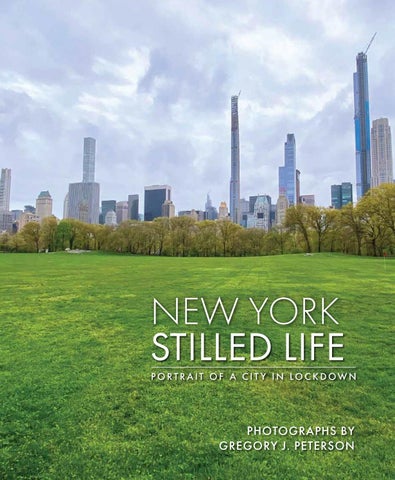
NEW YORK PORTRAIT OF A CIT Y IN LOC KDOWN
FOREWORD BY BARRY BERGDOLL
FOREWORD Empty Stages: A Short History of Urban Photography Absent People By Barry Bergdoll
Urban photography has always aimed to document both the architectural frame and the human actors that animate the city. But during the COVID-19 pandemic that swept over cities worldwide with little warning the actors suddenly vanished. How does an image captured through the lens of a camera come to be devoid of people? The answer has changed through time.
From photography’s invention, announced triumphantly in 1839, the speed of the
camera exposure time and the pace of metropolitan life were in a race with one another that resembled Aesop’s tortoise and hare. Louis Jacques Mandé Daguerre had managed on a spring morning in 1838 to record simply with light and a chemically treated plate the view outside the window of his studio on Paris’s Boulevard du Temple, arguably the first daguerreotype of a city scene. But the scene Daguerre captured was hauntingly empty of people, as though the city had come to a halt; the very culture of the boulevard that had given rise to the city stroller or flâneur and the boulevardier or dandy had somehow been evacuated from the very scene that announced a whole new technology of recording life with unprecedented realism and accuracy. That morning, traffic on the boulevard and its wide sidewalks—people, horses, and vehicles—disappeared from view even in a device that was dubbed “the pencil of nature” for recording precisely what the eye could see, seemingly without artistic interpretation. Yet the human retina could observe motion, while the early daguerreotype erased it from the transcript of time. Only a single blurred pair of figures—a shoe shine man and his lingering customer—is recorded in Daguerre’s view of the boulevard.
v
Even as late as the late 1860s, as Charles Garnier’s spectacular new Paris Opera House
was rising, the building’s official photographer, Louis-Emile Durandelle, would need to ask construction workers to stop what they were doing and pose long enough to be registered by his camera. In order to document labor then it was necessary to stop working. Photography had still not caught up with the speed of urban transformation, even though it was the camera that left us the most compelling record of rapid urbanization. By the late 1870s the tortoise seemed to be gaining ground as the photographer Eadwaerd Muybridge captured images of people and animals in motion, images that allowed understanding of movement in ways that surpassed the vision of the human retina. Fast forward a century and half and everyone is a photographer of sorts. It has been estimated that every second there are many more photographs taken by devices with lenses than were taken in the entire 19th century. The shutter speed on the newest model iPhones has reached 1/8000 of a second, or eight times as fast as Muybridge’s camera which captured a trotting horse with all four hooves in the air.
Architectural historians debate whether in photographing one should include passers-
by or wait for a moment when the scene is free of people who distract from the architectural subject matter and immediately—as do cars—put the date stamp of changing fashion on an image. Some are willing to run the risk of dating the image to gain human scale or a sense of lived experience. Today, all too sadly in terms of recent police brutality, anyone can pivot in a matter of seconds from talking on the phone or texting to capturing city life in all its speed, changeability, and danger. By the opening years of our century the tortoise had forever vanquished the hare.
Then, quite suddenly, in late winter 2020 the stakes of the race changed abruptly as the
urban stillness, given its out-of-town previews in Wuhan, China, arrived in New York City in time for the Ides of March. Overnight Broadway theaters went dark as Times Square emptied of tourists and commuters who generally shoulder their way through crowds day and night, giving rise to the native New Yorker’s famous oxymoronic advice that “nobody goes there, it’s too crowded.” Over the course of the second week of March, the city’s great museums, one after another, announced that they were closing in the next hours to reopen again when possible, and suddenly, indeed, nobody went there. Neighborhoods normally abuzz with stu-
vi
dents, from Columbia University’s Morningside Heights campus to New York University’s Washington Square Park, appeared like ghost towns as academic activities moved to the Zoom screen of computer or smart phone. Shares in on-line meeting software companies soared on Wall Street, even as the traders abandoned the famous trading floor of the New York Stock Exchange. The city appeared depopulated, as all but essential workers frantically, heroically confronting danger in hospitals, remained at home. Even shoeshine shops in the airport and subway concourses shut down. New York, like cities around the world, was as empty as the earliest photographic city portraits.
By early April 2020 Gregory Peterson determined to capture this historic moment of
as yet unknown duration. Avoiding contagion by riding his bike around the emptied streets of the boroughs of the city from the Upper West Side into the neighborhoods of Brooklyn and Queens, Peterson took vivid color photographs of an abandoned city; a modern-day Pompeii stilled not by the fiery ash-filled cataclysm of volcanic eruption but by the transmission of a deadly virus moving invisibly through the atmosphere. The air, although potentially charged with illness, was the image of health as that spring’s fine weather turned crystalline, the air cleansed of the pollution of cars, trucks, and airplanes. Peterson’s photographs record many facets of the city’s monumental architecture and engineering from the Brooklyn Bridge to the Metropolitan Museum of Art, from the newly completed glass and steel entrances of some of the city’s recently renovated subway stations to the late 19th century evocation of the ancient Roman forum in architect Charles McKim’s campus of Columbia University, to the soaring super-tall apartments of billionaire’s row along 57th Street, reputed to be largely empty even in the best of times. These are the spaces that have merited New York’s image as a crossroads of the world, even for those who have not yet joined the influx of tourists that made the city’s population swell on any given day many times beyond its population of over eight million. In the year before COVID-19 became a universally known acronym, the city greeted nearly 38 million tourists of whom approximately a third were international.
To witness, in Peterson’s photographs, the places on the tourist’s must-visit list devoid
of all but avian life provides a sensation at once surreal and familiar. Even a tourist agency wouldn’t be so brazen as to offer such pristine views of New York City to prospective tourists.
vii
Even an architect providing perspective views in drawing or computer imagery of a future project would not leave the rendering devoid of human figures. But here was a city seemingly stilled, even the great interior of Grand Central Terminal—sometimes called the city’s living room—and Times Square itself are captured devoid of people. In “normal” times no shutter speed can capture that in broad daylight.
The images are haunting, their rather insistent preference for wide-angle views broad-
ening the uncanny absence of activity, of human presence. We cannot decide if these images record a now lost chance of seeing some of the greatest architectural and landscape designs of New York’s history, from Central Park’s Bethesda Terrace to the Guggenheim Museum and the United Nations Secretariat, as though they were full scale architectural models held for extended contemplation without the distraction of the crowds and the traffic, or if they are somehow infused with the sense of troubling melancholy we have in visiting Pompeii or the remains of the great Roman cities in the North African desert. For anyone who was there in a city in which the population became invisible, the atmosphere was not one of the stillness here recorded. For just as Daguerre in 1838 was unable to record the people who were actually there on the boulevard that morning—he noted the time on the verso—Peterson gives us a visual archive in which the haunting sirens of ambulances and the daily ritual of banging pans from apartment windows at 7 p.m. to honor the front-line workers do not trouble the apparent stillness. Taken in a moment that seemed it might last an eternity, Peterson’s images are a captivating record of a historic threshold in the life of New York.
Barry Bergdoll is Meyer Schapiro Professor of Art History at Columbia University and the former chief curator in the Department of Architecture and Design at the Museum of Modern Art, New York. A specialist in the history of modern architecture, he curated numerous exhibitions at MoMA, the Canadian Centre for Architecture, the Musée d’Orsay, and other venues, including Mies in Berlin (2001), Bauhaus 1919–1933: Workshops for Modernity (2009–2010), Latin America in Construction: Architecture 1955–1980 (2015), and Frank Lloyd Wright at 150: Unpacking the Archive (2017). He is the author most recently of Marcel Breuer: Building Global Institutions (2017), and many other publications including Mastering McKim’s Plan: Columbia’s First Century on Morningside Heights (1997).
viii
PREFACE With this book I invite you to explore the extraordinary, arresting beauty of the City of New York as it appeared during the COVID-19 pandemic lockdown in 2020. Some may find it curious for a person to live through times of panic, desperation, boredom, struggle, heroism, and loss, and manage to focus on beauty. But being in the eye of the beholder, beauty is what I beheld, in all its surreal grandeur. This photo essay is meant to document and preserve the astonishing views I was fortunate to witness.
I am a native New Yorker and a corporate lawyer by profession. I was born in Har-
lem, and for my entire life I have lived within the city’s boroughs. From PS 148Q in Queens through Columbia Law School, all my education, work, and most of my recreational, political, religious, and personal involvements have taken place here. I have traversed the city streets daily for decades, passing by great monuments, magnificent parks and burgeoning boulevards, mostly preoccupied, distracted by the urban tumult, taking them for granted, without really seeing. Only on some rare, quiet occasions would I stop and gaze in awe.
In March of 2020, my two dear friends Håkan and Biljana came to town for a brief
visit. I had planned a party for them at my apartment, and the evening before, immediately after they landed, we got together to discuss their trip. They had traveled via Italy, a country that was then grappling with the beginnings of the pandemic and a severe national lockdown. Håkan and Biljana had just escaped in the nick of time. I was grateful they had landed and that our party could go on as planned. It did. My thirty-five guests that night were cheek to jowl in my two-bedroom apartment: drinking, eating, singing, hugging, kissing, breathing. No one had the slightest misgivings about our mutual closeness. Although alarms were being raised in news articles at the time, in general the pandemic to us was abstract and distant.
But over the next few days, the news became ominous. Calamities happening “over
there” suddenly were here, and New York became America’s number one coronavirus hot
ix
Photo by Visko Hatfield
x
spot. My office, an “open plan” space with dozens of workers sitting side by side and opposite each other at twenty-foot-long tables, was completely empty. No one would risk commuting to or working in such a space. I was undaunted, as I was able to ride in by bike. I wore gloves, and my dear friend Bettina hand-sewed a mask for me. I would be alone. There was a big bottle of hand sanitizer. I was fine.
Then word came in about my high school buddy, Jonathan. As a pulmonologist, he
was an easy mark for the virus, attending to unwitting COVID patients, well before COVID was known and understood. Jonathan had fallen gravely ill, and his family and friends prayed for his recovery. He was in intensive care for many days. No one expected his survival. Suddenly the pandemic became very real.
In the days and weeks that followed, we lived a life I had not seen, even in fiction. The
city shut down. Jonathan managed to survive, but there was no flour in the supermarkets, no rubbing alcohol, no bathroom tissue. No children in the playgrounds. No one on the bus. The city was stilled, its streets silent.
One evening I ventured out for a masked, socially distanced neighborhood walk. I
came upon Lincoln Center for the Performing Arts as twilight fell and saw its majestic plaza devoid of people. Shocking. How many hundreds and thousands of times had I been there? There was always someone on the plaza, a big crowd before a performance, a bevy of ballerinas off to rehearsal, tourists taking selfies, dog walkers, ticket scalpers, guards, always someone. Now, no one. It took me a moment to come to terms with what I was seeing; for its implications to sink in. Amidst all the disruption of the pandemic, here emerged a tranquil, elegant vista one might see only in a drawing.
This must be historic, I said to myself. I had to know if there were other city landmarks
revealed in this unthinkable denuded state. Surely I would have to rush down to Midtown and see what was happening there, really hurry before the chance evaporated.
The next day I took my bike down to Rockefeller Center, a place I’ve visited regularly
since childhood. I’ve skated many times in the sunken skating rink. I worked there for thirteen years. When I was a member of the NBC law department my 10th-floor office looked out
xi
directly over the star of the legendary annual Christmas tree. I’ve seen the plaza at all times of day and night and in every season of the year, but I never dreamt I would see it like this—at 6:00 p.m., normally the height of rush hour—deserted.
I took a few photos and shared my astonishment on Facebook. The next day I returned
to Lincoln Center and photographed the plaza at twilight. The photos gained a lot of attention. I followed up with pictures of the new Hudson Yards, of the American Museum of Natural History and neighboring Central Park. Facebook “friends” commented heavily. People started asking me to photograph specific locations, and I complied. Many had not seen such sights; indeed, many had no idea what was going on outside their own doors because for months after the onset of the lockdown they feared even to leave their apartments.
No people, no flags at the United Nations. Easter Sunday at the Cathedral Church of
Saint John the Divine—not a soul. I was immediately compelled to document these mesmerizing, surreal sights. Gradually, I realized from the reactions of others, that the photographs evoked a powerful response. Virtually each day that I posted a new image someone would suggest, or even insist that I sell the photos or produce a book. One person wrote: Without its people these photos reveal the city’s soul as a primeval place. You see the city’s landmarks in a whole new way, distilling the spirit of place and harking back to Eugene Atget’s indelible photos of 19th Century Paris. Another said, It is stunning to see landmarks that should be humming with people empty and silent. Yet, some of the buildings have an almost anthropomorphic quality for me as my mind imposes my own memories of these spaces on the pictures. I’m sure in the future though they would help me to recall this surreal time. Yet another said, Devoid of people, these views reveal a serene beauty most often obscured by the frenzy of our fast-paced lives. Over the following two months I ventured out every day to capture these views. Not feeling xii
safe to travel by car, taxi, bus, or subway, I reached all the locations on foot or by bicycle. I wore a mask, spoke to no one, and touched nothing other than my iPhone and my bike. I knew that from the time I left home on West 72nd Street until the time I returned I would not be able to eat or drink or find a restroom, as no restaurants, shops, or office buildings would be open or accessible, so most locations are in Manhattan, south of 125th Street and down to the Battery. Sometimes the photos practically took themselves when the sites were completely vacant and the weather and lighting were optimal. Other times I would have to make multiple trips and/ or wait for hours for the sun to come out or for a vehicle to move. Ultimately, I photographed more than 200 locations in well over 400 images. Here is a selection of my favorite views. Almost all are devoid of humans, although
there may be an occasional tiny individual in the background who went unnoticed until I had scoured the picture on my computer screen dozens of times. All photos were taken with my 12-megapixel iPhone 11 Pro. At no time was any person digitally removed, and absolutely nothing is staged. Notably absent are the Plaza Hotel, the Morgan Library, the Chrysler Building, and, most glaringly, the Flatiron Building. Unfortunately, these architectural gems were marred by scaffolding at the time, and I would not dishonor their dignity by shooting them in such a condition.
In this book the photos are arranged, loosely, as their subjects are located geograph-
ically, going from north to south almost as though you were taking a long walk or bike ride from Harlem to the southern tip of Manhattan.
By mid-June, the city had started to loosen its lockdown, businesses began to attract
more people back into the city, and I created a website to share the photos privately. But I continued to find new locations well over a year after I began.
Disturbingly, after the Memorial Day killing of George Floyd in Minneapolis, polit-
ical unrest broke out and business owners took to boarding up and sometimes barricading their buildings. This engendered yet another range of never-before-seen images. I shot many boarded-up locations (some of which include people as I found the boarding up to be sufficiently unusual in and of itself) which I include in a chapter entitled Plywood New York.
I have never aspired to a career in photography. But I have come to realize these imag-
es have a special emotional hold over viewers as they encapsulate this unique interlude. Some xiii
may see them as eerie; others may experience a pang of sadness at the thought of the weddings, graduations, memorials, and other life events that were foiled, the businesses closed, the financial losses, political strife, and personal tragedies of this era. But when I view these images of the monuments, the landmarks and touchstones of my existence, and I see them, truly see them, the backdrops of New York City life now center stage, I see my dearest friends, the city that has molded me, a montage of palpable memories and hopes for the future that only thrill my heart and make me love my city more.
xiv
—Gregory J. Peterson
2
Apollo Theater and West 125th Street May 2, 2020, 7:22 a.m.
3
Carnegie Hall May 14, 2020, 10:36 p.m.
66
67