≥
Das Museum und seine Ausstellungen schreiben weiter an einer famosen Erfolgsgeschichte. Der Blick einmal rund um die Welt zeigt im Fokus eine immer weiter steigende Zahl von herausragenden Präsentationen mit vielfältigen Themen, Inhalten und wegweisenden Gestaltungen. Und wichtiger denn je: „Exhibitions“ sind verlässliche Orte für demokratisierende Wirkungen. „Das Museum der Zukunft ist kein Museum mehr“, streamte das ZKM in Karlsruhe aus der Nachdenklichkeit, die eine Funktionsüberprüfung des Formates Museum notwendig gemacht hat: „Bereits seit einigen Jahren werden Rufe nach einer Erneuerung des Museums laut. Spätestens die Corona-Pandemie führte uns jedoch schlagartig vor Augen, dass das bis dato physisch gedachte Museum allein nicht mehr existieren kann. […] Mit Gewalt wurden wir in das digitale Zeitalter geschoben, keine Produktionsund Rezeptionsformen werden nun davon unberührt bleiben. Der Auszug respektive die Erweiterung der Kultur in den virtuellen Raum ist unausweichlich und irreversibel.“ 1 Die Definition des Museums wurde angepasst, als Ort der Kommunikation, Integration und Wissensvermittlung, „das Museum ist ein Ort der Permanenten Konferenz“ 2 (Joseph Beuys), und den von Alexander Dorner bereits 1949 formulierten Begriff des „sozialen Kraftwerks“. „Nicht eine Versammlung von Objekten als vielmehr von Menschen – als eine Assembly – muss das Museum im 21. Jahrhundert gedacht werden. […] Das Museum der Zukunft muss ganzheitlich gedacht werden: als ein intelligenter Hybrid aus Analogem und Digitalem muss es, im Sinne des Bildungsauftrags, so viele Türen wie möglich zu einer kritischen Auseinandersetzung mit der gesellschaftlichen Entwicklung öffnen. […] Es muss den Spagat zwischen dem physischen und dem virtuellen Raum schaffen, um das Publikum des 21. Jahrhunderts zu erreichen.“ 3 Museum Space, Architektur und Museologie: Das Museum ist eine Art von Gebäude und Raum. Mit Displays als Präsentation im Raum. Das Museum ist ein organisierter Raum. Raum verbessert sozusagen Objekte und Objekte verbessern den Raum. Das Museum als „Stadt“ und als „Maschine“. Spezielle Informationen werden vermittelt und verschiedene Ebenen geben verschiedene Erfahrungen. 4 Dass das Museum eine Identitätsfabrik (Gottfried Korff) und „eine Schule des Befremdens“ (Peter Sloterdijk) sein kann, zeigt sich durch seine Verfasstheit als „Bedeutungsbeschleuniger“ (Matthias Henkel). Im ICOM tobte 2020 schon heftiger Streit um die grundlegende Verfasstheit. Der erste Satz der neuen Definition: „Museen sind demokratisierende, inklusive und polyphone Räume für kritischen Dialog über die Vergangenheiten und die Zukünfte.“ Ziel des Museums sei: „zur Menschenwürde und sozialen Gerechtigkeit, zur globalen Gleichheit und zum Wohl des Planeten beizutragen“. Damit sind dann wohl museale Gegenerzählungen und gegenwartsbezogene Diskursräume gemeint. Historisch vorbereitet hat sich unsere Buchreihe „New Exhibition Design“ mit Richard P. Lohse, der auch den Titel „Neue Ausstellungsgestaltung“ gesetzt hat. Lohse selbst hat sich auf den Band „Exhibition Design“ von Misha Black von 1950 bezogen. Nach diesen Vorbildern hat Klaus Frank seinen Band „Exhibitions. A Survey of International Designs“ 1961 in den USA publiziert. 5 Misha Black hat seine Aufsatzsammlung programmatisch geordnet: Exhibition Design, Constructional Methods and Materials,
Museums and their exhibitions continue their amazing success story. A journey around the world focusing on these two formats reveals an ever-growing number of outstanding presentations covering a whole range of topics, content and ground-breaking designs. And more important than ever: “Exhibitions” are reliable places for effects of democratisation. Deliberating on the format museum, the ZKM in Karlsruhe announced, “The museum of the future is no longer a museum”, triggering a reassessment of its function and nature: “For some years, there has been a growing call for a renewal of the museum. However, it took the coronavirus pandemic to abruptly make it plain once and for all that the museum as a purely physical concept can no longer exist on its own […] We have been shoved with force into the digital age; no forms of production and reception will be left untouched. The move or extension of culture into the virtual space is inevitable and irreversible.” 1 The modified definition of the museum sees it as a place of communication, integration and the mediation of knowledge, “the museum is a place of permanent conference” 2 (Joseph Beuys) and a “social powerhouse” to use the term coined by Alexander Dorner as early as 1949. “The museum in the 21st century must be conceived as an ‘assembly’ of people, not a collection of objects. […] The museum of the future must have a holistic concept: as an intelligent hybrid of analogue and digital, it is bound by the educational mandate to open as many doors as possible to enter into a critical discourse with the development of society. […] It must manage the balancing act between physical and virtual space if it wants to reach the public of the 21st century.” 3 Museum space, architecture and museology: the museum is a kind of building and space. With displays as spatial presentation. The museum is an organised space. Space, as it were, improves objects and objects improve the space. The museum as “city” and as “machine”. Special information is conveyed, and different levels afford different experiences. 4 That the museum can be an identity factory (Gottfried Korff) and “a school of disconcertment” (Peter Sloterdijk) is evident in its function as “meaning accelerator” (Matthias Henkel). In the ICOM, a heated debate has been raging in 2020 about the fundamental function and nature of museums. The first sentence of the new definition: “Museums are democratising, inclusive and polyphone spaces for critical dialogue about the past and future.” It goes on to state that the objective of the museum was: “to contribute to human dignity and social justice, to global equality and to the wellbeing of the planet”. Presumably this refers to counternarratives of the museums as places for discourse in the here and now. Historically our series “New Exhibition Design” was prepared by Richard P. Lohse, who also chose the title “Neue Ausstellungsgestaltung”. Lohse was in turn referencing the volume “Exhibition Design” by Misha Black from 1950. Modelled on these works, Klaus Frank published his book “Exhibitions. A Survey of International Designs” in the USA in 1961. 5 Misha Black ordered his collection of essays programmatically: Exhibition Design, Constructional Methods and Materials, Travelling Exhibitions, Exhibition Scripts, Models and Display Devices, Sound, Exhibition Lighting, Planting, Mural Decoration and Sculpture, ≥
Vorwort Preface
P⁄ 003
Travelling Exhibitions, Exhibition Scripts, Models and Display Devices, Sound, Exhibition Lighting, Planting, Mural Decoration and Sculpture, Administration, Typography, Lettering and Photographs. Ein geradezu aktuelles Programm. Einzig „Planting“ überrascht in dieser Reihe auf den ersten Blick, blendet man aber aktuelle Beispiele gegen, dann zeigt sich, wie botanische Gestaltungselemente in die Szenografie kommen („Biodesign“). Ein Museum nur für mich: Ständig erscheinen neue Bücher zur Szenografie. Dabei wird auch weiter auf das Sammeln als anthropologische Konstante referiert. Und Bücher für Kinder haben das Feld entdeckt: „Alle sagen, dass mir Museen sicher gefallen werden“, sagt das kleine Mädchen in „Ein Museum nur für mich“ von Emma Lewis. „Kubbes Museum“, erzählt und illustriert von Åshild Kanstad Johnsen, zeigt ganz präzise, was die Museumstheorie herausbekommen hat. „Wie kommt die Kunst ins Museum“ oder „My Collection of Collections“ von Nina Chakrabarti erklären das Prinzip des Sammelns und wie ein Museum funktioniert sehr gut: bis zu „Wie die Ausstellung vorbereitet wird“ und „Wie die Ausstellung aufgebaut wird“. „The Museum is not Enough”, die erste Ausgabe eines großformatigen, wunderbar gestalteten Magazins, sozusagen eine Compilation von Fragen, Gedanken und Bildern zur Identität und Funktion des Museums, schickte gerade das CCA, das Canadian Centre for Architecture aus der Krisenzeit herüber: „I really think that in our world being a museum is not enough“. Das Inhaltsverzeichnis setzt auch hier Grundlegendes, das Museum, das Zentrum spricht zu uns: “Hello, this is me – I look for grey areas – I seek content in display – And I keep revisiting archives. This is me, online – Education worries me – And I am wary of the present – So I need a plan – Or I could reinvent myself. […] Topics addressed in this volume include the institution’s engagement with the present, the significance of the archive as a site for the production of new ideas, display strategies in architecture exhibitions, the need for mediation in art, and the impact of the digital in current museum practices.” 6 “Some people might claim that the museum still has an educational purpose, but today it is maybe also (or even mainly) a social space, somewhere to enjoy yourself. Doctors have recently started prescribing a visit to a museum as a kind of active medicine to fight stress or depression. […] What I am for is questioning what is going on around me – and uncovering alternatives. I try to act as a frame for making sense of, anticipating, and projecting on the world.” 7 Nicht umsonst ist in unserer Beispielauswahl auch das „Museum of Capitalism“ aufgefallen. Nicht zu vergessen, dass „Ausstellung“ im neuen Sinne, aus einer Situation der Präsentation von „Warenkabinetten“ heraus, entstanden ist oder aus der Machtpräsentation von Wunderkammern. Also direkt aus der „Sphäre des Wettbewerbs“ 8. Was findet sich beim Rundblick auf das Panorama der Ausstellungen: Es gibt mehr Ausstellungen, mehr Budgets, mehr Aufwand für Konzeption und Gestaltung, es gibt wundervolle Objekte und faszinierende szenografische Präsentationen, aufwendige Kataloge und famose Gestaltungen. Es wird nach wie vor heftig und unerschrocken zitiert bei den alten Gestaltungen und den alten Meistern. Neue Ideen und Medien kommen dazu. Die
P⁄ 004
Administration, Typography, Lettering and Photographs. A programme that has lost none of its currency. The only term in this series which might jar at first glance is “Planting”; but a look at some current examples shows how botanical design elements are entering scenography (biodesign). The museum of me: a growing corpus of books about scenography are being published. They continue, however, to refer to collecting as an anthropological constant. And even children’s books have discovered the field: “Everyone is sure that I will like museums”, says the child in “The Museum of Me” by Emma Lewis. “Kubbes Museum”, told and illustrated by Åshild Kanstad Johnsen, shows very precisely what museum theory has found out. The books “Wie kommt die Kunst ins Museum” (how does art get into a museum—not available in English) or “My Collection of Collections” by Nina Chakrabarti explain very well the principle of collecting and how a museum works: “How the exhibition is prepared” and “How the exhibition is built”. “The Museum is not Enough”, a first edition of a large, wonderfully designed magazine, as it were a compilation of questions, ideas and images on the identity and function of the museum, was issued by the CCA (Canadian Centre for Architecture) at the height of the crisis: “I really think that in our world being a museum is not enough”. 5 The table of contents spells out some fundamental truths, the museum, the centre speaks to us: “Hello, this is me—I look for grey areas—I seek content in display—and I keep revisiting archives, this is me, online—education worries me—And I’m wary of the present—So I need a plan—Or I could reinvent myself. […] Topics addressed in this volume include the institution’s engagement with the present, the significance of the archive as a site for the production of new ideas, display strategies in architecture exhibitions, the need for mediation in art, and the impact of the digital in current museum practices.” 6 “Some people might claim that the museum still has an educational purpose, but today it is maybe also (or even mainly) a social space, somewhere to enjoy yourself. Doctors have recently started prescribing a visit to a museum as a kind of active medicine to fight stress or depression. […] What I am for is questioning what is going on around me – and uncovering alternatives. I try to act as a frame for making sense of, anticipating, and projecting on the world.” 7 It was not without reason that our choice of examples includes the “Museum of Capitalism”. Not to forget that “exhibition”, in the new sense of the word, stems from the “cabinets of goods” or from the display of power in the “Wunderkammer”, i.e. directly from the “sphere of competition” 8. What does a panoramic view of exhibitions reveal: there are more exhibitions, more budgets, more effort going into conception and design, there are wonderful objects and fascinating scenographic presentations, elaborate catalogues and splendid designs. They still quote heavily and unabashedly from old designs and the old masters, but also add new ideas and media. The imagery has become more complex. There are exhibitions about exhibiting, “from the ‘Wunderkammer’ to the curatorial situation”. There are no longer permanent exhibitions in the conventional sense. Walk-in collections of objects on display no longer seem to be the ultima ratio; rather the archive, the collection and the
Bildwelten werden komplexer. Man macht Ausstellungen über das Ausstellen, „von der Wunderkammer zur kuratorischen Situation“. Die Dauerausstellung gibt es so nicht mehr. Begehbare Schausammlungen scheinen nicht mehr ultima ratio zu sein, das Archiv, die Sammlung und die Ausstellung mit allem, was die Einrichtung Museum dazu bieten kann, werden zu mehr hybriden Räumen. Die Wunderkammer bleibt ein schönes Bild, löst aber das Problem nicht, auch wenn sie oft sehr schön aussieht. Der Text bleibt der nachhallende Erfolg, die Poesie der Narration wird stärker. Schon im Jahr 2000 war klar, wie die Veränderungsprozesse von konzeptionellem Zugang und Szenografie weitergehen würden: vom Objekt zur Erfahrung, Museum und Funktionen in Strukturen und Gesellschaft, Transzendieren und Dekonstruieren von Objekten und Dingen, Museumserfahrung und das „Real Thing“, Ethische Grundlagen im Museum: „The Good Life of the Public Servant“, das Museum als „permanente Konferenz“ und Bildungsinstrument zur Fortschreibung der Aufklärung („The Museum in Transition“ 9 ). Stichworte für die Situation und die Diskurse und die Themenfelder sind: immersiv, partizipativ und inklusiv. Die Ordnung der Dinge im digitalen Kontext, Transmediales Storytelling und Anschlusssuche nach der Digitalisierung. „Die Macht der Dinge. Zur Beharrlichkeit musealer Ordnungen“ (Friedrich von Bose) in Enzyklopädischen Situationen. Präsenz und Ereignis in der Dramaturgie der Parcours. Demokratisierung des Museums als Ort des bürgerschaftlichen Engagements und der Erkenntnis. Aufarbeitung von Kolonialismus, Rassismus und sozialer Ungerechtigkeit. Kulturelles Gedächtnis und Aneignung von Vergangenheit im Anthropozän. Migration und Überbevölkerung als zentrale Fragen zu einem Leitbild für die „Zukunft der Erdbewohner“ (Marc Augé). Ökologische Verantwortung und Nachhaltigkeit. Bildung im lebenslangen Lernen. Neurowissenschaftliche Erkenntnisse und die Frage nach der Vermittlung von wissenschaftlichen Erkenntnissen in einer Zeit von Bullshit-Kommunikationen. Weiterhin aber auch die Faszination von Aura und die „Sprache der Dinge – Museumsobjekte zwischen Zeichen und Erscheinung“ (Thomas Thiemeyer). 10 Das Kolumba, das Kunstmuseum des Erzbistums Köln, reagierte fein auf die Folgen eines pandemiebedingten Schließens, als sich die Ausstellungen wörtlich „fassungslos“ befanden: „Wir sind fassungslos, weil Rahmenbedingungen fehlen, die uns Halt geben, unsere Freiheit garantieren, uns orientieren, planen und handeln lassen. […] Doch was macht ein Museum, wenn es geschlossen ist? […] Sie zwingen uns, nach innen zu gehen – zur Sammlung.“ 11 Der Verlust von echter Nachdenklichkeit im konkreten Moment und ohne direkte Präsenz hat erhebliche Folgen. Über den realen Ort nur bindet sich die reale Gegenwart und deren Wirkmächtigkeit an die Zeit: „Dazu zählen alle Details, die das Besondere der Atmosphäre, der Räume, der Ausstellungen und Veranstaltungen ausmachen“, eben auch die Intimität einer realen persönlichen Anwesenheit. Nun bezieht sich der Begriff Museum immer auf zweierlei: auf den inszenierten Raum, dessen Erlebnisqualität durch nichts zu ersetzen ist, und auf die Sammlung, das Depot als Ressource der faszinierenden Objekte, geführt von einer narrativen Erläuterung über die Sprache.
exhibition combined with everything that the museum as institution has to offer create more hybrid spaces. The “Wunderkammer” remains a pretty picture but does not solve the problem (although they often still look very beautiful). The text remains the echoing success, the poetry of the narration is getting stronger. Even back in the year 2000 it was obvious how the change process of conceptional access and scenography would evolve: from the object to experience, museum and functions in structures and society, the transcending and deconstruction of objects and things, museum experience and the “real thing”, ethical principles in the museum “The Good Life of the Public Servant”, the museum as “permanent conference” and educational instrument to continue the enlightenment and (“The Museum in Transition” 9). Keywords that describe the situation, the discourses and the themes: immersive, participatory and inclusive. The arrangement in the digital context, transmedia storytelling and the search for what comes after the digitalisation. “The power of things. The tenacity of museum arrangements” (Friedrich von Bose) in encyclopaedic situations. Presence and theme in the dramaturgy of the routing. Democratisation of the museum as place of social responsibility and perception. Reappraisal of colonialism, racism and social injustice. Cultural commemoration and the acquirement of the past in the Anthropocene. Migration and overpopulation as central questions for the model of the “future of the earthlings” (Marc Augé). Ecological responsibility and sustainability. Education in life-long learning. Neuroscientific insights and the question of how to convey scientific information in a time of “bullshit communications”. But at the same time a continuing fascination with aura and the “language of things—museum artefacts between sign and appearance” (Thomas Thiemeyer). 10 The Kolumba, the art museum of the archbishopric of Cologne, reacted sensitively to the consequences of the closure because of the pandemic as the exhibitions lost their framework. “We are lost because the framework that gives us stability, guarantees our liberty, allows us to navigate, plan and act is missing. […] But what does a museum do if it is closed? […] We are forced to look inward—at the collection.” 11 This results in a loss of reflectiveness, of the moment of physical presence which is tied to time through the real place and its powerful effect: “This includes all the details which make the atmosphere, the rooms, the exhibitions and events so special”, but also the intimacy of a real personal presence. Now, the term museum also refers to two things: to the staged space whose quality of experience cannot be replaced, and to the collection, the depository as resource of fascinating objects, guided by a narrative explanation using language. Further horizons for reflection include: Who is actually doing the curating? And who is democratically involved? Development of a semantic of the exhibition and a grammar of design and scenography. A proactive response to the dynamic development and acceleration. Dissolving existing usage and establishing new didactical strategies. Creation of educational sense and meaning. “Wherever does the superstition come from that truth can itself break new ground?” (Ernst Bloch) Passionate quest for the aura of things. Stronger sustainability and responsibility of the privilege Vorwort Preface
P⁄ 005
Horizonte des Nachdenken sind weiterhin: Wer kuratiert eigentlich? Und wer ist demokratisch beteiligt? Entwicklung einer Semantik der Ausstellung und einer Grammatik der Gestaltung und Szenografie. Aktive Reaktion auf die Dynamisierung und Beschleunigung. Aufbrechen bestehender Deutungsgewohnheiten und Etablierung neuer pädagogischer Strategien. Herstellung von aufklärerischem Sinn und Bedeutung. „Woher stammt nur der Aberglaube, dass die Wahrheit sich selber Bahn breche?“ (Ernst Bloch) Leidenschaftliche Suche nach der Aura der Dinge. Stärkere Nachhaltigkeit und Verantwortung des Privilegs kultureller und künstlerischer Arbeit. “Mmuseumm is a style of storytelling about the modern world. It is object-based journalism. It is a new type of museum, expanding in a network of expected and unexpected locations, dedicated to exploring modern humanity and current events through revealing objects from around the world. […] This is an exploration of the language of museums,” sagt Alex Kalman trefflich. „Museen pendeln zwischen Geschichte und Zukunft, müssen das eine darstellen, um das andere adressieren zu können. Aus dieser grundsätzlichen Dichotomie ergeben sich weitere Gegensätze, denen das Museum nicht entkommen kann: das Meisterwerk und der Alltagsgegenstand, die auf Dauer angelegte und die temporäre Präsentation, die kanonisierende und die aktualisierende Darstellung, das singuläre Objekt und seine kontextbezogene Einbettung, ein Ort der Einmaligkeit und ein Medium der Information, Forschen und Präsentieren, Bewerben und Belehren, Original und Kopie […].“ 12 Die Aufgabe des Museums: das Überlieferte mit dem Bewusstsein der Gegenwart zu lesen und für Besucher wieder lesbar zu machen. Das Internet ist vielleicht sozusagen die neue, zukünftige Vitrine des Wissens. Das Museum kann diese Vitrine weiter kritisch bespielen. Neue Technologien bedeuten ja nicht unbedingt eine andere Form des miteinander Sprechens oder Erklärens oder Aufklärens. Welche gesellschaftlichen Entwicklungen führen zu welchen Veränderungen von Wahrnehmung und Vermittlung? Projektionen, digitale Bilderatlanten, Animationen und all diese Dinge sind ja strukturell und sogar ästhetisch wie die Tafeln oder Displays alter Zeit, nur eben „technisch“ interpretiert, bespielt und ausgeführt. Der Umgang mit Kultur und kultureller Praxis schafft Symbole, Darstellungen, Kommunikationsobjekte, die Aspekte der Wirklichkeit verdeutlichen, sozial handhabbar, kommunizierbar machen. Kulturobjekte sind Anlass für Bewusstseinsprozesse, Denkanstöße, sie sind Gegenstand von Erinnerungen, Zukunftsentwürfen, Interpretationen von Wirklichkeit. Kultur in den unterschiedlichsten Ausprägungen hat dabei immer auch eine soziale Dimension. Jede Realisation der Zwischenmenschlichkeit ist kulturell modifiziert. In allen Stufen des Soziallebens baut der Mensch seine eigene, kulturelle Welt. Lernen und pädagogisches Handeln knüpft an kulturelle Praxis und ästhetische Aktivität, also an das Machen, den eigenen Umgang mit Gestaltung, mit Materialien, mit der Umwelt, mit Beziehungen, Symbolen etc. an. In den Materialien, der Umwelt, den Beziehungen, den Symbolen etc. des Menschen spiegeln sich Interessen, Artikulation und Identität wider. Wo stehen die Ausstellung und das Museum bei der Weiterentwicklung einer demokratischen Gesellschaft mit
P⁄ 006
of cultural and artistic work. “Mmuseumm is a style of storytelling about the modern world. It is object-based journalism. It is a new type of museum, expanding in a network of expected and unexpected locations, dedicated to exploring modern humanity and current events through revealing objects from around the world. […] This is an exploration of the language of museums,” as Alex Kalman succinctly puts it. “Museums oscillate between history and future, have to present one in order to be able to address the other. This fundamental dichotomy gives rise to further opposites, which the museum cannot avoid: the masterpiece and the everyday utensil, a presentation designed to be permanent and a temporary one, the canonising and the updating presentation, the singular object and its contextual integration, a place of uniqueness and a medium of information, research and presenting, promoting and teaching, original and copy […].” 12 The task of the museum: to read what has been handed down with the consciousness of today and to help the visitor understand it again. The internet is maybe the new, future showcase of knowledge. The museum can continue to fill this showcase with critical content. After all, new technologies do not necessarily require another form of communication or explaining or teaching. What social trends lead to what changes in perception and mediation? Projections, digital picture books, animations and all these things are structurally and even aesthetically like the info boards or displays of the old days, just “technically” interpreted, presented and executed. Dealing with culture and cultural practice creates symbols, presentations, communication objects which illustrate aspects of reality, making it socially manageable and communicable. Cultural objects give rise to consciousness processes, provide food for thought, they are the object of memories, future designs, interpretations of reality. Culture in all its different facets always has a social dimension. Every realisation of human relationships is culturally modified. In all stages of social life, humans create their own cultural world. Learning and teaching build on cultural practice and aesthetic activity; making things, the way one handles design, the environment, relationships, symbols, etc. reflect interests, articulation and identity. Where does the exhibition and the museum stand as regards the further development of a democratic and socially just society? How does the museum help to convey and improve intercultural aspects of realities of life? The museum and its exhibitions are the marketplace for the condensed knowledge of humankind and the material of enlightenment. In uncertain times, responsible action for democracy and conscious living will presumably have to be relearned as competence and education. We must not allow the exceptional situation to question all qualities that have been acquired. The technologies have not changed in 2020. The critical questions in connection with digitalisation regarding the safeguarding of democratic processes, data protection, governance, regulation and consequences of the change for mankind are just as relevant. The pandemic calls for redesign, the boundaries of growth have long been reached, “Spaceship Earth is shaking” (Buckminster Fuller). Peter Friedrich Stephan and Raz Godelnik have formulated a pre-manifest: “What climate crisis? Where are the designers? What can designers learn?
sozialer Gerechtigkeit? Bei der Entwicklung und Ausbildung persönlicher Äußerungs- und Ausdrucksfähigkeit? Einer differenzierten Wahrnehmungs- und Interpretationsfähigkeit, die Urteilskraft und Kritikfähigkeit sowie divergentes Denken und kreative Problemlösefähigkeiten stärkt? Wie hilft das Museum, interkulturelle Aspekte von Lebenswirklichkeiten zu vermitteln und zu verbessern? Das Museum und seine Ausstellungen sind der Marktplatz des kondensierten Wissens der Menschheit und Stoff der Aufklärung. Vermutlich wird verantwortliches Handeln für die Demokratie und bewusstes Leben unter Unbestimmtheit neu zu erlernen sein als Kompetenz und Bildung. Die Ausnahmesituation darf nicht alle erworbenen Qualitäten infrage stellen. Die Technologien haben sich 2020 nicht verändert. Die kritischen Fragen an eine sogenannte Digitalisierung bezüglich Sicherung demokratischer Prozesse, Datenschutz, Governance, Regulierung und Folgen der Veränderungen für die Menschen sind aktuell. Die Pandemie fragt nach einem Redesign, die Grenzen des Wachstums sind längst erreicht, „Spaceship Earth is shaking“ (Buckminster Fuller). Peter Friedrich Stephan und Raz Godelnik haben dazu ein Pre-Manifest verfasst: “What climate crisis? Where are the designers? What can designers learn? The power of design and systems-level change. Permanent crises. Decolonize Design. Systems-level change for design.” 13 Deshalb darf man weiter die Ausstellung verhandeln (Luise Reitstätter) und Museen umprogrammieren (Nora Sternfeld). Spürbares kann in der Ausstellung in Sichtbares verwandelt werden. Dass das Format Museum eine Beharrungskraft hat, kann auch von Vorteil sein, wenn Gestaltung als Wissenserzeugerin gesehen wird. In einer Zeit des Zeigens leistet die Ausstellung transdisziplinäre Wissensproduktion. „Das Vergessen-Wollen verlängert das Exil, und das Geheimnis der Erlösung heißt Erinnerung“, hat der ehemalige Bundespräsident Richard von Weizsäcker in seiner Rede zum Gedenken an das Ende des Krieges gesagt. Ein Angebot aus der Mitte der Gesellschaft mit der Chance auf Selbstvergewisserung und jenseits der Geschichte zu poetischer Weltentdeckung. Ein alarmierender Paradigmenwechsel für das Museum steht nicht an, alles, was analysiert und gesagt werden musste, ist offenbar lange schon Konsens – jetzt gilt es, das Wissen und Handwerkszeug neu anzuwenden. Die Folie für die großen Weltentwürfe und die kleinen Wirkungen liegt hier. Immersive und effektive Wissensräume sind sozusagen in der Inszenierung gemischter Realität denkbar. Das Museum kann für Menschen Räume schaffen, in denen sie sich selbst finden können. Und zwar im ganz konkreten, realen Sinne, wie auch als transzendente Erfahrung.
The power of design and systems-level change. Permanent crises. Decolonise design. Systems-level change for design.” 13 That is why exhibitions can still be negotiated (Luise Reitstätter) and museums can still be reprogrammed (Nora Sternfeld). The perceptible can be transformed by an exhibition into the visible. The staying power of the format museum can also be an advantage when design is seen as a generator of knowledge. In a time in which “showing” is important, the exhibition contributes transdisciplinary knowledge production. “The desire to forget prolongs the exile, and the secret of release is remembrance” is how former German president Richard von Weizsäcker commemorated the end of the war in his speech. An offer from the middle of society with the chance of personal affirmation and beyond the narrative of the poetic discovery of the world. An alarming paradigm change is not on the cards for the museum; there has evidently been a consensus on everything that had to be analysed and said for quite a while—it is now time to use the knowledge and tools in new ways. The blueprints for the world at large and the small effects are at our disposal. Immersive and effective knowledge spaces are quite possible in the staging of mixed reality. The museum can create spaces for people in which they can find themselves. Both in a very concrete, real sense, and as a transcendental experience.
1 Impulskonferenz „Das Museum der Zukunft ist kein Museum mehr“. Karlsruhe: ZKM, 3.7.2020. 2 Joseph Beuys: Das Museum – ein Ort der permanenten Konferenz, in: Notizbuch 3. Kunst. Gesellschaft. Museum. Hrsg. von Horst Kurnitzky. Berlin: Medusa, 1980, p. 56. 3 Impulskonferenz „Das Museum der Zukunft ist kein Museum mehr“. Karlsruhe: ZKM, 3.7.2020. 4 Kali Tzortzi: Museum Space. Where Architecture Meets Museology. London⁄NYC: Routledge, 2015. 5 Misha Black: Exhibition Design. London: The Architectural Press, 1950. Siehe auch: Richard P. Lohse: Neue Ausstellungsgestaltung. Zürich: Verlag für Architektur, 1953. – Klaus Frank: Exhibitions. A Survey of International Designs. New York: Frederick A. Praeger, 1961. 6 The Museum is Not Enough. Hrsg. von CCA mit Giovanna Borasi, Albert Ferré, Francesco Garutti, Jayne Kelley, Mirki Zardini. Montreal⁄Berlin: CCA, Sternberg Press, 2019. 7 Ibid. 8 Anke te Heesen: Theorien des Museums. Hamburg: Junius, 2012. pp. 189–191. 9 Hilde S. Hein: The Museum in Transition. A Philosophical Perspective. Washington, D.C.: Smithsonian, 2000. 10 wissen-und-museum.de am 1.8.2020. 11 kolumba.de am 1.8.2020. 12 Anke te Heesen: Theorien des Museums. Hamburg: Junius, 2012. pp. 189–191. 13 medium.com⁄@razgo⁄corona-redesign-a-pre-manifesto-e59506a24950 am 1.8.2020.
Vorwort Preface
P⁄ 007
Guus Beumer. Fashion Curating—Critical Practice in the Museum and Beyond. Interview
Guus Beumer, who studied social sciences, has been director of Het Nieuwe Instituut, the national institute for architecture, design and digital culture in the Netherlands, since January 2013. In the 1980s Beumer was a journalist for publications including Avenue, Marie-Claire and HP-De Tijd and in the 1990s he was art director of the fashion labels orson + bodil and SO. From 2005 he was director of Marres, House for Contemporary Culture and Bureau Europa⁄NAiM, both in Maastricht. Beumer is currently based in Rotterdam and is known as a prolific exhibitionmaker and a regular writer about design.
Guus Beumer. © Photo Blommers and Schumm
Guus Beumer, studierter Sozialwissenschaftler, ist seit Januar 2013 Direktor des Het Nieuwe Instituut, Landesinstitut für Architektur, Design und digitale Kultur in den Niederlanden. In den 1980er-Jahren arbeitete Beumer als Journalist für Publikationen wie Avenue, Marie-Claire und HP-De Tijd, und in den 1990er-Jahren als Artdirector bei den Fashion Labels orson + bodil und SO. Ab 2005 war er Direktor von Marres, House for Contemporary Culture und Bureau Europa⁄NAiM, beide in Maastricht. Zurzeit lebt Beumer in Rotterdam und hat sich dort als Ausstellungsgestalter sowie durch regelmäßige Publikationen zum Thema Design einen Namen gemacht.
P⁄ 008
Fashion Curating—Critical Practice in the Museum and Beyond.
P⁄ 277
≥ Petersburger Hängung neu interpretiert⁄Petersburg hanging reinterpreted
P⁄ 278
Dauerausstellung, Museum Permanent Exhibition, Museum
1
1 2
Eintauchen in die vielschichtige Objektwelt⁄Deep dive into the multilayered world of the artefacts Multiperspektivität als Gestaltungsmittel⁄Different perspectives as design tool
2 Krone. Macht. Geschichte. Nürnberg auf einen Blick.
P⁄ 279
Fastnacht der Hölle. Der Erste Weltkrieg und die Sinne. jangled nerves
Dates 2014 — 2015
Realisation Eicher Werkstätten, KeBau
„Fastnacht der Hölle“ – so beschrieb der Offizier und Schriftsteller Ernst Jünger den Ersten Weltkrieg 1916 in seinen Kriegstagebüchern. Dieses Bild aufgreifend, rückt die Ausstellung das unmittelbare Empfinden der Menschen, ihre Erfahrungen und Wahrnehmungen, während dieses ersten industrialisierten, globalen Kriegs in den Mittelpunkt. Fünf Sinnesstationen bilden den Auftakt zur Ausstellung und simulieren anhand von Proben spezifische Sinneseindrücke: wie dieser Krieg schmeckte, wie er roch, sich anfühlte, aussah und klang. Das Zentrum der Ausstellung besteht aus drei Großvitrinen, in denen authentische, persönliche Exponate des Ersten Weltkriegs nach ihren Schauplätzen verortet sind: Front, Etappe und Heimat. Über den mehr als 400 Objekten erscheinen die in Briefen und Tagebüchern festgehaltenen Erfahrungsberichte der Betroffenen als ephemere und schwerelose Einspiegelungen. Ein Kalender, der vom ersten bis zum letzten Kriegstag reicht, fasst den in gedämpftes Licht getauchten Raum als chronologisches Lichtband ein. Der Epilog zeigt die bis heute sichtbaren Folgen des Kriegs und entlässt den Besucher durch eine Projektion der Krater an der Somme.
“Carnival of Hell”—that is how officer and writer Ernst Jünger describes the First World War in his war diaries in 1916. Picking up on this image, the exhibition places the focus on the direct emotions of the people, their experiences and perceptions during this first industrialised, global war. Five sensory stations form the starting point of the exhibition and samples are used to simulate specific sensory impressions: how the war tasted, how it smelled, what it felt like, what it looked like and how it sounded. At the heart of the exhibition are three large display cabinets in which authentic, personal exhibits from the First World War are grouped by their setting: the frontline, the base and home. Chronicles of firsthand experiences recorded in letters and diaries appear as weightless, ephemeral projections of the more than 400 artefacts. A calendar from the first to the last day of the war runs as a chronological band of light around the whole room, in which lighting has been used to create a subdued mood. The epilogue shows the consequences of the war that are still visible to this day, dismissing visitors with a projection of the Somme craters.
P⁄ 280
Temporäre Ausstellung Temporary Exhibition
jangled nerves janglednerves.com
Location Haus der Geschichte Baden-Württemberg DE — Stuttgart Size 515 m2 Client Company Haus der Geschichte Baden-Württemberg DE — Stuttgart Design Company jangled nerves Architect⁄Designer Thomas Hundt, Ingo Zirngibl, Katja Belitz, Thomas Rustemeyer, Yasmin Ataalla Designer Lighting LDE Belzner Holmes Designer Communication Gerd Häußler, Lukas Betzler, Marcel Michalski
P⁄ 281
≥ Erfahrungsberichte werden scheinbar schwebend über den Exponaten eingespiegelt Chronicles of firsthand experiences appear as weightless projections above the exhibits
P⁄ 282
Temporäre Ausstellung Temporary Exhibition
1
2
3 1 2 3 4 5
Zusammenspiel von Typografie und Objektpräsentation⁄Combined typography and object presentation Lichtinszenierung im Epilog⁄Lighting design in the epilogue Blick auf die Großvitrinen⁄View of the large-scale display cabinets Kalender der Kriegstage als chronologisches Lichtband⁄Calendar of war days as a chronological light strip Fünf Sinnesstationen bilden den Auftakt zur Ausstellung⁄Five sensory stations act as a prologue to the exhibition
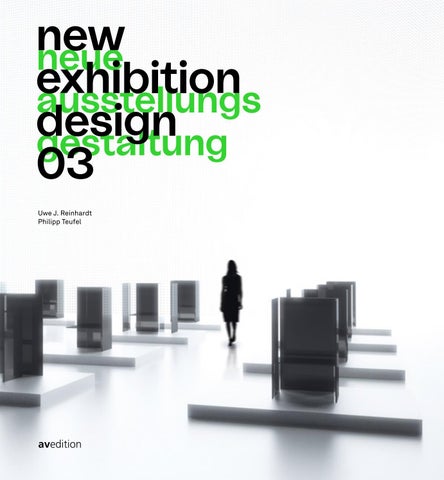
Ein neuer Band der erfolgreichen Reihe New Exhibition Design präsentiert und dokumentiert in Bild, Text und Information das Museum und seine Ausstellungen – eine famose Erfolgsgeschichte. Ein breiter Überblick über die aktuellen Konzepte und Trends von Ausstellungsgestaltung und Szenografie einmal rund um die Welt. Mit über 110 Projekten: Bekannte Büros, Gestalter und Kuratoren kommen zu Wort. Zahlreiche herausragende Präsentationen mit vielfältigen Themen, Inhalten und wegweisenden Gestaltungen. Und wichtiger denn je: „Exhibitions“ sind verlässliche Orte für Bildung, Aufklärung und Demokratisierung. In Interviews erläutern 16 Expert:innen ihre Thesen zu aktuellen Diskussionen und spannenden Methoden. Uwe J. Reinhardt und Philipp Teufel geben eine Analyse der gegenwärtigen Lage, beziehen Stellung zum gesellschaftlichen und politischen Diskurs und eröffnen neue Strategien für poetische Räume.
The new volume in the successful series New Exhibition Design presents and documents in images, text and information the museum and its exhibitions—a fantastic success story. A broad overview of current concepts and trends in exhibition design and scenography from around the world. With more than 110 projects: wellknown agencies, designers and curators have their say. There are numerous outstanding presentations with varied themes, content and ground-breaking designs. And more important than ever before: “exhibitions” are reliable places for education, enlightenment and democratisation. In interviews 16 experts explain their take on current discussions and exciting methods. Uwe J. Reinhardt and Philipp Teufel provide an analysis of the current social and political discourse and open up new strategies for poetic spaces.