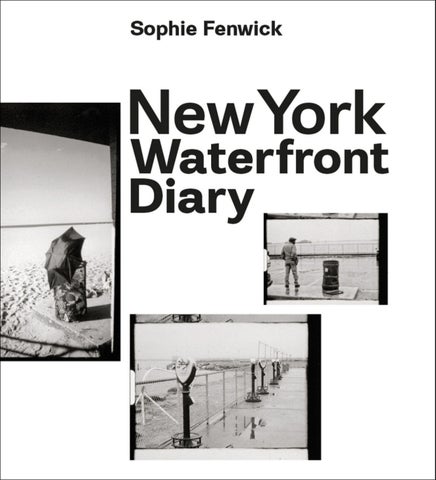
What makes photography alluring to me to this day is its primary raw material—light and time. The process of taking pictures is like a kind of performance, as Alec Soth once said. The picture is a document of that performance—the ephemeral is captured and the physical print is the exquisite result; it will never become obsolete. Photography is a universal language, reminiscent, suggestive; an image is frozen in time and truly sparkles. The camera is a sort of talisman as I see it, a charm, one that can bring good fortune, a dream catcher, a companion; the printed book is the ultimate reward, a record of the journey. In the case of New York Waterfront Diary, it is its final resting place, an archive but also a safe haven, a dream come true. P. V. Your photographs are evocative, rather than
descriptive. They remind me of Chris Marker’s universe. How would you describe your relationship to photography?
S. F. My father was a big influence, I realize now in retrospect. When I was small he worked for a French publication and was sent on assignments around the world. He would show me his photographs upon his return. I believe this planted the seed, the desire to document, to record, to trace. To create one’s own memory. This instilled reverie and wonder, much like Chris Marker’s work. I consider fragments of memory in terms of geography, drawing up one’s own maps, one’s own history and to be able to reflect, later, more importantly. Many of my images were taken by chance. I trust in luck; they traced their own itinerary, I became their guide. They provided a sort of haphazard navigation through time.
6
P. V. The way you combine your images with your poetry
makes this series very literary—a visual diary indeed. Do you have any strong influences and inspirations, in photography, film or literature?
S. F. The poetry came very recently. I have never written much before. In March 2020, my father passed away, during the pandemic. This prevented me from traveling to France and seeing my family. Possibly as the only way to transcend the sudden pain and loss, I fell into a deep dream state. These are nocturnal daydreams, my way to process the sadness and helplessness I felt at the time; these are excerpts from those dreams. I have many inspirations from film and photography, too many to list. To mention just a few, Andrei Tarkovsky, Jean Vigo, Sergei Eisenstein, Chris Marker, Jean-Luc Godard and in photography Walker Evans, Man Ray, Eugène Atget, André Kertész, Margaret Bourke-White, David Seymour, Helen Levitt, Robert Frank, Raymond Depardon, Saul Leiter . . . the list is endless! P. V. Some (if not most, if I am not mistaken) of your
photographs were made a long time ago—they are what one would call your “early work.” One could imagine them viewed as a slide show with a voice-over, perhaps your voice. What made you want to gather them in a book, years later?
S. F. I left New York in 2005. When I returned twelve years later to the same neighborhood, I returned to its waterfront and much had changed. I decided it was important to gather the images and create an archive as most of the spots I had photographed were no longer there.
P. V. The Statue of Liberty is the heroine of your book.
She stands so beautifully, and so movingly, like a very special and reassuring presence in our tormented times. Bartholdi said: “Colossal statuary does not consist simply in making an enormous statue. It ought to produce an emotion in the breast of the spectator, not because of its volume but because its size is in keeping with the idea it interprets.” In the same way, your “diaries” go beyond the personal: they evoke a more universal feeling. This is one of the beauties of photography . . . Would you tell us about your relationship with Lady Liberty, and its symbolism?
S. F. It is quite simple, for me she symbolizes the city I love, she is a geographical marker, a reference, a sense of belonging, an inspiration. More importantly she is pacifying and consistent . . .
Pauline Vermare is a French photography curator and historian based in New York. She was formerly the cultural director of Magnum Photos NY, and a curator at the International Center of Photography (ICP) and the Museum of Modern Art (MoMA). From 2002 to 2009, she worked at the Henri Cartier-Bresson Foundation, in Paris. She is the author of numerous interviews and essays on photography. She sits on the boards of the Saul Leiter Foundation and the Catherine Leroy Fund.
7
Light reflects, shadows forming, Ripple of the ebb and flow. The eternal swaying sails, the gentle sound of wind, sending its lasting echoes ashore. City of spires, welcoming, everlasting. Dazzled!
8
9
10
11
12
13
14
15
16
17
18
19
20
21
22
23
24
25