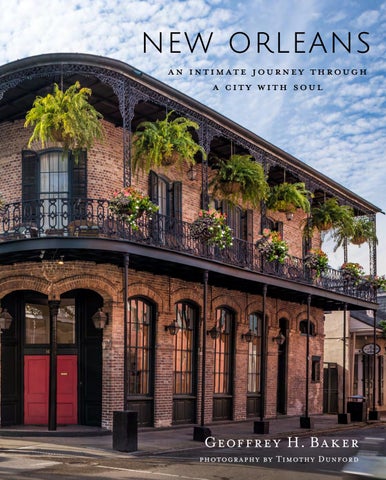
NEW ORLEANS An Intimate Journey Through a City With Soul
Geoffrey H. Baker photography by Timothy Dunford
10
FOREWORD
This beautifully presented book demonstrates how out of the ashes of the Katrina destructions a shining new New Orleans is arising. The famed Vieux Carré and Garden District are reborn and, more importantly, Geoffrey H. Baker documents how the technology, the order and scale, the character and charm, the materials and colors of these historic districts are determining the guidelines for new constructions in and around the historic districts. He explains how after decades of disregarding the opinion of residents, the administration has at long last heeded the wishes of its population. The New Orleans reconstruction experience proves that the quality of “historic” constructions is not due to past history and age, but to the ever relevant and eminently practical and aesthetic qualities that guided their conception. Léon Krier
11
O
n receiving the National Building Museum’s Vincent Scully Prize in Washington D.C. in November 2005, His Royal Highness The Prince of Wales, a long-time advocate of architectural surroundings that are familiar, traditional, well-tried, and beautiful, suggested three areas that need our attention. Firstly, the importance of retaining our connection with the natural world; secondly, to remember that buildings should tell the irresistible story of human character and idiosyncrasy; and thirdly, we should create things both beautiful and satisfying, and which appeal to our sense of the sacred. Having returned from a tour of France in 2010, I was struck by the way the French take great care to preserve their ancient towns, enriched by magnificent churches built over many centuries. These old towns form the heart of many cities, and visibly retain what The Prince of Wales calls “the soul, surely what culture is all about at the end of the day.” On visiting these towns, usually we find a beautiful, deeply satisfying inner core that tells the story of the origins of the city, inevitably surrounded by the mundane architecture of supermarkets, office blocks, apartments, and all the soulless and frequently ugly imagery of modernity. The contrast is depressing. As I wandered around these places, deeply engaged with their beauty, I was always in hope I would not encounter any modern buildings. In most of these old towns my wish was thankfully met. In Paris, the fine Haussmann boulevards, built during the nineteenth century, remain intact. But once we leave this we find depressingly repetitive blocks of offices and apartments. The environs of Paris have their share of visual chaos, without anything resembling the style, dignity, beauty, or discipline of the central core. In Berlin, the Gendarmenmarkt, built during the eighteenth and nineteenth centuries, is far and away the city’s finest space. By comparison, the modern Potsdamer Platz may be glossy, efficient, and seductive to shoppers, but no one would suggest it has the presence of the nineteenth-century origins of the city. It delivers on its own levels of expectation, as modernity does. It is popular and successful, as modernity is, but the contribution to the urban fabric cannot match what remains of Berlin’s nineteenth-century legacy, and we must visit parts of the city formerly in Communist hands to find the great monuments by Karl Friedrich Schinkel and others that take our attention.
15
So if the “soul” of a city, as defined by The Prince of Wales, is present in certain places, on what does this depend? I have spent time in New Orleans and in Hove in the U.K., two places that each possess a soul that I can feel. In New Orleans the incomparable spirit of the city resides in a Southern building tradition nuanced by the climate and conditions of the region and its people. It is, and this is an important reason for its charm, the opposite of modernity’s efficiency. New Orleans is a patchwork of glorious, majestic houses, a strong vernacular tradition, and imperfections that represent every variety of the human condition—an extraordinarily organic accumulation of mankind‚ our basic needs, and capacity for grandeur. New Orleans reflects all the idiosyncrasies of humanity. It is flawed, as we all are, and above all, it is not monotonous. In the most popular parts, such as the Vieux Carré (French Quarter), people can find, as they do in so many European cities, an escape from modernity. And like its European equivalents it is very popular indeed. Cities with such experiential richness are rare in the United States. New Orleans is not merely a tourist attraction, it is a national treasure because of its heritage and because of the way this is expressed throughout the city in high architecture and in modest buildings that tell the story of this culture. Hove was established as a seaside community in the nineteenth century with elegant, spacious homes modeled on London equivalents at the time. As such, it eloquently tells a story of gracious living in Southern England during the nineteenth century. As in New Orleans, there are expensive residences intermixed with more modest homes and seafront terraces of considerable distinction. Much of the housing in New Orleans and Hove was built during the nineteenth and early twentieth centuries, and because of the then-renewed interest in antiquity, the Greek Revival informs the architectural language of each city. Neoclassical columns, capitals, entablatures, and pediments abound in New Orleans and Hove, giving an ambience of dignity and elegance that reflects a high regard for the origins of Western civilization. To return to The Prince of Wales’s criteria for the existence of a soul in a city, both New Orleans and Hove have many fine churches, in each case mostly originating in the nineteenth century. This recognition of “sacred” in each city is also shared with the powerful presence of nature. Hove responds to the vagaries of the English Channel with its ever-changing seascape and October gales, and New Orleans is
16
THE IDENTITY OF NEW ORLEANS
In a curious way, despite the odds, each city had a vocation to become what it eventually became, not because their origins were gifted by nature, but because they each brought from man an inspirational response to a rare challenge. Man does not interact passively with nature. He can damage or enhance his habitat and, in fact, fashion the genius loci, the spirit of place. In New Orleans and Venice man and nature have always coexisted with a respect born of necessity; the tension between danger and opportunity bringing out flair and passion summoned up by their unusual interdependence. And if, as Frances Mayes suggests, “beauty is intrinsic to life,� this possibility receives a dramatic charge when man is faced with uncertainty. In New Orleans, nature dominates in a very particular way, with its live oaks, magnificent foliage, and persistent year-round blossom. The intricate complexity and majesty of nature needs an architecture in kind, whose beauty and elegance can match such exotic surroundings. Layers of cultural history add strata of meaning to this city,
24
and these meanings remain in place. But because the city has always been an evolving working city it is not preserved in aspic. The Big Easy, as New Orleans is nicknamed, is laid-back, with its own old-fashioned streetcars that belong to an old-fashioned city. They travel the green meridians, slowing the pace of life, and enabling journeys by car or trolley to take in the endless variety of nature and architecture. The overwhelming presence of nature reduces pressures, resulting in a friendly, relaxed atmosphere. Live oaks shelter and enclose, increasing the sense of intimacy and protection, and neighborhoods with oaks have a special ambience to which the architecture belongs. The city has always had many canals, most of which have been built over to form the green meridians that now soften the impact of traffic. In many places shops, banks, restaurants, some businesses, including small stores and coffeehouses, intermingle with houses. Generations who have lived here love it passionately and the emotional attachment is palpable. These natives will not, despite the hurricanes, leave for some anonymous, characterless nowhere. Dwellings express the individual character of their occupants in subtle ways. This doesn’t happen everywhere, and is sometimes discouraged, but in New Orleans there is a relaxed approach. There is a comfortable untidiness about some neighborhood streets. The narrow lots and lack of garages means that the front porch can become a garden-shed collection of bicycles, barbecues, and porch furniture. People occupy their front porches and greet passers-by with cheery acknowledgement. Compared with most modern cities—some just dull and others sanitized to conform—punches are not pulled in New Orleans. It is exactly what it is: uninhibited and authentic. The evolution of the city, from its beginnings, shows through vividly as so much is retained, especially in the Vieux Carré. And unusually for an American city it is mostly walkable. It is real life with a vengeance. Americans like to dream, and the creation of fantasy places from faraway is contrived if it gives pleasure or if it is lucrative. La Madeleine (faux-French) restaurants exist here. Starbucks too. But New Orleans resists the brand. My favorite coffeehouse, Rue de la Course (pp. 26–27), is locally owned and located in what was originally a nineteenth-century bank. It has a French name, the architecture is overwhelmingly Greek Revival, and it only plays classical music. As a family business it has its own identity and is very much part of this culture. Many who choose to live in New Orleans value the past. Shallow modernity can seem trivial here, and when it surfaces it can look out of place.
25
30
Great cities have common characteristics. Although complex, the medieval city of Siena preserves its unity and identity with uniform height and use of the same masonry throughout. The same is true for Paris and Santorini. New Orleans is no less complex. It speaks of grandeur and elitism; of poverty and crime; of political corruption, music, parades, restaurants, and coffeehouses. There is a delightful low-key ordinariness; all kinds of in-between; and ubiquitously neoclassical architecture. The city’s golden age coincided with the emergence of the neoclassical style and Ionic, Doric, and Corinthian capitals, pediments, and dentils are everywhere. Like nature, it is a kaleidoscope of intricate patterns, yet a variety of common architectural languages ensure unity and emotional security. We can easily diagram the essence of New Orleans architecture. There are few modernist boxes because it makes sense to have a pitched roof in subtropical areas where it rains above average. The basic house, needing to relate to the street and provide shelter and shade, will have a porch or a balcony, which softens the impact on the street. If brick terraces are common in Northern Europe and the northern U.S., timber houses with porches work well in New Orleans, establishing its character. In Genius Loci: Towards a Phenomenology of Architecture, Christian Norberg-Schulz explains how buildings that relate to the earth and rise to the sky in a similar way create a distinct character in towns and cities: “Buildings stand on the ground and rise towards the sky. The character of a place is to a high extent determined by how this standing and rising is achieved. This holds true of entire settlements such as towns. When a town pleases us because of its distinct character, it is usually because a majority of its buildings are related to the earth and the sky in the same way; they seem to express a common form of life, a common way of being on the earth, they constitute a genius loci that allows for human identification.” In Renaissance Italy, symmetry and balance in frescos and architecture were thought to represent the perfection of God. In New Orleans, symmetry and balance are also present in both great and humble architecture. This ordering is reassuring and has symbolic value; it contributes to the emotional security provided by familiar models. It is always good to be reminded that we are in the city of New Orleans, with its rich architectural language and beautiful natural habitat.
31
38
39
COURTYARDS
From the beginning, many houses were placed on narrow plots on street frontages. But there is a hidden world behind these façades with courtyards turning their back on the public realm. As architect Malcolm Heard commented in French Quarter Manual: An Architectural Guide to New Orleans’s Vieux Carré, “they are full of intent.” He points out a hidden energy that lies in “the tension between the clear street grid and the idiosyncratic spaces stacked and wedged and hung in interstices behind the streets.” There is an outer, fairly regular face to the world, and a private, introverted world with its own energy behind. As Heard points out, the courtyards were integral with the dwellings: “Neither part makes sense without the other ... Light and air enter most rooms of the townhouse through the courtyard; without it the rooms would be dark and dull.” Courtyards used for service purposes, such as drying clothes or raising livestock, have become opportunities for bars and restaurants. The courtyard at The Napoleon House (p. 50) at 500 Chartres Street is archetypal Vieux Carré, and named for Napoleon’s popularity in New Orleans (although he never visited the city). The threestory addition to a Spanish colonial structure was erected in 1814, and its unique, lively ambience would surprise the original Creoles. At 613 Royal Street, The Court of Two Sisters (pp. 51–53) is on a block originally known as Governor’s Row, which has been home to Governors, State and U.S. Supreme Court Justices, and Zachary Taylor, the 12th President of the United States. The present building, constructed in 1832, is in the French-townhouse style and the restaurant is named for two sisters who sold Mardi Gras costumes, formal gowns, lace, and imported perfumes from a ground-floor shop in the late 1800s. So we have two worlds: the world of the street, and the complex and indeterminate world of the courtyards. Like Venice’s distinctive canals offering one kind of experience, and its labyrinth of alleys giving pleasure or exasperation, so too does the French Quarter have two kinds of experience: streets that establish the routes clearly, and labyrinthine courtyards behind them, which are not generally accessible. These contrasts offer a range of experience and mystery of a kind that doesn’t happen in modern cities, and this kind of discovery can be exhilarating.
48
49
BALCONIES
In 1856, Owen Jones’ The Grammar of Ornament became a key decorative source in Western culture, drawing inspiration from Islamic motifs and providing a rich and complex design language. This influence is apparent in the elaborate iron railings on balconies and support columns, giving the Vieux Carré a uniquely romantic flavor that sets the tone for the kind of decoration that now extends throughout the city. Balconies play a key role in the theater of the street in the Vieux Carré. It was difficult to have outdoor space at ground level but it could occur above. Balconies could extend upper rooms out into the streets and connect them like a corridor. They give shade and protection from the rain to those in the homes and to people in the street below. Doors and windows can be left open to allow breezes to blow through. Importantly for those living in the city, these richly decorated iron cages provide enclosed, private boxes that allow users to participate in the street life of the French Quarter in a privileged way, rather like theater-goers in boxes. Over time this interaction developed via increasingly decorative overhanging balconies. Patterns that evoke foliage were fashionable at a time when the Arts and Crafts Movement and later art nouveau saw nature as an important, even necessary source. Elaborate pattern was intrinsic to the Victorian period and fully exploited with its lace-like intricacy casting complex shadows. Being disposed according to circumstance and opportunity rather than to any system or plan gave these balconies an ad hoc vitality characteristic of the Vieux Carré. Like the Creole cottages, whose presence is felt strongly throughout the Vieux Carré, the balconies exert a powerful personality in a very different way to the simple, low cottages. This is why the French Quarter is so remarkable. Such juxtapositions rarely happen in most cities because there isn’t usually such a mix. Here, each form of habitation has importance, each is retained, reminding us of the stubborn adherence to the origins of this unique place. Volumetrically, balconies offer an extra layer to the street, and give a feeling of enclosure and intimacy. As with all aspects of the Vieux Carré there are many variations on the balcony theme; the diversity of types, sizes, and ages of dwelling, with all kinds of textures and colors providing a visual feast. This reminds us of
54
Venice in that these cities have apparently unlimited experiential variables. As in Venice, the Vieux Carré offers a profound visual and sensual experience rooted in the familiarity and authority of the architectural syntax. Spatially and volumetrically the balconies transform the façades in the Vieux Carré. Sometimes they are linked together, sometimes they have no canopy. Randomly placed in the street, they maintain the unpredictable spontaneity that constantly stimulates. Alongside them, the remaining buildings are also random, so this becomes a complex street condition, animated by many differences of size and treatment. It is a far cry from the organized façades we are familiar with in most cities. A variant on the cast-iron patterns occurs at The Cornstalk Hotel (pp. 58–59) at 915 Royal Street. Built in 1816, the house was commissioned by Judge Francois Xavier Martin, a native of Marseilles, who became Chief Justice of the Louisiana Supreme Court. Dr. Joseph Secondo Biamanti purchased the mansion in 1834, and later commissioned the cast-iron fence in which ripe ears of corn are seemingly ready for harvest, to remind his Iowan wife of her native soil. Pumpkins forming the base of iron columns are entwined by pumpkin vines, leaves, and morning glory.
55
SHUTTERS
As in many European cities the use of materials from previous periods gives the French Quarter a strong tactile quality. There are many different textures, imbued with the patina of age. Wood, not of factory origin, is found in doors, windows, frames, cornices, dormers, and smaller details. The preservation of original components adds an important experiential dimension, nowhere better illustrated than in the deployment of shutters. As Heard writes: “French Quarter shutters are a physical diagram of the subtle balances builders have established between the separate demands of security, light, and air. Ingenious in their own design they are also capable of ‘dressing’ a façade, giving it varying patterns depending on which ones are open or closed, and transferring shadow patterns to the spaces inside.” If the street was a place for interaction with the world, shutters provided protection. They are vital in offering security against intruders and hurricanes, and their flexibility allows façades to be in constant change. When closed by batten shutters, the façade is serene in its balanced symmetry, and the cottage has a clear image when it is, as it were, asleep.
63
66
67
272
273
New Orleans: An Intimate Journey Through a City with Soul champions an architecture that preserves the unique character and spirit of New Orleans. Geoffrey H. Baker takes readers through the city’s most distinctive neighborhoods to demonstrate how the beauty of New Orleans is testament to its reverence for the past, and its architectural origins in the neoclassical and vernacular traditions. With magnificent color photographs by Timothy Dunford, this book illuminates how important architecture is to New Orleanians who protect, preserve, and celebrate their magical city by continuing to design and build houses in a manner that nourishes the soul.
“This beautifully presented book demonstrates how out of the ashes of the Katrina destructions a shining new New Orleans is arising.” —Léon Krier
$50.00 [USA] £35.00 [GB]