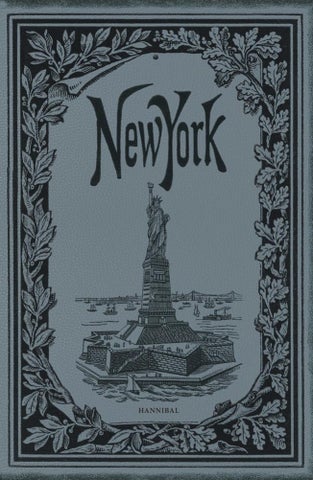
“There is no place like New York, no place with an atom of its glory, pride, and exultancy. It lays its hand upon a man’s bowels; he grows drunk with ecstasy; he grows young and full of glory, he feels that he can never die.”
A
Photographic Journey ET AR H N TAO I N
— Walt Whitman, American poet, essayist, and journalist — 1819 – 1892
T H E
Dazzling Past O F
A
Metropolis ER CEASES T H AT N E V ZE AMA TO
W R I T T E N
B Y
J A C Q U E L I N E G O O S S E N S R T O M R O N S E C U R A T E D
B Y
N A TA C H A H O F M A N
HANNIBAL
WALL STREET
If you walk down Wall Street, you’ll see rectangles in the middle of the road that resemble blunt-ended beams. They are a reminder of the wall that was built on this spot in 1652. War had erupted between England and the Netherlands, and New Amsterdam feared an invasion. Earlier still, an earthen wall had been erected here after the cruel governor, Willem Kieft, had launched a war against the Indians. Built of thick wooden planks and loam, the new wall was almost 4 metres high and boasted artillery platforms. It ran from one shore to the other, which was a far shorter distance than it is today due to the fact that both sides have since won a great deal of land. The wall had two gates: one on Pearl Street, which then bordered the East River and was named after the glistening oyster shells that paved the road, and one on the Breede weg [broad way], which later became Broadway. Yet the barrier was in vain. The British, who had established supremacy, attacked from all sides and Peter Stuyvesant had no option but to surrender. The street running parallel to the wall is thought to have been called Walstraat [wall street] by the Dutch. On some historic maps it is called ‘Waal Straat’, perhaps because it was home to Huguenots from Wallonia. At any rate, since the wall was there, the British more or less adopted the original name. The structure survived for a good many years and was even restored when New York feared a French invasion in 1693. It was demolished in 1699.
WALL STREET
By this time, Wall Street no longer formed the northern border of New York, although most of Manhattan was then still uninhabited. It was the main thoroughfare, where the largest church and town hall were located, and evolved into the business centre of the small town. The slave trade played a major role in this development. From 1711 to 1760, Wall Street was the official slave market of New York. This was where you could purchase or hire a black man or Indian for a day or a week. Every transaction in the city was taxed. The cash register was ringing. But other business was also conducted. Under the leafy buttonwood tree that stood at the top of Wall Street, brokers and speculators gathered to trade stocks and other securities. In 1792, the New York Stock Exchange was officially founded, initially a modest company with offices in a building that was also used for slave trading. As it grew, the enterprise moved to the Merchants’ Exchange Building and officially became known as the New York Stock and Exchange Board. It goes without saying that only gentlemen of breeding were allowed to participate. And there was a dress code: top hats and tails were mandatory. But the building did not survive the great fire that destroyed seven hundred properties in 1835. After the War of Independence, New York became the first capital of the US and the City Hall in Wall Street became the seat of government. In Federal Hall, as the building was renamed, Congress met and the first president, George Washington, was inaugurated. It was demolished in 1812 and reconstructed thirty years later in the Greek Revival style which was in fashion back then. It is now a historical museum that is free to visit. With the exception of a few sharp interruptions, the entire nineteenth century was a period of growth and prosperity for Wall Street. At the beginning of this epoch, the street was still semi-residential, but it quickly filled up with banks and offices. New York was the commercial centre of the country and Wall Street the ‘money capital of America’. The stockbrokers went wild when Samuel Morse demonstrated his telegraph in 1837. In no time at all, the street was full of the all-important wires. High-speed information transmission became an obsession. This is truer today than ever before: a couple of microseconds can make all the difference between millions in gains and millions in losses. Other inventions followed that quicken ed Wall Street’s pulse, such as the ticker machines (invented in 1867) that continuously spewed forth data on stock prices. The information was relayed to employees via pneumatic tubes, after which it was transcribed and wired to the traders. It was a cumbersome process, but it worked. In 1882, Wall Street became the first street in the world to be served by its own power station. Built by the inventor Thomas Edison, it had the capacity to illuminate 7,200 light bulbs.
NEW YORK
The period between the end of the Civil War and the beginning of the First World War is called the Gilded Age in America and la belle époque in France. It was an era defined by major technological advances. Investments in railways, electricity grids, steamships and the burgeoning automobile and chemical industries generated vast fortunes, all of which passed through Wall Street. The majority of the buildings in the street date from that ‘gilded era’, with its love of adornment contrasting sharply with the utilitarian style of the neighbourhood’s modern buildings. Until then, the tallest building in New York was Trinity Church. This neo-Gothic building still keeps watch at the entrance to Wall Street. It seems like a dwarf amongst the skyscrapers nowadays, but it dominated New York’s skyline until the late nineteenth century. With its 86-metre-high spire, it was the tallest building in America until 1869, and the tallest in New York until 1883. That spire was the first thing the sailors and immigrants saw as they approached the metropolis. But then came the era of skyscrapers, which nowadays dominate both the city and the street. Yet Wall Street boasts three exceptions to this urge for heights, and this cluster of buildings forms its very heart: Federal Hall, the Stock Exchange and the ‘House of Morgan’. The stock exchange building, on the corner of Wall Street and Broad Street, opened in 1903. It was the first air-conditioned building in America. Which was useful, because things could get extremely heated on the marble trading floor. J.P. Morgan built his headquarters at 23 Wall Street, directly opposite the Stock Exchange. It was called ‘the Corner’ for short. According to the writer John Brooks, in the early twentieth century, during the heyday of Wall Street, this building was “the precise centre, geographical as well as metaphorical, of financial America and even of the financial world”. Morgan had a finger in every financial pie. Rightly or wrongly, he was widely considered to be the most powerful man in the world. Yet the ‘House of Morgan’ only comprises four floors. But this was exactly how the banker wanted to distinguish himself from the lesser gods with their ‘ordinary’ high-rise buildings. After the First World War, Wall Street continued its ascent. The Roaring Twenties was a time of boundless optimism. Rising stock market prices trig gered feverish speculation and the flow of money into Wall Street became a deluge. People were building like crazy. Between 1922 and 1930, a new property was completed in New York every 51 minutes on average. In Wall Street, soaring Art Deco towers were erected, such as One Wall Street, with its beautiful banking hall literally shining through the red and gold mosaics, and 40 Wall Street (now the Trump Building), which for a brief moment was the tallest in the world. Back then, the neighbourhood still boasted residential areas. The district around Bowling Green, New York’s oldest park, now home to the popular Wall Street Bull sculpture, was known as ‘the back yard
COLOFON & BIBLIOGRAFIE
Texts: Jacqueline Goossens & Tom Ronse Curator: Natacha Hofman Image editing: Séverine Lacante Cover design: after Instantaneous Views of New York Harbor, New York, c. 1885 Photo credits: komt later
Copy-editing: Derek Scoins Coordination: Hadewych Van den Bossche Artdirection: Natacha Hofman Design: Johan Jacobs Printing: die Keure, Bruges, Belgium Binding: Brepols, Turnhout, Belgium ISBN 978 94 6388 754 0 D/2020/11922/16 NUR 653 © Hannibal Books, 2020 Hannibal Books is part of Uitgeverij Kannibaal bv www.hannibalbooks.be All rights reserved. No part of this publication may be reproduced or transmitted in any form or by any means, electronic or mechanical, including photocopy, record ing or any other information storage and retrieval system, without prior permission in writing from the publisher. Every effort has been made to trace copyright holders for all texts, photographs and reproductions. If, however, you feel that you have inadvertently been overlooked, please contact the publisher
Abu-Lughod J.L., 1999, New York, Chicago, Los Angeles, America’s Global Cities, Minneapolis, MN, University of Minnesota Press. — Alpern A., 1996, Historic Manhattan Apartment Houses, New York, Dover Publications. — Birmingham S., 1979, Life at the Dakota, New York’s Most Unusual Address, New York, Random House. — Berlin I. & Harris L.M., 2005, Slavery in New York, New York, The New Press. — Brown E., The Plaza, 1967, New York, Meredith Press. — Burke K.W., 2007, Hudson River Bridges, Charleston SC, Arcadia Publishing. — Burns R. & Sanders J., 1999, New York, an Illustrated History, New York, Alfred A. Knopf. — Burrows E.G. & Wallace M., 1999, Gotham, a History of New York to 1898, New York Oxford, Oxford University Press. — Busse F. & Berger M., New York, City on Many Waters, New York, Golden Griffin Books (s.d.). — Dolkart A.S. & Sorin S.G., 1997, Touring Historic Harlem, New York, New York Landmarks Conservancy. — Dokart A.S. & Postal A.M, 2004, Guide to New York City Landmarks, New York City Landmarks Preser vation Commission, John Wiley & Sons. — Ellis E.R, 1997, The Epic of New York City, New York, Kodansha America, Inc. — Isay D. & Abramson S., 2000, Flophouse, Life on the Bowery, New York, Random House. — Goossens J., 1998, De beste straat ter wereld, leven in New York, Leuven, Van Halewyck. — Goossens J., 2002, Mijn New York, Leuven, Van Halewyck. — Goossens J., 2007, New York: De vette jaren, Leuven, Van Halewyck. — Goossens J. & Michiels B., 2007, Dit is niet New York: de iconen voorbij, Leuven, Van Halewyck. — Goossens J., 2012, 100 x New York, De mooiste reisbestemmingen, Tielt, Lannoo. — Goossens J, Thys L. & Vandenberghe T, 2013, New York Street Food, Tielt, Lannoo. — Goossens J. & Ronse T., 2015, 360 Graden New York, Tielt, Lannoo. — Greenberg S., 2003, Waterworks, New York, Princeton Architectural Press. — Goodman C., 1979, Choosing Sides, Playground and Street Life on the Lower East Side, New York, Schocken Books. — Hamann H., 1998, New York Vertical, New York, Neues Publishing Company. — Helmreich W.B., 2013, The New York Nobody Knows, Walking 6000 Miles in the City, Princeton, NJ, and Oxford, Princeton University Press. — Homberger E., 1994, The Historic Atlas of New York City, a Visual Celebration of Nearly 400 Years of New York City’s History, New York, Henry Holt and Company, Inc. — Jackson K.T., 2010, The Encyclopedia of New York City, Second Edition, New Haven, CT, Yale University Press. — Jacobs J., 1992, The Death and Life of Great Ameri can Cities, New York, Vintage Books. — James H., 1994, New York Revisited, New York, Franklin Square Press. — Jonnes J., 2002, South Bronx Rising, The rise, fall and resurrection of an American city, New York, Fordham University Press. — Kayton B., 1999, Radical Walking Tours of New York City, New York, Seven Stories Press. — Kisseloff J., 1989, You must Remember this, An oral history of Manhattan from the 1890s to World War II, Orlando, FL, Harcourt Brace Jovanovich Publishers. — Koeppel G.T., 2000, Water for Gotham, A History, Princeton, NJ, Princeton University Press. — Koolhaas R., 1994, Delir ious New York, New York, The Monacelli Press. — Kostelanetz R., 2003, Soho, The Rise and Fall of an Artists’ Colony, London, Routledge. — Kurlansky M., 2006, The Big Oyster: History on the Half Shell, New York, Penguin Group. — Leavy M., 2006, The New York Central System, Images of the Rail, Charleston SC, Arcadia Publising. — Lopate P., 2004, Waterfront, A Walk around Man hattan, New York, Anchor Books. — Lyman S.E. & Feininger A., 1954, The Face of New York, New York, Crown Publishers, Inc. — Mitchell J., 1993, Up in the Old Hotel, New York, New York, Vintage Books — Museum of the City of New York,1997, Our Town, Images and Stories from the Museum of the City of New York, New York, Harry N. Abrams, Inc. — Museum of the City of New York, 2012, The Greatest Grid, The Master Plan of Manhattan 1811-2011, New York, Columbia University Press. — Nissenbaum S., 1997, The Battle for Christmas, New York, Vintage Books. — Pericoli M., 2004, See the City, the journey of Manhattan unfurled, New York, Alfred A. Knopf. — Reaven M. & Zeitlin S., 2006, Hidden New York, A Guide to Places that matter, New Brunswick, NJ, Rivergate Books. — Reier Sharon, 1977, The Bridges of New York, Mineola, NY, Dover Publications. — Riis J.A., 1957, How the Other Half Lives, Studies among the tenements of New York, New York, Hill and Wang. — Ronse T., 1992, Rambo op lemen voeten: Amerika in de jaren negentig, Leuven, Kritak. — Ronse T., 2012, ‘Zwemmen in een draaikolk’, in: Mijn Amerika, Pelckmans, Kalmthout — Sanderson E.W., 2009, Mannahatta, A Natural History of New York City, New York, Abrams.. — Seitz S. & Miller S., 1996, The Other Islands of New York City, A History and Guide, Woodstock, VT, The Countryman Press. — Shorto R., 2004, The Island at the Center of the World, The epic story of Dutch Manhattan. & the forgotten colony that shaped America, New York, Doubleday. — Silver N., 1967, Lost New York, New York, Wings Books, — Sirefman S., 1997, New York, a Guide to Recent Architecture, London, Ellipsis London Limited. — Sorkin M., 2011, All Over the Map, Writing on Buildings and Cities, New York, Verso. — Tauranac J., 1995, The Empire State Building, The Making of a Landmark, New York, St. Martin’s Griffin. — The New-York Historical Society, 2010, Nueva York 1613-1945, London, Scala Publishers. — White E.B., 1999 (first published 1949), Here is New York, New York, The Little Bookroom. — Wolfe G.E., 1994, New York, a Guide to the Metropolis, Walking Tours of Architecture and History, New York, McGraw-Hill, Inc. — Zinn, H., 1980, A People’s History of the United States, New York, HarperCollins.