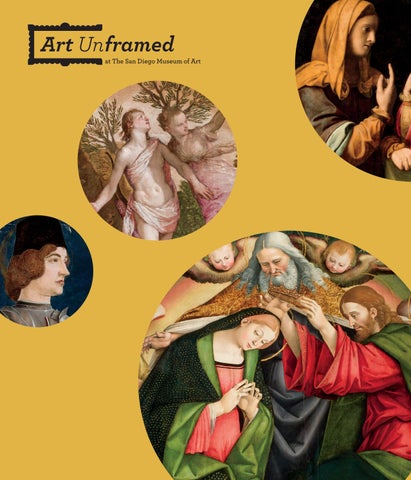
Myths, Angels, and Masquerades
Exploring European Art
Amy Gray and Lucy Holland The San Diego Museum of Art
Myths, Angels, and Masquerades
Exploring European Art
Amy Gray and Lucy Holland The San Diego Museum of Art
6 7 8 Introduction Foreword
1
Profiles in Courage
2
Timeless Stories
3 4 5
Heroes in Narrative Art
Mythology in Art
Fit for a Church Altarpieces of the Early Italian Renaissance
A New Look Paintings of the High Renaissance in Italy
Portrait Pairs Northern European Companion Paintings
6 8
10
14
20
24
28
9
Family Moments Paintings of the Virgin Mary and Family
Arresting Scenes Images of Capture in Art
Winged Ones Angels in Christian Art
Saints and Symbols Saints in Sacred Imagery
10
Pictures Come to Life
11
Hold It!
High Renaissance and Baroque Portraiture
The Art of Baroque Still Life
32
36
40
46
52
56
12
Greetings, Your Highness Portraits of Royals and Aristocrats
13
Mystery Ladies
14
Far Away Places
15
Let’s Celebrate!
16
Escape to the Countryside
17
Clashing Styles
Portraits of Unknown Women
Art and Travel
Parties and Dancing in European Art
62
68
72
78
82
French Landscape Painting
Art at the End of the 19th Century
86
Timeline
92
Checklist
93
Glossary
97
Acknowledgments
101
6 7 8 Introduction Foreword
1
Profiles in Courage
2
Timeless Stories
3 4 5
Heroes in Narrative Art
Mythology in Art
Fit for a Church Altarpieces of the Early Italian Renaissance
A New Look Paintings of the High Renaissance in Italy
Portrait Pairs Northern European Companion Paintings
6 8
10
14
20
24
28
9
Family Moments Paintings of the Virgin Mary and Family
Arresting Scenes Images of Capture in Art
Winged Ones Angels in Christian Art
Saints and Symbols Saints in Sacred Imagery
10
Pictures Come to Life
11
Hold It!
High Renaissance and Baroque Portraiture
The Art of Baroque Still Life
32
36
40
46
52
56
12
Greetings, Your Highness Portraits of Royals and Aristocrats
13
Mystery Ladies
14
Far Away Places
15
Let’s Celebrate!
16
Escape to the Countryside
17
Clashing Styles
Portraits of Unknown Women
Art and Travel
Parties and Dancing in European Art
62
68
72
78
82
French Landscape Painting
Art at the End of the 19th Century
86
Timeline
92
Checklist
93
Glossary
97
Acknowledgments
101
4
A New Look
Paintings of the High Renaissance in Italy
In with the New!
The depiction of figures evolved during the High Renaissance, the height of artistic achievement in the early sixteenth century. Artists demonstrated even more mastery of human form, pose, and expression. Large advances were made in the study of anatomy and proportion, alongside other new discoveries in science and astronomy during this unique period of history. Italian painters Bernardino Luini and Vincenzo Catena worked during this time of great innovation in art and science. If we compare the way figures are painted in Catena’s Holy Family with Saint Anne and Luini’s Conversion of the Magdalene (at right and below) to earlier Renaissance paintings, such as those by Giotto or Bonsi (see pages 20–22), we can notice several striking differences. The soft, blended brushwork and the realistic portrayal of the figures of the paintings seen here are characteristic of the High Renaissance, while the earlier works appear flatter and less dynamic.
Vincenzo Catena (ca. 1475–1531). Holy Family with Saint Anne, ca. 1510–15. Oil on panel.
A Day in the Life of the Holy Family Catena, a well-known painter of the High Renaissance, was unlike most other artists from the time in that he was already very wealthy and highly educated when he decided to become a painter. He worked in a traditional style that he learned from Giovanni Bellini, a famous Venetian Renaissance artist, and frequently represented biblical imagery in his works. This painting shows us an intimate moment in the life of the Holy Family — baby Jesus with his mother (Mary), father (Joseph), and grandmother (Anne). The wooden walker that Joseph leans on isn’t for him — it’s a baby walker that he likely made in his carpenter’s woodshop. Mary and Joseph bend tenderly toward Jesus, whom they may be teaching how to walk.
Comparing the Catena painting to an early Renaissance altarpiece by Giotto or Bonsi, what other differences do you notice about the way the figures are painted?
Catena shared an art studio between about 1504 and 1510 with Giorgione, another — and more famous — Renaissance painter (see page 52). However, Catena was the more well-established artist at the time. The two artists worked closely together, and even shared their materials. An x-ray of a Giorgione painting (one of his selfportraits) revealed that he painted right over one of Catena’s works! A castle.
24
25
4
A New Look
Paintings of the High Renaissance in Italy
In with the New!
The depiction of figures evolved during the High Renaissance, the height of artistic achievement in the early sixteenth century. Artists demonstrated even more mastery of human form, pose, and expression. Large advances were made in the study of anatomy and proportion, alongside other new discoveries in science and astronomy during this unique period of history. Italian painters Bernardino Luini and Vincenzo Catena worked during this time of great innovation in art and science. If we compare the way figures are painted in Catena’s Holy Family with Saint Anne and Luini’s Conversion of the Magdalene (at right and below) to earlier Renaissance paintings, such as those by Giotto or Bonsi (see pages 20–22), we can notice several striking differences. The soft, blended brushwork and the realistic portrayal of the figures of the paintings seen here are characteristic of the High Renaissance, while the earlier works appear flatter and less dynamic.
Vincenzo Catena (ca. 1475–1531). Holy Family with Saint Anne, ca. 1510–15. Oil on panel.
A Day in the Life of the Holy Family Catena, a well-known painter of the High Renaissance, was unlike most other artists from the time in that he was already very wealthy and highly educated when he decided to become a painter. He worked in a traditional style that he learned from Giovanni Bellini, a famous Venetian Renaissance artist, and frequently represented biblical imagery in his works. This painting shows us an intimate moment in the life of the Holy Family — baby Jesus with his mother (Mary), father (Joseph), and grandmother (Anne). The wooden walker that Joseph leans on isn’t for him — it’s a baby walker that he likely made in his carpenter’s woodshop. Mary and Joseph bend tenderly toward Jesus, whom they may be teaching how to walk.
Comparing the Catena painting to an early Renaissance altarpiece by Giotto or Bonsi, what other differences do you notice about the way the figures are painted?
Catena shared an art studio between about 1504 and 1510 with Giorgione, another — and more famous — Renaissance painter (see page 52). However, Catena was the more well-established artist at the time. The two artists worked closely together, and even shared their materials. An x-ray of a Giorgione painting (one of his selfportraits) revealed that he painted right over one of Catena’s works! A castle.
24
25
Glamor or Glory? This High Renaissance painting by Luini reveals a biblical story of two very different sisters. Mary Magdalene, the woman on the right, enjoyed having fine possessions and is shown with her fancy jewelry, expensive clothing, ointment jar, and a letter on the table before her. Her saintly sister Martha (on left), on the other hand, focused more on the Imagine the spiritual realm dialogue that took than the material place between these two world. This painting illustrates sisters. What do you think they would have said to the moment that Mary converts to Christianity. each other? In convincing Mary to give up her obsession with material objects, Martha points upward to heaven. One of the painting’s titles, An Allegory of Modesty and Vanity, suggests the virtues and vices the two different women represent through allegory, in which characters or events represent hidden meanings or ideas.
Be the Copycat Find a work of art that inspires you with its style, subject matter, or color. Take a turn being the copycat — great artists learn by imitating other artists’ work and have been doing so for centuries. Study the painting closely and then copy it (or parts of it) in the frame below.
Bernardino Luini (1481/82–1532). The Conversion of the Magdalene (An Allegory of Modesty and Vanity), ca. 1520. Oil on panel.
Though we are more used to seeing images of a youthful Mary Magdalene, as she is shown here, she was often represented as an older, less glamorous woman.
A Leonardo Copycat
Leonardo da Vinci (1452–1519). Virgin of the Rocks (detail), 1483–86. Oil on panel. Musée du Louvre, Paris, France / Bridgeman.
26 a new look
Luini was thought of as a forward-thinking artist of the High Renaissance, and was influenced in developing his style by the famous Leonardo da Vinci, considered a master in his own day (as he is today). Luini painted his version of Mary Magdalene with a mysterious smirk, soft gaze, and golden curls in a way that mimics Leonardo’s style and techniques seen in the painting to the left, allowing us to say that this representation looks very “Leonardesque.” Luini admired Leonardo’s work, and both artists worked in northern Italy, so it is no surprise that he, along with Giorgione and several other painters, would have copied his techniques. 27
Glamor or Glory? This High Renaissance painting by Luini reveals a biblical story of two very different sisters. Mary Magdalene, the woman on the right, enjoyed having fine possessions and is shown with her fancy jewelry, expensive clothing, ointment jar, and a letter on the table before her. Her saintly sister Martha (on left), on the other hand, focused more on the Imagine the spiritual realm dialogue that took than the material place between these two world. This painting illustrates sisters. What do you think they would have said to the moment that Mary converts to Christianity. each other? In convincing Mary to give up her obsession with material objects, Martha points upward to heaven. One of the painting’s titles, An Allegory of Modesty and Vanity, suggests the virtues and vices the two different women represent through allegory, in which characters or events represent hidden meanings or ideas.
Be the Copycat Find a work of art that inspires you with its style, subject matter, or color. Take a turn being the copycat — great artists learn by imitating other artists’ work and have been doing so for centuries. Study the painting closely and then copy it (or parts of it) in the frame below.
Bernardino Luini (1481/82–1532). The Conversion of the Magdalene (An Allegory of Modesty and Vanity), ca. 1520. Oil on panel.
Though we are more used to seeing images of a youthful Mary Magdalene, as she is shown here, she was often represented as an older, less glamorous woman.
A Leonardo Copycat
Leonardo da Vinci (1452–1519). Virgin of the Rocks (detail), 1483–86. Oil on panel. Musée du Louvre, Paris, France / Bridgeman.
26 a new look
Luini was thought of as a forward-thinking artist of the High Renaissance, and was influenced in developing his style by the famous Leonardo da Vinci, considered a master in his own day (as he is today). Luini painted his version of Mary Magdalene with a mysterious smirk, soft gaze, and golden curls in a way that mimics Leonardo’s style and techniques seen in the painting to the left, allowing us to say that this representation looks very “Leonardesque.” Luini admired Leonardo’s work, and both artists worked in northern Italy, so it is no surprise that he, along with Giorgione and several other painters, would have copied his techniques. 27
5
Portrait Pairs
Northern European Companion Paintings
He Loves Me . . .
Skilled artists have been commissioned to paint portraits of wealthy aristocrats, merchants, scholars, clergy, and often royalty across centuries of European art. Some portraits would capture the exact likeness of a sitter while others would glamorize the person, smoothing out flaws in her or his features. Sometimes portraits were created for a specific purpose or event, which tells us about the sitter’s status and culture. These northern European Renaissance paintings contain clues that provide insight into who the people were, where they lived, and what occasion they were celebrating. Comparing the man at right to the woman on the next page, notice the carnation that each holds. This is an important detail, which tells us that the man and woman each were engaged to be married. The portraits of their soonto-be spouses, presented on separate panels that once accompanied each of these portraits, are not by their sides anymore — scattered to different museums around the world.
What other flowers can you find in paintings from the Renaissance or Baroque eras?
My Better Half Marriage in the Renaissance was often arranged by families, sometimes for financial reasons. Painters in northern Europe such as Bruyn the Elder and Breu the Elder were commissioned to paint diptychs (twopanel paintings) commemorating the engagement of couples. The bride-to-be would accompany her fiancé in these dual portraits, which would have been hinged together so the couple faced toward each other.
Flowers are important visual symbols in Renaissance art. A red carnation is a symbol of true love and indicates an engagement for marriage. On the wedding day, often the bride would carry a carnation.
Above Left Barthel Bruyn the Elder (1493–1555). Portrait of Scholar Petrus von Clapis, 1528. Oil on panel. Museum of Fine Arts, Budapest.
28
Above Right Barthel Bruyn the Elder (1493–1555). Lady with Carnation, ca. 1525–30. Oil on panel.
29
5
Portrait Pairs
Northern European Companion Paintings
He Loves Me . . .
Skilled artists have been commissioned to paint portraits of wealthy aristocrats, merchants, scholars, clergy, and often royalty across centuries of European art. Some portraits would capture the exact likeness of a sitter while others would glamorize the person, smoothing out flaws in her or his features. Sometimes portraits were created for a specific purpose or event, which tells us about the sitter’s status and culture. These northern European Renaissance paintings contain clues that provide insight into who the people were, where they lived, and what occasion they were celebrating. Comparing the man at right to the woman on the next page, notice the carnation that each holds. This is an important detail, which tells us that the man and woman each were engaged to be married. The portraits of their soonto-be spouses, presented on separate panels that once accompanied each of these portraits, are not by their sides anymore — scattered to different museums around the world.
What other flowers can you find in paintings from the Renaissance or Baroque eras?
My Better Half Marriage in the Renaissance was often arranged by families, sometimes for financial reasons. Painters in northern Europe such as Bruyn the Elder and Breu the Elder were commissioned to paint diptychs (twopanel paintings) commemorating the engagement of couples. The bride-to-be would accompany her fiancé in these dual portraits, which would have been hinged together so the couple faced toward each other.
Flowers are important visual symbols in Renaissance art. A red carnation is a symbol of true love and indicates an engagement for marriage. On the wedding day, often the bride would carry a carnation.
Above Left Barthel Bruyn the Elder (1493–1555). Portrait of Scholar Petrus von Clapis, 1528. Oil on panel. Museum of Fine Arts, Budapest.
28
Above Right Barthel Bruyn the Elder (1493–1555). Lady with Carnation, ca. 1525–30. Oil on panel.
29
A Bright Future
Painting with Oils
Each sitter is dressed in a style that was common to fifteenth-century Germany. The woman on the previous page wears a white cap and full dress, since modesty was valued in potential brides. But check out her fine jewelry and ornate belt buckle, which indicate her nobility nonetheless. The young man is also situated to impress his new fiancée. He is shown against a vast landscape, perhaps indicating that he is lord of a large amount of land.
Bruyn the Elder and Breu the Elder, both German artists, were influenced by paintings from Italy where the Renaissance began. The Renaissance, which lasted roughly two centuries, had only reached Germany and northern Europe once it was well underway. Unlike many Italian artists at the time, these German painters used oil paint, which was a medium invented in northern Europe. Instead of using egg yolk as a binder, pigments were mixed with walnut, linseed, or poppyseed oil to achieve deep, bold colors that were often richer than those achieved with tempera paint. Artists often preferred slow-drying oil paints because they allowed the painter to gradually change colors and details in a painting as they reworked sections that otherwise would have dried with tempera, a fast-drying medium.
If you were having your portrait painted, against what kind of background would you choose to pose?
Jörg Breu (ca. 1475–1537). Portrait of a Young Man, ca. 1510. Oil on panel.
Draw the Bride A ship.
30 portrait pairs
This young man’s companion piece doesn’t hang next to him today. Reunite the happy couple by imagining what his fiancée would have looked like and drawing her in the space provided. 31
A Bright Future
Painting with Oils
Each sitter is dressed in a style that was common to fifteenth-century Germany. The woman on the previous page wears a white cap and full dress, since modesty was valued in potential brides. But check out her fine jewelry and ornate belt buckle, which indicate her nobility nonetheless. The young man is also situated to impress his new fiancée. He is shown against a vast landscape, perhaps indicating that he is lord of a large amount of land.
Bruyn the Elder and Breu the Elder, both German artists, were influenced by paintings from Italy where the Renaissance began. The Renaissance, which lasted roughly two centuries, had only reached Germany and northern Europe once it was well underway. Unlike many Italian artists at the time, these German painters used oil paint, which was a medium invented in northern Europe. Instead of using egg yolk as a binder, pigments were mixed with walnut, linseed, or poppyseed oil to achieve deep, bold colors that were often richer than those achieved with tempera paint. Artists often preferred slow-drying oil paints because they allowed the painter to gradually change colors and details in a painting as they reworked sections that otherwise would have dried with tempera, a fast-drying medium.
If you were having your portrait painted, against what kind of background would you choose to pose?
Jörg Breu (ca. 1475–1537). Portrait of a Young Man, ca. 1510. Oil on panel.
Draw the Bride A ship.
30 portrait pairs
This young man’s companion piece doesn’t hang next to him today. Reunite the happy couple by imagining what his fiancée would have looked like and drawing her in the space provided. 31
16 Escape to the Countryside French Landscape Painting
Picture Perfect
Landscape painting is a tradition that became very popular in the nineteenth century in Europe. French artists such as Jean-Baptiste-Camille Corot were some of the first in Europe at this time to explore painting the landscape with a new focus on capturing nature as it was rather than depicting an imaginary or idealized version of it, as was previously popular. Before Corot, artists like Titian and Rubens would depict mythical figures like Venus lying in a scene with tumultuous skies and impossible lighting. Later, Impressionist artists such as Claude Monet and Berthe Morisot would also escape the bustle of Paris for the picturesque French countryside to capture the feeling of a fleeting moment and the effects of light and color on a scene. Morisot liked to paint along the quiet banks of the Seine River, which meandered from Paris through the surrounding rural terrain. Monet spent much of his time at Giverny, a quaint village outside of Paris where he had a country house with a lily pond and a giant, flowering garden to inspire him — one that required numerous gardeners, for whom he left detailed instructions daily!
What Time Is It? Monet was famous for painting a subject numerous times at different times of day or season to study the changing effects of light on the subject. He painted several versions of haystacks and Rouen Cathedral in northwestern France, altering the hues and temperature of his colors each time to reflect the What time of day do you changing light. suppose it is here? Explain why you think it is that particular time.
Claude Monet (1840–1926). Haystacks at Chailly, 1865. Oil on canvas.
If you were to choose one spot to paint outdoors, where would it be?
Two haystacks.
82
83
16 Escape to the Countryside French Landscape Painting
Picture Perfect
Landscape painting is a tradition that became very popular in the nineteenth century in Europe. French artists such as Jean-Baptiste-Camille Corot were some of the first in Europe at this time to explore painting the landscape with a new focus on capturing nature as it was rather than depicting an imaginary or idealized version of it, as was previously popular. Before Corot, artists like Titian and Rubens would depict mythical figures like Venus lying in a scene with tumultuous skies and impossible lighting. Later, Impressionist artists such as Claude Monet and Berthe Morisot would also escape the bustle of Paris for the picturesque French countryside to capture the feeling of a fleeting moment and the effects of light and color on a scene. Morisot liked to paint along the quiet banks of the Seine River, which meandered from Paris through the surrounding rural terrain. Monet spent much of his time at Giverny, a quaint village outside of Paris where he had a country house with a lily pond and a giant, flowering garden to inspire him — one that required numerous gardeners, for whom he left detailed instructions daily!
What Time Is It? Monet was famous for painting a subject numerous times at different times of day or season to study the changing effects of light on the subject. He painted several versions of haystacks and Rouen Cathedral in northwestern France, altering the hues and temperature of his colors each time to reflect the What time of day do you changing light. suppose it is here? Explain why you think it is that particular time.
Claude Monet (1840–1926). Haystacks at Chailly, 1865. Oil on canvas.
If you were to choose one spot to paint outdoors, where would it be?
Two haystacks.
82
83
First Impressions
Berthe Morisot (1841–1895). The Seine Valley at Mézy, 1891. Oil on canvas.
Morisot and Monet, as cutting-edge Impressionist painters, were both well known for their spontaneous, sketch-like portrayals of the French countryside. Morisot spoke of her desire to paint as “wanting to capture something that passes; oh, just something! A smile, a flower, a fruit, the branch of the tree. . . .” These artists often created brightly colored scenes with paints straight out of the tube (without mixing them) and used fast, gestural brushstrokes to portray a quickly passing view, such as a changing cloud, the color of light on the grass, or wind through the trees. That’s why sometimes the works by these artists appear “unfinished” — more like a sketch than a painting.
Color Monet’s Haystacks Monet often painted the same scene at different times of day or season. Using colors of your choice, change the time of day or year of Monet’s composition, or photocopy this page to try out several. How does your version of the scene differ from the original?
In Plain Sight Corot, Morisot, and Monet painted en plein air, which is French for “in the open air.” Their paintings are often small because they would carry a canvas out to a field, set up an easel, and complete a painting quickly on the spot. Sometimes they would sketch in the field first and then return to the studio to complete a larger painting. Corot, the leading artist of the Barbizon School of painting (named for the village outside of Paris where many of the group worked), explored the legendary forests of Fontainebleau, which provided miles of woodland inspiration for artists and poets (also the subject of the photograph below). He painted directly from observation of nature but was most inspired to capture an emotion or mood.
right Constant Alexandre Famin (1827–1888). Forest Scene, ca. 1865. Albumen print. National Gallery of Art. far right Jean-Baptiste-Camille Corot (1796–1875). A River Scene with Houses and Poplars, ca. 1850–55. Oil on canvas.
The paint tube wasn’t invented until 1841 by an American painter named John G. Rand. This simple but groundbreaking innovation allowed artists to conveniently store their paints, and also enabled them to venture out of the studio. Before the tube was invented, artists stored their paints in pig bladders, which would often burst open!
84 Escape to the countryside
85
First Impressions
Berthe Morisot (1841–1895). The Seine Valley at Mézy, 1891. Oil on canvas.
Morisot and Monet, as cutting-edge Impressionist painters, were both well known for their spontaneous, sketch-like portrayals of the French countryside. Morisot spoke of her desire to paint as “wanting to capture something that passes; oh, just something! A smile, a flower, a fruit, the branch of the tree. . . .” These artists often created brightly colored scenes with paints straight out of the tube (without mixing them) and used fast, gestural brushstrokes to portray a quickly passing view, such as a changing cloud, the color of light on the grass, or wind through the trees. That’s why sometimes the works by these artists appear “unfinished” — more like a sketch than a painting.
Color Monet’s Haystacks Monet often painted the same scene at different times of day or season. Using colors of your choice, change the time of day or year of Monet’s composition, or photocopy this page to try out several. How does your version of the scene differ from the original?
In Plain Sight Corot, Morisot, and Monet painted en plein air, which is French for “in the open air.” Their paintings are often small because they would carry a canvas out to a field, set up an easel, and complete a painting quickly on the spot. Sometimes they would sketch in the field first and then return to the studio to complete a larger painting. Corot, the leading artist of the Barbizon School of painting (named for the village outside of Paris where many of the group worked), explored the legendary forests of Fontainebleau, which provided miles of woodland inspiration for artists and poets (also the subject of the photograph below). He painted directly from observation of nature but was most inspired to capture an emotion or mood.
right Constant Alexandre Famin (1827–1888). Forest Scene, ca. 1865. Albumen print. National Gallery of Art. far right Jean-Baptiste-Camille Corot (1796–1875). A River Scene with Houses and Poplars, ca. 1850–55. Oil on canvas.
The paint tube wasn’t invented until 1841 by an American painter named John G. Rand. This simple but groundbreaking innovation allowed artists to conveniently store their paints, and also enabled them to venture out of the studio. Before the tube was invented, artists stored their paints in pig bladders, which would often burst open!
84 Escape to the countryside
85