Russia
Contents Kazakhstan Georgia Kyrgyzstan Uzbekistan Azerbaijan Turkmenistan Turkey Armenia Tajikistan
Xinjiang
Mongolia North Korea China
Iraq
Iran
Afghanistan
Pakistan
South Korea
Tibet Nepal India
Japan
Bhutan
Bangladesh
Taiwan
Laos
Myanmar Thailand
Philippines
Cambodia Vietnam
Malaysia Sri Lanka
Brunei
Indonesia
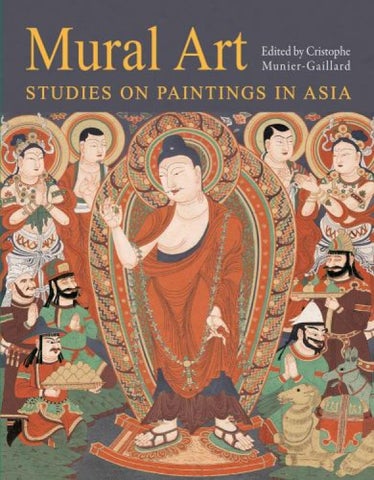
First published and distributed in 2018 by River Books Co., Ltd. 396 Maharaj Road, Tatien, Bangkok 10200 T: (66) 2 225-4963, 2 225-1039, 2 622-1900 F: (66) 2 225-3861 E: order@riverbooksbk.com Collective work © Cristophe Munier-Gaillard and River Books Text & images © Cristophe Munier-Gaillard All rights reserved. No part of this book may be reproduced or transmitted in any form or by any means, electrical or mechanical, including photocopying, recording or by any information storage or retrieval system without the written permission of the publisher. Publisher: Narisa Chakrabongse Copy editor: Nicolas Revire Production: Paisarn Piemmettawat Design: Ruetairat Nanta ISBN: 978 616 7339 96 2 Cover: digitally reconstructed image of 11th century mural panel 5 from temple no. 15 at Bezeklik, Xinjiang Uyghur autonomous region of China. © Y. Okada
Opening pages: 1) Gandharvas. Dungkar, Tibet, cave with the lantern ceiling, late 11th century. © H.F. & H.A. Neumann; 2) one of the 996 Bodhisattvas. Dungkar, Tibet, cave with the mandala ceiling, late 11th century. © H.F. & H.A. Neumann. 3) Mañjuśrī and Maitreya in mystical debate. Mural signed by the painter Mchims bsod nams ‘bum, 1306-15 AD. Tibet, Shalu monastery, Yum chen mo skor lam, south wall. © Y. Heller; 4) the Buddha under the nāga king Mucalinda. Hpaya Hpyu temple, Shwe Mokhto complex, Ma U, Myanmar, early 19th century. © J.P. Forst Previous page: Amitābha, Bse sgoma Lha khang, Zhalu, Central Tibet, 13th century. © H.F. & H.A. Neumann
Above: map of Asia with countries cited in the volume. © S. Freiré-Diaz & M. Sabrié
Back cover: cave with lantern ceiling. Dungkar, Ngari, Tibet, end of 11th century. © H.F. & H.A. Neumann Printed and bound in Thailand by Sirivatana Interprint Public Co., Ltd.
FOREWORD
15
PREFACE
16
AFGHANISTAN
Parinirvāṇā Scenes in Bāmiyān Murals: Transformation of Gandhāran Art in Central Asia Akira MIYAJI
18
The Origins of the Earliest Buddhist Murals in Bāmiyān Shumpei IWAI
42
XINJIANG
Digital Reconstruction of the Mural Panels from Temple no. 15 at Bezeklik, Xinjiang Uyghur Autonomous Region of China Yoshihiro OKADA and Takashi IRISAWA
TIBET
58
Mural Conservation in Tibet 1995-2007: Grathang, Shalu and Lukhang Conservation Projects Amy HELLER
86
Late 13th Century Wall Paintings of Pang gra phug, a Cave in West Tibet. Iconography, Style and Similarities to the Luri Stūpa in Mustang Helmut F. and Heidi A. NEUMANN
98
Inscriptions, Captions and Murals of the Buddha-vita in Pang gra phug (mNga’ ris, Western Tibet) Kurt TROPPER
MYANMAR
120
The Story of the Buddha’s Eyetooth Relics and Its Pagan Reception Lilian HANDLIN
140
Typology of 17th- and 18th-century Gold Murals in Myanmar Cristophe MUNIER-GAILLARD
166
THAILAND
At the Nexus of Power: Chinese Traces in the Heart of Wat Ratchaburana in Ayutthaya Pattaratorn CHIRAPRAVATI
MONGOLIA
192
Pe har and Oracle Deities in Mongolia: Paintings of the Five Kings in Yeke juu Monastery of Hohhot Isabelle CHARLEUX
208
INDEX
248
15
Foreword
M
ural Art was initially planned as a bi-yearly academic journal on mural paintings in Asia. It would have been the first of its kind as, unlike ceramics for instance, there is none solely dedicated to this form of painting. However, as it took seven years to finalise all the articles, the format of a book finally materialised. In this regard, and in the name of all authors, I would like to thank Lilian Handlin who made it possible and Narisa Chakrabongse and her team at River Books for having brought it to light beautifully. My initial aim was also to put Burmese murals on the map of Asian murals. With paintings executed, without any hiatus, from the 11th to the 20th century in thousands of monuments of which almost a thousand survive, Burma or Myanmar, has one of the richest heritage of the Buddhist world. It is still, however, in a pioneering phase of study and this publication may be a good start in this late recognition and in motivating new scholars to come to the field. May all the authors who patiently contributed to Mural Art be thanked for having believed in this project; Nance Cunningham, Lilian Handlin, Roy Hart and Nicolas Revire for having gone through all articles. To my wife Eimi & our son Hugo for their daily sustaining joy. Cristophe Munier-Gaillard Yangon, 2017
Arrival in palanquin of the newborn Bodhisatta Siddhattha to Kapilavatthu. Temple no. 1, Monywe complex, Hsalingyi, 1730-70, Myanmar. © A. Kirichenko
Parinirvāṇa Scenes in Bāmiyān Murals: Transformation of Gandhāran Art in Central Asia1 Akira MIYAJI Abstract Before the destruction of the two colossal images of Śākyamuni Buddha and Maitreya Buddha by the Taliban in 2001, the author conducted field research at Bāmiyān in 1969, 1974, 1976 and 1978. Based on his findings, this article discusses the parinirvāṇa scenes in the murals from caves Fc, K3, G, Jd, Jg and Ee, documented before their destruction. Their iconography is investigated and compared to the sculptures from Gandhāra and the murals in the caves of Kizil and Dunhuang. Murals with parinirvāṇa scenes in Bāmiyān probably date to between the 6th and the 7th or 8th centuries. They partially follow the narrative reliefs from Gandhāra, but they differ from the Gandhāran reliefs in the following ways: (1) Subhadra meditating on the final conflagration; (2) Mahākāśyapa worshipping the sacred feet of the Buddha; (3) the lamentation of Queen Māyā; (4) the fervent gestures of people in grief; (5) the representation of Sun and Moon gods; and (6) the combination of the parinirvāṇa scenes with the Bodhisattva Maitreya and
the Thousand Buddhas. Some of these features, (1) to (4) can be observed in the parinirvāṇa scenes of Dunhuang caves from the Sui period (581-619 AD); features (2) and (4) can also be found in the murals of Kizil caves at Kucha (ca. 6th-7th centuries). In the overall composition of the Bāmiyān murals, the Bodhisattva Maitreya is depicted at the top of a ceiling, the Thousand Buddhas surround it and the parinirvāṇa scene is shown on the upper part of a side wall. This iconographic program does not describe the demise of Śākyamuni, an anecdote from the Buddha’s life. It can be understood as the belief in the Bodhisattva Maitreya, the Buddha of the future, residing in the Tuṣita Heaven, and the belief in the Thousand Buddhas of the bhadra kalpa following Maitreya. Thus the art of Bāmiyān can be assumed to have been developed due to Buddhist beliefs in the area in the 6th and 7th centuries, and has a connection to Kucha and Dunhuang as well.
22 Mural Art
Parinirvāṇa Scenes in Bāmiyān Murals 23
22 Mural Art
Parinirvāṇa Scenes in Bāmiyān Murals 23
44 Mural Art
The Origins of the Earliest Buddhist Murals in Bāmiyān 45
A
considerable number of studies have been conducted on the Bāmiyān mural paintings, which most archaeologists and art historians date from the 6th to the 8th or the th 9 century.1 This has been confirmed by a radiocarbon dating conducted by both the National Research Institute for Cultural Properties (NRICP) of Japan and Nagoya University in 2006, although the earliest murals may date from the late 5th century (1).2 The samples used for the radiocarbon measurement were vegetable chaff tempers collected in situ from the rendering layers directly applied to the rock. From our observations of the crosssections of these layers, there were no cases in which a newer Buddhist mural overlapped an older one. The chaff in the samples is probably contemporary with the mural paintings – unless a previous paint layer had been stripped off and then repainted, or murals were painted on an earlier rendering layer.3 The dates attributed by the art historians and given by the radiocarbon dating are consistent with each other. The only contradiction concerns the murals of cave M [111] and of caves J [383-389]5 that art historians considered as the latest murals in Bāmiyān (around the 8th century) but are now dated by radiocarbon to the earliest period of Bāmiyān (late 5th-early 6th century). "This raises many questions, as one scholar puts it, for further studies of the very earliest stages of Buddhist art in Bāmiyān".6 This article attempts to examine from an art historical view the hypothesis that the murals of cave M and caves J are actually the earliest in Bāmiyān. 300
500
700
900 AD
M(29):1559±28BP J(d) (23):1560±27BP J(g) (26):1559±27BP J(b) (22):1557±27BP J(b) (21):1550±27BP J(e) (24):1543±26BP J(g) (25):1538±26BP
A full-fledged scientific investigation of the Bāmiyān sites was launched by the Délégation archéologique française en Afghanistan (DAFA) led by A. Foucher in the early 20th century. Though a series of field works revealed the structures and murals of the major caves, including the two Giant Buddhas' niches and the caves around these niches, they did not date each of these murals and did not lay out a comprehensive and clear chronology.7 Among the expeditions and research at the Bāmiyān caves that dramatically increased our knowledge of the site,8 the comparative studies of murals from an art historical point of view by Miyaji9 and archaeological and historical studies by Kuwayama10 play a significant role in the establishment of a general consensus that the Bāmiyān sites had developed from the 6th to the 8th century. The motifs of the murals and their dating have been researched for a long time,11 and Klimburg-Salter’s comprehensive study of Bāmiyān murals is one of the most important works regarding Bāmiyān art history.12 All researchers, although diverging on some points, agree that the oldest murals are those depicted on the two Giant Buddhas' niches and that the murals of cave M and caves J are later works (around the 8th century).13 One reason to assume that the murals of cave M and caves J are more recent is that they present some characteristic motifs such as a particular parinirvāṇa scene, a formalised ‘Thousand Buddhas’ and a crowned Bodhisattva seated with crossed legs. It would be natural to imagine that a specific set of these motifs had been gradually formed in the process of the development of Bāmiyān Buddhism and that the murals of cave M and caves J sharing these motifs might belong to the late period of the site.
The Result of the Radiocarbon Dating
C(a) (6):1506±27BP C(a) forecourt (5):1501±27BP C(b) (7):1496±27BP D1 (10):1484±27BP D1 (11):1471±27BP A low (2):1462±27BP A low (1):1447±27BP Da-A1 (35):1420±25BP Da-A2 (36):1386±25BP D forecourt (8):1394±27BP D (9):1386±27BP S(a) (31):1397±25BP N(a) (30):1375±27BP F(a) (17):1362±27BP F(a) (16):1307±27BP B(a) (3):1348±29BP East-lll (24):1347±28BP B(d) (4):1296±28BP K3 (28):1319±25BP K3 (27):1283±25BP E(e) (14):1308±28BP E(e) (12):1289±27BP E(e) (13):1280±28BP E(e) (15):1278±28BP l (20):1270±27BP F(c) (18):1245±27BP F(c) (19):1208±27BP Z1 (32):1216±27BP
300
Previous Studies on the Chronology of the Bāmiyān Murals
500
700
1. Calibrated dating of the Bāmiyān caves. © T. Nakamura 4
900 AD
The result of the radiocarbon dating conducted by the NRICP of Japan and by Nagoya University may not be accepted by some researchers. The point in question is not only the absolute date of the late 5th century but the reassessment that it implies, both regarding the chronology of Bāmiyān murals and the nature of its earliest phase to which cave M and caves J belong. When this radiocarbon dating was done, the radiocarbon ages were calibrated to calendar years using the IntCal98 data set.14 Concerning the data set, the relation between the radiocarbon age and the calibrated year is complicated especially in the calendar age range of 430-540 AD, and therefore one radiocarbon year may correspond to more than one calendar year in this range. This means that the absolute date of the late 5th century could be too early.15 On the other hand, the result shows that two or three samples extracted from different locations in a same cave, as well as the samples from each cave of a same group of caves, all indicate the same radiocarbon age. This datation of cave M and caves J as the earliest in Bāmiyān16 is therefore highly credible. Moreover, the radiocarbon dating of the wooden pegs and ropes utilised for constructing the two Giant Buddhas, done in 2005 by a German team, is consistent with the 2006 result of the dating of the murals. The Eastern Giant Buddha was dated from cal17 557 AD ±15, and the Western Giant Buddha from cal 601 AD
2. Section of the cliff at Bāmiyān with caves M and J. © NRICP-Tokyo ±12.18 Nagoya University conducted a radiocarbon dating with the same samples, and dated the Eastern Buddha from cal 430-560 AD, and the Western Buddha from cal 600-650 AD.19 Both results fall in the same time frame and indicate that the Eastern Giant Buddha was constructed in the middle of the 6th century, while the Western Giant Buddha was built in the early 7th century.
Murals of Cave M and Caves J at Bāmiyān
To solve this contradiction in the chronology of Bāmiyān murals between art historical studies and the radiocarbon dating, the murals of cave M and caves J (2) will be sketched out first in the context of previous research.20
Cave M [111] Cave M (3) has a distorted square plan close to a trapezoid with a flat ceiling.21 Although some murals remain,22 almost all were lost during the civil war in Afghanistan (1978-2001). Murals on the north wall included a Buddha triad inside the niche with the Buddha flanked by two standing (?) Bodhisattvas each wearing a different type of crown (4-6) and, on both the upper external left and right sides of the niche, the Moon and Sun gods (7, 8). Murals on the south wall, near the entrance, depicted donors in Central Asian costume (9, 10). Finally, the ceiling was covered with a multitude of small seated Buddhas known as the Thousand Buddhas (11).
3. Entrance of cave M.23 © NRICP-Tokyo
Cave J(d) [388] The cave (12) has a square plan with a domed ceiling, but no squinches in the four corners. Mural paintings of the Buddhist triad are represented on three walls. On the centre of the domed ceiling, we can find a crowned Bodhisattva with crossed legs who is holding a water pot29 in his left hand (presumably Maitreya). His crown seems to belong to the triple-sided type common in depictions of Bodhisattvas in the Mogao caves at Dunhuang.
4. Cave M: north wall (late 5th-early 6th c. by radiocarbon dating). © Kyoto University
66 Mural Art
Digital Reconstruction of the Mural Panels from Temple no. 15 at Bezeklik 67
The cases presented below illustrate the similarity between the pranidhi scenes in temples nos. 15 and 20. Panel 11 from temple no. 15 (15) shows the final result of its digital reconstitution, while the corresponding panel 7 from temple no. 20 (14) is a sepia lithograph from Chotscho39 of a mural once exhibited in the Museum of Ethnology in Berlin.
15. Bezekilk, temple no. 15, panel 11. © Y. Okada
16 (opposite page). Bezeklik, temple no. 20, panel 7. © Y. Okada (after Chotscho)
100 Mural Art
Late 13th Century Wall Paintings of Pang gra phug, a Cave in West Tibet 101
T
he history of wall painting in West Tibet starts in the 10thcentury with the ‘Du khang3 of Tabo (1).4 Slightly later are 11th-century murals at Tholing5 and nearby Mangnang,6 which did not survive the Cultural Revolution (1966-76). Chronologically, they are followed by the caves of Pedongpo7 and Phyiwang8 (2) and the nearby cave temples of Dungkar9 (3), a locality north of Tholing which was chosen as a residence by
1. Two clay statues from the Vajradhātu maṇḍala, blue Vajrasādhu and red Vajraratna. Tabo, Spiti, ‘Du khang, south wall, 11th century. © H.F. & H.A. Neumann
2. Dhūpā, the goddess of incense, cave of the Offering Goddesses. Phyiwang, Ngari, end of 11th century. © H.F. & H.A. Neumann
3. Cave with lantern ceiling. Dungkar, Ngari, end of 11th century. © H.F. & H.A. Neumann
several kings of Guge in the second half of the 11th century.10 In this period of about 200 years, a particular West Tibetan painting style arose, largely based on the art of Kashmir. Their prominent characteristics are very regular, almost schematic features, with the upper eyelid drawn as a straight line, and an athletic body with a very slim waist.11 At the beginning of the 12th century, the artistic activities
came to a sudden halt due to the Garlog invasion, which broke the strong independent political and religious activities in West Tibet.12 Following the rise of a powerful ruler of the kingdom of Guge at the beginning of the 15th century13, major temples were erected in Tholing (4) and Tsaparang. Artists followed the fashion of their time but incorporated many of the special West Tibetan traits of the early period into their stylistic repertoire, thus creating
Inscriptions, Captions and Murals of the Buddhavita in Pang gra phug (mNga’ ris, Western Tibet)1 Kurt TROPPER Abstract The lower part of the central wall in Pang gra phug (mNga’ ris, Western Tibet) displays a band of painted scenes on the life of the Buddha, which are combined with seventeen short captions and nine inscriptional panels of different lengths. The edition
of the epigraphs and the identification of the various scenes supplied in this essay establish a basis for future comparative studies on similar depictions of the life of the Buddha in Western Tibet.
194 Mural Art
Chinese Traces in the Heart of Wat Ratchaburana in Ayutthaya 195
A
mong the impressive and extensive ruins of temples and archaeological sites surviving from the ancient kingdom of Siam in present-day Ayutthaya (Thailand), Wat Ratchaburana, which was built by King Boromaracha II in 1424, is undoubtedly the most significant. The objects recovered from its main tower comprise not only the largest and most important collection of archaeological remains of the early Ayutthaya period, but also are the most important source of information regarding the history, culture, and religious practices of Central Thailand in the 15th century (1). Most of the deposits in the crypt are Buddhist imagery of the early Ayutthaya period as well as images from Sukhothai, an earlier Thai kingdom (13th to 14th centuries), and from neighboring kingdoms (e.g. Angkor in Cambodia). But perhaps most remarkably, Wat Ratchaburana turned out to be a storehouse of foreign traces of faraway places such as China, Sri Lanka, India, Nepal, and Kashmir. Very few artefacts from Ayutthaya can be dated with confidence by the usual methods that make use of inscriptions or historical records. This group of objects, however, sealed away in Wat Ratchaburana, can apparently be attributed to the period when the temple was founded. Thus, the deposit of Wat Ratchaburana can be used like a text to study the history of early Ayutthaya. In my essay for the exhibition catalogue of The Kingdom of Siam: Art from Central Thailand (1350-1800), I suggested that Wat Ratchaburana was built as part of an effort to establish the king’s legitimacy and his right to claim the title of Universal Monarch (cakravartin).1 According to the Royal Chronicles, written in 1680, a temple was built at the cremation site of the two brothers of King Borommaracha II or Chao Sam Phraya, who were both killed in a duel for the throne after their father passed away in 1424.2 The temple was a conspicuous symbol in the centre of his kingdom, which included regions that had once been under the suzerainty of the Thais of Sukhothai and the Cambodians of Angkor. Buddhist artefacts that were deposited within the structure included sculptures, Buddhist tablets, and mural paintings. In addition, there were large deposits of gold royal regalia, vessels, costumes, and jewellery. Religious merit would be accrued to ensure a future birth for each of the king’s deceased brothers, for the king and his family, and for his subjects. Among the oldest of existing Thai paintings are the murals painted on the walls inside the tower in the centre of the small crypt, on both levels I and II, of Wat Ratchaburana (2, 3).
2a. Plan of Wat Ratchaburana from the southern side. © FAD Thailand
1. Wat Ratchaburana, Ayutthaya, 1424. © K. Tsuruta 2b. Diagram of the crypt. © FAD Thailand
3. Passage from level I to level II. © C. Munier-Gaillard
196 Mural Art
Chinese Traces in the Heart of Wat Ratchaburana in Ayutthaya 197
The Buddhist paintings on level II (4-9), deliberately hidden from human sight, are comparable in purpose to the familiar paintings that adorned the cave temples and reliquary chambers of Sri Lankan stūpas. On level I, the south and east walls are adorned with Chinese figures (10, 19-23, 25-34), which have never been found in any earlier monument in the Thai regions of Sukhothai or Lanna. The north and west walls are adorned with Thai-style celestial figures (11, 12, 15, 16, 18). This essay will focus on the Chinese materials that were recovered from the main tower of Wat Ratchaburana, namely mural paintings, Chinese inscriptions on a gold plaque, and Buddhist tablets. I will use these materials to speculate upon the roles of China in the early Ayutthaya period (14th and 15th centuries).
8, 9. Mural at level II: scene from a jātaka – the Nandiyamiga Jātaka no. 385 (?), and detail. © C. Munier-Gaillard
5 (detail of 4). Pair of birds from a jātaka. Gold leaves used on the mural are original and not late addition (the murals have been cleaned between 2012 and 2014). © C. Munier-Gaillard
4. Mural at level II: ceiling of the crypt decorated with lotus flower motif. © C. Munier-Gaillard
10 (detail of 25). Chinese-style mural at level I. © C. Munier-Gaillard
6. Mural at level II: two Buddhas from the series of the 24 past Buddhas. © C. Munier-Gaillard
7. Mural at level II: the elephant of the Pārileyya (or Pārileyyaka) forest offering water to the Buddha (10th retreat after Enlightenment). © C. Munier-Gaillard
11. Mural at level I: Thai-style male celestial figures. © C. Munier-Gaillard
252 Mural Art