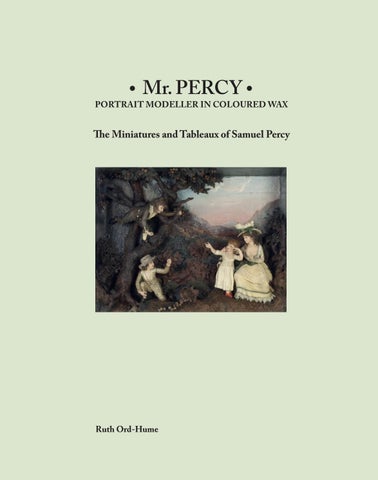
Mr. PERCY
Mr. PERCY
PORTRAIT MODELLER IN COLOURED WAX
The Miniatures and Tableaux of Samuel Percy
The Miniatures and Tableaux of Samuel Percy Ruth Ord-Hume
ISBN: 978-1-78884-037-8
ËxHSLHSIy840378zv&:<:;:!:!
Ruth Ord-Hume
£45.00/$65.00
www.accartbooks.com
Mr. Percy Dust Jacket.indd 1
15/01/2020 12:10
PREFACE
I
came across Samuel Percy quite by chance, after seeing some wax portraits at an antiques fair. I had always been interested in miniature portraits but these were something different. I found that the Victoria and Albert Museum (V&A) had a small gallery showing the work of wax modellers and wondered how one artist could successfully create two quite different scenes – on the one hand a sombre dead Christ and on the other, three musicians having a riotous good time. I decided to find out more about this Mr Percy. This biography is the result. When I began this study by first undertaking my desk research, as I was taught to do, I had no idea that Percy spent a good proportion of his working life travelling round the country. Occasional references to his presence in various towns cropped up in the literature I read but I was quite unprepared for the extent of his travels. If I had had to sit down and scour the newspapers of all England looking for adverts, without knowing where he went or in what sequence he visited the towns, I would have been as old as Methuselah before the job was done. So while it is fair to say that without these newspaper advertisements there would be no story to tell, I will always be grateful to the British Library for making so many newspapers available online, by happy coincidence just as I was beginning this project. The various sections of this book will be of interest to different people. It includes a general introduction to the modelling of wax portraits for non-specialists but nevertheless, I hope it fills some gaps for museum and gallery curators. Social historians will find the text highlights a variety of aspects of late eighteenthcentury and Regency business and social life. Through Percy’s newspaper advertisements we can see what worried him, what was important, what was likely to go wrong over which he had no control, but also the opportunities he saw and seized. We get a glimpse of how networking operated to his advantage, and that of his friends. It would not have been practical to reproduce all one hundred of his newspaper advertisements, but no apology is offered for quoting so many of them in full. Each is different and only by reading so many is it possible to get an idea of the personality behind them and besides, Samuel had a surprisingly wide vocabulary with which to express his sentiments when aggravated. It is unlikely that a similar collection of advertisements exists and for that reason Percy’s deserve attention; without them there would be no story to tell. Costume historians will find the series of scenes or groups of miniature figures illustrated are a new resource, documenting the dress of working people; there is very little upper middle class costume depicted here. The likenesses, on the other hand, do show middle class costume and hair styles, especially women’s. From a commercial point of view, auction houses and dealers may find it useful to have access to so many illustrations and a focussed bibliography. Overall, this is a biography, about a real person whose descendants are very much alive today and have been enormously supportive and patient in helping me bring the project to a conclusion. I hope they, and you, find it an interesting read. 7
Percy Prelims.indd 7
10/01/2020 14:15
S C O T L A N D
Port of Leith
• Glasgow
••
EDINBURGH
•Newcastle upon Tyne •
Belfast
•
Armagh
I
R
E
L
A
N
•
Preston
•
D
•
•
Leeds
•Wakefield
Liverpool Manchester
•
•
DUBLIN
•
Sheffield
•
•
Holyhead
York
Buxton
Chester
• •
•
Derby
•
Shrewsbury
Norwich
Birmingham
•
•
Bury St Edmunds
E N G L A N D • Cork
•
Chelmsford
• Oxford Bristol
•
• Bath
Plymouth
•
•
•
•
Canterbury Deal Ashford Tunbridge Wells Dover
Salisbury
•
Weymouth
•
• • • •
•
•
Winchester Southampton
•
Exeter
LONDON
Reading
•
Taunton
Fig 1 Map of the British Isles, showing all towns and cities which Samuel Percy visited at least once, or considered visiting, or had a reason to visit.
•
Ipswich
W A L E S
Worthing
••
Brighton
Newport
•
ISLE OF WIGHT
5
10
20
30
50
Miles
8
Percy Prelims.indd 8
15/01/2020 11:59
Chapter 1
INTRODUCTION Solomon Grundy Born on Monday Christened on Tuesday Married on Wednesday Took ill on Thursday Grew worse on Friday Died on Saturday Buried on Sunday And that was the end Of Solomon Grundy
A
s far as life’s milestones were concerned, Samuel Percy’s story up to now (if it was considered at all) has resembled that of Solomon Grundy whose life was summed up so succinctly in the nineteenth-century nursery rhyme above. He was born, he lived, he passed away. Poor Solomon Grundy had lived a life so blameless and uninteresting that there was nothing to be said about him when he died. Similarly, Percy has simply been a name on the reverse of portraits and a convenient person to whom any coloured wax work could be attributed. His work may have been coloured but his personality, as far as writers were concerned, was absolutely colourless. As it happens, however, there is plenty to be said about Percy, it was simply that noone was searching in the right places. This book sets out the story of one hardworking artist whose career spanned the last quarter of the eighteenth century and extended into the Regency period. His name was Samuel Percy (b. circa 1753, d. 1819), creator of portraits and miniature figures in coloured wax and proud modeller to Princess Charlotte of Wales. Dictionaries have stated, quite rightly, that Percy modelled miniature portraits in coloured wax and they also refer to a handful of tableaux of little figures in coloured wax. They have provided a general idea of when his life began and ended, based on the scant information hitherto available. But there has been almost nothing known about his life in between that beginning and end, and it turns out that he did a great deal, some of it quite surprising, making it a very human story. In fact, it was through his own labours that he ensured he would not be completely forgotten. Not only did Percy leave a surprisingly large legacy in the form of miniature portraits, portrait busts and his miniature figures, but a handful of letters has survived, too, which help to throw light on his character. Most useful of all though are the idiosyncratic advertisements he composed throughout his career to promote his business. This book follows the development of his career in his home country of Ireland before tracing his 9
Percy Prelims.indd 9
10/01/2020 14:15
1. Introduction
Fig 2 Unidentified man and woman A pair of profile portraits signed by Percy and the lady numbered 953. They probably date from the 1780s, showing the man with a pigtail wig and the woman wearing typical 1780s (or even 1790s) style with a buffon neckerchief. Percy’s curtains have been lost but both portraits have his hanging instructions on the back: ‘Hold the top of the head to the light, that all features may catch a share, without which the beauty of the human face will be imperfectly seen.’ Frames: 7⅞ x 6¾ in. (20 x 17cm). Photo © Christie’s Images/Bridgeman Images
10
Percy Prelims.indd 10
10/01/2020 14:15
1. Introduction
journeys round England and into Scotland as he built up his portrait business. After that comes the success of his move into exhibitions of ‘rustic tableaux’ until finally, when in his sixties, he decided his whole collection must be sold. His continued attempts to be taken seriously as a sculptor are also recorded. Percy’s story throws up curiosities and, inevitably, its fair share of queries, such as why he bought a printing press, why he was involved in an Irish court case in Cork as well as one in Birmingham, who wrote him a spiteful anonymous letter and what exactly Percy despatched to Russia in a ship out of the Port of Leith. Finally, lest anyone suspect that in his sixties he may have lost some of his fighting spirit, they have only to read his address to the people of Liverpool in 1815 to realise how mistaken they were. Percy’s informative announcements in local newspapers as he travelled around the country say so much more than the rather bland statements normally used by portrait artists and reveal something about the nature of the man himself.1 Reading between the lines, Samuel Percy’s announcements are often as good as a journal in telling us what was going through his mind, when business had been good or when his patience had been sorely tried. The 1780s, for instance, find him railing against the activities of a fraudster who was copying his model portraits. He was well ahead of his time in recognising just how useful newspapers could be in getting a message out to a specific population. They were a business tool which succeeded spectacularly at a time when local newspapers were still in their early days, and Percy was in the forefront when it came to taking advantage of the opportunities offered by the regional press. He may even have been unique in his use of advertising at this time. Regional newspapers were burgeoning in the last quarter of the eighteenth century; frequent new titles were appearing both in London and across the country. The expanding coach network enabled delivery of copies to be made round a local area thus ensuring the public could learn about events, even those in London, within a day or two of them taking place. By discussing Samuel Percy’s methods and modelling work using coloured wax it is hoped this study will encourage a reappraisal of the genre of miniature portraits in wax, for so long regarded as neither fine art nor sculpture and therefore, not fitting conveniently into an existing category, being unworthy of serious study by either specialism. The narrative will touch on the initial refusal of the Royal Academy to accept Percy’s portraits and consider possible explanations. Percy’s most remarkable work, though, is his series of scenes of miniature figures, or ‘rustic tableaux’, referred to above, which throw a new light on aspects of daily life for ordinary folk in rural late Georgian England, preoccupied as they are with scenes of drinking and disagreement. Some of these have survived to the present day and serve to show just how talented he was as a modeller. One of the attractions in Georgian art galleries would have been the conversation pieces painted by artists to be just that – pictures to generate discussion. Samuel Percy described some of his scenes as ‘conversation pieces’, too. Their subjects ranged from scenes of country life, such as the Romani – referred to in Percy’s time as ‘gypsies’ – starting their day or fish-sellers having an argument, to a portrayal of a Bristol inn and its landlord. They depict happy occasions – young chimney sweeps having fun in their free time or young people dancing to the accompaniment of a travelling fiddler – and
1. To avoid readers of this book developing a lisp, the descending lower-case ‘s’ of eighteenth-century type, which looked very much like a lower-case ‘f’ in print, has not been reproduced here when quoting from newspapers. It led, for instance, to Samuel claiming that there was no need for ‘the leaft formality in fitting’, i.e. sitting, and to newspapers reporting that many ships had ‘failed’. Happily, context makes things clear for us now.
11
Percy Prelims.indd 11
10/01/2020 14:15
1. Introduction
Fig 3 The Lost Supper (Might also be ‘Gypsies disturbed by a farmer’) One of Percy’s early scenes, this is dated 1796 and signed (on the frame). Its whereabouts today are not known but a note attached to the frame apparently stated that it was the companion to ‘Quarrelsome Miller and Chimney Sweeper’ and that Percy was paid £150 for the two (see Fig 68). It measures about 17¼ in. wide x 2 in. deep (44 x 5cm). Photograph: Author’s collection
sombre ones such as the body of the dead Christ lying on the ground. This is not to forget the London tavern scene of well-known figures including Samuel Johnson which has even been quoted in medical papers as illustrating Johnson’s swollen legs. Here for the first time is published in full a catalogue of titles, as far as such a thing can be compiled from existing evidence, accompanied by illustrations of many of them. Photographs are a somewhat inadequate tool to show the three-dimensional aspect of his portraits and figures, but it is hoped the illustrations in this chronicle give some idea of why Percy was considered one of the best wax modellers in his day. His life and career should be considered in the historical context of Georgian Britain when portraits of all kinds were at the height of their popularity and the industrial 12
Percy Prelims.indd 12
10/01/2020 14:15
1. Introduction
revolution was in full flow. There were wars and political upheavals aplenty as well as a positive explosion of activity in all aspects of life. It was not simply a time of industrial change – society also changed at an almost dizzying rate and with it, the unwritten rules of social conduct changed too, something Percy had to contend with on at least one occasion. People could now enjoy more of what was around them – as long as it had an element of improvement about it. Cultural activity had to both delight and improve, as with dancing classes, drawing lessons, playing music, going to concerts, not to mention undertaking a ‘Grand Tour’ of Europe. Because travel had become easier, people – and therefore ideas and fashions – travelled as never before. Hence salesmen, musicians, actors, circuses, lecturers on science and philosophy, drawing masters, fencing masters, teachers of language, conjurors and magicians were now on the move.2 So too was Samuel Percy, aided by those great phenomena of growth in the eighteenth century, the provincial newspaper and the improving coaching network. Percy has always been something of a mystery figure to his admirers. As with Solomon Grundy, he came on the scene, worked diligently, and faded away again, apparently without rippling the surface of polite society. Under that surface, for those prepared to look, the truth was slightly different. Here was an actual person, as three dimensional as his models. This book sets out to bring him to life.
2. Plumb, J H (1980), Georgian Delights. London, Weidenfeld & Nicholson.
13
Percy Prelims.indd 13
10/01/2020 14:15
Fig 4 Mary Berry 1763-1852 Mary Berry was the elder of a pair of well-connected sisters in London in the second half of the eighteenth century, often known as ‘the Ladies of Raith’. She and her sister Agnes were two of a group of ladies who, defying convention, emulated young men of the age and travelled to the Continent or at least, to Paris. Mary in particular was determined to make up for the lack of an early education which her sex and the times imposed, which may help to explain why she looks so much more serious than her sister in Percy’s likeness (see Fig 31). Mary Berry is shown by Percy full-face in full relief, looking slightly to the left. She wears an elaborate white lace shawl with a ruff over a red dress which is decorated with pearls on the sleeves and the centre of the bodice. She also has pearls in her hair. Not dated but estimated as c.1800, it has Percy’s oval label giving hanging instructions on the reverse although without any number being written in. Frame 11⅔ x 11⅜ in. (30 x 29cm). Photograph: © Victoria and Albert Museum, London
14
Percy Ch.2.indd 14
10/01/2020 14:16
Chapter 8
THE LONDON YEARS (1800 to mid-1812)
T
he Percys had returned to London by early in 1799, if not before, and had opened the show in Wigley’s New Promenade Room in Spring Gardens which was purely an exhibition space. By the middle of 1800 they were residing at 26 Millman(s) Row in Chelsea where they were based for more than 10 years. Unsurprisingly it turns out he did not actually live there for the whole period, but he kept the house in his name and stored items there even when he was away. It was nicely out of town from the point of view of noise and smells, although whether his collection of likenesses and scenes of figures was also exhibited there is impossible to say. There may also have been other artists living in the area, for instance, a few doors away at number 15 lived a miniaturist, Rupert Green. Up to now, Percy’s life story has been pieced together largely by studying his advertisements. Over the first decade of the nineteenth century he appeared to stop advertising and it has been necessary to turn to other sources. Conveniently, in spite of the lack of personal papers, he has left enough evidence to provide a general idea of what was occupying him. It was Mr Christie, the auctioneer, who started off the new millennium for Samuel Percy. The lack of success which Samuel had in 1784 when he asked Mr Christie to sell four of his likenesses (Ch 6) had evidently not put him off the idea of using an auction again. As to why Percy uncharacteristically decided to sell off a large part of his stock by auction one can only hazard a guess. It may have been the simple fact that he needed some money. Equally likely was that he wanted to dispose of ‘old’ stock from his show of specimens, that is portraits of persons no longer in the public eye (and therefore no longer a draw to his own exhibition) or groups of figures he wished to replace with new ones he had completed – or that he was selling unsold items. In reality, a mixture of these is likely to have been the reasoning behind the sale on Friday, 31 January 1800 at twelve o’clock at Mr Christie’s Pall Mall premises, which was advertised widely over the few days prior to the sale itself.1 It was an auction devoted exclusively to Percy’s work and had its own catalogue; the full list of items offered for sale is reproduced in Appendix C. Records show that on this occasion all items were sold. Samuel Percy almost certainly had a hand in drafting the advertisement for ‘his’ auction; the phraseology has a familiar ring and promises portraits, historical ‘groupes’ together with subjects from nature and rustic life. Catalogues were produced and it is safe to suggest Percy also had a hand in compiling them. By great good fortune, one survives and is reproduced in Fig. 79.
1. True Briton (1793), 25 & 27 January 1800; Morning Chronicle, 27, 28 & 31 January; The Times, 28 & 30 January. The auction house of Christie’s is still in business today.
167
Percy Ch.8.indd 167
10/01/2020 14:19
8. The London Years
Fig 80 Queen Elizabeth I of England 1533-1603 Queen Elizabeth reigned from 1558 to her death, during which time the country was prosperous and mostly at peace with its neighbours, but when war with Spain was unavoidable and the Spanish Armada set sail for England, the Queen delivered a rousing speech to the departing sailors which became famous. The Spaniards were defeated. Elizabeth was a strong queen, even deposing her half-sister Mary. The portrait is claimed to have been commissioned by the owners of Horham Hall, Thaxted, Essex, in 1801 to celebrate a visit by George III, marking the 230th anniversary of the visit by Elizabeth to the Hall in 1571. If the Queen is looking rather stony-faced, then it is because that was the style at the time – and was certainly her personal style. Her red hair is shown dressed with pearls and what remains of her ruff is extraordinarily delicate. Her regal gown is decorated with coloured stones to indicate gems and more pearls cascade down the bodice. To ensure there should be no doubt as to the identity of this person, she is wearing a small gold and red crown. Percy’s usual dark green drapes cradle the image but in this example, there are none overhead. This likeness is a tour de force on Percy’s part but no-one except the residents of Horham Hall would have seen it. It is said he charged £28. 11s. 6d. Frame: 14⅛ x 12⅜ in. (36 x 31.5cm). Photograph courtesy of Elle Shushan
168
Percy Ch.8.indd 168
10/01/2020 14:19
Mr. PERCY
Mr. PERCY
PORTRAIT MODELLER IN COLOURED WAX
The Miniatures and Tableaux of Samuel Percy
The Miniatures and Tableaux of Samuel Percy Ruth Ord-Hume
ISBN: 978-1-78884-037-8
ËxHSLHSIy840378zv&:<:;:!:!
Ruth Ord-Hume
£45.00/$65.00
www.accartbooks.com
Mr. Percy Dust Jacket.indd 1
15/01/2020 12:10