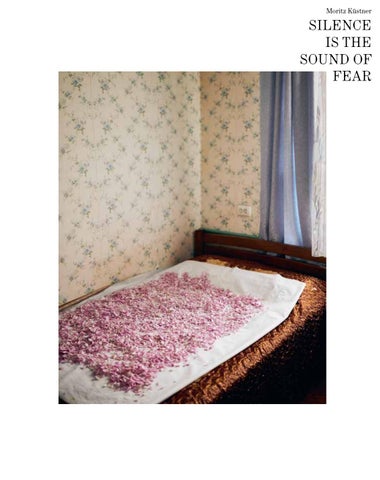
Moritz Küstner
SILENCE IS THE SOUND OF FEAR
SILENCE IS THE SOUND OF FEAR
Moritz Küstner
Diana Laarz
Introduction
When Russia annexed the Ukrainian peninsula of Crimea in March 2014, there was an ethnic group among its inhabitants who protested loudly against it: the Crimean Tatars. Their leaders called for a boycott of the referendum that would decide the future of Crimea. Many Tatars did not vote. According to official figures, 95 per cent of the Crimean inhabitants who took part in the referendum voted for annexation. Crimea became Russian, and since then the future of the Crimean Tatars has been more uncertain than it has been for a long time. Turkic-speaking Muslims have been living on the peninsula for many hundreds of years. The Crimean Tatars descend from them. It was in the Soviet Union where they experienced their most bitter defeat, which they refer to as the “Kara Gun” or, the “Black Day”. Within a few days in May 1944, Josef Stalin had more than 200,000 Tatars put into train carriages and deported to Central Asia. The accusation? Collaboration with Hitler’s Germany. Several thousand Crimean Tatars actually served on the side of the Wehrmacht, many more fought in the Red Army. During deportation, men, women, children, the old and the young were driven from their homes. Thousands died en route – and even more died in the first years after the deportation – from exhaustion and diseases like malaria and yellow fever. In Kazakhstan and Uzbekistan, their new homeland, Crimea remained a place of longing for the Tatars. Only with Gorbachev’s “glasnost” and “perestroika” did the return begin. A few weeks before Ukraine declared its independence from the Soviet Union in September 1991, the Mejlis, the political representation of the Tatars, began to organise in Crimea. In the mid-1990s, more than 250,000 Tatars were again living on the peninsula again. Since the annexation of Crimea in 2014, the Tatars have once again been living in
3
an atmosphere of fear and uncertainty. They attempted to resist the annexation to Russia – in vain. Their political organisations have been destroyed, and Mejlis’ self-governing body declared illegal. The new rulers have imprisoned Crimean Tatar activists, critics and participants in protest actions. Prominent supporters of the Tatars have been subjected to entry bans. The Tatar television station ATR has not been granted a broadcasting license. The UN Commissioner for Human Rights stated in a report that Crimean Tatars are “disproportionately persecuted by raids and trials that fall below all human rights standards”. The Crimean Tatars are now once again fighting for their place on the “green island”. Acts of civil disobedience – blockades of streets and power lines – have become rare. Tens of thousands of Crimean Tatars have fled to the Ukrainian mainland. In Kiev, they are building an alternative, autonomous government. Those Tatars who have remained in Crimea fall into two camps. Many persevere, get used to the omnipresent fear, offer quiet resistance and hope for a miracle – nothing less. Another fraction of the Crimean Tatars cooperates with the Russian authorities and continues to run its own schools and mosques. In return, the resistance forces call them “traitors”. The dispute threatens to tear the ethnic group apart. Any prospects for improvement are slim. Crimea barely plays a role in the international negotiations on the Ukrainian conflict. The government of Vladimir Putin has cemented its claim to the peninsula by building a bridge to the Russian mainland. The Tatars are left with nothing but their pride and tradition in the struggle for the island. As well as the certainty that again and again, they have always found a way to return.
4
Imprint © Moritz Küstner & Verlag Kettler, 2020
Photography Moritz Küstner Photo Editing Cale Garrido & Moritz Küstner Text Diana Laarz Design studio lindhorst-emme, Berlin Typeface Roumald by Erkin Karamemet Production Druckerei Kettler, Bönen “Silence is the Sound of Fear” was supported by the Robert Bosch Foundation and the Literarischen Colloquium Berlin within the program Grenzgänger
Published by Verlag Kettler, Dortmund www.verlag-kettler.de ISBN 978-3-86206-830-2