A BAD MOON RISING
Another iconic image is ‘Earthrise’, which was taken on Christmas Eve 1968 by astronaut William Anders during the Apollo 8 mission, the first manned spaceflight to exchange the Earth’s orbit for that of the moon. ‘Earthrise’ is the first colour image of our planet to be taken from space. Just like the ‘Blue Marble’ photograph, this picture had a direct impact in terms of raising global awareness about environmental issues. It’s no coincidence that the world’s first Earth Day event was held some 16 months later. The Apollo 8 flight was broadcast live on television that Christmas Eve and broke all viewing figures. The crew read the first ten verses from the book of Genesis – a not wholly uncontroversial gesture during a secular mission that was funded by taxpayers’ money and broadcast around the world. The astronauts concluded with the words: ‘Good night, good luck, a Merry Christmas, and God bless all of you, all of you on the good Earth.’ Cold War Warriors
Earthrise images photographed during the Japanese Kaguya mission – 2008 © JAXA
Walt Disney and Wernher von Braun – 1954 © NASA
14
Cosmonaut Yuri Gagarin took a different approach and declared on 12 April 1961, aboard Vostok 1, that he saw no evidence of a god floating above the earth. Gagarin was the first man to enter space and the first to make an orbit around the earth: a clear victory in the Space Race with America. The Soviets were also the first to succeed in sending living creatures into orbit (in 1968) and in photographing the far side of the moon (as early as 1959). Only ten years later, the American crew of Apollo 8 would become the first people to see the furthest side of the moon. This American mission, which was originally supposed to be very different, was a calculated gamble inspired by the race with the Soviet Union. Or, as the Apollo 8 commander Frank Borman would later let slip: ‘Everyone forgets that the Apollo programme wasn’t a voyage of exploration or scientific discovery, it was a battle in the Cold War and we were Cold War warriors.’ And yet Kennedy’s predecessor Dwight Eisenhower was not a huge fan of space travel in the late 1950s. The all-powerful anti-communists in the American administration, however, had predicted an apocalyptic nightmare if the Soviets gained exclusive control over space. Eisenhower was reluctantly drawn into the space race. During his farewell speech, he warned against the adverse impact of the growing military-industrial complex. In January 1961, John F. Kennedy moved into the White House and he too expressed a reluctance to expand the rocket programme, or at least at first. In April 1961, however, Yuri Gagarin made headlines around the world as the first person to enter space. Barely four days later, the invasion of the Bay of Pigs in Cuba ended in spectacular failure. Kennedy’s first six months as president were a disaster and his young, dynamic image was beginning to falter. In September 1962, he astonished both friend and foe alike by announcing that it was his dream to land a man on the moon by the end of the decade. Given that NASA was not then at the forefront of scientific developments, it was an incredibly ambitious idea. And yet the dream became a reality. All thanks to the German rocket scientist and Sturmbannführer Wernher von Braun, who had designed the V-2 missile during the Second World War. Of course, Kennedy was perfectly aware that he was hitting a sensitive chord in the attempt to realise his dream. A dream that people had fantasised about for centuries in countless stories, books, music, films and drawings. The Space Race ended when the Apollo 11 crew planted the American flag on the moon. But its origins date back to 1957, with the launch of Sputnik 1 by the Soviet Union. It was a moment that caught the entire world by surprise. Soviet launches were shrouded in secrecy until brought to a successful conclusion. The audience back home would always be given the positive news. Cosmonauts who died in the line of duty would be quietly erased from the annals. It wasn’t until the 1990s that the Soviet Union revealed they had made plans in the 1960s to land people on the moon. The state-controlled media never missed an opportunity to showcase and celebrate Soviet scientific achievements via a wealth of printed propaganda that honoured and glorified the fatherland. Yuri Gagarin became the ubiquitous poster boy for communism. And not just at home: people all over the world fell in love with his disarming smile. After his successful space voyage, he embarked upon an international victory tour that also proved popular in the West. The situation was not so very different on the American front. NASA might have communicated with greater transparency than the Soviets, but it was also in their best interests to maintain good public relations. The organisation developed a sophisticated strategy for content management and branding, by which they hoped to positively
A BAD MOON RISING
influence people’s perceptions. For example, NASA decided that all the photographs taken in space would be part of the public domain, thereby ensuring that they were distributed far and wide. And from the very beginning, they employed former journalists to determine which stories ought to be placed in the spotlight. One of the most remarkable collaborations of all, however, was that between NASA and Life magazine. Proud, Thrilled, Happy
USSR propaganda poster: ‘Glory to the Soviet people – pioneers of space!’
Cover of Life magazine – 21 September 1959
Unknown photographer
15
In 1957, the famous and influential Life magazine paid the Mercury 7 astronauts a total of $500,000 for stories about their private lives. A glamorous group portrait of ‘the astronaut wives’ appeared on the cover in 1959, accompanied by the words: ‘Their inner thoughts and worries’. The astronauts’ wives became celebrities in their own right, almost like ‘reality stars’ before the term had even been invented. The magazine painted a picture that was all apple pies and cocktail dresses, and printed photographs of the immaculately dressed women lovingly tending their children in stylish living rooms. The astronauts, in turn, were portrayed as caring boy scouts (it was not until 1983 that a female American astronaut entered space for the first time). The Friendship 7 mission of 1962 saw the first American enter into orbit. Rene Carpenter, the wife of the chosen astronaut, John Glenn, discussed her feelings about this triumph in great detail across several editions of Life magazine. Carpenter would later confess that there were occasions when she and her children would flee the house in secret to avoid the journalists camped outside and their barrage of questions: ‘At the end, we often feel emotionally drained. We tend to fall back on the comfortable phrases and words, like “happy, proud and thrilled.”’ The wives of the Apollo 12 astronauts would later poke fun of this ritual by wearing identical clothes, backcombing their hair and holding up placards carrying the same message. The astronauts themselves were forbidden from talking about the missions during this period, but the personal background stories and accompanying photographs were priceless tools by which NASA could showcase the righteousness of the astronauts and thus of the entire project. Photographer Ralph Morse, whom John Glenn lovingly called ‘the eighth astronaut’, documented the preparations and private lives of the astronauts and their families for 30 years on behalf of Life. These reportages were relatively innocuous: the men were heroes and nothing would be allowed to detract from this fact. The first issue of (the renewed) Life appeared in 1936. Radio and newspapers were the dominant news mediums at the time, but Life soon became famous for its visual imagery. At its peak in the 1950s, some seven million copies were read by more than 20 million people. The weekly magazine had cornered the market in high-quality photo reportage. Often featuring bold layouts, the pages were constructed around the images. All the best international photographers wanted to work for Life and the magazine, in turn, was responsible for launching countless careers. Life played a pioneering role in communicating stories through images and almost single-handedly created the genre of the photo essay. Important events such as the Great Depression and the Second World War were captured in photographs so powerful that they became almost instant icons. But the photojournalism fairy tale was destined to end. From the end of the 1940s onwards, the new medium of television started to gain ground. While newspapers remained the dominant force in terms of newsgathering, television provided entertainment and the rapid retransmission of images. Life couldn’t hope to compete against the irresistible combination of image, sound and movement and, from the late 1950s onwards, its influence began to wane. The coverage of Kennedy’s assassination was a breakthrough for television news and the Vietnam War was the first conflict to be broadcast directly into people’s living rooms. Life closed in 1972. It was relaunched as a monthly magazine in 1978, but was never able to recapture its topical relevance. This was the era in which television swallowed up both the radio and the magazines. A new invention – videotape – also made the collection and distribution of audiovisual material much cheaper and simpler. And satellites have been beaming images from one side of the world to the other at lightning speed since 1968, thus marking the start of what has since become an insatiable ‘global village’. It is almost impossible to imagine, in the age of the internet, the enormous impact of the live broadcast from the moon in 1969. On a fraction of the number of screens that are
14 June 1969 © NASA
‘Here men from the planet Earth first set foot upon the Moon – July 1969, A.D. – We came in peace for all mankind.’ A NASA technician is about to attach a plaque to the Apollo 11 lunar lander. This text was also read by the astronauts during the live television broadcast of the moon walk. The plaque was left on the moon.
18
36
INTERIOR OF THE APOLLO 11 COMMAND MODULE – 1969 © NASA
UNKNOWN PHOTOGRAPHER
62
72
ROBERT PUFLEB & NADINE SCHLIEPER (GERMANY) – ALTERNATIVE MOONS – 2017
The 40 cosmic landscapes in the series Alternative Moons play with our perception and are an ode to human imagination. The moon has always been a source of speculation, but it is not immediately clear what we are looking in these fictitious pictures. The seemingly familiar landscape of craters and plains appears to have a very earthly origin: we are not looking at a celestial body but at close-ups of pancakes, meticulously photographed in the studio, in order to create the perfect illusion.
73
JOJAKIM CORTIS & ADRIAN SONDEREGGER (SWITZERLAND) – MAKING OF AS11-40-5878 (BY EDWIN ALDRIN, 1969) – 2014
For their Icons series, Cortis & Sonderegger built ingenious 3D scale models in their studio and set about creating photographic illusions. In this way, they reworked some of the most iconic and influential images in the history of photography. The meticulously staged shots would be difficult to differentiate from the original images were it not for the fact that the camera has been pulled back to reveal the behind-the-scenes construction work. In the age of alternative truths, the work thus alludes to current themes such as photographic manipulation and the authenticity of images.
88
89
96
JOAN FONTCUBERTA (SPAIN) – IMAGE FROM SPUTNIK – 1998
97
EUROPEAN SPACE AGENCY – LUNAR BASE MADE WITH 3D PRINTING – 2013 © ESA / Foster + Partners
With the help of a 3D printer, the European Space Agency (ESA) wants to create a future lunar base that can be built with local raw materials. On the right, you can see the robot-controlled printer. According to the ESA, the Moon Village project was not established with the aim of colonising the moon. However, it does want to develop an environment in which governments, scientists and private partners can conduct research. Moon Village is an emphatically cooperative concept: ESA is currently working on a close collaboration with the China National Space Administration (CNSA).
142
ADOLPHE NEYT (BELGIUM) – ATLAS PHOTOGRAPHIQUE DE LA LUNE – 1869
The lunar atlas by the Belgian industrialist Adolphe Neyt (1830-1892) consists of 12 albumen prints of the moon’s surface. He placed his signature on each negative in an elegant arch, following the curve of the moon. To make the prints, Neyt established a private observatory in Ghent. As an amateur photographer he was fascinated by the new developments in photography, a technology that was only 30 years old at the time. He focused on astronomical and microscopic subjects.
143
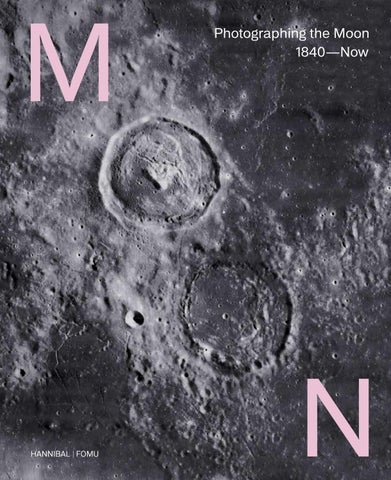
Dit boek werd uitgegeven naar aanleiding van de tentoonstelling Maan / Moon in FOMU – Fotomuseum Antwerpen van 28 juni 2019 tot 6 oktober 2019. FOMU-DIRECTEUR
Elviera Velghe CONCEPT, EDITING EN SELECTIE
Maarten Dings Joachim Naudts
We willen onze dank betuigen aan alle kunstenaars, fotografen, uitgevers, auteurs, collecties en archieven die dit boek mee mogelijk maakten. Veel mensen hielpen ons ook met feedback, aanbevelingen en discussies of met het opsporen van de verblijfplaats van bepaalde objecten. We danken hen allemaal, maar in het bijzonder: Saskia Asser, James Attlee, Daina Bouquin, Bernd Brunner, Michiel Demaeght, Rein Deslé, Duncan Forbes, Pascale Goossens, Hilde Langenaken, Luce Lebart, Ingrid Leonard, Frédérique Morré, Gautier Platteau, Hans Rooseboom, Kim Schepens, Andrew Smith, Yves Torfs, Hadewych Van den Bossche, Lander Van Neygen, Martin van Vreden, Elviera Velghe, Els Veraverbeke, Pieter-Jan Verheyen, Wilco Versteeg, Caroline Vincart, Guy Voet
AUTEURS
James Attlee Maarten Dings Joachim Naudts Wilco Versteeg VERTALING
Hilde Pauwels COVERONTWERP
Natacha Hofman Onze oprechte dank gaat uit naar het Archive of Modern Conflict voor de steun en de toestemming om een afbeelding van Léon Gimpel als cover te gebruiken.
VORMGEVING
Tim Bisschop EINDREDACTIE
Pascale Goossens We danken ook de teams van het FOMU en van Hannibal en hun interne medewerkers en vrijwilligers voor hun medewerking aan de totstandkoming van deze publicatie en de tentoonstelling.
PROJECTCOÖRDINATIE HANNIBAL
Pascale Goossens DRUK
die Keure, Brugge, België BINDWERK
Abbringh, Groningen, Nederland ISBN 978 94 9267 779 2 D/2019/11922/3 NUR 653 Copyright © 2019 Uitgeverij Hannibal / FOMU – Fotomuseum Antwerpen Copyright © 2019 Foto’s: de fotografen en hun rechthebbenden Copyright © 2019 Teksten: de auteurs Alle rechten voorbehouden voor alle landen. Niets uit deze uitgave mag worden verveelvoudigd, opgeslagen in een geautomatiseerd gegevensbestand en/of openbaar gemaakt in enige vorm of op enige wijze, hetzij elektronisch, mechanisch of op enige andere manier, zonder voorafgaande schriftelijke toestemming van de auteurs, de uitgever en FOMU. FOMU heeft geprobeerd voor alle beelden die in deze publicatie en tentoonstelling voorkomen de wettelijke voorschriften inzake copyright toe te passen. Wie meent nog rechten te kunnen laten gelden, wordt verzocht zich te wenden tot FOMU – Fotomuseum Antwerpen, Elviera Velghe, Waalsekaai 47, 2000 Antwerpen.
HANNIBAL
De Museumstichting FOMU – Fotomuseum Antwerpen Waalsekaai 47 2000 Antwerpen info@fomu.be – www.fomu.be Uitgeverij Hannibal Appelmarkt 8 8630 Veurne www.uitgeverijhannibal.be Uitgeverij Hannibal maakt deel uit van Uitgeverij Kannibaal