For Nandini, Naintara and Naira This book originated from a series of journeys made over decades to the Kameng region of Arunachal Pradesh. These were travels for more than a few reasons: a reconnaissance for a film in the making (it hasn’t been made yet), an expedition to where my wife lived as a child (she did remember the house), a trip to investigate temperate and monopodial bamboo, and a memorable series of visits for motor rallies. The list grew longer and more varied; any and every opportunity would do. Over time and very slowly, the idea of a book began to emerge. It coincided with my growing interest in photography, and in the Monpas and their way of life. The book owes much to friends from Arunachal, who good-humouredly indulged a growing fascination. They patiently put up with never-ending queries and brought in an ever-expanding circle of family and friends. It helped that many of them were restless travellers too, happiest behind a steering wheel on the road going anywhere and everywhere, sometimes even nowhere. I owe a lot to Lhakpa Tsering Gonpapa and to Oken Tayeng, who are both friends and family. Without them, the book would certainly not have been possible. Nor would it have been so much fun. Ameya Abhyankar, Chombay Kee, Dorjee Chom, Geshe Ngawang, Tashi Bapu, Gurbaaz Singh Takkar, Loup Mourier, Ngawang Choidraks, Omak Apang, Pema Edron, Phurpa Tsering, Rajesh Thakur, Ravi Singh, Rinchen Khandu, Rinchin Wangchuk, Sadhana Deori, Sagar Kalsi, Sang Phuntsok, Sonali Ghosh, Sonam Chombay, Sujatha Prasad, Tsering Gyurme, Tenzing Yankee Gonpapa, Urgen Tsering Serthipa, Yeshe Tsering and Yeshe Namgey provided encouragement, good advice, insights, knowledge, and abundant and often overflowing hospitality. Their inputs went into the shaping and making of the book.
On the road from Se La towards Tawang. Winter is particularly harsh here; snow chains on vehicle tyres are fitted well short of reaching the ascent. On the descent, drivers are especially careful, mindful of the road, of melting snow and foggy conditions.
Contents Foreword by His Holiness the Fourteenth Dalai Lama
9
Message from the Chief Minister of Arunachal Pradesh
11
I. The Colours of Monyul
13
II. The Monpas: Sturdy Highlanders
16
III. The Monpas and their Mountains
46
IV.
Faith and Belief
69
V.
House, Home and Hearth
102
VI.
From the Land
127
VII. The Monastery in the Mountains
147
VIII. Torgya: The Festival of Masked Dances
180
Glossary 198
I
The Colours Of Monyul This book is about the Monpas, the sturdy highlanders of the eastern Himalayas. It is about them and Monyul, their land. It is about their way of life and the fundamentality of their faith. It is about the challenging environment in which their small, close-knit communities exist and thrive. Till the middle of the twentieth century there had been little change. Since then, in a generation or two, there has been a rapid and accelerating transformation. It has been a fascinating experience to witness, and an incentive to document old practices as well as new.
I
A lama in a distinctive Geluk yellow hat with a brass receptacle in his hand.
n lore and legend, Monyul is the ‘lower region’, the land that extends southward from the Tibetan plateau and across the crests of the Himalayan mountain ranges into India. The Himalayas are a consequence of dramatic tectonic movement over millions of years. The disintegration of Gondwanaland, the mother continent, began recently, a mere hundred and fifty million years ago. A piece broke away to embark northwards, moving inexorably to a collision with the landmass of Asia. This was to become the Indian subcontinent, its northern borders delineated by the fabled mountain range. Deriving their name from the Sanskrit ‘him-alaya’, the abode of snow, the mountains are a young formation, still pushing upward, outward and northward at a geological gallop measured in centimetres. They have long been perceived as a natural barrier, bulwarks against ingress from the north, protectors of India and a way of life. Yet, the Himalayas were not impenetrable – not to pilgrims, travellers, merchants, explorers and scholars, not even to migrating populations. Not so long ago, pathways and tracks enabled the exchange of culture and goods. They no longer do so, as borders have become rigid and closed. Centuries-old cultural, religious and political bonds were severed with the tumultuous events of the mid-twentieth century in Tibet. The fourteenth Dalai Lama found refuge in India; with a closeknit group of followers, he entered Monyul through Khenzimane on India’s northern border. Nearly three centuries before that, a boy from a village near Tawang had crossed the Himalayas in the reverse direction at Bum La. He was on his way to Lhasa for enthronement as the sixth Dalai Lama. In only a few decades, much has altered. The lives of the Monpas have been transformed irrevocably. A relatively insular society has been thrown open by the winds of change, by connection with the outside world, people and cultures. Technology, communication, road networks have all made it easier. Some features have been unvarying: the adherence to the faith, the importance of the lamas, the venerated Buddhist monks, and their role in matters big and small, the enthusiasm with which festivals are celebrated. The community still gets together, sometimes for days, in celebration of religious occasions and for every event in the journey of birth, life, marriage and death. Festivals are occasions for gaiety and colour, each village seeking to outdo the other in the vibrancy of the attire and the dances. All through the year, through changing seasons, altitude and terrain, nature is at work with her palette, shifting colour and hue, tint and tinge. Change comes gradually, over the last weeks of spring, or when autumn begins to turn into winter. Sometimes landscapes shift dramatically and overnight – when snowfall blankets the earth or when the first showers arrive. The people’s clothes, shawls, shoulder bags, dresses and jackets, necklaces and earrings are vibrant. Women wear shingkas, elegant pink-and-white striped gowns, traditionally stitched from the madderdyed cloth woven on a backstrap loom. From the same looms emerge distinctive Monpa bags, in five or more colours. Men are resplendent in black or red wool jackets, resonant and rich. 11
I
The Colours Of Monyul This book is about the Monpas, the sturdy highlanders of the eastern Himalayas. It is about them and Monyul, their land. It is about their way of life and the fundamentality of their faith. It is about the challenging environment in which their small, close-knit communities exist and thrive. Till the middle of the twentieth century there had been little change. Since then, in a generation or two, there has been a rapid and accelerating transformation. It has been a fascinating experience to witness, and an incentive to document old practices as well as new.
I
A lama in a distinctive Geluk yellow hat with a brass receptacle in his hand.
n lore and legend, Monyul is the ‘lower region’, the land that extends southward from the Tibetan plateau and across the crests of the Himalayan mountain ranges into India. The Himalayas are a consequence of dramatic tectonic movement over millions of years. The disintegration of Gondwanaland, the mother continent, began recently, a mere hundred and fifty million years ago. A piece broke away to embark northwards, moving inexorably to a collision with the landmass of Asia. This was to become the Indian subcontinent, its northern borders delineated by the fabled mountain range. Deriving their name from the Sanskrit ‘him-alaya’, the abode of snow, the mountains are a young formation, still pushing upward, outward and northward at a geological gallop measured in centimetres. They have long been perceived as a natural barrier, bulwarks against ingress from the north, protectors of India and a way of life. Yet, the Himalayas were not impenetrable – not to pilgrims, travellers, merchants, explorers and scholars, not even to migrating populations. Not so long ago, pathways and tracks enabled the exchange of culture and goods. They no longer do so, as borders have become rigid and closed. Centuries-old cultural, religious and political bonds were severed with the tumultuous events of the mid-twentieth century in Tibet. The fourteenth Dalai Lama found refuge in India; with a closeknit group of followers, he entered Monyul through Khenzimane on India’s northern border. Nearly three centuries before that, a boy from a village near Tawang had crossed the Himalayas in the reverse direction at Bum La. He was on his way to Lhasa for enthronement as the sixth Dalai Lama. In only a few decades, much has altered. The lives of the Monpas have been transformed irrevocably. A relatively insular society has been thrown open by the winds of change, by connection with the outside world, people and cultures. Technology, communication, road networks have all made it easier. Some features have been unvarying: the adherence to the faith, the importance of the lamas, the venerated Buddhist monks, and their role in matters big and small, the enthusiasm with which festivals are celebrated. The community still gets together, sometimes for days, in celebration of religious occasions and for every event in the journey of birth, life, marriage and death. Festivals are occasions for gaiety and colour, each village seeking to outdo the other in the vibrancy of the attire and the dances. All through the year, through changing seasons, altitude and terrain, nature is at work with her palette, shifting colour and hue, tint and tinge. Change comes gradually, over the last weeks of spring, or when autumn begins to turn into winter. Sometimes landscapes shift dramatically and overnight – when snowfall blankets the earth or when the first showers arrive. The people’s clothes, shawls, shoulder bags, dresses and jackets, necklaces and earrings are vibrant. Women wear shingkas, elegant pink-and-white striped gowns, traditionally stitched from the madderdyed cloth woven on a backstrap loom. From the same looms emerge distinctive Monpa bags, in five or more colours. Men are resplendent in black or red wool jackets, resonant and rich. 11
12
13
12
13
II
The Monpas Sturdy Highlanders
The landscape is fascinating, the diversity of flora enthralling, but it is the Monpas who have attracted me most to the region. Over time, I have forged bonds of familiarity and friendship, and begun to comprehend the layers and nuances of their lives and relationships. I found them to be delightful people, who may lapse into moody philosophical discourse, then break the sombreness with laughter. Soft-spoken and gentle, deferential to elders and the learned, they were unfailingly hospitable to me. A visit to a Monpa family, whether to an imposing stone structure or to a herder’s hut, was incomplete without the partaking of rice (or millet or barley, even maize) beer, or of yak butter tea (sweetened and milky for plains-people). And laughter.
W
ell over two-thirds of the Monpas live in Arunachal Pradesh, in a contiguous belt in the upper Himalayas. A fifth live to the north, in Tibet, with whom there are fewer and fading links. A significant cluster reside in eastern Bhutan, with enduring ties to their Indian brethren. Most are Buddhists of the Mahayana school, following the traditions of the ‘yellow hat’ Geluk school founded by Tibetan philosopher Tsongkhapa, or those of the ‘red hat’ Nyingma school established by Guru Padmasambhava. Some are adherents of pre-Buddhist Bon traditions. Monpas are gently protective and proud of their faith. There are differences amongst the Monpas – of dialect, in dress, in food and drink. These are outweighed by the commonalities; there is, overall, a Monpa way of life. The spread of education and opportunity has altered old rhythms. Horizons have widened and aspirations enlarged. New ways of doing tasks have emerged. Technology has wrought change in their lives and livelihoods. The ubiquitous mobile phone has enabled unprecedented connection; the network of cell phone towers has marred attractive landscapes. Motor vehicles and motorcyclists move along roads that are still challenging, terrain and topography that is demanding. Scarred hillsides testify to frenetic road-building, weatherbeaten maintenance crews to the difficulties of upkeep. Some travellers come to Monyul in search of employment, others are tourists and trekkers. Visitors and sightseers rarely stay long; workers do, melting occasionally into the population. It is the women who keep the graceful and colourful Monpa traditions of dress alive, not just on special occasions but as functional, everyday attire too. At community events and festivals, or to honour a visiting dignitary, men also emerge in their formals and finery of striking maroon or black jackets.
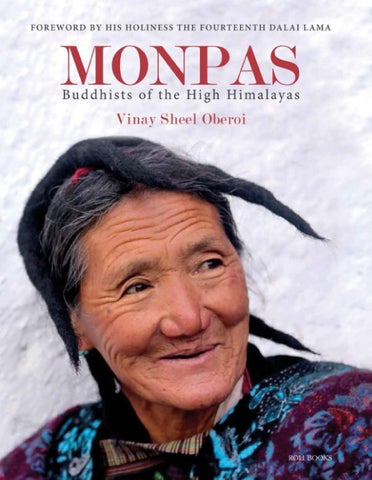
A Tawang Monpa returning from a visit to the monastery. Her handwoven traditional shawl is draped over the shingka; the tasseled hat keeps the snow and rain out.
Pankang Teng Tso is easily accessible from Tawang – just about an hour away in conducive weather and road conditions – and extremely popular with tourists.
Pankang Teng Tso is easily accessible from Tawang – just about an hour away in conducive weather and road conditions – and extremely popular with tourists.
The long and winding roads
R
oad-building in the Eastern Himalayas has never been easy, nor has maintenance. Till recently, in most places there were only tracks and paths, well worn by pilgrims, merchants and the itinerant traveller. The surge of road building led initially to trunk and lateral roads; villages and even remote settlements are now connected by weather-resilient routes. The expanding network means transporting produce to the market is quicker and easier than it used to be. Schools, hospitals and clinics are now within reach instead of at the end of an exhausting journey. Roads are, quite literally, carved through the hillsides. They can take several seasons to stabilize, testing the fortitude of even the most stoic and patient. Travellers still prudently recite a prayer before embarking on a journey. A typical winter view is a snow-clad road coiling across the Se La pass, where the gradient is easy and the drop is easier to navigate. Most drivers, with the exception of the truly skilled and confident, prefer to negotiate the pass before midday as after that the weather is less predictable. The road maintenance parties – vigilant angels of the high roads – mainly comprise women. They keep the road clear and the traffic moving all year round, even in the most adverse conditions.
64
Above: A truck lumbers along a newly-built road. Facing page, above: A snow clad road coiling across the Se La pass. Facing page, below: Vehicles strain through the snow on the road to Taktsang Gompa.
Khadas
Offering reverence
K
hadas, ceremonial silk scarves, are offered as a mark of respect and humility. They may be offered in gratitude, in welcome or even to celebrate an event, a journey, a rite of passage. They can be in any of the five ordained colours of white, red, yellow, green or blue, or even multicoloured. But more often than not, they are white, emphasizing the purity and compassion in the act of offering them. There is a protocol, tradition and courtesy in presenting a khada. For high lamas, teachers, dignitaries and elders of the community, the scarf is not placed around the neck but presented with humility and reverence – palms joined together near the forehead, and the body bent from the waist. The khada is vertically folded in half and offered with the open edges facing the person to whom the submission is made. The distinguished personage ceremonially returns the khada with a gesture of acknowledgement and a blessing to the giver. Khadas are also often tied to chortens, manis and prayer wheels, to doors, trees and even rocks. Vertically strung prayer flags have a khada or two tied at the base, most often by the person who has placed the flags, occasionally by a passerby. Households maintain a stock of khadas, so as to never be caught embarrassingly short of the scarves when needed for guests and family, for dignitaries and lamas. A visit to the gompa will need many to be tied to the kakaling – the grand gate of the monastery – placed on the altar, and presented to the lamas sitting in prayer.
84
Facing page: In the late afternoon, in weakening sunshine, a group of women sit outside the gompa in prayer. They lean forward in unison, chanting ‘Om Mani Padme Hum’. A passing vehicle momentarily distracts them – one looks out towards the road, the others face the gompa. The vehicle passes and the prayers recommence.
A snow-clad grazing ground for yaks, high above Tawang and bedecked with prayer flags. It is early in the morning. Even so, the sun’s rays are strong, spreading light and warmth. The yak herd will soon troop in from their refuge. They may feed on the few tufts of grass, or modestly bask in the sunshine.
A snow-clad grazing ground for yaks, high above Tawang and bedecked with prayer flags. It is early in the morning. Even so, the sun’s rays are strong, spreading light and warmth. The yak herd will soon troop in from their refuge. They may feed on the few tufts of grass, or modestly bask in the sunshine.
Above: Among the most popular performances is the Gon-Nyin chham, performed by eleven dancers representing the dakinis, the female protectors of the dharma. Each holds a ritual bell and a damaru, a small two-headed drum. Demons create impediments in the advancement of the Buddhist doctrine; the dakinis divert their attention so that the tenets of Buddhism can continue to flourish. Below: Performers awaiting their turn. Facing page: The Gon-Nyin chham in progress.
192
The Khenpo Rinpoche, Gongkar Tulku, presents the serkyem, a ritual offering of drink, to the masked deities who file past him. The masked figure standing by is Shinje Shey, or Yamantaka, the destroyer of death. Led by the Rinpoche, the congregation moves beyond the monastery wall where the flames are already leaping high, to submit the ritual cake, the torma, and all evil spirits to the fire. Following pages: A procession of yellow-hatted monks files past at the Torgya.
The Khenpo Rinpoche, Gongkar Tulku, presents the serkyem, a ritual offering of drink, to the masked deities who file past him. The masked figure standing by is Shinje Shey, or Yamantaka, the destroyer of death. Led by the Rinpoche, the congregation moves beyond the monastery wall where the flames are already leaping high, to submit the ritual cake, the torma, and all evil spirits to the fire. Following pages: A procession of yellow-hatted monks files past at the Torgya.
This book is supported by the Department of Tourism, Government of Arunachal Pradesh
All rights are reserved. No part of this publication may be transmitted or reproduced in any form or by any means without prior permission from the author. SHOWCASE A Roli Books imprint for titles sponsored by individuals or organizations. © Roli Books, 2021 First published by Roli Books M-75, Greater Kailash II Market New Delhi-110 048, India Phone: ++91-11-4068 2000 E-mail: info@rolibooks.com Website: www.rolibooks.com ISBN: 978-81-944257-9-3 Editor: Ekta Chadha Pre-press: Jyoti Dey Production: Lavinia Rao Printed and bound in India