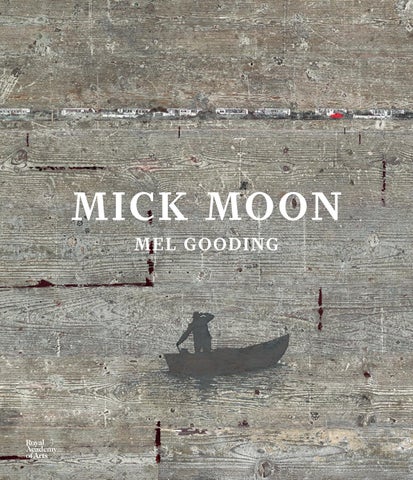
MICK MOON MEL GOODING
Contents Foreword
6
INTRO DU C TIO N
Starting with What You See
11
PA RT I
Ideas and Investigations: The Early Work
17
PA RT II
The Hanging Paintings
29
PA RT III
Abstractions, Things, Evocations
51
PA RT IV
The Late Works
103
Chronology Endnotes Exhibition History Works in Public Collections Select Bibliography Index Photographic Acknowledgements
150 156 156 157 157 158 159
Foreword In 1968 Mick Moon moved into the top-floor studio of a large house in Addison Gardens, West London. The house belonged to Howard Hodgkin, who had used the studio himself before moving to the country. Working in the studio downstairs was Mick’s friend Patrick Caulfield. That year Mick arranged a studio exhibition of his recent paintings and another friend, John Hoyland, brought along his dealer, Leslie Waddington. This visit led to a contract with the fledgling Waddington Gallery, which already represented Hodgkin, Hoyland and Caulfield. Three exhibitions of Mick Moon’s paintings followed in quick succession, one of them bought in its entirety by Alistair McAlpine, then the most prolific collector of contemporary art in Britain. This in turn led to an exhibition at the Tate Gallery in 1976. I joined Waddington Galleries in late 1972 with the responsibility of looking after their nascent print publishing programme. At that point I was less familiar with Mick’s work than with that of the other three artists, but I quickly developed an affinity for it. My arrival coincided with the period in which Mick had turned towards the actual contents of his studio as a means of creative expression. Process and content were fusing as he literally took impressions of the studio furniture − floorboards, doors etc. − as the bedrock of his paintings. I was intrigued by the way this elemental printmaking, not so different from brass rubbing or monotyping, not only underpinned the paintings but also became transmuted into its subject-matter. In the exhibition that accompanies this book there is a strikingly simple example of this lifelong transmogrification, with the floorboards of his studio in Peckham reappearing in the form of the Indian Ocean − from the mundane to the infinite.
His father had been in the army in India. Mick’s wife was Indian. He travelled to India for the first time to visit her relatives and it was there that he discovered, both from life on the street and through Indian miniatures, the vivid and intense colour that came to infuse his work. He was drawn to the East End of London, where ships would arrive from the subcontinent, bearing not only goods from India but also Indian migrants who then settled there. He became fascinated by displacement, both people and artefacts finding a home a long way from their roots. Throughout the 1980s and ’90s the materials from his studio served to conjure up a stream of paintings and painted monoprints that bore testament to this sense of displaced existence and, because printing was such a basic ingredient of his working methods, it was natural that he and I should be drawn closer and closer together in our working lives. I dealt in the paintings and distributed editions of prints, which regularly featured at both the gallery and at art fairs abroad, where they invariably proved highly successful commercially. Indeed, the vast majority were sold abroad, which is why they have remained relatively unknown in Britain. Besides, Mick has always chosen to live out his life away from the public eye, maintaining a healthy lack of interest in the glitz, glamour and hyperbole of the contemporary art world, preferring the company of fellow artists to that of dealers or collectors. For an artist of such stature, this monograph is long overdue and, after a personal association that has lasted over 40 years, it seems fitting that it should be published to coincide with an exhibition of his latest paintings at my gallery. Alan Cristea, 2019
Opposite: 1 East, 1996 Print, 120 x 91 cm
6
PA RT I
Ideas and Investigations: The Early Work ‘Abstract? To be an abstract painter does not mean to abstract from naturally occurring opportunities for comparison, but to distil pure pictorial relations.’ Paul Klee1 ‘The only valid thing in art is that which cannot be explained.’ Georges Braque2
The Thinking Eye Mick Moon has always been a philosophical painter. This might be taken to imply a certain cerebral quality to his approach both in technical matters (often complicated and carefully premeditated) and in his thematic preoccupations (constant for long periods, and through changes of manner), but in fact his paintings have always made an immediately direct, even visceral impact. They surprise and sometimes perplex the viewer, but they always bring a visual pleasure compounded of fact (the physical fact of their presence) and mystery: they are at once intensely material, powerful physical presences, and indeterminate in their imagery, which hovers at the bound of intelligibility and ambiguity. They are obscure objects of desire. From the mid-1970s, after the cessation of what he called the ‘strip paintings’, through to about 2010, the initiation of the ‘wood-grain as water’ paintings, his work has been obdurately objective and tangible, even confrontational. I mean by this that Moon’s paintings from this long period of creative diversity do not behave in the way that paintings tend to do in your presence; they beguile the eye, but do not easily or immediately
disclose their secrets. They demand attention, a constant movement of the eye and mind from surface to image, from layer to layer of matter, from recognisable, if enigmatic, object to indeterminate space or painterly opacity. Diversely printed and collaged, or directly imprinted, with stencilled lettering or signs on the surface, painted (from expressionist scribble to trompe l’oeil) and meticulously drawn, they are works that challenge the spectator to speculatively read their meanings or invent interpretations. Just as the mind grasps a coherence, they slide into ambiguity, as the eye seeks (and finds) a new configuration of forms, patterns, images, colours and textures. They are certainly things, with a distinctive and complex ‘thinginess’. After National Service, Moon studied at Chelsea School of Art, a college associated always and most particularly with painting, and having passed through the Royal College graduate school for one year without touching the sides, in the autumn of 1963 he was invited back to teach at Chelsea by the Principal, Lawrence Gowing, a somewhat conventional artist, but a teacher, art historian and art school administrator of great
Ideas and Investigations: The Early Work
17
intellectual distinction. He had clearly seen that Moon would bring to teaching a perceptive and intelligent eye and an acute and experimental approach to the problematics of painting. Gowing was gathering around him at that time a brilliant cohort of young artists to work alongside the established artists (Ceri Richards, Prunella Clough, Leon Kossoff, Jack Smith, Tony Whishaw among them) who had maintained Chelsea’s reputation as one of the great London colleges. These younger artists included Jeremy Moon (no relation), John Hoyland, Antony Donaldson, Allen Jones and Patrick Caulfield. For the young Moon it was a time of great excitement, and it was at Chelsea that he made, with Hoyland and Caulfield, the two closest and longest lasting artistic friendships of his life. Both played a part in Moon’s formation and development as a painter, though in each case their influence was mediated by way of working proximity, good company and conversation; it was deeply assimilated and not in any immediate way stylistic. The ironic literalist Caulfield was coolly systematic, a slow and painstaking worker who aimed for absolute clarity of image, a perfect almost industrial simplicity of surface, and more or less banal subject-matter (things known to the eye: formulaic images from comics and school books, cliché still-life objects, studio and other interiors, modern designer furniture and windows); Hoyland the passionate abstractionist immersed himself in energetic serial adventures in expansive planes of acrylic colour and dramatic atmospheres of light, space and matter. In different and unexpected ways, consciously and unconsciously, while entirely absorbed by his own quite specific and inner-directed preoccupations and determinations, Moon was to use aspects of the art of both friends in his own work. As he moved from the carefully judged hard-edge impeccable planes of shifting colour-tone of his early strip paintings to the intractable and messy imprinted surfaces of the mid-70s ‘painting-objects’ and ‘object-paintings’, and the paintings thereafter, to the apparition imagery of later collagepaintings, to the imprinted wood-grain-as-water paintings of the last few years, it was in Moon’s artistic nature − open and assimilative, concentrated and closely focused − to conduct this conversation, and to utilise in a profoundly personal way his awareness, without any need to suggest (let alone theorise) affinities, or to adopt or adapt stylistic devices or mannerisms. Their artistic relations were a matter of mind and of attitude rather than of manner and artifice, of consonances deeper than style. They brought a creative conviction to his uniquely personal, periodically changing, project, to a body of work always driven by a reflective originality. It was a project that began in earnest in 1967, with the making of the first of the so-called strip paintings. It was a late start: Moon was already thirty years old. What work he had done before this cannot have been entirely unimpressive, if his career at Chelsea and the Royal College, and his appointment
18
to the stellar staff at Chelsea were any indication. But it has been Moon’s decision from early on in his career to present the making of the strip paintings as its real beginning. It is the first body of work that he deems worthy of retrospective critical consideration. Its programme (and in this case, that term is wholly appropriate) was laid down with the first painting, in what became a series of perhaps fifteen works executed over a period of about five years, from late 1967 to 1972, when he brought it to an abrupt stop. First Strip (1967; fig. 5) was an experiment undertaken after Moon had looked again at the pedagogic notebooks of Paul Klee, an artist he had admired for many years, gathered together in his great book of practical theory, The Thinking Eye. It is clear that Moon was looking for a creative focus, for some clue as to what he might do that was not merely arbitrary. ‘Begin with an empty canvas and see what happens’ was still a starting point for many artists at this time: the history of post-war abstraction, and the instinctively automatic procedures of both tachisme and ‘action painting’ had left the field open to such freedom from purposeful forethought. It was not an option for Moon, even in the modified forms of Greenberg’s much vaunted ‘post-painterly abstraction’, whose primary qualities of ‘clarity and openness’ were those that at that moment Moon might have been inclined to favour. (Certainly there were significant contemporary colleagues − Hoyland and Jeremy Moon among them − whose work was within that ambit.) Moon was himself temperamentally inclined to the adoption of premeditated constraint. In this respect his prolonged engagement with the strip paintings − and his working of this mode to exhaustion − was indicative of his modus operandi thereafter. Horizon light: horizon colour Klee’s thinking was of a depth and richness that deeply affected Moon. In particular, he responded to Klee’s concept of art as essentially philosophical: as an experimental quest for, and demonstration of, correspondences between systematic graphic and painterly devices and ontological and metaphysical realities; and those between a material expression of relationships (as between colour, tone, interval, number, etc.) and the spatial and energetic realities of being and moving in the world (fig. 8). Especially, Klee was fascinated (one might say obsessed) with the ways in which gradations might chart and formally symbolise movements between one extreme of existence and its opposite: black to white; dark to light; bottom to top; deep earth to infinite air; density to clarity; chaos to order; origination to finality; etc. That we see these relations in terms of movement implies that they may be understood therefore as representations of the ineluctable modality of the temporal: that the graphic or painterly ‘pictorial form’, however abstract, may thus encompass the implication, or even the presentation of the tragic.
His final written thesis at Chelsea had been on the subject of Georges Braque’s late studio paintings, works which have never ceased to preoccupy his imagination, and whose philosophical potentialities are closely aligned with those that have animated his own painting to this day. Over time, and through many phases of work, Moon has progressively shifted his immediate creative gaze away from the rich confines of the artist’s studio, into other rooms haunted by other voices than those of Braque and Klee, to landscapes and urban places, and finally to the mysterious marine vistas of his latest work. But his essential philosophical focus has been utterly consistent: how can painting be truthful to experience, and transform the subjective immediacy of the incomplete and transitory moment, the here and now of the primary world, into a revelatory object that somehow both encapsulates and escapes time? North Light (1975; fig. 14) was the first successful work to emerge from the new approach. Nearly twelve feet by eight
14 North Light, 1975 Acrylic on mixed materials, 246.4 x 355.6 cm Courtesy Waddington Custot, London
feet, it is a magnificent object that intends to memorialise the light that enters the studio window − the ‘north light’ of the title, the diffuse indirect sunlight favoured by artists − whose angle of fall might be suggested by the diagonal edge at lower left. Nothing could be further in presence or appearance from the immaculate formalities of the finely calibrated strip paintings. And yet a persistence of interest in the phenomenal world, its variegation and light, is indicated by the title. Of course: Moon had no intention of relinquishing his central artistic interest in the ineluctable actualities of seeing and being as the essential subject of his artistic transformations. The diagonal light through the enlarged studio window is the light of the world beyond.
Ideas and Investigations: The Early Work
25
Left: 15 Double Glaze, 1996 Acrylic on canvas, 226 x 243.8 cm Courtesy Waddington Custot, London Below: 16 Top Light, 1976 (detail) Acrylic on canvas with polythene, 139.7 x 127 cm Courtesy Waddington Custot, London
26
PA RT I I
The Hanging Paintings ‘Life then becomes a perpetual revelation.’ Georges Braque1
An exemplary table There appears to have been no ordered progression in the making of the work in the transitional period between 1973 and 1978, when Moon finally settled on a mode of making that gave him the freedom to develop a coherent series of works original and recognisable in method and manner, rich in possibilities of reference and allusion, and powerful and extensive as paintings in the grand (abstract) manner. Characteristically, Moon tried one thing after another, sometimes doubling back between making the ‘object paintings’ (casts of studio objects folded and fragmented in polythene bags) and the more straightforward ‘paintings’, cast impressions folded and hung from the wall, recognisable as the objects from which they had been cast (windows, drawing boards, floorboards, table surfaces, padded insulation jackets). Drawing (1976; fig. 18) consists of four panels, cast, two from each of two imperial-size drawing boards, the basic portable flat surface for life drawing or sketching. These impressions were made from wet-painted canvas wrapped around the prepared wet-painted boards and stuck down for many hours. Removed by force, the imprinted canvas was folded and glued so as to create an all-round cast of the board. The configuration of simple forms suggests a kind of demonstration of both method and result: a model of the procedure by means of which Moon worked on the more ambitious paintings. There is a deadpan banality about the work that draws attention to the surfaces as interesting in themselves − they were ‘half-way to being paintings’ Moon remarked; and in this they anticipate without irony in themselves the way in which the larger hanging paintings would
incorporate evocative graphic markings and object imprints into painterly surfaces. Table (1978; fig. 19), made using essentially the same direct-printing techniques as in Drawing, is an altogether more ambitious work, and is less ambiguous in its reference to the sources of its themes, its acknowledgement of specific art-historical precedence. It comprises four layered canvas casts of a studio worktable (two of these were taken from the underside, which adds its own twist to the basic device of tilting a horizontal surface into the vertical). As I have suggested, this has implications for the spectator aware of the procedure, who addresses the image with its 90-degree shift held in mind, an aspect of his psychological apprehension of it that demands a subtle mental poise, in which two points of view, so to speak, are held simultaneously. ‘[It] is not the actual physical placement of the image that counts,’ wrote Leo Steinberg in his seminal essay ‘The Flatbed Picture Plane’.2 ‘There is no law against hanging a rug on a wall, or reproducing a narrative picture as a mosaic floor. What I have in mind is the psychic address of the image, its special mode of imaginative confrontation, and I tend to regard the tilt of the picture plane from vertical to horizontal as expressive of the most radical shift in the subject-matter of art, the shift from nature to culture.’ ‘The flatbed picture plane makes its symbolic allusion to hard surfaces such as table-tops, studio floors, charts, bulletin boards—any receptor surface on which objects are scattered, on which data is entered, on which information may be received, printed, impressed—whether coherently or in confusion.’ Such pictures, insists Steinberg, ‘insist on a radically new orientation, in which the painted surface is no longer the
The Hanging Paintings
29
26 First Floor, 1980 Acrylic and mixed media on canvas, 223 x 365 cm Arts Council Collection, Southbank Centre, London
38
PA RT I I I
Abstractions, Things, Evocations ‘So painting does not imitate the world but is a world of its own.’ Maurice Merleau-Ponty1
Rooms for the eye and mind: monoprints with collage ‘In our encounter with a painting’, Maurice Merleau-Ponty writes, ‘at no stage are we sent back to the natural object.’ Aesthetically speaking, precision of ‘resemblance’ to the object portrayed (a table, a pipe, a bunch of grapes, a window frame) is not important, unless it is created − as in tromp l’oeil − for ironic or reflexive purposes, rather than, say, for the achievement of the effects of ‘naturalism’ (itself, paradoxically, an impossible category, and one that has never interested Moon). ‘Suffice it is to say’, he continues, ‘that even when painters are working with real objects, their aim is never to evoke the object itself, but to create on the canvas a spectacle which is sufficient unto itself.’2 (‘Exactitude is not truth’ declared Matisse, who certainly believed in the truth of painting to life.) Merleau-Ponty knew well that an apple or a pipe painted by Cézanne will, as we might say, by definition, look very different from one painted by Braque, or Picasso, Matisse or any other painter: ‘the subject consists entirely in the manner in which [it] is constituted by the painter on the canvas.’3 Such acts of creative constitution are unique to the agent-artist in question. In the case of the ‘hanging paintings’, even as Moon resorted to the process of relief casting − or direct printing − from the objects, he was well aware, as are we, when we look at them, that the imprinted canvas, bearing the traces of the ‘reality’ of those very objects (‘les choses mêmes’) was the (unorthodox) support for ‘a spectacle sufficient to itself’.
‘And what a spectacle!’ we might think, immersed in the joyous excess of the scale, the colour, the sensation of the art-object itself, here present, intractably sensational and objective, in our world. We are present at a transformation, at which we recognise the studio as precisely the arena of dramatic transitions − concrete to abstract, horizontal to vertical, hard to soft, actual to fictional; from a time-bound there-and-then, with its irrecoverable light, to a timeless here-and-now, in the once-in a-lifetime light in which we stand. We know too that we are not looking at a ‘picture’ (whatever the veridical ‘exactitude’ of the impressions made in the casting process), and that the arbitrary detail and the incidental/accidental markings and details ‘mean’ nothing. Nothing, that is, but what we make of them. Set firmly within the discourses of twentieth-century art, art history and philosophy, those works Moon made between 1973 and 1985 continue to be sui generis, and among the most powerful and original pieces of their time. Nevertheless, sometime in the early to mid-80s Moon felt the need to move on. His solution to the problem ‘what next?’ was, as always, surprising and unpredictable. He had felt, at times, uneasy at the structural looseness that was intrinsic to the format of the hanging works: the intentionality of the work, its predisposition to possible meanings, seemed perhaps too self-directed; gravity is its own law, a hanging fabric may fall as it pleases. We are taken up, enveloped by scale, distracted by the incidental,
Abstractions, Things, Evocations
51
the recognisable detail, the chance and deliberate markings, the grand generalising fold and fall of the drapery. In the early 1980s Moon decided that he would make pictures on a smaller, more domestic scale, in which he could more closely determine the structural constraints, even if his own intentions were to do no more than to let things happen within them. Moon works always with the knowledge that what emerges from the practical processes he uses will inevitably be unpredictable. In this series of works, even as he made the initial cast of the primary surface − a rectangular board, often painted black, into which he had inscribed linear motifs or patterns − he was aware of the fact (and welcomed it) that the stripping away of the canvas or calico from the board would leave the surface of that support pitted, marked and defaced, ‘interesting’ in its own right, but in itself nothing more than the tabula upon which could be superimposed whatever directed marks and superimpositions − collage elements, wood block prints, cut-out shapes − he might come up with. The chosen space of this operation of aggregation and superimposition was the rectangle of conventional painting (almost invariably in vertical, ‘portrait’ format), and Moon’s adopted procedures were such as to lead to an extreme visual complication of the picture surface. What were gone were the direct references to the studio workspace that were intrinsic to the method of direct printing employed in the hanging paintings − floorboards, window frames, work tables, cupboards, etc. The collage-monotypes (as Moon designated this body of work) are unique works that have the richness of facture and the complexity of surface that we associate with oil painting, and their imagery is utterly abstract. Seeking a complete autonomy of image, Moon had taken a decisive step away from the literal re-presentation, in directprinted form, of aspects of the ‘artist’s world’, its surfaces and paraphernalia; he had eliminated the poetic quotation of the familiar motifs of the ‘cave of making’ with all its associations and its metonymic connotations. The intention of these new works was, rather, to free the mind from any consideration of the creatively unproductive and mundane ‘facts’ of normative actuality: they intended, rather, to present a space − a room, perhaps − within which the mind could freely play, and unidentifiable objects with which it could inventively and ‘intuitively’ engage. The mind could leave behind the ‘natural attitude’ and avoid any contact whatsoever with the banality of everyday things. It could encounter mystery. Marcel Proust has been called the ‘phenomenologist of experience itself’: his exhaustive (and sometimes exhausting) observations of phenomena do not merely reflect on things themselves but reflect on the reflections themselves. There is a passage in In the Shadow of Young Girls in Flower (the second volume of his great novel) in which the young protagonist enters the studio of Elstir, the painter; it is the nearest thing I
52
can think of that catches, uncannily, at the way in which these monoprint-paintings of Moon’s work: ‘…once in the studio itself, I paid no attention to the chocolate coloured mouldings on its skirting boards: I was perfectly happy among all the studies ranged about, for I glimpsed in them the possibility that I might rise to a poetic awareness, rich in fulfilling insights for me, of many forms which I had hitherto never distinguished in reality’s composite spectacle. Elstir’s studio seemed like a laboratory out of which would come a new creation of the world: from the chaos made of all the things we see, he had abstracted, by painting them on various rectangles of canvas now standing about on all sides, glimpses of things…. The blinds being down on most sides, the studio was rather cool, and, except where daylight’s fleeting decoration dazzled the wall, it was dim; the only window open was a small rectangle… so most of the studio was in halfdarkness, transparent and compact in its mass, but moist and glistening at the angles where the light edges it, like a block of rock crystal with one of its sides already cut and polished in patches, so that it shines like a mirror and gives off an iridescent glow…’4 At work, the artist himself assumes the true phenomenological attitude: ‘The effort made by Elstir, when seeing reality, to rid himself of all the mind contains, to make himself ignorant so as to paint, to forget everything for the sake of his own integrity (since the things one knows are not one’s own), was especially admirable in a man whose own mind was exceptionally cultivated.’5 The complicated, quasi-automatic technical procedures that Moon employed in the making of these (and all his later) works precisely served the purpose of suspending intentional operations of the mind, allowing him to set aside ‘all the mind contains… the things one knows [that] are not one’s own’. Significantly, in writing of them for a catalogue in 1986 it was these technical matters on which he concentrated, without the slightest hint as to ‘subject’ or thematic concerns: ‘The materials for these works are provided essentially by two methods of printing, the first being that of conventional monoprinting in the workshop. In this case, any smooth-surfaced plate, which can be either cut into or will take a sharp line or mark, can Opposite: 35 Broken Green, 1986 Monotype with paper and calico collage elements printed in acrylic and cellulose filler from wood blocks, 156.5 x 137.7 cm Private collection
resort to mimesis, was not on the cards, though its achievement was well within his descriptive powers as a painter. What was ‘out there’, phenomenologically speaking, was interesting only insofar as it is the object of the perceptual gaze, the process whereby it might be brought ‘within’, become an object of bodily consciousness, something possessed by the mind. How best to achieve the distancing that would remove from the objects thus perceived the sense of an irrelevant fictional presence, a mise-enscène? As he knew, ‘the subject consists entirely in the manner in which [it] is constituted by the painter on the canvas’.13 The objects that are imaged in these paintings (their ‘subject’ in Merleau-Ponty’s terms) consist usually of Indian bidriware vases, bowls, hookah bases and trays, or of crystal and engraved glassware, drinks tumblers, champagne flutes. (Bidriware, unique to Bidar in central southern India, is an intricately worked metalware, in which a silver filigree is inlaid onto a blackened and polished copper-zinc alloy ground in patterns of complex tracery.) These beautiful handcrafted accoutrements of gracious subcontinental society are by no means the everyday table tops, bottles and cheap glasses of the café and bar. Unlike those common motifs of classic Cubist still-life − ‘things the
Left: 43 Night Light, 1985 Mixed media and collage on monotype base, 154.9 x 111.8 cm Private collection Right: 44 Arranging the Furniture, 1987 Hand-painted monotype with collage, 189 x 149 cm Private collection
mind already knows’ − they are not the interchangeable pretexts for exercises in mind-eye perception, for games with the problematics of how we know what our eyes see. On the contrary, these phantasmic objects − albeit spectral − are seen with crystal clarity and a kind of cool objectivity, a disconcerting exactitude. It is clear that the traditional purposes of still-life as such are not of interest to the artist: the heavily determined forms of the metalware and glassware (objects replete with intention, utterly stylised utility or ornamental elaboration) are not seen, so to speak, in natural spaces, in a given place, in a time-bound light. They seem, rather, to be illuminated by a light from within. Neither can they be said to bear any ‘symbolic’ function; they do not ‘stand’ for anything else; they are not emblematic
Abstractions, Things, Evocations
59
Mick Moon RA was born in Edinburgh in 1937 and grew up in Blackpool. He studied at Chelsea School of Art and the Royal College of Art before teaching for seventeen years at the Slade School of Fine Art, during which he spent a year-long residency in Melbourne, Australia. His enigmatic paintings and prints combine an eclectic range of elements, from intricate woodcuts of Indian metalware and A–Z maps of the East End to delicate casts of the floorboards in his studio in south London. More recently, photographic elements have made an appearance in his work, along with textural materials such as wood and cloth. These he combines to create the complex and atmospheric images that have become his hallmark. In this beautifully illustrated monograph, the art historian Mel Gooding examines the many-layered subtlety of Moon’s visual world and artistic philosophy, asserting Moon’s place as a major figure in post-war British art. Mel Gooding is an art historian, writer and curator. His previous publications include monographs on Bruce McLean, Partick Heron, Mary Fedden, Will Alsop, John Hoyland, Ceri Richards, herman de vries, Frank Bowling, and major essays on abstract art, art and nature, and many other artists and topics.
On the cover: Mick Moon RA, Looking Back, 2014 (detail of fig. 121). Acrylic, 122 x 122 cm. Private collection