CREDITS Copyright © 2020 Grounds For Sculpture. All rights reserved. No part of this publication may be reproduced or transmitted in any form or by any means, electronic or mechanical, including photocopying, recording, or any information storage and retrieval system, without permission in writing from Scala Arts Publishers, Inc. and Grounds For Sculpture. All artwork copyright © Michael Rees from the collection of the artist unless otherwise specifically stated. All photography copyright © Grounds For Sculpture unless otherwise specifically stated. Designed by International Arts & Artists, Washington, DC. Published by Grounds For Sculpture in association with Scala Publishers, Inc. Authors Tom Moran Dr. Edward Shanken Murat Orozobekov Edward Winkleman Michael Rees
First printing. This catalogue was published in conjunction with an exhibition curated by Tom Moran and organized by Grounds For Sculpture, Hamilton Township, NJ. Executive Director Chief Curator
Gary Garrido Schneider Tom Moran
Grounds For Sculpture 80 Sculptors Way, Hamilton Township, NJ 08619 June 2, 2018−January 10, 2021 www.groundsforsculpture.org
Michael Rees: Synthetic Cells: Site and (Para)Site is funded in part by the Elizabeth Firestone Graham Foundation, Habatat Galleries. The exhibition is also supported by Gordon and Lulie Gund.
Every effort has been made to acknowledge correct copyright of images where applicable. Any errors or omissions are unintentional and should be notified to the publisher, who will arrange for corrections to appear in any reprints.
Printed in China. ISBN: 9781785513176 LCCN 2020002273 Library of Congress Cataloging-in-Publication Data: A catalog record for this book is available from the publisher
Scala Arts Publishers, Inc. c/o CohnReznick LLP 1301 Avenue of the Americas, 10th floor New York, NY 10019 www.scalapublishers.com Distributed in the book trade by ACC Art Books 6 West 18th Street, Suite 4B New York, NY 10011 www.accartbooks.com
Michael Rees_inside pages_MAR2020_Pag15e17e19a25e57e108a116_OP.indd 4
22/04/20 14:53
Michael Rees_inside pages_MAR2020_Pag15e17e19a25e57e108a116_OP.indd 5
22/04/20 14:53
CONTENTS
6
Michael Rees_inside pages_MAR2020_Pag15e17e19a25e57e108a116_OP.indd 6
22/04/20 14:53
8 Foreword Gary Garrido Schneider
12 Michael Rees Synthetic Cells: Site and (Para)Site Tom Moran
26 Embodied Minds and Enminded Bodies: Michael Rees’s Synthetic Cells — Playing with the Virtual Germination of Joy and Wisdom Dr. Edward Shanken 38 Augmented Reality is the Street Art of the 21st Century! Murat Orozobekov and Edward Winkleman
56 Notes on Synthetic Cells: Site and (Para)Site Michael Rees
68 Plates 106 Artist CV 7
Michael Rees_inside pages_MAR2020_Pag15e17e19a25e57e108a116_OP.indd 7
22/04/20 14:53
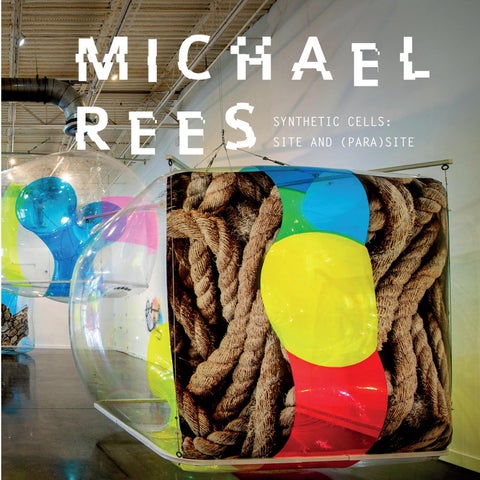
FOREWORD This catalogue is published on the occasion of the exhibition Michael Rees: Synthetic Cells and its parallel augmented reality exhibition Site and (Para)Site. Grounds For Sculpture has a long history, along with our colleagues at The Seward Johnson Atelier and the Digital Atelier, of applying technology to advance the process and capabilities of sculpture. We are excited to have an opportunity with this exhibition to continue to expand these boundaries. As an artist, Michael Rees has long been an early adopter of technology, finding unexpected ways of incorporating it over the course of his career as the tool, medium, and as the subject matter. These translucent, colorful, and suspended volumes command the West Gallery space in ways that are at once light and heavy— the skin or membrane marking a threshold between the tangible and perceptible, while the vortex inside and the external augments create networked microcosms and macrocosms within the space. While
this new body of work explores layers of augmented form, it remains decidedly sculptural, inhabiting a distinctive space between the physical and digital. This exhibition comes at a time when these distinctions between what is real and virtual, between our bodies and our technological tools, are converging in ways that are profoundly reshaping our lived experience. Projects of this scale and complexity require a team dedicated to supporting artists in realizing their often boundless visions. I want to acknowledge Tom Moran, Chief Curator, who worked collaboratively with Michael, conceptually framing the project through to the pragmatic fabrication. Our Director of Exhibitions and Collections, Faith McClellan, and her team worked tirelessly on logistics as the project evolved. After much research, Tom and Michael sourced a fabricator in China that specialized in inflatable structures (i.e., bouncy houses) that had the
8
Michael Rees_inside pages_MAR2020_Pag15e17e19a25e57e108a116_OP.indd 8
22/04/20 14:53
technological expertise to execute these seemingly simple but in fact complex structures. We thank Bruce Sha of the Xiamen Aoqile Inflatable Manufacturing Co. Ltd, for embracing and meeting the challenge. The Site and (Para)Site augmented reality layer of this project conceptually serves as an opensource platform, an exhibition within an exhibition, that has generously invited other artists to create auxiliary artworks that occupy the gallery space alongside Michael’s work. We were thrilled to have Murat Orozobekov and Edward Winkleman serve as guest curators of this layer of the project. In addition to augments by Michael Rees, they invited the participation of artists John Craig Freeman, Carla Gannis, Claudia Hart, Christopher Manzione, William Pappenheimer and Tamiko Thiel. This group is among the leading artists working with augmented reality today and we are honored to have them associated with this project. This project was many years in the
planning, and we are especially grateful to the Grounds For Sculpture Board and to our founder John Seward Johnson for their commitment to supporting artists in making ambitious new works. We are fortunate that this exhibition and catalogue received significant support from the Elizabeth Firestone Graham Foundation and Gordon and Lulie Gund. We partnered with International Arts & Artists on the design and publication of this handsome catalogue and extend our gratitude to Deanna Luu and her team for their guidance and support. Lastly, I want to extend my appreciation to Michael Rees for the opportunity to work with him over these last few years. His blend of playful humor, intellect, and philosophical curiosity that played out in our many conversations and through his artwork has been an inspiration.
Gary Garrido Schneider Executive Director Grounds For Sculpture
9
Michael Rees_inside pages_MAR2020_Pag15e17e19a25e57e108a116_OP.indd 9
22/04/20 14:53
Michael Rees_inside pages_MAR2020_Pag15e17e19a25e57e108a116_OP.indd 10
22/04/20 14:53
CLAUDIA HART
Claudia Hart, The Monument App, 2018, augmented reality application
Claudia Hart is an associate professor in the Department of Film, Video, New Media, and Animation at the School of the Art Institute of Chicago. She has exhibited widely and has been collected by galleries and museums including the Museum of Modern Art, the Metropolitan Museum, the New Museum, and Eyebeam Center for Art + Technology, where she was an honorary fellow in 2013–14. She exhibits with Transfer and bitforms galleries.
Although the ratio of men to women in Site and (Para)Site is 50/50—and representation tends to be more equitable in the digital art world than in technology industries—the computer and software culture in general has long been predominantly a “boys’ club.” Claudia Hart is no stranger to the gender bias in this arena, having taught 3D animation for eight years in vocational schools before becoming a professor at Chicago’s School of the Art Institute; and she creates her 3D imagery, which is integrated into photography, multi-channel animation installations, performances, and AR works, through what she calls “a feminist lens.” As she has noted, “By creating virtual images that are sensual but not pornographic within mechanized, clockwork depictions of the natural, I try to subvert earlier dichotomies of woman and nature pitted against a civilized, ‘scientific’ and masculine world of technology. In my own way, I am staging a romantic rebellion against technocratic and bureaucratic culture.” Hart acknowledges, however, that she is on very friendly terrain in this exhibition (Michael Rees is her long-time friend, and she
48
Michael Rees_inside pages_MAR2020_Pag15e17e19a25e57e108a116_OP.indd 48
22/04/20 14:54
has known other artists in the show for many years as well), and she takes the evolving concept of “friendship” in the age of identitybranding and social networks as the subject of her AR contribution. Titled EatFacebook, her AR work involves an animated, blinking pattern made by “glitching” the familiar Facebook logo and combining it with flashing signage that commands us to “EAT, EAT, EAT,” referencing the compulsion behind our hyper-consumerist culture. (In computer graphic parlance, “glitching” means to exploit what would normally be viewed as an error or “glitch” in a digital image, often for the harmless fun of it; but, in fine art, also for the specifically mischievous aesthetics that glitching achieves.) As with many of her AR pieces, this pattern will also double within her series of works called The Monument as an image trigger (or “trackable”) for a larger piece, serving as what Hart thinks of as a “Lego” in a monumental sculpture of her own devising.
directly raising the question of what this work means in the context of this show—both as an offering to a friend and as a creative challenge to have one’s artwork serve as a “cog” in another artist’s “machine.” While each artist in this exhibition had to contend with that question, Hart chose to address it head-on: breaking through the exhibition’s fourth wall, so to speak.
In selecting EatFacebook as her contribution, Hart is not only asking what friendship might mean post-Friends-on-Facebook; she is 49
Michael Rees_inside pages_MAR2020_Pag15e17e19a25e57e108a116_OP.indd 49
22/04/20 14:54
CHRIS MANZIONE
Chris Manzione, Untitled, 2018, augmented reality application
Chris Manzione is an assistant professor in visual arts and technology at Stevens Institute of Technology in Hoboken, NJ. His work includes sculpture, installation, virtual reality, 3D printing, and performance. He has shown nationally and internationally at venues such as the Boston ICA, Abington Arts Center, Kim? Art Center in Riga, Alt Art Space in Istanbul, Philadelphia International Festival of the Arts, the Surry Hills Festival in Melbourne, and Gürzenich Köln Museum in Cologne.
One of the promises, perhaps, of immersive media is that the technology will eventually become sophisticated enough to present a virtual world so convincing as to fool the human senses. The main hurdle in achieving that goal is that our senses are actually far more advanced than we tend to realize; at least until we try to fool them. Our ears, for instance, can detect not only the direction a sound is coming from, but even (if only subconsciously) whether it is bouncing off a surface of wood or of marble. Chris Manzione is one of the artists interested in the gap separating the present state of immersive media technology and the ultimate point at which our senses would be incapable of identifying its simulations as fake; not so much because he is determined to reduce that gap (although that would be an interesting challenge) but because that gap itself is a fascinating area to explore. Manzione’s seven AR contributions to Site and (Para)Site are a continuation of his series Only as Beautiful as the Objects it Reflects, which includes sculptures, 3D images, and AR animations. The process he uses in this series
50
Michael Rees_inside pages_MAR2020_Pag15e17e19a25e57e108a116_OP.indd 50
22/04/20 14:54
involves making a 3D scan of objects, such as a fallen tree, a brick flowerbed, or a large boulder, and then using software to apply a fully reflective texture to them. Questioning the origin and presence of objects in our world of ubiquitous digital and network technologies, he uses software to “bounce” other highres images of environments (e.g. a circus, a quarry, an open field, a mountaintop, or deep woods) off these mirrored objects. The only clues we have as to the identities of these high-res environments are the pieces of information we can discern in the reflections on the complex objects he shows us. The environments are not shown to us, even though, in immersive media, they easily could be. In one AR work, we see the thin structure of a cabinet of curiosities with some back panels or shelving, which reflects deep blues and oranges, alongside fleshy tones that suggest perhaps a TV screen. The original environment eludes us, however, never forming quite clearly enough for us to recognize it with certainty.
Adding yet another layer of complexity to these works are Manzione’s ingenious audio tracks, which include a mixture of ambient sounds from environments (such as a carnival or the woods), or more specific sounds, such as that of stones rubbing against each other. In one work, Manzione uses the Shepard tone, also known as a “sonic barber’s pole,” which is an auditory hallucination of sorts in which the track creates the illusion of getting constantly louder. Together, the animations and audio tracks tease out the layers of this “reality” that both dissipates and reveals.
51
Michael Rees_inside pages_MAR2020_Pag15e17e19a25e57e108a116_OP.indd 51
22/04/20 14:54
WILL PAPPENHEIMER
Will Pappenheimer, It’s OK, 2018, augmented reality application
Will Pappenheimer is an associate professor at Pace University in New York City and a founding member of Manifest.AR. In 2014, he was commissioned by the Whitney Museum of American Art to create an AR work—a digital drug-trip piece entitled Proxy, 5-WM2A— which celebrated the museum’s move from its Marcel Breuer Madison Avenue home to its new location in lower Manhattan. He has exhibited internationally at institutions, festivals, and galleries, including the Stedelijk Museum, Amsterdam; FACT, Liverpool; the Golden Thread Gallery, Belfast; Virtuale Switzerland biennial project for the Lausanne Metro stations; FILE, São Paulo; Alt Art Space, Istanbul; the Institute of Contemporary Art and the Museum of Fine Arts, Boston; the Corcoran Gallery of Art, Washington, DC; Fringe Exhibitions, Los Angeles; and Exit Art, Postmasters, Vertexlist, and DUMBO Arts Festival in New York.
Will Pappenheimer has been continually exploring not only the aesthetic, political, and interactive arenas of AR as a fine-art medium, but also its potential to activate certain emotional and even physical experiences—while never betraying the “nerd” roots of this technology and its enthusiasts. His two contributions to Site and (Para)Site are richly suggestive of this mission. Both artworks use video game characters, and both play with the composition of the image that triggers them (which is fun, as well as being a tip-of-the-hat to Michael Rees’s generous offer to other artists within his exhibition); but each also demonstrates the potential of immersive media to combine the powers of painting, video, and performance in its calculated effect on our emotional response as art viewers. In Angsty Pool, Pappenheimer causes the crosshatched black-and-white abstract image on the wall of the exhibition to ripple into a vertical swimming pool. Five identical 3D male characters in their underwear move through the liquified pattern, cleaning themselves or lounging about or looking directly out at us. Pappenheimer notes, “As suggested
52
Michael Rees_inside pages_MAR2020_Pag15e17e19a25e57e108a116_OP.indd 52
22/04/20 14:54
[ PLATE 9 ]
Synth Cell 011 Hatch, Turtle 2018 air-inflated PVC vinyl, ink-jet print on vinyl, steel, augmented reality application 9ft 2in × 9ft 2in × 9ft 2in (2.8 × 2.8 × 2.8 m)
102
Michael Rees_inside pages_MAR2020_Pag15e17e19a25e57e108a116_OP.indd 102
22/04/20 14:56
103
Michael Rees_inside pages_MAR2020_Pag15e17e19a25e57e108a116_OP.indd 103
22/04/20 14:56
105
Michael Rees_inside pages_MAR2020_Pag15e17e19a25e57e108a116_OP.indd 105
22/04/20 14:56
ARTIST CV
106
Michael Rees_inside pages_MAR2020_Pag15e17e19a25e57e108a116_OP.indd 106
22/04/20 14:56
PHOTOGRAPHY CREDITS Ken Ek
pages 2—12, 26, 33, 39, 57, 66—105
Veronica Lukasova
page 20
Michael Rees
pages 14 (bottom image), 18, 19, 28, 61, 62, 64
Tom Moran
pages 21, 40, 118—119
Grounds For Sculpture
pages 22, 106
Courtesy of the Artists
pages 44—54
Michael Rees_inside pages_MAR2020_Pag15e17e19a25e57e108a116_OP.indd 120
22/04/20 14:56