This edition © Kulturalis Ltd, 2027
Contents
Text © Old Treasury Building, Melbourne, 2027 Illustrations © various; see p. 64 for details The authors have asserted their rights under the Copyright, Designs and Patents Act, 1988, to be identified as authors of this work. First published in 2027 by Kulturalis Ltd 14 Old Queen Street London SW1H 9HP United Kingdom www.kulturalis.com In association with Old Treasury Building 20 Spring Street East Melbourne VIC 3002 www.otb.org.au ISBN 978-1-83636-038-4 Project manager and copy-editor: Catherine Bradley Designer: Matt Wilson Indexer: Nic Nicholas Reproduction by Opero, Verona Printed and bound in China by 1010 Printing
The Old Treasury Building
4
Introduction
5
1
First Peoples
8
2
Claiming Port Phillip
12
3
City of Gold
22
4 Marvellous Melbourne 5
10 9 8 7 6 5 4 3 2 1
A New Century
6 Making Modern Melbourne
All rights reserved. No part of this book may be reproduced, stored in a retrieval system or transmitted in any form or by any means electronic, mechanical, photocopying, recording or otherwise, without the written permission of the Authors and Publisher.
7
30 38 46
Millennial Melbourne
52
Select Bibliography
60
Index
62
Image Credits
64
British Library Cataloguing in Publication Data. A catalogue record for this book is available from the British Library. EU GPSR Authorised Representative: EASY ACCESS SYSTEM EUROPE OÜ, Mustamäe tee 50, 10621, TALLINN, Estonia email: info@easproject.org
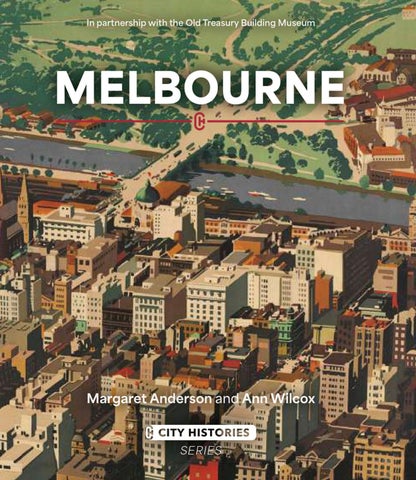
Front cover: James Northfield (1887—1973),
Melbourne. The Garden Capital of Victoria, Australia — Take a ‘Kodak’, lithograph, 1936. © James Northfield Heritage Art Trust, courtesy of State Library Victoria
Back cover and inside front cover:
Old Treasury Building Museum, 2012. © Dan Gossie Photography
PUBL I SHER’S NOTE: This book contains material that refers to deceased persons, content that is distressing and colonial records that use language now considered offensive. They are included here as historical evidence.
was discharged straight into the Yarra, which soon became a noisome polluted stream. We can trace the precocious growth of Melbourne through a remarkable series of sketches by artist, architect and surveyor Robert Russell. He drew the city from the same perspective at intervals from 1836 until 1854, copying and colouring his sketches in the 1880s.
hunting and foraging grounds destroyed by the settlers’ flocks, they were increasingly dependent on government rations for survival. William Thomas, Assistant Protector of the Wurundjeri people, wrote: ‘I could not but feel for the poor blacks. They had till this visit an undisturbed range among the lagoons … now one side of the
Above: William Thomas
Yarra is forever closed from them.’
his Journal of Proceedings,
(1793—1867), excerpt from March to May 1841.
Public Record Office Victoria, VPRS 4410/P0, unit 3
RA MPAN T G ROW TH Meanwhile the settler population grew in leaps and bounds.
Opposite and below:
In 1842 Melbourne was officially proclaimed a town; in 1847 it
1876), Panoramic Sketch of
Samuel Jackson (1807—
became a city. In 1846 10,954 people were living in Melbourne. By 1851 this had increased to 23,143, to the great detriment of the local environment. Most of the waste of people, animals and industry
18
Melbourne Port Phillip from the Walls of Scots Church on the Eastern Hill, 1841, watercolour.
State Library Victoria
CITY HISTORIES: MELBOURNE
2 : C laiming P ort P hillip
19
CHAPTER 3
City of Gold Opposite: N. Chevalier
In March 1851 gold was found near the New South Wales town
(1828—1902), Emigrants
of Bathurst. By July there were reports of good finds in Victoria,
Wharf, Melbourne, c. 1850s,
at Clunes and Anderson’s Creek near Warrandyte, followed by the discovery of rich deposits at Ballarat, Bendigo and Mount
Landing at the Queen’s
wood engraving on paper. National Library of Australia
Below: Edmund Thomas
Alexander. The news spread like wildfire. Stories of fabulous
(1827—1867), Canvass Town [sic], 1853, engraving with
discoveries in California were already well known; now the
hand colouring.
State Library Victoria
goldfields of Victoria promised the same opportunity. Here was a chance for independence from a life of wage-labour —
Tents could be rented at
a chance, with luck, to make a fortune.
shillings per week, but
‘Canvas Town’ for a few conditions were poor and illness rife.
T H E GOLD R U S H Melbourne was thrown into chaos as working men rushed to the
During 1852 alone, 45,000 passengers from
goldfields. Businesses foundered, banks were stripped of cash to
Britain arrived in Melbourne, mostly gold-seekers.
buy supplies and prices soared. In reporting conditions to London
They were soon joined by thousands from Europe,
in October 1851 Lieutenant-Governor Charles La Trobe wrote:
America, China and New Zealand, all keen to try their luck. The influx overwhelmed the city, leaving
Melbourne and Geelong and their large suburbs have been
immigrants to fight for space in overcrowded
almost emptied of many classes of their male inhabitants.
hotels and boarding-houses. Hundreds were forced
… Cottages are deserted, houses to let, even schools are
to spend a night on the wharves and thousands
closed. In some of the suburbs, not a man is left.
more braved ‘Canvas Town’, a sprawling tent city on the south bank of the Yarra River. Most would-be
One-third of Melbourne’s adult male population was said to have
miners set out for the diggings as quickly as they
left for the diggings. Deserted wives and families struggled to pay
could — while their money lasted.
for basic food and clothing. By 1852 news of the gold strikes had
The chaos of Melbourne was more than
reached London and every available ship was rushed into service.
matched by the hardships of life on the diggings.
22
CITY HISTORIES: MELBOURNE
3 : C ity of G ol d
23
With gold came a decade of unparalleled economic growth. Before the rush some 50 merchants operated in the city, but by 1860 there were more than 300. The total value of imports was £15 million, more than five times that of 1851. This new merchant class challenged the previously unrivalled power of the pastoral generation. As author E. Carlton Booth recalled: ‘Every shopkeeper became a merchant and every merchant a prince.’ Increasing wealth and a growing middle class stimulated a range of cultural activities. New theatres were built in the city, the fare ranging from the popular to the serious. An influx of skilled artists saw the growth of professional art societies, schools and galleries. Booksellers and publishers prospered too, and the increased
Top: François Cogné
Above: François Cogné
Henry Burn (1807—1884),
and the eight-hour day for some lucky workers (1856), along with
circulation of daily newspapers such
(1829—1883), Treasury Buildings, 1863, tinted lithograph.
1864, lithograph with hand
North from Princes
universal male suffrage (1857). The thriving city took pride in its
as The Age, Argus and Australasian also
State Library Victoria
(1829—1883), Collins Street, colouring.
Melbourne, 1862, looking Bridge, lithograph.
State Library Victoria
State Library Victoria
brought reading into people’s homes.
The Treasury Building (now Old
With Melbourne’s wealth and
Treasury), commissioned in 1857,
Retail activity in the city had
Henry Burn painted this
was designed in the Renaissance
now settled into a pattern,
view of grand Gold Rush
Revival style. The Italianate,
one maintained in Melbourne
Melbourne from Princes
progress came a demand for industrial
palazzo-style sandstone structure,
to this day. Bourke Street
Bridge in 1862. It features
and political rights. This period saw
built between 1858 and 1862,
became the preferred ‘strip’,
St Paul’s Church,
the introduction of the secret ballot
expressed the rapidly growing
while Collins Street had
demolished in 1885.
wealth of Gold Rush Melbourne.
smaller, more specialist stores.
26
CITY HISTORIES: MELBOURNE
3 : C ity of G ol d
achievements. As The Age wrote in April 1858: We have the ballot; we have manhood suffrage; we have abolished the property qualification for the Assembly … in liberality of public opinion and feeling we have made wonderful advances.
27
CHAPTER 4
A.C. Cooke (1836—1902), Melbourne,
Still visible in this isometric panorama are ‘the Falls’ intersecting
State Library Victoria
to straighten the river and correct its propensity to flood.
1882, colour engraving.
the Yarra. They were blown up in 1883 in one of many attempts
Marvellous Melbourne After the frenetic growth of the Gold Rush decade, the 1860s and 1870s were years of adjustment. Population growth slowed, although Melbourne still doubled in size. By 1881 268,000 people lived in the city and inner suburbs; about 66,000 inhabited the City of Melbourne municipality. From 1865 Melbourne was the largest city in Australia and easily the richest, with brick and stone buildings predominating. As gold mining contracted, however, thousands of surplus miners competed for work. These were to prove turbulent years in both
Below: De Gruchy &
the economy and politics.
Melbourne, 1863, lithograph.
In the 1880s confidence returned; soon Melbourne was booming again. Commerce flourished and capital followed, as a seemingly inexhaustible line of credit financed opulent new buildings, extensive public works and a property boom. City buildings began to creep
30
Leigh, Panoramic View of State Library Victoria
A view of Spring Street in 1863. The Treasury Building is shown on the far left and other stone buildings on Collins and Bourke Streets.
CITY HISTORIES: MELBOURNE
4 : M arvellous M elbourne
31
Opposite: Moreland Road, The Land of Promise,
West Brunswick, Close to
Essendon, 1888, lithograph. State Library Victoria
B O O M A ND B U ST However, the late 1880s saw a renewed frenzy of property speculation. With no effective regulation, property changed hands at absurdly inflated prices, all of which rested on credit. When the inevitable credit squeeze came, it hit hard. Between 1891 and 1893 a succession of financial institutions collapsed, land values dropped and the economy contracted sharply. Thousands lost jobs, homes and savings while the government did little to help. Many in Melbourne suffered cruelly as the city that had once grown so confidently contracted. Only two bright spots enlivened this bleak decade. The first was the final completion of a sewerage system, opened with great flourish in February 1898. The other was progress towards a federated nation, finally enacted in 1900. As the twentieth century dawned, Melbourne emerged from depression to become the interim capital city of the new Commonwealth of Australia.
John Macfarlane (1857—
1936), Among the Workless — Feeding the Hungry,
1892, wood engraving. State Library Victoria
36
CITY HISTORIES: MELBOURNE
4 : M arvellous M elbourne
37
benefits of its 27 years as national capital, with local investment from both state and federal governments. A start was made on beautifying the city, rejuvenating and expanding the ring of parks that eventually encircled it.
A LOW-R IS E CI T Y Two landmarks of the city date from this first decade — Flinders Street Railway Station and the new City Baths (1904). Flinders Street Station was one of few
Above: Flinders Street Station,
Right: Rose
buildings begun during the
State Library Victoria
Swanston Street &
c. 1913, photograph.
1890s. Built in red brick with
Stereograph Co.,
The clocks showed the next departure
white masonry and a distinctive
times for trains on each line. Such was
copper dome, the station opened
when the system was automated in 1983.
their popularity that they were retained
Manchester Unity
Building, Melbourne, c. 1935, photograph. State Library Victoria
in 1910 and swiftly won a place in Melburnians’ hearts. Meeting
construction and internal lifts. However, concern at the
‘under the clocks’ at Flinders
proliferation of such ‘skyscrapers’, along with fear of fire, led
Street Station became a tradition
governments to limit the height of city buildings to 132 feet — the
that lasts to this day, while many
height of the fire brigade’s ladders. This restriction remained in
flocked to the public balls held in
place for four decades. Only one city building exceeded this limit:
the upper-floor ballroom.
the Manchester Unity Building, one of few constructed during
Inspired by examples in
the Great Depression. Hailed as ‘a new symbol of enterprise and
the United States Melbourne’s
confidence’, the building housed Melbourne’s first escalators.
buildings crept upwards,
James Northfield (1887—1973), Melbourne. The Garden Capital
These proved a real attraction, with thousands visiting the Unity
enabled by steel-frame
© James Northfield Heritage Art Trust, courtesy of State Library Victoria
Building merely to ride on them.
40
of Victoria, Australia — Take a Kodak, lithograph, 1936.
CITY HISTORIES: MELBOURNE
5 : A N ew C entury
41
CHAPTER 6
Making Modern Melbourne Melbourne grew rapidly after the Second World War, reaching a population of 2.5 million by 1971. Primary and secondary industry expanded, unemployment averaged an astonishing 1.9 per cent
Below left: Assembly Line,
and individual incomes increased at an annual rate of almost four
General Motors-Holden at
per cent. Historians call this period following the Second World
Fishermans Bend, 1951—52, photograph.
War until the early 1970s the ‘long boom’.
National Library of Australia
Victoria prospered, with high investment in protected
Urban society was also changing. Postwar immigrants brought new
manufacturing industries such as cars, clothing and electrical
ideas and ways of living. Young people distinguished themselves
goods. Manufacturing output
from older generations through culture and politics, while women’s,
yearly between 1949 and
First Nations and other activist groups demanded social change. Gone were antiquated liquor laws, compelling pubs to close at 6 pm: the city and its people were growing up.
increased six per cent 1967, while the number of factories in Victoria almost doubled. In 1951 over 40 per cent of wage earners were employed in manufacturing.
Left: Bruce Postle (1940—),
Above left: Laurie Richards
Above: Edwin G. Adamson
1970, photograph.
at Melbourne Town Hall,
c. 1950s, photograph.
The Melbourne Moratorium March,
(1895—1974), Scott’s Hotel,
© Bruce Postle, courtesy of The Age
20 February 1969, photograph.
This photograph of 8 May 1970
© Australian Services Union, courtesy of Museums Victoria
A measure introduced in 1916
Women’s groups were active
6 pm to reduce drunkenness. The
shows 80,000 Melburnians marching down Bourke Street to demonstrate against Australia’s involvement in the Vietnam War. Such protests against the Vietnam War (1962—73) crystallised the growing divide within society, with young people demanding a greater voice.
46
(1907—1985), Equal Pay Protest
throughout the 1960s in support of equal pay and issues such as legal, safe abortion. In 1972 the Arbitration Commission ruled in favour of the principle of ‘equal pay for work of equal value’, but wage equality remains an elusive goal.
Royal Historical Society of Victoria
forced public bars to close at unforeseen result was a frantic rush to consume as much alcohol as possible before closing time. On 1 February 1966 drinking hours were extended to 10 pm, ending the infamous ‘six o’clock swill’.
47
CHAPTER 7
Right: Laurie Thomas (1933—),
Southbank Precinct, Melbourne, 1983, photograph.
© Laurie Thomas, courtesy of State Library Victoria
Millennial Melbourne
Manufacturing jobs declined by one-
third between 1971 and 1981. A further third was lost with the recession of
1982. Whole sections of the inner city,
including Southbank, were abandoned.
The transition from industrial to postindustrial has been difficult for many people and communities, but unlike the experiences of some cities … Melbourne’s story isn’t simply a tale of abandonment. Seamus O’Hanlon, 2010 The period from 1970 to 2025 saw Melbourne transformed once again, as factories made way for office and residential towers. Melbourne’s
competition from an industrialising Asian market combined to hit
central business district (CBD) is now
industry hard. When the Australian government removed tariff
a high-rise residential city surrounded
protection, many industries could no longer compete. Between
by low-density suburbs that stretch
1973 and 1980 over 3,000 factories closed. By 2001 just 16 per cent
over 70 km.
of wage earners were employed in manufacturing: by 2016 the figure had fallen to only 7.8 per cent. Alternative employment was
UR BAN DECLI NE
slow to emerge and many factory workers were forced into low-
By the mid-1970s Australia’s ‘long
paid, casual work, lacking the benefits of full-time employment.
boom’ was over. The economy
In the city centre things were grim. Retail activity waned
stagnated and Melbourne, along
as suburban shopping malls burgeoned. Employment in inner-city
with much of the Western world,
retail fell, with almost 7,000 jobs (one-quarter) lost between 1971 and
experienced years of recession. Global
Les Thompson, Melbourne, View from the
1981. In the same period the city’s residential population dropped by
inflation, rising oil prices and increased
courtesy of Royal Historical Society of Victoria
25 per cent. Weekends saw the central city all but deserted.
52
Northwest, 1972, photograph. © Les Thompson,
CITY HISTORIES: MELBOURNE
7 : M illennial M elbourne
53
UR BAN T RAN SFORMATIO N
buildings and warehouses
By the late 1980s Melbourne’s CBD was widely considered an
Below: Katie Dunning
for residential use. It was
urban backwater. Residential and retail activity had largely shifted
(1985—), Melbourne’s City
Skyline Showing Southbank,
a resounding success. The
to the suburbs and the streets were dominated by noisy cars and
a High-Density Urban Living
number of residential units in
Old Treasury Building Melbourne
Melbourne increased from
Unfortunately windowless
738 in 1980 to 9,895 in 2002,
trams. The population in the city centre was estimated to be just 2,000 people. Urban policies such as ‘Postcode 3000’ (1992) sought to
Community, 2026, photograph.
bedrooms exist in almost
then to 40,000 in 2024.
one-quarter of new residential
repopulate the city. The policy encouraged the building of new
developments, prompting
apartments and the re-purposing of vacant offices, heritage
the ‘slums’ of the future.
Residential towers now
concerns that the city is building
cram inner-city blocks at record densities and heights. They are occupied by students, ‘empty nesters’ and young professionals, with fewer than 10 per cent of inhabitants employed in manufacturing. Residents still reflect the diversity Above: Vietnamese Shops
encouraged by immigration policies, but the city’s ethnic make-up
Street, Richmond, 1994,
has changed. Until the 1970s most immigrants were from Britain,
and Shoppers in Victoria photograph.
National Archives of Australia, NAA: A12111, 3/1994/13B/31
The White Australia Policy was dismantled from the mid-1960s. Today Melbourne is one of the world’s great, multicultural metropolises. More than one-half of its current residents were born overseas.
Greece, Italy and the Mediteranean. Today most hail from Asia, Africa and India, although rising costs in the central city have encouraged immigrants to gravitate towards the outer suburbs. As in the city, Melbourne’s inner industrial suburbs of Collingwood, Richmond, Carlton and Fitzroy have been gentrified and colonised by well-paid workers in post-industrial professions. Whole manufacturing precincts have been re-invented as fashionable places in which to live, work and play. Property prices now prohibit low-income earners and public housing is at risk, located as it is on prime real estate.
7 : M illennial M elbourne
55