Introduction The McMichael Canadian Art Collection is located on the original lands of the Ojibway Anishinaabe People. It is uniquely situated along the Carrying Place Trail which historically provided an integral connection for Aboriginal people between Ontario’s Lakeshore and the Lake SimcoeGeorgian Bay Region. The McMichael is a special place indeed; it is an Ontario government agency with a unique mandate to celebrate the art of Canada, which it does within a great building on some 100 acres of forested conservation land perched above the historic Humber River Valley. It sits in the pretty village of Kleinburg, itself falling within the burgeoning city of Vaughan, some 20 kilometres north of Toronto. The building is a major work by the prominent modernist Toronto architect Leo Venchiarutti (1947–2007) in a style that I have come to think of as ‘Scandi-Canadian Mid-twentieth Century Pioneer Modernism’: basically, it looks like what a sapient log cabin might dream of becoming when it grows up – which, metaphorically speaking, more or less describes how it in fact came about. Originally a four-room home completed in 1954 for young photographer and marketing entrepreneur Robert McMichael, and his wife Signe, it was designed in a robust yet stylish log cabin aesthetic involving huge reclaimed timbers, great chunks of pink Canadian fieldstone and enormous windows, framing outstanding views across the beauteous Humber Valley. It was small but ambitious – it featured prominently and photogenically in the December 1956 edition of Canadian Homes and Gardens, in an article that proclaimed it ‘The House That Was Made for Christmas’. That feature revealed some paintings around the walls: in 1955, the McMichaels had purchased their very first – Montréal River by Lawren Harris (now in our collection). Very quickly they became passionate collectors. That passion was initially almost exclusively for the iconic Canadian landscape artist Tom Thomson (1877–1917) and his friends and fellow artists of the Group of Seven. The McMichaels’ timing was perfect: although these artists were well-known, their work was not particularly fashionable at that time and consequently affordable – the McMichaels
4
|
The McMichael Canadian Art Collection
were not enormously wealthy. That Harris, for instance, cost them a mere $250 – nowadays you could safely multiply that figure by a thousand. They assiduously cultivated and befriended other collectors, dealers and artists. Five of the Group of Seven were still alive in the 1960s; A.J. Casson and his wife Margaret became their close friends and A.Y. Jackson spent the last six years of his life at ‘Tapawingo’, as his hosts had called their home, believing it to be an Indigenous word meaning ‘Place of Joy’. The subsequent growth of the building mirrored the evolution of the institution. In 1963 they added a large room and a swimming pool beneath, now the Founders’ Lounge and the theatre respectively. By this time the collection held 194 artworks and their home had taken on something of the feel of a public art gallery – people had taken to knocking on the door to see the collection. The McMichaels offered them, and classes of local schoolchildren, a warm welcome, thereby morphing from enthusiastic collectors into, effectively, curators. Their next step was brilliant, bold and visionary. On 18 November 1965 the McMichaels signed a Gift Agreement that donated their home, their collection and their land to the Province of Ontario. The de facto art gallery became one in actual fact, opening to the public on 8 July 1966 with the McMichaels as live-in curators. The expansion continued in earnest, with new wings added in 1965, 1967, 1969 and 1972, culminating in the awe-inspiring grandeur of the Entrance Hall. It originally contained a remarkable waterfall feature, long since switched off in the name of environmental control. All these additions were designed in harmony with Venchiarutti’s original aesthetic. A ‘campus’ of other buildings was added over time – the Meeting House, originally the McMichaels’ garage,
introduction
|
5
Introduction The McMichael Canadian Art Collection is located on the original lands of the Ojibway Anishinaabe People. It is uniquely situated along the Carrying Place Trail which historically provided an integral connection for Aboriginal people between Ontario’s Lakeshore and the Lake SimcoeGeorgian Bay Region. The McMichael is a special place indeed; it is an Ontario government agency with a unique mandate to celebrate the art of Canada, which it does within a great building on some 100 acres of forested conservation land perched above the historic Humber River Valley. It sits in the pretty village of Kleinburg, itself falling within the burgeoning city of Vaughan, some 20 kilometres north of Toronto. The building is a major work by the prominent modernist Toronto architect Leo Venchiarutti (1947–2007) in a style that I have come to think of as ‘Scandi-Canadian Mid-twentieth Century Pioneer Modernism’: basically, it looks like what a sapient log cabin might dream of becoming when it grows up – which, metaphorically speaking, more or less describes how it in fact came about. Originally a four-room home completed in 1954 for young photographer and marketing entrepreneur Robert McMichael, and his wife Signe, it was designed in a robust yet stylish log cabin aesthetic involving huge reclaimed timbers, great chunks of pink Canadian fieldstone and enormous windows, framing outstanding views across the beauteous Humber Valley. It was small but ambitious – it featured prominently and photogenically in the December 1956 edition of Canadian Homes and Gardens, in an article that proclaimed it ‘The House That Was Made for Christmas’. That feature revealed some paintings around the walls: in 1955, the McMichaels had purchased their very first – Montréal River by Lawren Harris (now in our collection). Very quickly they became passionate collectors. That passion was initially almost exclusively for the iconic Canadian landscape artist Tom Thomson (1877–1917) and his friends and fellow artists of the Group of Seven. The McMichaels’ timing was perfect: although these artists were well-known, their work was not particularly fashionable at that time and consequently affordable – the McMichaels
4
|
The McMichael Canadian Art Collection
were not enormously wealthy. That Harris, for instance, cost them a mere $250 – nowadays you could safely multiply that figure by a thousand. They assiduously cultivated and befriended other collectors, dealers and artists. Five of the Group of Seven were still alive in the 1960s; A.J. Casson and his wife Margaret became their close friends and A.Y. Jackson spent the last six years of his life at ‘Tapawingo’, as his hosts had called their home, believing it to be an Indigenous word meaning ‘Place of Joy’. The subsequent growth of the building mirrored the evolution of the institution. In 1963 they added a large room and a swimming pool beneath, now the Founders’ Lounge and the theatre respectively. By this time the collection held 194 artworks and their home had taken on something of the feel of a public art gallery – people had taken to knocking on the door to see the collection. The McMichaels offered them, and classes of local schoolchildren, a warm welcome, thereby morphing from enthusiastic collectors into, effectively, curators. Their next step was brilliant, bold and visionary. On 18 November 1965 the McMichaels signed a Gift Agreement that donated their home, their collection and their land to the Province of Ontario. The de facto art gallery became one in actual fact, opening to the public on 8 July 1966 with the McMichaels as live-in curators. The expansion continued in earnest, with new wings added in 1965, 1967, 1969 and 1972, culminating in the awe-inspiring grandeur of the Entrance Hall. It originally contained a remarkable waterfall feature, long since switched off in the name of environmental control. All these additions were designed in harmony with Venchiarutti’s original aesthetic. A ‘campus’ of other buildings was added over time – the Meeting House, originally the McMichaels’ garage,
introduction
|
5
subsequently adapted as a home for the caretakers; and Pine Cottage, originally the public washrooms and workshop, becoming an education space. Signe was simultaneously transforming the surrounding grounds, which early photographs reveal to have been largely farmland, devoid of trees. She planted hundreds, frequently the pines and firs beloved of the Group of Seven. After nine years in the post, Robert McMichael resigned as Director in 1981. Thereafter, the McMichaels’ relationship with their creation, now a Government agency, became complicated. A painful two decades ensued. Like many a collector/founder before them, the McMichaels found it hard to let go of their creation, and they perhaps inevitably objected to some of the directions the new governance devised for the institution. Robert McMichael even tried to sue the Government on one
6
|
The McMichael Canadian Art Collection
occasion; and this difficult chapter in the Gallery’s history was often played out in public. Robert died in 2003, Signe in 2007. They were buried on site, as had always been their wish; indeed it had been a condition of the 1965 Gift Agreement. By the time of their deaths the Artists’ Cemetery had already been established; the final resting place for six of the Group of Seven (Lawren Harris, Fred Varley, Frank (Franz) Johnston, A.Y. Jackson, Arthur Lismer and A.J. Casson. Despite their name, the Group of Seven rarely amounted to seven artists – ten artists were part of the Group at one time or another), four of them with their wives. The idea had come from Casson and Jackson themselves. In 2011 the McMichael’s mandate expanded to include contemporary art; and the concept of the ‘Art of Canada’ which the Gallery is mandated to celebrate is nowadays much broader than the McMichaels originally envisaged, to the great enrichment of the institution. To their credit, they had always included the collection of Indigenous art, of both First Nations and the Inuit, in their plans, having encouraged, for instance, the career of Anishinaabe artist Norval Morrisseau, founder of the Woodland School, with an artist residency in 1979. Now Indigenous art accounts for over a third of the total collection and regular exhibitions celebrate that fact; in addition the McMichael is proud to be custodian of around 100,000 Inuit drawings from the artistic community of Kinngait (Cape Dorset) in Nunavut, on behalf of the West Baffin Eskimo Co-operative. Otherwise, the collection’s strengths still lie largely with Tom Thomson and the Group of Seven, their contemporaries such as Emily Carr and David Milne, and the succeeding generation of artists predominantly but not exclusively of Ontario. The collection now numbers some 6,500 objects. Today, the Gallery hosts a dynamic exhibition program, vibrant creative learning, and public programs to inform, engage and entertain. Whether visitors come to hike the miles of trails, take part in classes or to view the collection and take in the current exhibitions – or all of the above – the McMichael offers a revelatory opportunity, for Canadians and non-Canadians alike, to engage with the essence of Canada, in nature and its art. Robert and Signe McMichael’s visionary leap in the dark has resulted in a truly unique institution. In 2016 the McMichael Canadian Art Collection celebrated its 50th anniversary – the log cabin has truly grown into something remarkable.
introduction
|
7
subsequently adapted as a home for the caretakers; and Pine Cottage, originally the public washrooms and workshop, becoming an education space. Signe was simultaneously transforming the surrounding grounds, which early photographs reveal to have been largely farmland, devoid of trees. She planted hundreds, frequently the pines and firs beloved of the Group of Seven. After nine years in the post, Robert McMichael resigned as Director in 1981. Thereafter, the McMichaels’ relationship with their creation, now a Government agency, became complicated. A painful two decades ensued. Like many a collector/founder before them, the McMichaels found it hard to let go of their creation, and they perhaps inevitably objected to some of the directions the new governance devised for the institution. Robert McMichael even tried to sue the Government on one
6
|
The McMichael Canadian Art Collection
occasion; and this difficult chapter in the Gallery’s history was often played out in public. Robert died in 2003, Signe in 2007. They were buried on site, as had always been their wish; indeed it had been a condition of the 1965 Gift Agreement. By the time of their deaths the Artists’ Cemetery had already been established; the final resting place for six of the Group of Seven (Lawren Harris, Fred Varley, Frank (Franz) Johnston, A.Y. Jackson, Arthur Lismer and A.J. Casson. Despite their name, the Group of Seven rarely amounted to seven artists – ten artists were part of the Group at one time or another), four of them with their wives. The idea had come from Casson and Jackson themselves. In 2011 the McMichael’s mandate expanded to include contemporary art; and the concept of the ‘Art of Canada’ which the Gallery is mandated to celebrate is nowadays much broader than the McMichaels originally envisaged, to the great enrichment of the institution. To their credit, they had always included the collection of Indigenous art, of both First Nations and the Inuit, in their plans, having encouraged, for instance, the career of Anishinaabe artist Norval Morrisseau, founder of the Woodland School, with an artist residency in 1979. Now Indigenous art accounts for over a third of the total collection and regular exhibitions celebrate that fact; in addition the McMichael is proud to be custodian of around 100,000 Inuit drawings from the artistic community of Kinngait (Cape Dorset) in Nunavut, on behalf of the West Baffin Eskimo Co-operative. Otherwise, the collection’s strengths still lie largely with Tom Thomson and the Group of Seven, their contemporaries such as Emily Carr and David Milne, and the succeeding generation of artists predominantly but not exclusively of Ontario. The collection now numbers some 6,500 objects. Today, the Gallery hosts a dynamic exhibition program, vibrant creative learning, and public programs to inform, engage and entertain. Whether visitors come to hike the miles of trails, take part in classes or to view the collection and take in the current exhibitions – or all of the above – the McMichael offers a revelatory opportunity, for Canadians and non-Canadians alike, to engage with the essence of Canada, in nature and its art. Robert and Signe McMichael’s visionary leap in the dark has resulted in a truly unique institution. In 2016 the McMichael Canadian Art Collection celebrated its 50th anniversary – the log cabin has truly grown into something remarkable.
introduction
|
7
Christiane Pflug (1936–1972)
Interior at Night 1964–65 Oil and resin and/or oil medium on canvas, 140.1 × 127.3 cm Gift of ICI Canada Inc., McMichael Canadian Art Collection 1995.19.42
The term ‘magic realism’ doesn’t really suffice when faced with the complex world of German-born Canadian artist Christiane Pflug. The knowledge that she ended her own life aged only 36 tempts us into the dangerous pursuit of projecting meaning onto her canvasses that may – or may not – be there. Certainly this picture is typically disturbing, radiating unease, intensified by the realisation that both figures – not just the one on the windowsill – are in fact dolls. Any consideration that the artist is merely recording a charming arrangement by her two daughters of their favourite toys is utterly confounded by the rest of the painting. The view through the window is shadowy and mysterious – we seem to be in Hitchcock territory, Rear Window to be precise. The realisation that the window is open (the curtain is shifting in the breeze) suddenly feels threatening, as if something hostile lurks outside and might get in. The top half of the window, which at first sight seems to show a continuation of the architecture seen below, with, perhaps, the moon above, is in fact a reflection into the room where the artist stands, hidden, at her easel, the reflected cupboards behind her, lit by a single bulb that glares off the wall. Everything – the dolls, the view, the reflection – needs a second glance. It is the kind of painting that prompts conspiracy theories. If it does in fact give a glimpse into the state of Pflug’s internal self, then that was a rather dark and complex place to be. But the painting is nonetheless a thing of great beauty. Ars Longa, Vita Brevis.
8
|
McMichael Canadian Art Collection
I n t e r i o r a t Ni g h t
|
9
Christiane Pflug (1936–1972)
Interior at Night 1964–65 Oil and resin and/or oil medium on canvas, 140.1 × 127.3 cm Gift of ICI Canada Inc., McMichael Canadian Art Collection 1995.19.42
The term ‘magic realism’ doesn’t really suffice when faced with the complex world of German-born Canadian artist Christiane Pflug. The knowledge that she ended her own life aged only 36 tempts us into the dangerous pursuit of projecting meaning onto her canvasses that may – or may not – be there. Certainly this picture is typically disturbing, radiating unease, intensified by the realisation that both figures – not just the one on the windowsill – are in fact dolls. Any consideration that the artist is merely recording a charming arrangement by her two daughters of their favourite toys is utterly confounded by the rest of the painting. The view through the window is shadowy and mysterious – we seem to be in Hitchcock territory, Rear Window to be precise. The realisation that the window is open (the curtain is shifting in the breeze) suddenly feels threatening, as if something hostile lurks outside and might get in. The top half of the window, which at first sight seems to show a continuation of the architecture seen below, with, perhaps, the moon above, is in fact a reflection into the room where the artist stands, hidden, at her easel, the reflected cupboards behind her, lit by a single bulb that glares off the wall. Everything – the dolls, the view, the reflection – needs a second glance. It is the kind of painting that prompts conspiracy theories. If it does in fact give a glimpse into the state of Pflug’s internal self, then that was a rather dark and complex place to be. But the painting is nonetheless a thing of great beauty. Ars Longa, Vita Brevis.
8
|
McMichael Canadian Art Collection
I n t e r i o r a t Ni g h t
|
9
F.H. (Frederick Horsman) Varley (1881–1969)
Iceberg c.1938 Oil on wood panel, 30.5 × 38 cm Gift of Dr. and Mrs. Walton Groves, McMichael Canadian Art Collection 1968.14
Looking at this gorgeous thing, it is almost impossible to believe that Varley wasn’t aware of the works of the Swiss artist Ferdinand Hodler (see right); and his colour sense and painterly bravura always set him apart from his colleagues in the Group of Seven. In this case the picture looks as if it is painted in mother-of-pearl. He was a Yorkshireman who emigrated to Canada with his family in 1912 on the encouragement of Arthur Lismer, who had arrived in Toronto the year before. Both were from Sheffield, and Varley’s art training there was supplemented with a period of study in Antwerp, making him a formidable technician in paint. On arrival in Ontario he found work at the commercial design firm, Grip Ltd, alongside Tom Thomson, Lismer, J.E.H. MacDonald, Frank Johnston and Franklin Carmichael. He served in World War I and was signed up by Lord Beaverbrook as an artist for the Canadian War Memorials Fund, in which capacity he produced some remarkable paintings. In 1920 he became one of the founding members of the Group of Seven, despite his natural leaning towards portraiture. The landscapes he produced in the early days of the Group are nonetheless among their most impressive masterpieces. In 1926 he left Toronto to take the post as Head of the Department of Drawing and Painting at the School of Decorative and Applied Arts, Vancouver. He had issues with alcohol and was seen as the ‘wild man’ of the Group. He also suffered bouts of depression, which led him to leave Vancouver in 1936. This work dates from a trip he made to the Arctic in the company of other artists in 1938, inspired no doubt by the earlier example of A.Y. Jackson and Lawren Harris.
60
|
McMichael Canadian Art Collection
Ferdinand Hodler, Swiss (1853–1918) Lake Thun and the Stockhorn Mountains 1910 Oil on canvas 83 × 105.4 cm Purchased 1975 Scottish National Gallery of Modern Art
Iceberg
|
61
F.H. (Frederick Horsman) Varley (1881–1969)
Iceberg c.1938 Oil on wood panel, 30.5 × 38 cm Gift of Dr. and Mrs. Walton Groves, McMichael Canadian Art Collection 1968.14
Looking at this gorgeous thing, it is almost impossible to believe that Varley wasn’t aware of the works of the Swiss artist Ferdinand Hodler (see right); and his colour sense and painterly bravura always set him apart from his colleagues in the Group of Seven. In this case the picture looks as if it is painted in mother-of-pearl. He was a Yorkshireman who emigrated to Canada with his family in 1912 on the encouragement of Arthur Lismer, who had arrived in Toronto the year before. Both were from Sheffield, and Varley’s art training there was supplemented with a period of study in Antwerp, making him a formidable technician in paint. On arrival in Ontario he found work at the commercial design firm, Grip Ltd, alongside Tom Thomson, Lismer, J.E.H. MacDonald, Frank Johnston and Franklin Carmichael. He served in World War I and was signed up by Lord Beaverbrook as an artist for the Canadian War Memorials Fund, in which capacity he produced some remarkable paintings. In 1920 he became one of the founding members of the Group of Seven, despite his natural leaning towards portraiture. The landscapes he produced in the early days of the Group are nonetheless among their most impressive masterpieces. In 1926 he left Toronto to take the post as Head of the Department of Drawing and Painting at the School of Decorative and Applied Arts, Vancouver. He had issues with alcohol and was seen as the ‘wild man’ of the Group. He also suffered bouts of depression, which led him to leave Vancouver in 1936. This work dates from a trip he made to the Arctic in the company of other artists in 1938, inspired no doubt by the earlier example of A.Y. Jackson and Lawren Harris.
60
|
McMichael Canadian Art Collection
Ferdinand Hodler, Swiss (1853–1918) Lake Thun and the Stockhorn Mountains 1910 Oil on canvas 83 × 105.4 cm Purchased 1975 Scottish National Gallery of Modern Art
Iceberg
|
61
Yvonne McKague Housser (1898–1996)
Marguerite Pilot of Deep River (Girl with Mulleins) c.1932 Oil on canvas, 76.2 × 61 cm Gift of the Founders, Robert and Signe McMichael, McMichael Canadian Art Collection 1966.16.13
The Group of Seven have come in for understandable criticism in recent times for their exclusion of women from their ranks, especially given that many accomplished women artists were their contemporaries – Mary Wrinch, Marion Long (an early inhabitant of the Studio Building), Florence McGillivray, and Anne Savage in Montréal, to name just four. They made up for it, perhaps, through their encouragement of Emily Carr (though she was not invited to join, despite being hailed as ‘one of us’ by Lawren Harris) and through their inviting women to exhibit alongside them. Yvonne McKague was invited to participate in their last three exhibitions, indicating the Seven’s appreciation of her as a forward-looking artist. She was teaching at the Ontario College of Art when she was awarded a scholarship to study in Paris in 1921, and became one of the founding members of the Canadian Group of Painters in 1933 (the more inclusive group that emerged from the disbanding of the Group of Seven after J.E.H. MacDonald’s death). She married Fred Housser, the author of the first book about the Group (A Canadian Art Movement: The Story of the Group of Seven) in 1935. This deservedly popular picture certainly shows the influence of the Group, particularly of Harris, in the abstracted forms and deep blues of the mountain landscape and in the simplified planes of Marguerite Pilot’s face, neck and arms. Pilot was a young woman of half French-Canadian, half Indigenous parentage, the particular yellow of whose dress clearly evoked the colour of mulleins to the artist, who was also sensitive to a certain tension in her subject’s body language – the defensive clasp of the arms, the slight tightness in the shoulders, the proud distance of her expression.
62
|
McMichael Canadian Art Collection
M a r g u e r i t e Pi l o t o f D e e p Ri v e r ( Gi r l wi t h M u l l e i n s )
|
63
Yvonne McKague Housser (1898–1996)
Marguerite Pilot of Deep River (Girl with Mulleins) c.1932 Oil on canvas, 76.2 × 61 cm Gift of the Founders, Robert and Signe McMichael, McMichael Canadian Art Collection 1966.16.13
The Group of Seven have come in for understandable criticism in recent times for their exclusion of women from their ranks, especially given that many accomplished women artists were their contemporaries – Mary Wrinch, Marion Long (an early inhabitant of the Studio Building), Florence McGillivray, and Anne Savage in Montréal, to name just four. They made up for it, perhaps, through their encouragement of Emily Carr (though she was not invited to join, despite being hailed as ‘one of us’ by Lawren Harris) and through their inviting women to exhibit alongside them. Yvonne McKague was invited to participate in their last three exhibitions, indicating the Seven’s appreciation of her as a forward-looking artist. She was teaching at the Ontario College of Art when she was awarded a scholarship to study in Paris in 1921, and became one of the founding members of the Canadian Group of Painters in 1933 (the more inclusive group that emerged from the disbanding of the Group of Seven after J.E.H. MacDonald’s death). She married Fred Housser, the author of the first book about the Group (A Canadian Art Movement: The Story of the Group of Seven) in 1935. This deservedly popular picture certainly shows the influence of the Group, particularly of Harris, in the abstracted forms and deep blues of the mountain landscape and in the simplified planes of Marguerite Pilot’s face, neck and arms. Pilot was a young woman of half French-Canadian, half Indigenous parentage, the particular yellow of whose dress clearly evoked the colour of mulleins to the artist, who was also sensitive to a certain tension in her subject’s body language – the defensive clasp of the arms, the slight tightness in the shoulders, the proud distance of her expression.
62
|
McMichael Canadian Art Collection
M a r g u e r i t e Pi l o t o f D e e p Ri v e r ( Gi r l wi t h M u l l e i n s )
|
63
Haida
Raven Rattle c.1825 Wood with paint, 11 × 31.7 × 10.3 cm Purchase 1974, McMichael Canadian Art Collection 1974.6
The Haida people’s heartland is on Haida Gwaii (formerly the Queen Charlotte Islands) off the West Coast of British Columbia. Theirs is one of the strongest visual cultures of Canada’s Northwest coast Indigenous peoples, with an ancient tradition of carving. Their villages were sculptural treasure troves of totem poles and house posts, and their artefacts, costumes and ceremonial items use a rich visual language which continues to thrive today. The fact that these objects were made for use, for instance in potlatches or shamanic ceremonials, means that relatively few old pieces survive – the First Nations have a very different concept of heritage value. The idea of a totem pole in a museum, divorced of all context, would have been evidence of colonial insanity to a nineteenth-century Haida carver. This rattle was for ceremonial use so its survival – it is nearly 200 years old – is exceptional, as is its quality: it is one of the McMichael’s greatest masterpieces. Every inch of this elaborate piece is covered with interlocking mythological creatures, principal among which, giving the rattle its distinctive form, is Raven, the trickster god of much North American Indigenous myth. He played key roles in the creation of the world and its peoples – usually by mischievous means. On Raven’s back lies a curious human / bear hybrid, presumably a shaman mid-transformation. Its tongue touches what looks like a small frog’s head, whose tongue in turn touches that of a woodpecker-like bird. The tongues are the means of transferring valuable knowledge from the animal world to the shaman. These rattles were used by chiefs and were usually a pair. To have even one is a privilege.
64
|
McMichael Canadian Art Collection
Raven Rattle
|
65
Haida
Raven Rattle c.1825 Wood with paint, 11 × 31.7 × 10.3 cm Purchase 1974, McMichael Canadian Art Collection 1974.6
The Haida people’s heartland is on Haida Gwaii (formerly the Queen Charlotte Islands) off the West Coast of British Columbia. Theirs is one of the strongest visual cultures of Canada’s Northwest coast Indigenous peoples, with an ancient tradition of carving. Their villages were sculptural treasure troves of totem poles and house posts, and their artefacts, costumes and ceremonial items use a rich visual language which continues to thrive today. The fact that these objects were made for use, for instance in potlatches or shamanic ceremonials, means that relatively few old pieces survive – the First Nations have a very different concept of heritage value. The idea of a totem pole in a museum, divorced of all context, would have been evidence of colonial insanity to a nineteenth-century Haida carver. This rattle was for ceremonial use so its survival – it is nearly 200 years old – is exceptional, as is its quality: it is one of the McMichael’s greatest masterpieces. Every inch of this elaborate piece is covered with interlocking mythological creatures, principal among which, giving the rattle its distinctive form, is Raven, the trickster god of much North American Indigenous myth. He played key roles in the creation of the world and its peoples – usually by mischievous means. On Raven’s back lies a curious human / bear hybrid, presumably a shaman mid-transformation. Its tongue touches what looks like a small frog’s head, whose tongue in turn touches that of a woodpecker-like bird. The tongues are the means of transferring valuable knowledge from the animal world to the shaman. These rattles were used by chiefs and were usually a pair. To have even one is a privilege.
64
|
McMichael Canadian Art Collection
Raven Rattle
|
65
A.J. (Alfred Joseph) Casson (1898–1992)
Little Island 1965 Oil on canvas, 75.5 × 88.5 cm Donated by Miss Adele E.G. Curry and Dr. B.H. Gaylord Curry, McMichael Canadian Art Collection 1998.4
A.J. Casson had been a young apprentice at a lithography company in Hamilton for a few years when his family moved back to Toronto, where he had been born. In 1919 he became Franklin Carmichael’s assistant at the commercial art firm Rous and Mann, and Carmichael encouraged him to paint. As a young man in the early 1920s he mixed with the Group of Seven, often at the Arts & Letters Club in downtown Toronto. Frank Johnston’s departure from the Group after their first exhibition left a gap which in 1926 Casson was invited to fill. He and Carmichael moved to another commercial printing firm, Sampson-Matthews Ltd, in 1926, where Casson eventually became Vice-President. He retired at 60 to paint full-time and long outlived his Group of Seven colleagues, living to the age of 93. Closest in style to his friend and mentor Carmichael, he stayed faithful to the Group’s aesthetic throughout his life. His style was highly finished, its certain slickness occasionally showing his roots in commercial art. Like Carmichael, he was a virtuoso watercolourist. Little Island is my favourite work of his at the McMichael, although not the most famous (that honour falls to the iconic White Pine, shown right). Even in 1965, Casson maintained his cool, crisp, almost Art Deco look, but these stylised, shard-like trees jostling for space on the tiny island are marvellous in their soft jade greens and autumnal oranges, singing out against the greys of the sky and water. It is an unapologetically decorative painting – composed with a designer’s eye – and the reflections in the lake give the whole a poetic quality special to Casson. He and his wife Margaret were great friends and helpers of Robert and Signe McMichael, and are buried in the Artists’ Cemetery.
66
|
McMichael Canadian Art Collection
A.J. Casson White Pine c.1957 Oil on canvas 76 × 101.3 cm Gift of the Founders, Robert and Signe McMichael McMichael Canadian Art Collection 1966.16.119
Li t t l e I s l a n d
|
67
A.J. (Alfred Joseph) Casson (1898–1992)
Little Island 1965 Oil on canvas, 75.5 × 88.5 cm Donated by Miss Adele E.G. Curry and Dr. B.H. Gaylord Curry, McMichael Canadian Art Collection 1998.4
A.J. Casson had been a young apprentice at a lithography company in Hamilton for a few years when his family moved back to Toronto, where he had been born. In 1919 he became Franklin Carmichael’s assistant at the commercial art firm Rous and Mann, and Carmichael encouraged him to paint. As a young man in the early 1920s he mixed with the Group of Seven, often at the Arts & Letters Club in downtown Toronto. Frank Johnston’s departure from the Group after their first exhibition left a gap which in 1926 Casson was invited to fill. He and Carmichael moved to another commercial printing firm, Sampson-Matthews Ltd, in 1926, where Casson eventually became Vice-President. He retired at 60 to paint full-time and long outlived his Group of Seven colleagues, living to the age of 93. Closest in style to his friend and mentor Carmichael, he stayed faithful to the Group’s aesthetic throughout his life. His style was highly finished, its certain slickness occasionally showing his roots in commercial art. Like Carmichael, he was a virtuoso watercolourist. Little Island is my favourite work of his at the McMichael, although not the most famous (that honour falls to the iconic White Pine, shown right). Even in 1965, Casson maintained his cool, crisp, almost Art Deco look, but these stylised, shard-like trees jostling for space on the tiny island are marvellous in their soft jade greens and autumnal oranges, singing out against the greys of the sky and water. It is an unapologetically decorative painting – composed with a designer’s eye – and the reflections in the lake give the whole a poetic quality special to Casson. He and his wife Margaret were great friends and helpers of Robert and Signe McMichael, and are buried in the Artists’ Cemetery.
66
|
McMichael Canadian Art Collection
A.J. Casson White Pine c.1957 Oil on canvas 76 × 101.3 cm Gift of the Founders, Robert and Signe McMichael McMichael Canadian Art Collection 1966.16.119
Li t t l e I s l a n d
|
67
Jessie Oonark (1906–1985)
Untitled c.1970 Wool, felt, embroidery thread, thread, 120.2 × 130.3 cm Gift of Sam and Esther Sarick, McMichael Canadian Art Collection 1977.43
Jessie Oonark was born in 1906 near Deep River in the so-called Barren Lands north of Baker Lake. Into the 1950s she lived the traditional life of an Inuit woman within a hunting and fishing community – bearing and raising children, preparing skins and sewing clothing, which in that climate was a matter of life and death. But life was hard. She survived near-starvation and multiple childbirths before eventually being airlifted to Baker Lake, where she struggled to earn a living cleaning skins. Aged 53 she witnessed a children’s art class and announced to the teacher that she could do better. Provided with pencils and paper, she quickly proved her point. Her talent was exceptional, both in graphic art and in the making of textile wall hangings, and her prolific artistic career lasted 19 years. Alongside Kenojuak Ashevak she is possibly the most famous Inuit graphic artist, inducted into the Royal Canadian Academy of Arts in 1975 and made an Officer of the Order of Canada in 1984. Her subject matter reflected her long and complex life experience. Although she became a Christian, shamanic and mythical references abound in her work. Birds appear frequently, Jessie Oonark often with shamanic significance as spiritual helpers. She liked My Dream of a Person symmetry of form and composition, and had a remarkable colour with Birds 1981 sense and formidable imaginative powers. Many of her stylistic Linocut and stencil characteristics may have come from her expertise with a needle. on Japanese paper, 63.2 × 94.3 cm This textile features the horned head of a shaman at the top, surGift from the Christopher rounded by the animal spirits that inspire him. Shape-shifting fish Bredt and Jamie Cameron Collection, McMichael sprout human heads and bird forms, while humans work animal Canadian Art Collection skins in the four corners. Decorative, mysterious and colourful. As 2015.10.160 for the print, I love it for its simplicity, its joyfulness in the company of birds (something I share) and its colour.
70
|
McMichael Canadian Art Collection
Untitled
|
71
Jessie Oonark (1906–1985)
Untitled c.1970 Wool, felt, embroidery thread, thread, 120.2 × 130.3 cm Gift of Sam and Esther Sarick, McMichael Canadian Art Collection 1977.43
Jessie Oonark was born in 1906 near Deep River in the so-called Barren Lands north of Baker Lake. Into the 1950s she lived the traditional life of an Inuit woman within a hunting and fishing community – bearing and raising children, preparing skins and sewing clothing, which in that climate was a matter of life and death. But life was hard. She survived near-starvation and multiple childbirths before eventually being airlifted to Baker Lake, where she struggled to earn a living cleaning skins. Aged 53 she witnessed a children’s art class and announced to the teacher that she could do better. Provided with pencils and paper, she quickly proved her point. Her talent was exceptional, both in graphic art and in the making of textile wall hangings, and her prolific artistic career lasted 19 years. Alongside Kenojuak Ashevak she is possibly the most famous Inuit graphic artist, inducted into the Royal Canadian Academy of Arts in 1975 and made an Officer of the Order of Canada in 1984. Her subject matter reflected her long and complex life experience. Although she became a Christian, shamanic and mythical references abound in her work. Birds appear frequently, Jessie Oonark often with shamanic significance as spiritual helpers. She liked My Dream of a Person symmetry of form and composition, and had a remarkable colour with Birds 1981 sense and formidable imaginative powers. Many of her stylistic Linocut and stencil characteristics may have come from her expertise with a needle. on Japanese paper, 63.2 × 94.3 cm This textile features the horned head of a shaman at the top, surGift from the Christopher rounded by the animal spirits that inspire him. Shape-shifting fish Bredt and Jamie Cameron Collection, McMichael sprout human heads and bird forms, while humans work animal Canadian Art Collection skins in the four corners. Decorative, mysterious and colourful. As 2015.10.160 for the print, I love it for its simplicity, its joyfulness in the company of birds (something I share) and its colour.
70
|
McMichael Canadian Art Collection
Untitled
|
71
This edition © Scala Arts & Heritage Publishers Ltd, 2018 Text and photography © McMichael Canadian Art Collection, 2018 First published in 2018 by Scala Arts & Heritage Publishers Ltd 10 Lion Yard, Tremadoc Road London SW4 7NQ UK www.scalapublishers.com In association with McMichael Canadian Art Collection 10365 Islington Avenue Kleinburg
Copyright Credits: p. 36: © Ian Samson, McMichael Canadian Art Collection Archives; p. 48: © Hans Thorwid/National Museum Stockholm; p. 58: © Edward Burtynsky, courtesy Metivier Gallery, Toronto; pp. 60, 93: © The Varley Art Gallery of Markham; p. 61: © Scottish National Gallery of Modern Art; pp. 68–9, 73: Reproduced with the Permission of Dorset Fine Arts; pp. 70–71: © Public Trustee for Nunavut, Estate of Jessie Oonark; p. 75: © Public Trustee for Nunavut, Estate of Janet Kigusiuq Uqayuittuq; All other photos: © McMichael Canadian Art Collection.
Ontario L0J 1C0 Canada www.mcmichael.com ISBN 978-1-78551-176-9 Edited by Laura Fox Designed by Nigel Soper Photo Editor: Alexandra Cousins Printed in China 10 9 8 7 6 5 4 3 2 1 All rights reserved. No part of this book may be reproduced, stored in a retrieval system or transmitted in any form or by any means electronic, mechanical, photocopying, recording or otherwise, without the written permission of McMichael Canadian Art Collection and Scala Arts & Heritage Publishers Ltd. Every effort has been made to acknowledge correct copyright of images where applicable. Any errors or omissions are unintentional and should be notified to the Publisher, who will arrange for corrections to appear in any reprints.
96
|
McMichael Canadian Art Collection
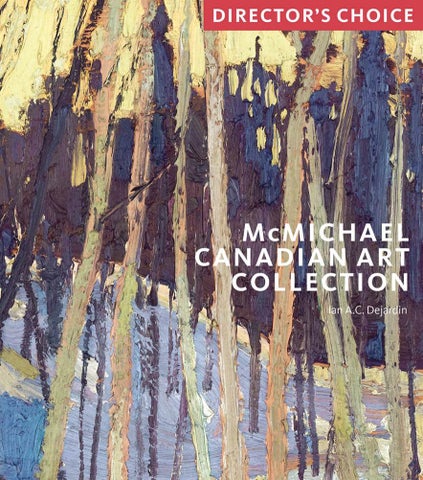
cover: Tom Thomson Snow Shadows, 1916 (see pp. 42–43) Frontispiece: Jessie Oonark My Dream of a Person with Birds, 1981 (see pp. 70–71)